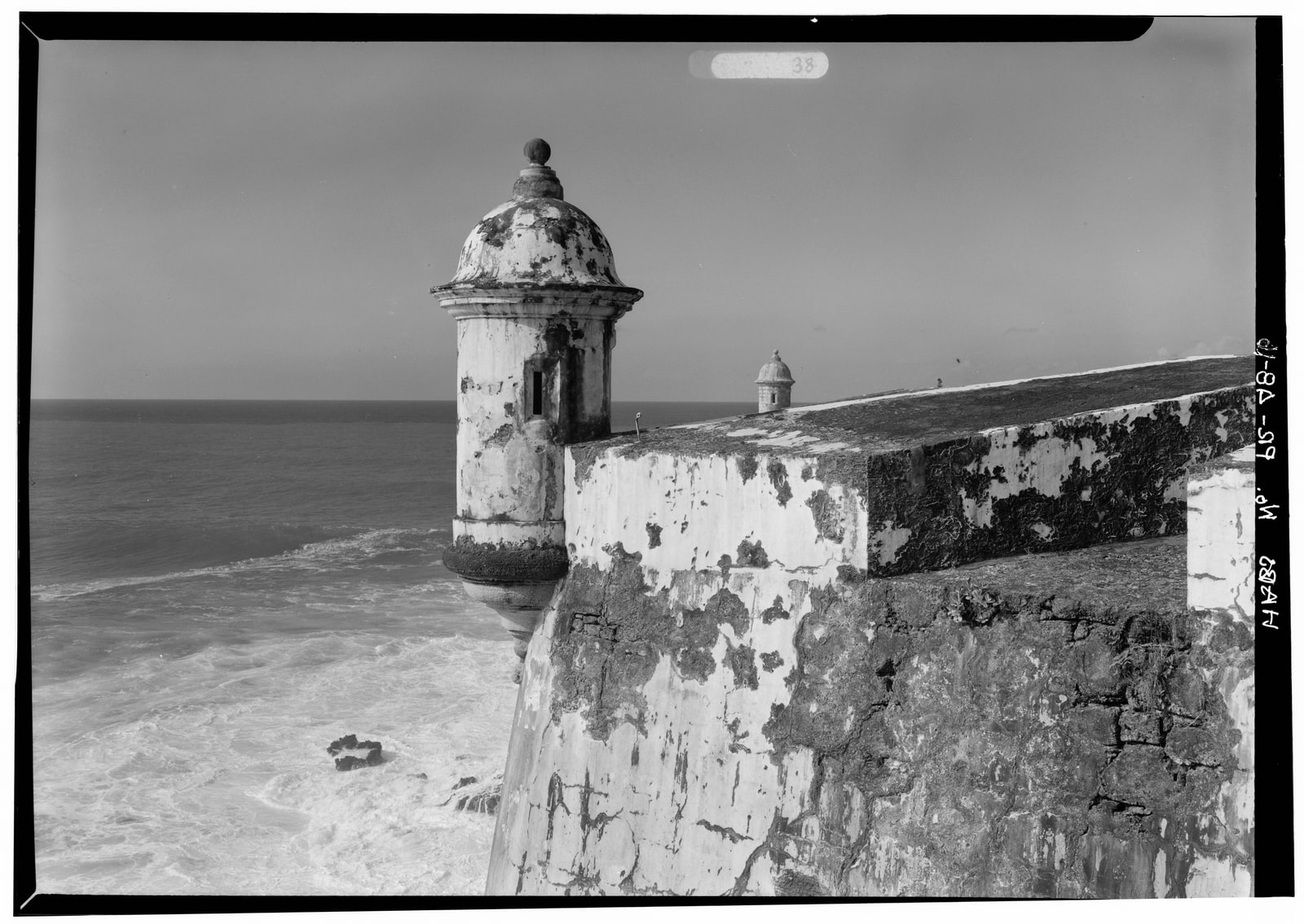
From El Morro's lawn, a garita looks almost too small for the fortress around it. The sentry box projects from a wall like a stone lantern: round chamber, domed cap, one dark opening cut against an unreasonable amount of Atlantic blue. It has become one of Puerto Rico's most portable images. Yet the object makes more sense when you stop treating it as a logo and stand where a guard once had to look.
That is the whole visit: one object type, the Atlantic-facing garita, read at two scales. First use a visible sentry box to see how its silhouette belongs to San Juan's skyline. Then, if staff identifies an approachable post, study its threshold; otherwise compare its narrow opening with the broad horizon from the nearest permitted parapet. The two views need not be of the same box. El Morro offers huge views everywhere; the garita matters because it withholds most of one.
Give the exercise 90–120 minutes and start at 08:45, just before the current 09:00 opening. The National Park Service lists fort access from 09:00 to 17:00, except Thanksgiving, Christmas Day and New Year's Day; severe weather, preservation work or safety conditions can add closures [1][10]. Standard admission is $10 per person age 16 and over, paid cashlessly, and the receipt remains valid for 24 hours at both El Morro and Castillo San Cristóbal [2]. For this close reading, however, do not turn two forts into a race. Let one small room explain the larger system first.
Cross the field without making it an obstacle
The first useful move happens before the fort. Arrive at the edge of the grounds, not with a plan to drive to the door. The NPS ride-hail point leaves a roughly 5-minute walk across the esplanade to the entrance, and private cars do not continue along El Morro's service road [3][10]. If you drive, use a public garage and walk. A recent local-and-visitor parking discussion repeatedly favors Ballajá, Doña Fela or La Puntilla over hunting for street space; contributors also warn that heat, resident restrictions and cruise traffic make improvising by car a poor opening move [6]. Prices in that thread are anecdotes, not tariffs, so confirm the live rate at the garage.
The fort itself is the navigation cue. From Plaza del Quinto Centenario or the Ballajá side, follow the long green approach west until the walls and lighthouse fill the end of the field. Do not try to erase the approach with a fast diagonal. Take 5–10 minutes and read what the grass is doing that morning.
In the afternoon trade winds, it may hold chiringas, the Puerto Rican word you will hear for kites. A December 2025 r/PuertoRico thread shows the attachment in residents' own language: people remember coming here to fly chiringas and still delight in seeing them above the field [5]. The NPS documents afternoon kite flying on the lawn, while Discover Puerto Rico calls it a favored family tradition [1][4]. At 08:45, treat the grass as the approach rather than the destination. Keep to the paved walk, give any kite line a wide berth, and save the lawn pause for the return.
At the entrance, have a card or contactless payment ready. That is the second local move: buy once, keep the receipt, move out of the doorway. The NPS no longer accepts cash, and the same $10 receipt covers both fortifications for 24 hours [2]. A July 2026 community review reported no wait at the 09:00 opening, while several 2026 reviews describe the later walk and heat as the real friction [7]. Treat “no wait” as one recent observation, not a guarantee. Budget a 10-minute arrival cushion and let the live line decide.
Ask for an open garita, not a famous name
Once inside, resist the natural urge to descend immediately through every ramp, casemate and tunnel. Ask a ranger whether an Atlantic-facing garita is open today and which permitted parapet gives the clearest exterior view. Barriers, preservation work and safety closures can change access [10]. The exterior form is the anchor; approaching a threshold or entering a post is an optional bonus, never a condition of the visit.
Be precise about the name. Garita is the ordinary Spanish word here for a sentry box. Garita del Diablo, the famous “Devil's Sentry Box,” is associated with Castillo San Cristóbal, not the El Morro object this visit is built around [1]. That distinction corrects a common visitor mistake before it starts: you are not hunting one legendary booth or trying to collect every turret. You are learning how the type works in the fort that guarded the sea entrance.
The scale around it matters. The NPS describes El Morro as a six-level fortification facing the Atlantic; that is a description of the structure, not a promise that every level is open or accessible [1][11]. The NPS dates its foundation to 1539 and says the fortification was not considered complete until 1787 [1]. UNESCO describes the wider defenses as successive Renaissance, Baroque and French Enlightenment ideas adapted to a Caribbean harbor [8]. The NPS historic inventory adds San Juan sandstone walls, brick vaulting and piers, earth fill, plastered surfaces, later concrete additions, and sentry boxes positioned on bastions and the top level [9]. The safest reading is layered: no visible surface should be assumed to belong to one moment.
The third move is therefore to see the garita from two paces outside—or from the nearest permitted parapet—before considering entry. Stand clear of the narrow threshold or barrier. Let the projecting cylinder register against the wall, then find the small opening that seemed almost decorative from the lawn. If another person is inside, wait back rather than leaning into the door. A sentry box only works as a close-up when nobody has to squeeze around the close reader.
Let the little room edit the ocean
Step in only where access is clearly open. The change is immediate: outside, the Atlantic occupies the horizon; inside, masonry takes over and the sea survives in fragments—a slit, an arch, a bright cut beside a dark wall. If every garita is gated, stay behind the barrier and compare its visible opening with the broad view from the nearest permitted parapet. The exercise still works without crossing a threshold.
That is the fourth move: look through, or carefully along, the opening before raising a camera. Hold still for one minute and name what this particular position permits you to see—perhaps waterline, harbor approach, wall face or neighboring bastion—and what it removes. The interpretive point is an inference from the room's form, not a claim that every sentry used every garita in the same way. The object turns “a view” into a sector. It makes attention directional.
This small act helps the entire fortress come into focus. El Morro's Atlantic-facing levels were built to defend the sea approach to San Juan Bay [1][9]. Across the channel, El Cañuelo helped create crossfire at the harbor entrance [4]. UNESCO describes the wider San Juan defenses as European military architecture adapted over centuries to a difficult Caribbean port site [8]. Beside a garita, “adapted to the site” stops sounding like heritage language. Wind, glare, salt, height, masonry and line of sight become physical constraints around one body.
Only then make the fifth move: take one quick frame from the threshold if it is open, then photograph the exterior from an angle that includes wall and sea. Do not occupy a narrow opening for a portrait session. The most useful image is not a face filling the doorway; it is the relationship between small shelter and enormous exposure. If the threshold is busy or closed, skip the interior photograph. The observation survives without proof of attendance.
For the sixth move, change vantage once, but let the permitted route choose how. Ask whether an open lower route preserves a view toward an Atlantic-facing garita. If it does, descend once and look back; if it does not, step away along the nearest allowed parapet until wall and sentry box share one profile. The goal is one comparison of room and defensive edge, not a promised staircase or a comprehensive fort tour.
Bring the symbol back into San Juan
Calling the garita an icon is accurate but incomplete. Discover Puerto Rico presents the sentry boxes as symbols of the island's historic inheritance [4]. The symbol also carries a harder history: imperial competition, colonial rule and centuries in which San Juan was made strategically consequential to Caribbean movement. UNESCO's designation recognizes the engineering adaptation and continuity of the fortifications, not a harmless fantasy castle [8]. The seventh move is to keep admiration and purpose in the same frame. Beautiful masonry can still be military architecture.
Leave the interior by 11:00 if you arrived at opening. On the esplanade, turn around and look for any projecting garita still legible against the walls. It will look smaller than the object you studied at closer range. That reversal is the point: San Juan has absorbed a military lookout into a civic silhouette without making its history disappear.
The eighth and final move is to give the lawn 15 minutes on the way out. Sit well off the central path and outside any active kite line; keep the fort entrance and projecting sentry boxes in view. Families may be arriving, and vendors sometimes sell chiringas on busy days [1][4][5]. This is not an invitation to script local life for a photograph. It is a chance to watch the fort's historic glacis operate as shared ground [10].
If you want sunset, make it a separate outdoor visit. Current NPS management guidance distinguishes the fort interiors, restricted to 09:00–17:00, from El Morro's open grounds and historic walls, which generally remain available outside those hours unless conditions require a closure [10]. A glowing lawn does not mean an open garita. Check the live park page, obey gates, and keep the two experiences separate.
Four visitor traps, with the better move
Mistake one: turning one no-wait report into a promise. A July 2026 reviewer walked in at the 09:00 opening, but recent community advice also warns that cruise traffic can quickly change Old San Juan's heat and congestion [6][7]. Better: arrive at 08:45, carry a 10-minute cushion and obey the live line.
Mistake two: driving toward the fort door or gambling on street parking. There is no visitor parking at the entrance, and the designated drop still leaves a 5-minute walk [3][11]. Recent community advice favors parking once in a public garage or using a ride-hail over circling Old San Juan [6]. Better: let the exposed lawn be part of the arrival.
Mistake three: underestimating the walk because the fort is visible. Recent reviewers repeatedly flag the exposed lawn, hills and amount of walking rather than the ticket desk as the effort [6][7]. Better: carry water, secure your hat and count the approach inside the visit time.
Mistake four: planning every level as if the route were flat and fully open. A 2026 review notes hills and stairs, while official accessibility guidance says the sixth level uses steep ramps and the lower levels are not accessible [7][11]. Better: make a permitted exterior view of the garita type the primary anchor and treat any threshold, interior or lower viewpoint as conditional.
The go details
- Primary anchor: the exterior form of an Atlantic-facing garita, viewed from whichever permitted vantage is clearest that day. Approach a threshold or enter only if staff and barriers indicate that it is open.
- Best window: arrive at the grounds around 08:45 for the current 09:00 opening; finish the interior reading by roughly 11:00. The forts close on Thanksgiving, Christmas Day and New Year's Day, and weather or preservation work can alter access [1][10].
- Time needed: 90–120 minutes, including the lawn approach, one garita exterior, one conditional interior or alternate parapet view, and a 15-minute outdoor pause.
- Expected spend: $10 standard admission per visitor age 16 and over, cashless; budget roughly $10–$20 before food if adding a shared garage cost, but verify parking rates live [2][6].
- Queue and reservation reality: for an ordinary individual visit, the current NPS page presents self-guided entry rather than a timed slot; educational and company-led groups follow a separate advance-reservation process [1][12]. Allow a 10-minute cushion. A July 2026 reviewer found no opening-time wait, while recent community reports warn that cruise traffic can change conditions [6][7].
- Navigation cue: from the designated ride-hail drop, follow the paved walk west across the open lawn for about 5 minutes; from Ballajá or Plaza del Quinto Centenario, keep the fort walls and lighthouse at the end of the green approach [3].
- Where to stand: two paces outside an open threshold—or at the nearest permitted parapet if it is gated. Inside, stay only long enough to read the framed sector and yield.
- What to bring: water, sun protection, a secure hat and shoes with grip. The lawn is exposed, the Atlantic side is windy, and stone ramps can be slick after rain [4][7].
- Access boundary: NPS describes the approach sidewalk as accessible-grade and the fifth-level plaza, exhibits, bookstore and theater as accessible. The sixth level requires steep ramps, lower levels are not accessible, and no source promises access to a garita; contact staff for current accommodation options [11].
The fort gives you the Atlantic almost everywhere. The garita does something more interesting: it takes the ocean away, then returns a disciplined fragment. Look at the little stone room from the city; if access permits, approach an opening and look back out—or make the comparison from a nearby parapet. San Juan's emblem becomes architecture again.
Sources
- U.S. National Park Service, “Plan Your Visit — San Juan National Historic Site” (updated August 11, 2026) — current 09:00–17:00 hours, El Morro's six levels and 1539–1787 construction sequence, harbor-defense role and afternoon kite use.
- U.S. National Park Service, “Fees & Passes — San Juan National Historic Site” — current $10 cashless individual admission, free entry for children under 16 and 24-hour validity at both fortifications.
- U.S. National Park Service, “Directions — San Juan National Historic Site” — designated El Morro ride-hail point, five-minute grounds approach, cruise-pier walking context and GPS guidance.
- Discover Puerto Rico, “Exploring Castillo San Felipe del Morro in Old San Juan” (updated August 20, 2026) — recent local destination guidance on garitas, the kite lawn, walking time, tropical-weather preparation and El Cañuelo crossfire; current hours in this article follow NPS source 1 instead.
- r/PuertoRico, “🪁” (December 1, 2025) — recent local community conversation confirming residents' continuing affection for flying and seeing chiringas at El Morro.
- r/PuertoRicoTravel, “Where to park to see Old San Juan?” (April 7, 2026) — recent community field reports on Ballajá, Doña Fela and La Puntilla, early arrival, resident street restrictions, heat and cruise-day traffic.
- Tripadvisor, “Lovely historical castle offering some amazing views of the surrounding areas” (visited July 2026) — exact community review reporting no wait at the 09:00 opening, substantial walking, hills and stairs, the $10 admission experience and nearby Ballajá garage.
- UNESCO World Heritage Centre, “La Fortaleza and San Juan National Historic Site in Puerto Rico” — official statement on the fortifications' European design line, Caribbean harbor adaptation, authenticity and long engineering history.
- U.S. National Park Service, National Register of Historic Places Inventory — El Morro — primary architectural inventory of bastions, sentry boxes, listening posts, masonry, brickwork, plaster and later additions.
- U.S. National Park Service, “Superintendent's Compendium — San Juan National Historic Site” (2026) — current distinction between fort-interior hours, generally open exterior grounds, private-vehicle restrictions and preservation boundaries.
- U.S. National Park Service, “Accessibility — San Juan National Historic Site” — official approach-grade, fifth-level, steep-ramp and inaccessible-lower-level boundaries, with contact guidance for accommodations.
- U.S. National Park Service, “Self-guided or company-led education groups” — separate advance-reservation rules for educational and commercial group visits.
- Library of Congress, “16. Sentry box, Santa Barbara Bastion” — source page for the real HABS photograph used as the article image and archival context, not a promise of present-day visitor access.
- Library of Congress, Castillo de San Felipe del Morro: Index to Photographs — HABS caption index identifying photograph PR-48-16, Jack E. Boucher and January 1960.