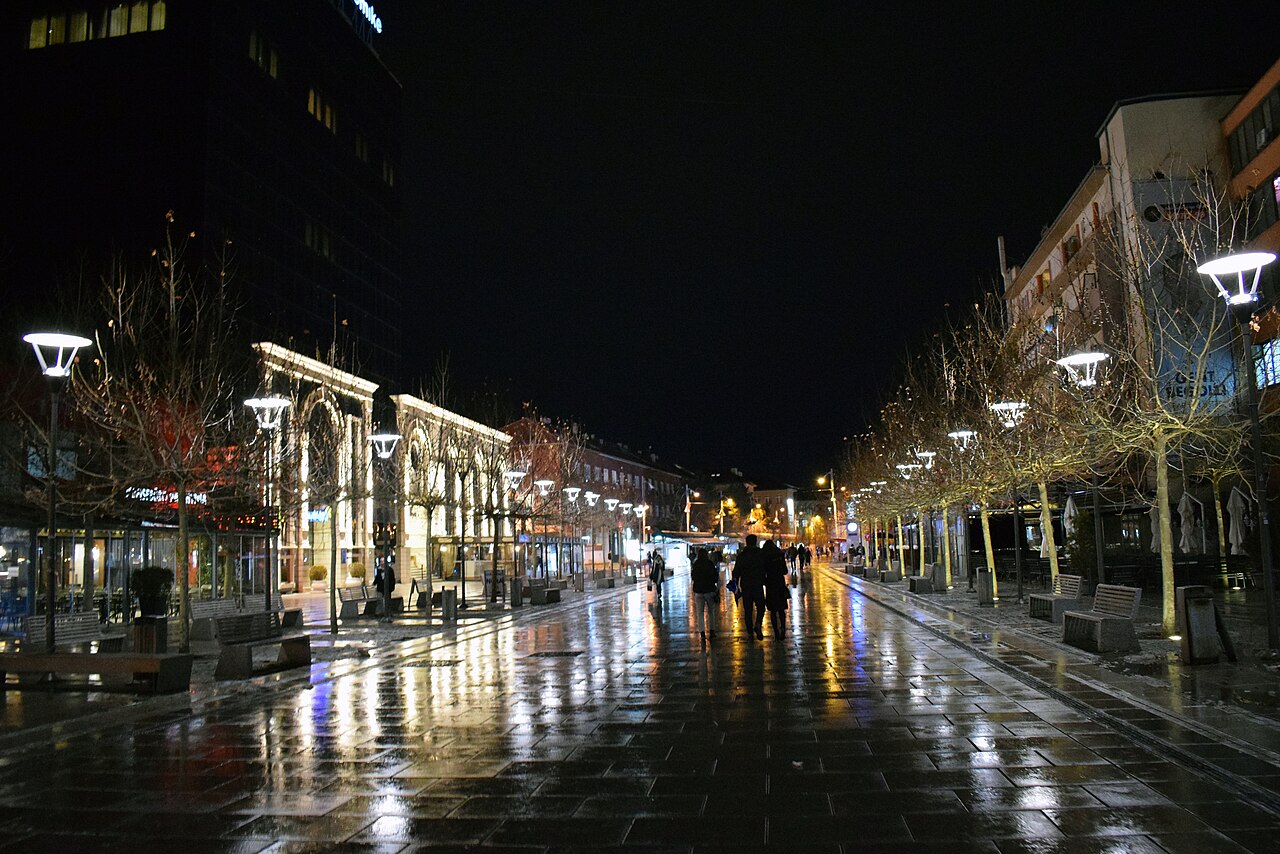
At 19:00, Mother Teresa Boulevard does not ask what you have come to see. It asks whether you know how to come back.
Prishtina's evening xhiro is a walk with no obligation to become a route. Friends, couples and families enter the pedestrian spine, move toward Skanderbeg Square, pause, turn, meet someone, and cover familiar ground again. The repetition is not wasted distance. It is how a central street becomes a social room.
The city's own tourist map gives this habit a longer memory. From the 1970s into the 2000s, the street carried vehicles by day but served as Prishtina's promenade mainly in the evening. Since the mid-2000s it has been closed to traffic, paved in granite and used only as a promenade, with Zahir Pajaziti Square and Skanderbeg Square at its ends [1]. The geometry changed; the evening claim on the street remained.
Keep this visit equally simple: one pedestrian axis, two passes, 75–90 minutes. On a warm, dry weekday, enter from Zahir Pajaziti Square between 18:30 and 19:00, walk through the Mother Teresa Square section to Skanderbeg Square, then reverse the same line. Spend the first pass moving, the second noticing. The boulevard costs €0, requires no booking and works best when you resist turning it into a transfer between attractions.
Enter by a name the driver can find
The first local move is to arrive with a precise pin. A recent long-stay visitor described the main pedestrian area as busy and thriving, but also reported that asking a taxi simply for “the center” produced confusion [7]. Do not make the driver interpret an abstract downtown. Show Zahir Pajaziti Square, Mother Teresa Square, Skanderbeg Square, or the Grand Hotel on your phone. The current EU in Kosovo guide also treats the Grand Hotel as a useful central landmark and places most headline sights within a 15-minute walk of the boulevard [3].
If you are already staying in Qendra, walk. If you arrive by urban bus, Prishtina's operator introduced new fares on 1 July 2026: a single ride is €0.60 with the digital wallet or €0.80 with a physical ticket; a digital day ticket is €1.00 and a physical one €1.20 [2]. Those numbers make the evening's practical spend €0–€1.60 for a central visitor who needs, at most, two physical single rides. Coffee is optional and separate.
Begin at Zahir Pajaziti Square because it gives the walk a clean threshold. The second move is to wait two minutes before joining the flow. Events, temporary stages and gatherings often use this central axis—the municipal map calls the boulevard the place where much of the city's cultural and commercial activity occurs [1]. Read what the square is doing tonight. If barriers create a lane, follow it. If a performance has gathered a standing crowd, pass around its rear rather than splitting it.
Make the first pass without choosing a table
The third move is deliberately counterintuitive in a city famous for café life: do not choose a café yet.
Local reporting describes the pedestrian boulevard as the heart of the capital, surrounded by cafés, restaurants, clubs and small side streets; it also treats coffee as a social ritual rather than a quick drink [4]. That is good evidence for staying, but poor reason to sit at the first open table. A café shows one room. The first circuit shows how all the rooms connect.
Walk at the speed already present. Do not weave between groups as though the boulevard were a concourse and you had a platform to catch. Keep enough space for children, prams and people who stop when they recognize someone. On this first pass, notice three kinds of pause: the public bench or edge, the standing conversation and the café table. Each has a different price and duration, but all face the same current of people.
The fourth move is to keep the camera down until Mother Teresa Square. Google Maps' live review surface repeatedly frames this as a place to walk, sit and watch life pass; recent reviews from September and November 2025 also note that the square becomes busier in the evening and sometimes changes character when a concert occupies it [6]. That is the useful subject. The photograph is not “the boulevard without people.” It is the boulevard becoming itself through people.
At the square, take one 10-minute public pause. Choose a bench or a building edge that is clearly meant for sitting; do not perch on a doorway, shop threshold or circulation pinch point. Look back toward the line you have walked. The Grand Hotel's bulk, the Mother Teresa statue, storefront light and the next square do not form a polished ensemble. They form a set of recognition cues in a center rebuilt in layers.
Let the old korzo interrupt the new paving
This unevenness is city-specific, not a design failure to edit out of the experience. KOHA's account of Prishtina's architectural transformation describes how the post-1945 city remade the area and reproduces a 1959 view identified as the city's korzo—its promenade—on what is now Mother Teresa Boulevard [5]. The municipal map adds the crucial operating detail: for decades the same ground was road by day and evening promenade by custom before pedestrianization made the social use permanent [1].
That history changes what to watch. A visitor can read the granite as a finished pedestrian project. A resident habit reads across regimes, names and surfaces. The boulevard matters not because every building is beautiful, but because public life has repeatedly claimed the axis even while the architecture around it changed.
The fifth move is therefore to turn at Skanderbeg Square instead of collecting another sight. Do not automatically extend north into the old town or south toward the cathedral. Both are worthwhile on another walk. Tonight, the boundary is the ritual: reach the equestrian statue, move to the side before stopping, face back down the boulevard, and begin the return.
That reversal prevents the usual city-break mistake in which every space is merely the approach to the next named object. It also matches current community advice. A recent r/Kosovo visitor thread recommends the boulevard specifically as an evening stroll rather than a daytime box to tick [8]. Another 2026 account says the pleasure of the center is simply wandering the pedestrian area and its side streets [7]. Neither asks the street to deliver a climax.
The second pass belongs to recognition
The sixth move is to retrace, not improvise. On the return pass, three things change even though the route does not: you approach faces from the other direction, storefronts reveal their opposite edges, and the people who stayed put become reference points. Someone you passed near Mother Teresa Square may now be walking toward you. Someone at a bench may still be mid-conversation. Repetition turns anonymous crowd into a loose sequence.
This is where the word xhiro earns its place. A generic evening walk measures distance. This walk measures reappearance. The boulevard's modest scale is an advantage because it makes a second pass socially legible rather than physically ambitious.
The seventh move is to decide about coffee only after that return has started. If you want one, choose a side street or terrace because its mood fits, not because sitting down is the admission fee for local life. Check the posted menu before ordering and keep the table as long as the venue's own rhythm permits; the local account of Prishtina's café culture emphasizes time and company, not hurried consumption [4]. If you want nothing, keep walking. The public ritual remains complete at €0.
The square is also an event surface, so avoid pretending that one evening reveals a timeless routine. The local cultural calendar has long used central Prishtina for concerts and festivals [4], and recent review evidence records the way a concert can overtake Mother Teresa Square [6]. The eighth move is to let the live city overrule this route. If a rally, performance, security cordon or construction boundary occupies the axis, keep its working lanes clear and shorten the xhiro rather than pushing for the planned turnaround.
That flexibility matters south of the core too. Prishtina's municipality has proposed extending the pedestrian public realm from the Grand Hotel toward the cathedral along Xhorxh Bush Boulevard, explicitly describing the project as a new frame for public life [9]. It is evidence that the promenade idea is still being negotiated, not a guarantee that every connecting block will look or operate the same on your visit. Keep this first xhiro inside the established core unless the live street plainly invites you farther.
Four visitor mistakes, corrected on the return
Mistake one: testing the boulevard at midday and declaring it empty. Local and community sources repeatedly place its strongest social register in the evening, while a recent review notes the late-afternoon crowd building into night [1][6][8]. Better: use 18:30–20:00 in warm weather, shifting earlier with winter darkness and current conditions.
Mistake two: walking it once as a link between monuments. That converts a promenade into a corridor and encourages impatient weaving through groups. Better: make two passes, turn at Skanderbeg Square and let recognition—not distance—be the second pass's purpose [1][7][8].
Mistake three: assuming local participation requires a café purchase. Prishtina's café culture is real, but the boulevard is a public pedestrian space before it is a row of terraces [1][4][6]. Better: walk once and sit publicly for 10 minutes before deciding whether a table adds anything.
Mistake four: asking a driver for “the center,” then extending the route to rescue a vague drop-off. A recent visitor reports exactly that navigation problem, while the current institutional guide identifies the Grand Hotel and the boulevard as reliable center cues [3][7]. Better: show one named square or landmark, begin where you land on the core, and keep the ritual compact.
The go details
- Anchor: the established pedestrian core of Mother Teresa Boulevard, from Zahir Pajaziti Square through Mother Teresa Square to Skanderbeg Square and back. The cathedral and old town are context, not second anchors.
- Best window: 18:30–20:00 on a warm, dry weekday. This is an editorial window built around the boulevard's documented evening use; shift earlier in winter and yield to live events [1][6][8].
- Time needed: 75–90 minutes: two minutes to read the entry square, a first pass, a 10-minute public pause, a turn at Skanderbeg Square and one return pass.
- Expected spend: €0 on foot. If central transit is needed, two current single rides cost €1.20 digital or €1.60 physical; optional café spending is outside the route [2].
- Queue and reservation reality: no ticket, door or booking. Crowds are the atmosphere, not a queue; a concert or civic event can temporarily redraw the walking lanes [1][4][6].
- Navigation cue: Zahir Pajaziti Square → Mother Teresa Square → Skanderbeg Square → same line back. Use the Grand Hotel as a supporting landmark, not “city center” as a destination [1][3][7].
- Where to sit: first on a public bench or clearly usable edge at Mother Teresa Square, out of doorways and moving lanes. Choose a café only on the return pass.
- Walking etiquette: match the social pace, pass around—not through—standing groups, move aside before stopping at the Skanderbeg statue, and ask before making a stranger the subject of a close photograph.
- Live check: inspect the first square for barriers or staging. Let a rally, concert, works zone or security line shorten the route; the city's pedestrian realm is active infrastructure, not a reserved visitor set [6][9].
The xhiro does not reveal a secret Prishtina hiding behind the obvious one. It makes a simpler correction: the obvious boulevard is useful only after you stop demanding novelty from every metre.
Walk it once to learn the line. Turn around. On the second pass, the square has not changed—but your place inside it has.
Sources
- Municipality of Prishtina, Touristic Map of Prishtina — primary city map and history of Mother Teresa Square as the evening promenade, its mid-2000s pedestrianization, granite surface, cultural role and endpoint squares.
- Trafiku Urban Prishtina, “Njoftim për qytetarët” (July 1, 2026) — current official digital, physical, daily and airport bus fares and ticket-wallet guidance.
- European Union in Kosovo, “Pristina city guide: districts, getting around and where to stay” — current institutional orientation to Qendra, Mother Teresa Boulevard, the Grand Hotel landmark and the center's walkable scale.
- KOHA, “Prishtina, destinacioni i ri për adhuruesit e udhëtimeve” — local reporting on the boulevard as the capital's pedestrian heart, evening culture, cafés, side streets and recurring public events.
- KOHA, “Transformimi arkitekturor i Prishtinës përballë humbjes së identitetit” — local architectural history of the post-1945 center and the 1959 Prishtina korzo on today's boulevard.
- Google Maps, “Mother Theresa Square” — live community mapping and review surface, including late-2025 reports on afternoon walking, evening crowd levels and concert use.
- r/digitalnomad, “Pristina, Kosovo” (March 16, 2026) — recent long-stay field report and local discussion confirming the pedestrian area's busy everyday use, walkable span and the weakness of vague taxi directions.
- r/Kosovo, “Interesting places to visit in Prishtinë this summer?” — community advice to make Mother Teresa Boulevard an evening stroll rather than a daytime checklist stop.
- Municipality of Prishtina, “Prezantohet projekti për transformimin e Bulevardit ‘Xhorxh Bush’” (January 13, 2024) — primary description of the proposed pedestrian-realm extension between the Grand Hotel and cathedral and its intended public-life role.
- Wikimedia Commons, “Mother Teresa square in Prishtina during night.jpg” — source page, authorship, date, dimensions and camera metadata for Liridon Selmani's real February 2, 2018 photograph.