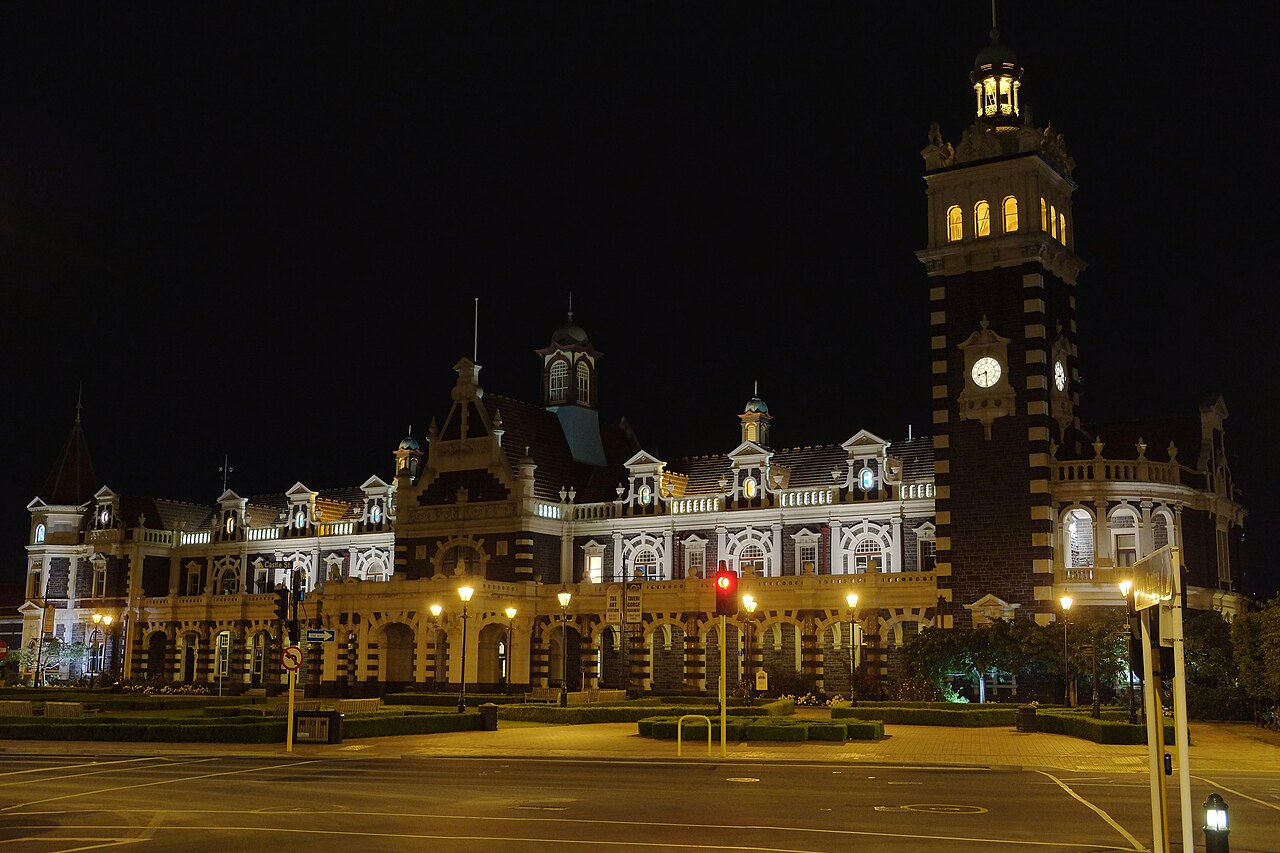
At night, Dunedin Railway Station does something more precise than glow. Its clock tower tells the time in three directions, and all three dials face the city. There is no fourth face toward the railway and the former harbour edge. A local Dunedin tour source puts the tower at more than 37 metres, the three illuminated dials at 1.5 metres across, and the missing harbour-side clock in the original logic of the site: that direction was not the audience [1].
This is the useful way to visit the station after dark. Do not collect it as another floodlit facade. Read it as a building that still announces where early twentieth-century Dunedin believed its public life was located. The station is the sole anchor; the Octagon, Lower Stuart Street and Anzac Square are only the positions from which that choice becomes visible.
Allow 30–45 minutes, spend NZ$0 if you arrive on foot, and begin about 15 minutes before local sunset. The aim is not to wait for a theatrical switch-on. It is to watch one dark-and-pale building change from the end of a street into a clock facing a city.
Make two visits if the interior matters
The first local move happens before the night walk: separate the interior from the exterior in your plan. The operator's current contact page labels 08:30–16:30 Monday to Friday as office hours and says weekends depend on scheduled train operations [4]. The Otago Art Society, upstairs in the station, lists 10:00–16:00 Sunday to Friday and 09:30–15:30 Saturday for its galleries [5]. Those are different occupants with different clocks, not a universal promise that every door, platform or mosaic remains accessible.
If the mosaic floor, stained-glass locomotives and tiled booking hall matter to you, see them during a confirmed daytime opening [2][4][5]. Then return after dark for the facade. Night lighting is not evidence that the foyer is open, and a railway name is not evidence of a commuter service. The current company markets scenic journeys from the building; its own visitor pages do not present the station as an urban commuter terminal [3][4].
Search results became easier to misread after the operator adopted Dunedin Railway Station as its company name in April 2026 [11]. A listing may describe the booking office, the building, a gallery, a restaurant or a train departure while appearing to answer one simple question: “Is the station open?” The better move is to ask which interior you mean. For this night visit, no interior is required.
Let Stuart Street aim the building
The second move is to start at the Octagon rather than underneath the station's porte-cochère. The operator's walking directions put the station 500 metres away—less than a five-minute walk—straight down Stuart Street, with State Highway 1 to cross at the far end [3]. That short axis is the visit's first real view. The clock tower holds the end of the street before the details of the facade resolve.
A recent community photograph made from Stuart Street calls it a “nice quiet night,” which is modest but accurate evidence for the position: the station reads best at first as a destination held at a distance [10]. A Dunedin-based photographer makes the same night choice, describing the building as a long central hall between dignified wings and emphasizing how its local basalt and pale stone become legible under illumination [9]. Local eyes keep returning to the axis, not because it is secret, but because the city already composed the shot.
Walk downhill without rushing the last block. Keep the tower ahead, but do not use the road as a viewing platform. Heritage New Zealand records that the station was forced onto reclaimed land only after controversy over access to the wharves; about 600 piles had to reach bedrock beneath it [2]. That history survives as a present crossing problem. The building appears to close Stuart Street, but highway traffic still cuts between street and square.
Cross State Highway 1 only on the pedestrian signal. Finish the crossing before raising a phone or camera. This is the third local move and the most important visitor correction: the centered facade is not worth lingering in a live traffic lane.
Count the faces from the city side
Once inside Anzac Square, stay on the public garden path and hold the centered view for 10–15 minutes. This is the fourth move. The dark Kokonga and Port Chalmers basalt absorbs the last blue in the sky while the Oamaru-stone dressings retain their pale edges. George Troup used those materials in a long, symmetrical composition, but put the domed tower at the south-west corner rather than the centre [2]. The slight imbalance keeps pulling the eye toward the clock.
Now shift only far enough south to read the tower as a separate mass. Do not chase the missing fourth dial through a closed gate or onto a platform. The absence is already intelligible from the public side: three clock faces address people approaching from the city; the unclocked side once looked toward the harbour edge [1]. The tower does not simply mark time. It distributes attention.
That is Dunedin's non-tactical detail, and it is more revealing than the familiar “Gingerbread George” nickname. The station stood on a disputed seam between town and water. Its city faces received clocks; its harbour side did not. Seen after dark, when the dials are illuminated and the booking hall is no longer the main event, that old hierarchy becomes the building's clearest graphic [1][2].
Give other people the central path. A tripod, if you use one, belongs off the walking line, with its legs visible and compact. The fifth move is to let the square remain a square. Railway excursions and events can change the forecourt's rhythm, while a quiet ordinary evening may offer no queue at all [3][4]. Check the operator's calendar if an empty view matters, but do not treat people using the station grounds as an obstruction to a photograph.
Leave on the same city-facing line
The sixth move is to turn around before leaving. From the station, Stuart Street rises back toward the Octagon. The clock's intended audience becomes physical: the facade faces the route you just walked, while the rail corridor and harbour lie behind it. Heritage New Zealand notes that the Harbour Board feared this placement would block access to the wharves [2]. The station is both a gateway and a barrier, depending on which direction you approach.
If you drove, read the meter rather than relying on a generic “free at night” rule. For 2026/27, Dunedin City Council lists Railway Station North and South at NZ$3 per hour Monday–Friday and NZ$2 per hour Saturday during the 09:00–18:00 charging window, with Sunday shown as free [7]. A recent r/dunedin parking thread agrees that ordinary paid hours end at 18:00 and flags market-related closures near the station, but local advice is a confirmation layer, not a substitute for the sign beside your actual bay [8]. That is the seventh move: match day, lot and posted control before walking away.
The eighth is a small practical kindness. Dunedin City Council lists a 24/7 Changing Places accessible toilet at the railway station, distinct from the inside-building toilets with shorter hours [6]. Note the distinction before you need it; after dark, “at the station” and “inside the station” are not equivalent.
Four visitor mistakes, corrected
Arriving after dark for the mosaics. The illuminated exterior does not extend the office or gallery day [4][5]. See the interior earlier, then make the night walk a separate short return.
Starting beneath the entrance canopy. Up close, decoration crowds out orientation. Begin 500 metres away on Lower Stuart Street so the station first reads as the end of the city axis [3].
Stopping in the highway crossing for symmetry. The visual line continues across State Highway 1; pedestrian priority does not continue after the signal changes. Cross fully, then compose from the square.
Looking for the fourth clock from restricted ground. There is no harbour-facing dial to find. The omission is the point, and it can be understood from the public city side [1].
The go details
- Anchor: Dunedin Railway Station, 22 Anzac Avenue. The Octagon and Anzac Square are approach and viewing positions, not extra stops [3][4].
- Best window: begin on Lower Stuart Street about 15 minutes before local sunset and stay until roughly 30 minutes after. In deep summer this can be late; use that day's sunset, not a fixed clock time.
- Time needed: 30–45 minutes for the exterior sequence. Add a separate daytime visit if you want the foyer or gallery.
- Expected spend: NZ$0 on foot. If driving before 18:00, current station-lot rates can reach NZ$3 per hour on weekdays or NZ$2 per hour on Saturday; verify the bay [7].
- Queue and reservation: neither is normally required for the public exterior. Scheduled trains or events can alter access and crowding, so check the operator before seeking a quiet forecourt [3][4].
- Recognition cue: the dark basalt and pale Oamaru-stone facade, with the domed clock tower at the south-west end [2].
- Where to stand: first on the Lower Stuart Street axis, then on the public central path in Anzac Square, then slightly south for the tower. Keep the highway crossing, gates and platform clear.
- After-dark facility: the council lists the accessible Changing Places toilet at the station as 24/7; inside-building toilets follow a different schedule [6].
The reward is not a perfect empty photograph. It is a piece of urban orientation made visible by darkness. Dunedin Railway Station has three lit clocks because it was built to speak toward town. Walk down the line they face, cross the twentieth-century traffic barrier, and leave the harbour-side absence alone. The building will tell you not only the time, but whom it expected to be looking.
Sources
- Dunedin Tours, “Dunedin Railway Station” — archived April 15, 2026 copy of the local account documenting the tower height, three city-facing 1.5-metre clock faces, omitted harbour-side dial and after-dark illumination.
- Heritage New Zealand Pouhere Taonga, “Dunedin Railway Station, Platform & Gates” — Category 1 listing history, architect, materials, reclaimed-land dispute and pile foundations.
- Dunedin Railway Station, “Getting Here” — official 500-metre Stuart Street approach, State Highway 1 crossing, transit and parking directions.
- Dunedin Railway Station, “Contact Us” — official address and current booking-office hours, including weekend dependence on scheduled train operations.
- Otago Art Society, gallery home page — current public hours for the first-floor galleries inside the station.
- Dunedin City Council, “Public toilets” — separate schedules for the 24/7 Changing Places facility and the toilets inside the station building.
- Dunedin City Council, “Parking” — 2026/27 hourly rates and charging windows for Railway Station North and South.
- r/dunedin, “Parking overnight near Octagon” (April 2026) — recent local discussion of paid hours, station-area lots and market-related closures.
- John Caswell, “…from a Small City: Dunedin Railway Station at Night” (February 13, 2025) — Dunedin-based night reading of the illuminated facade and its stone composition.
- r/TheNightFeeling, “Looking toward the Train Station” (July 2026) — recent community photograph and on-site note from the Stuart Street night axis.
- Otago Daily Times, “Name change ‘brings everything together’” (April 24, 2026) — recent local confirmation that Dunedin Railways adopted the Dunedin Railway Station name.
- Wikimedia Commons, “File:Dunedin Railway Station at night.jpg” — source page for Pseudopanax's public-domain October 1, 2013 photograph.