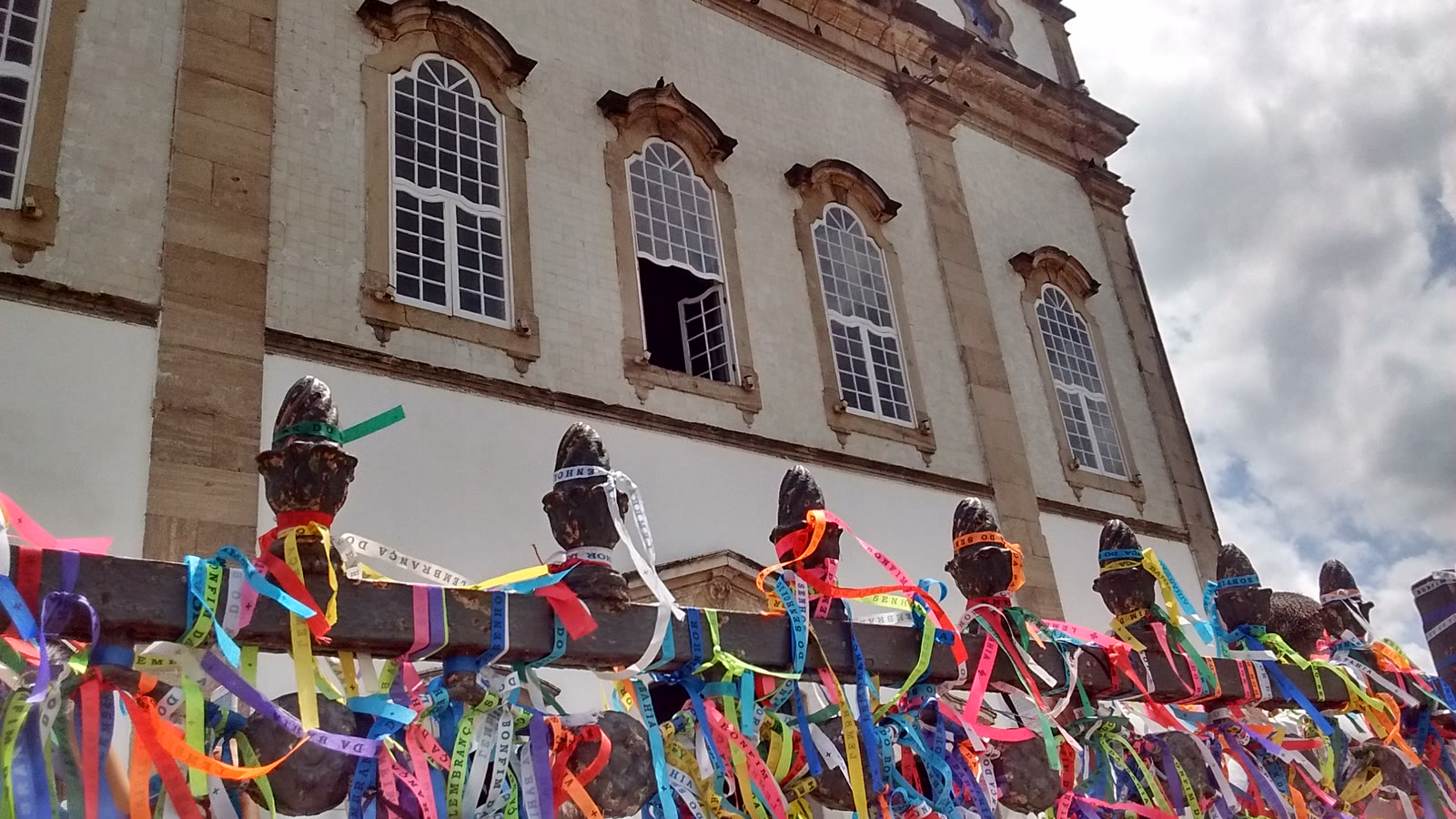
From across Largo do Bonfim, the Basilica's rail reads as a band of colour. At arm's length, colour gives way to hundreds of separate decisions: a tight knot, a loose tail, a strip bleached by sun, another still bright enough to read. Many carry the words Lembrança do Senhor do Bonfim da Bahia—a remembrance of the Lord of Bonfim of Bahia. No single ribbon explains the rail, and no visitor needs to add one for the place to be complete.
That is the useful scale for this visit. Keep one non-food anchor: the ribbon-covered ironwork immediately in front of the Basílica Santuário do Senhor do Bonfim. Allow 45–60 minutes, including a quiet look inside if worship is not under way. The object is not merely the thin strip sold around Salvador. It is what happens when that strip crosses from merchandise into a public surface of private promises.
The cover photograph shows the recognition cue precisely: narrow ribbons tied over dark iron with the church's white-tiled façade behind them [9]. Begin with the same relationship. Stand about two metres back, keep the steps and entrance clear, and let the Basilica remain larger than its most portable symbol.
The first ribbon was a measure
The modern strip makes more sense once you picture its much broader ancestor. Salvador's official visitor history describes an early Medida do Bonfim measuring 47 centimetres, the length associated with the right arm of the image of Senhor do Bonfim inside the church. It could be six to seven centimetres wide, white, made from cotton or silk, and embroidered by hand. Rather than being knotted to a wrist, it was worn around the neck with medals or ex-votos attached [2].
Even its starting date resists a tidy souvenir label. The familiar account credits church treasurer Manoel Antônio da Silva Serva with creating the measure in 1809 to raise funds for the devotion. A local historian interviewed by Correio points to an 1804 document mentioning ribbons within the brotherhood and places the object inside a wider Portuguese Catholic tradition of devotional measures [2][3]. The honest caption is therefore not “invented in 1809.” It is “documented by the early nineteenth century, with 1809 as the traditional attribution.”
The material changed with the meaning. The broad measure disappeared around 1940. Narrow ribbons reappeared as Salvador's tourism economy expanded in the 1950s, and the now-familiar three-wish custom became attached to them. Cotton, silk, acetate, nylon, and polyester have all belonged to different chapters of the object's life [2][3]. A strip that looks timeless is actually a record of changing manufacture, devotion, promotion, and travel.
Before choosing a colour, read one complete ribbon from end to end. Notice its fibre, printing, length, fading, and the way its knot uses the rail. Salvador's city guide describes colour associations with different orixás, but a visitor should not turn those relationships into a universal paint chart or use one colour as a costume cue [2]. If the meaning matters to your own gesture, ask rather than decode.
Promise and product occupy the same few centimetres
The rail concentrates two truths that travel writing often separates. The ribbon can carry faith, hope, remembrance, or a private request. It is also inexpensive merchandise sold in a busy visitor economy. Neither fact cancels the other.
The Basilica itself no longer sells the ribbons; independent sellers around the square do [2][3]. A local destination editor who revisited in May 2026 recommends buying from a fixed stall rather than from a roaming hawker and reports that church admission remains free [4]. Review aggregation likewise records free entry, optional donations, street sales, and complaints about persistent approaches or unclear souvenir prices [5]. Those are practical signals, not a licence to treat every seller as suspect.
Make the commercial decision before anyone starts tying something to you. Your three valid choices are no ribbon, one ribbon, or a clearly priced small pack. If buying, point to the exact item and ask the total before accepting it. A simple Quanto fica tudo?—“What is the total?”—establishes the boundary. If something is presented as a gift, confirm explicitly that it is free or decline it with Não, obrigado or Não, obrigada.
That caution is locally grounded. In a December 2025 r/Salvador thread, residents warned first-time visitors that supposedly free ribbons, necklaces, body paint, or posed photographs can become pressured transactions [6]. The thread is anecdotal, so its quoted prices are not a market guide. Its durable lesson is consent: agree to the object and the price before either reaches your wrist.
The core visit costs R$0. If you want a ribbon, R$0–R$20 is a useful self-imposed micro-purchase envelope, not a claim about the correct current price. Transport and donations sit outside it. The point of a cap is not to bargain a devotional object down to the last real; it is to prevent a small exchange from becoming ambiguous.
Tie only if the gesture is yours
Popular guidance says that a ribbon worn on the wrist goes around twice and receives three knots, one for each secret wish; it should be allowed to break naturally rather than be cut [2]. That is a widely repeated wrist custom, not an instruction that every visitor must perform at the church rail.
If you do tie one at Bonfim, keep the action small. First watch the rail for one full minute without touching it. Find a side section away from the central entrance and from anyone praying or photographing a companion. Use one ribbon rather than spreading several across the ironwork. Make the knot without moving, untying, or cutting ribbons already there. Then step back before taking a photograph so another person can approach.
If you do not have a personal request to make, looking is enough. Read the printed sentence, study how the colours weather at different rates, and notice where the rail itself remains visible. The respectful move is not to invent a wish for the sake of a photograph.
Do not ask another visitor to repeat a knot, disclose a wish, or hold still for your frame. If an identifiable person becomes the subject rather than background, ask permission. The rail is visually exuberant, but it is not an interactive installation built for content capture.
The rail is an archive that gets cleared
A faded ribbon can appear permanent because no one is visibly maintaining it. In fact, the accumulation is periodically edited. Older municipal history and reporting from Correio described the tied ribbons being removed and burned every three or four months [2][3]. A January 2026 local account instead describes a ritual incineration held every six months, a formal practice it dates to 2012, with volunteers and local sellers helping clear the rail [10]. The reported cadence has changed; the stable point is that the rail is renewed by the Basilica's community rather than left to accumulate forever.
That cycle changes how to look. The rail is neither an untouched historical artefact nor a permanent artwork with a fixed composition. It is a temporary devotional surface. Some requests have been exposed to months of rain and sun; others may have arrived that morning. The photograph above records the rail on November 29, 2015, not an arrangement a visitor should expect to reproduce [9].
The clearing also makes taking an existing ribbon especially wrong. A loose strip is not a free souvenir, and a faded one has not become ownerless décor. Leave removal to the Basilica's own practice. If your ribbon later falls naturally, its absence belongs to the custom; pulling someone else's loose simply shortens a story you do not know.
Use the Mass clock, not just the opening hours
Salvador's official tourism page, updated in March 2026, lists visiting hours as 07:00–18:00 Monday through Thursday and Saturday, and 05:30–18:00 Friday and Sunday. It also publishes a much denser Mass schedule on Friday and Sunday. From Tuesday through Thursday, the listed services are at 07:30, 09:00, 11:00, and 17:00 [1].
For a visitor seeking a quiet object study rather than a service, 12:15–14:15 Tuesday through Thursday is a practical editorial window inferred from that gap. It is not an official low-crowd guarantee. Check the Basilica's current notice or call the published number on the morning of the visit; a wedding, funeral, feast, school group, or revised liturgy should outrank this article.
The same-day check is not boilerplate. On July 5, 2026, a local Salvador outlet reported that the Basilica cancelled its 17:00 Mass and closed at 16:00 for a Brazil World Cup match, while earlier services continued [8]. Ordinary hours can yield to the city's calendar in very ordinary ways.
There is no timed ticket or reservation for reading the exterior rail, and current visitor sources describe church entry as free [4][5]. Queueing, when it appears, belongs to services, groups, the small museum, or a special event—not to a formal ribbon-rail admission line. If worship is in progress, do not treat the nave as the next mandatory room. Lower your voice, put the camera away, and either sit respectfully at the back or keep the visit outside.
January requires an entirely different plan. The annual Lavagem do Bonfim is a city-scale religious and cultural event, not a busier version of this 45-minute visit. For the 2026 celebration, Bahia's government deployed 2,087 police officers and firefighters and coordinated 20 agencies [7]. Festival-day closures, processions, transport changes, and crowds invalidate every normal timing assumption here.
Four ways visitors flatten the object
Mistake one: calling the modern ribbon an unchanged 1809 tradition. That erases the disputed 1804 evidence, the broad devotional measure, its disappearance around 1940, and the narrow tourism-era return [2][3]. Better: let the object's transformation be part of what you came to see.
Mistake two: accepting a “gift” before agreeing whether it is free. Local community advice and visitor reviews both identify this as a common pressure point [5][6]. Better: decide what you want, choose a fixed stall if buying, ask the total, and decline cleanly if you are not.
Mistake three: performing three wishes for the camera. The two-wrap, three-knot account belongs most clearly to wearing the ribbon on a wrist, while the rail holds many individual devotional choices [2]. Better: tie one only when the gesture means something to you, keep any wish private, and never direct someone else's ritual.
Mistake four: arriving on Friday, Sunday, or during the Lavagem and expecting an empty backdrop. Those times belong to denser worship or a major public celebration [1][7]. Better: attend intentionally or use a Tuesday–Thursday gap, with the current Basilica notice open on the day.
A compact go plan
- Anchor: the ribbon-covered rail at Basílica Santuário do Senhor do Bonfim; the church interior is contextual and optional, not a second attraction.
- Address: Praça/Largo do Bonfim, s/n, Bonfim, Salvador, BA 40425-360. Use the exact Basilica name and square for ride-hail pickup and drop-off [1].
- Best window: 12:15–14:15 Tuesday–Thursday, inferred from the current 11:00 and 17:00 Masses; confirm the day's schedule before leaving [1][8].
- Time on site: 45–60 minutes—one minute to read the rail untouched, about 20 minutes for the object's history and detail, then space for one deliberate purchase or knot and a quiet interior look if appropriate.
- Expected spend: R$0–R$20 for the anchor itself. Entry is free; R$20 is an optional personal ribbon cap, not a quoted tariff [4][5].
- Queue and reservation reality: no reservation and no formal exterior-rail queue. A service, museum visit, group, or feast can create waits; do not push through worshippers to keep a personal timetable [1][4][5].
- Where to stand: begin two metres outside the rail, then use a side section that does not block the central steps, gate, seller line, or another person's prayer.
- Commerce cue: choose before contact, use a fixed stall if buying, establish the total first, and treat an unsolicited “gift” as an unconfirmed transaction [4][6].
- Exit: leave from the occupied square by the same planned transport mode. Parking is limited, so current local guidance favours a taxi or ride-hail over improvising a space or an unfamiliar side-street walk [4].
- Same-day check: Basilica notice, Masses, special closures, weather and shade, festival calendar, return ride, and whether you actually want to tie anything.
The Bonfim ribbon is easy to carry away because it is light, flat, and reproducible. The better memory may be the one that stays at the rail: a small strip understood as material history, private promise, public devotion, and street commerce all at once. Stand back far enough and the ribbons become colour. Look carefully and each one becomes a boundary—between looking and touching, offering and buying, someone else's wish and your own.
Sources
- Salvador da Bahia, “Igreja Nosso Senhor do Bonfim” — official city visitor page updated March 3, 2026, used for address, contact, visiting hours, Mass schedule, the 47-centimetre measure, and Lavagem context.
- Salvador da Bahia, “10 histórias e curiosidades sobre as fitinhas do Bonfim” — municipal destination history used for the measure's dimensions and materials, disputed origin, changing form, wrist custom, commerce, colour associations, and periodic clearing of the rail.
- Thais Borges, Correio, “Do algodão ao ouro: conheça a história das fitinhas do Bonfim” — local reporting with the Basilica rector and a historian on the 1804/1809 question, manufacture, modern ribbon lengths, church sales, and three-to-four-month clearing cycle.
- Tourb, “Igreja do Bonfim” — independent destination review based on a May 2026 visit, used for free church entry, fixed-stall advice, museum queue context, limited parking, accessibility, and ride-hail guidance.
- Wanderlog, “Basílica do Senhor do Bonfim” — current Google- and Tripadvisor-backed review surface used to check free admission, optional donations, morning crowd change, street-vendor presence, and reported sales pressure.
- r/Salvador, “Primeira vez em Salvador” (December 2025) — recent local community discussion used narrowly for the warning about unsolicited “gift” ribbons and other unclear tourist transactions; individual price claims were not treated as authoritative.
- Government of Bahia, “Governo da Bahia integra ações de segurança, cultura e cuidado na Festa do Senhor do Bonfim” (January 2026) — official operational scale for the 2026 Lavagem, including 2,087 public-safety personnel and 20 participating agencies.
- Portal Salvador FM, “Jogo do Brasil altera programação de missas na Igreja do Bonfim” (July 5, 2026) — recent local confirmation that a one-off event changed a Mass and closing time.
- Wikimedia Commons, “Fitas senhor do bonfim salvador.jpg” — source page for Py4nf's real November 29, 2015 photograph of the ribbon rail and Basilica, licensed CC BY-SA 4.0.
- Alô Alô Bahia, “Com rito próprio, pedidos e fitinhas do Senhor do Bonfim são incinerados nesta sexta (9) na Colina Sagrada” (January 9, 2026) — recent local reporting on the twice-yearly incineration rite, its stated 2012 start, and the community clearing of the rail.