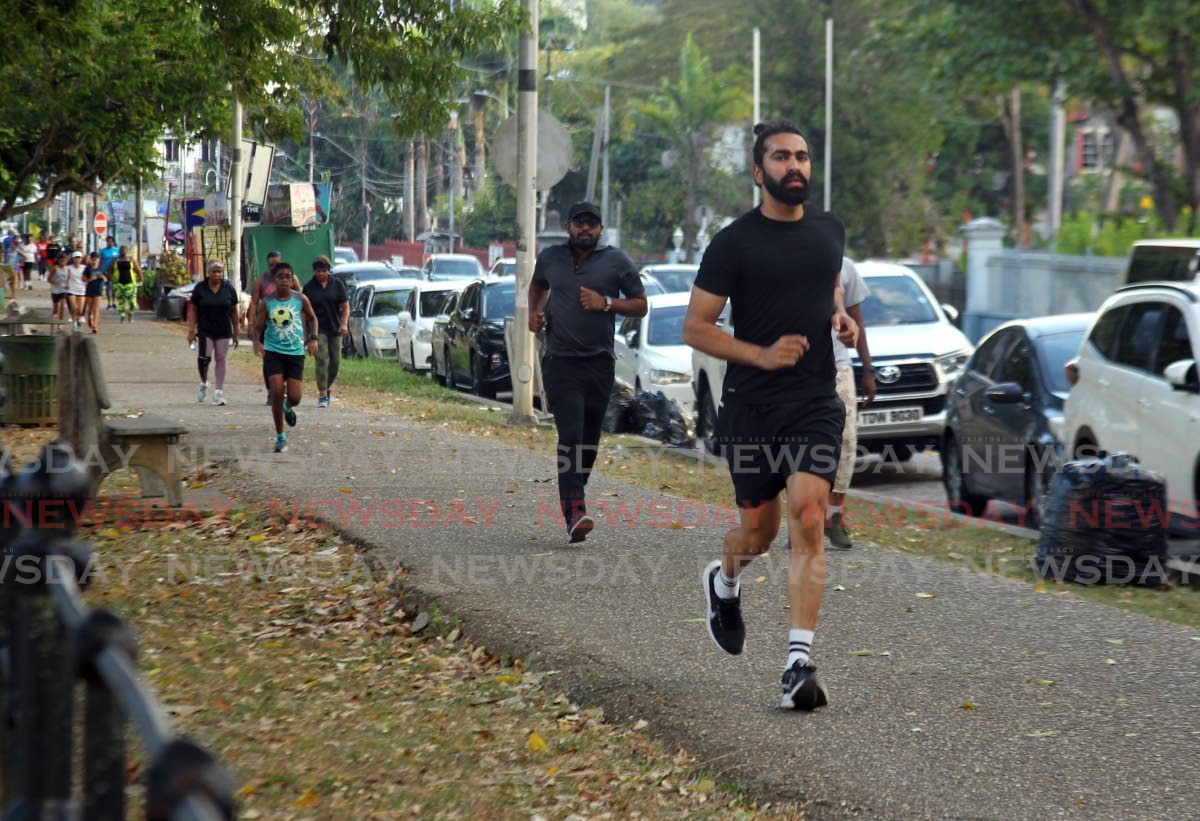
Queen's Park Savannah does not need an occasion to become Port of Spain's evening room. After work and school, walkers gather on the perimeter, runners find a passing lane, football training begins inside the green, and a coconut vendor waits at the edge. A Newsday photo essay recorded precisely that unannounced mixture on an ordinary Monday afternoon in March 2024 [3]. The useful visitor experience is not to tour everything around it. It is to join that daily change of pace for one complete lap.
Make the National Academy for the Performing Arts—NAPA—your start and finish. Arrive about 75 minutes before local sunset, face west along the southern edge, and walk clockwise with the Savannah on your right. The paved perimeter is commonly measured at about 3.5 kilometres; current review listings range a little higher, so treat the number as orientation rather than a certified race distance [2][5]. Allow 50–70 minutes without trying to improve your pace. This is a non-food ritual with one anchor: the old Pitch Walk itself.
That narrow choice matters. The Savannah covers roughly 232 acres in the National Trust's account, large enough to tempt a visitor into cutting across the field or assembling a checklist from the buildings around it [1]. A lap does the opposite. It lets the same piece of ground change four times—city edge, mansion edge, mountain edge, exercise edge—while Port of Spain's working day gives way to its public evening.
Move one: begin by reading the current
Stand near NAPA until you can see how people are using the path. Then merge without taking over its width. Keep left when that matches the visible flow, let runners pass, and do not walk three abreast. The exact etiquette is situational; the durable rule is to copy the functioning lane rather than invent one.
Choose a normal weekday if you can. Late afternoon is repeatedly described as the cooler, livelier walking window in local reporting and current reviews, but neither source makes it a safety guarantee [3][5]. The 75-minute buffer is an editorial recommendation: it gives you enough light for the full circuit, enough slack for a brief rain shower or photograph, and a reason not to convert an evening walk into a night crossing.
Before moving, settle the route in one sentence: NAPA -> southern edge westbound -> Magnificent Seven -> northern curve -> Queen's Park East -> NAPA. Keep the open green on your right throughout. If the Savannah shifts to your left, you have changed direction; if NAPA disappears behind a second attraction, you have changed the assignment.
Move two: let a circuit be a circuit
Do not cut diagonally across the grass to save time. The perimeter is the experience because it is shared infrastructure. Historian Bridget Brereton records that the paved walk was once called the Pitch Walk and has long been used for walking, jogging, and strolling. In the first half of the twentieth century, an electric tram also travelled around Queen's Park Savannah [2]. Both facts turn repetition into the point: the city has been circling this ground in different ways for generations.
Walk the first 10 minutes without headphones. Traffic is close, games and conversations carry from inside the rail, and faster users may approach from behind. A soundtrack would not make the route more atmospheric; it would remove the information that helps you share it.
If you stop for a photograph or map check, step completely off the moving line. The image above is useful because the walkers remain the subject rather than being treated as obstacles in front of a landmark [3]. Make one similar observation with your eyes: who is arriving, who is finishing, and how the path accommodates different speeds.
Move three: see the west side without collecting it
The westward stretch brings the Magnificent Seven into view. Use those buildings as a progress marker, not seven separate appointments. A local Trinidad and Tobago guide pairs the paved running track with the historic facades, coconut vendors, and food tents; community advice likewise describes an early-morning or evening circuit with the buildings visible along the way [4][6]. Neither requires you to cross the road.
Keep walking. One exterior photograph from the Savannah side is enough. Crossing back and forth for gates, plaques, and symmetrical angles breaks the exercise flow, adds live roads, and turns one civic ritual into an architecture scavenger hunt. If the buildings deserve a closer visit, give them another daylight outing.
The restraint also protects the timing. At an unhurried pace, you should reach this side while there is still usable light on the facades. If sunset is already arriving, do not compensate by hurrying into the northern half. Shorten the outing and return another day; a complete lap is a good form only when current weather, visibility, and your mobility support it.
Move four: carry the estate history around the whole green
Queen's Park Savannah did not begin as neutral open space. The National Trust traces the land to the Peschier family's 232-acre sugar estate, with a house, mill, boiling house, fields, and accommodation for enslaved Africans. Governor Ralph Woodford bought the estate in 1817; when Queen Victoria took the throne in 1837, the public ground acquired her name [1][2].
Do not confine that history to one plaque and then resume an innocent landscape. Carry it for the rest of the circuit. The openness now used for exercise and recreation was shaped first by colonial land allocation and enslaved labour. Later layers did not erase the first: cattle grazing, horse racing, cricket, football, kite flying, Carnival, vending, and everyday walking accumulated on the same ground [1][2].
This is where the ritual lens earns its keep. A landmark tour asks what object to look at next. A lap asks how a place keeps being remade by repeated use. The former estate has been public ground for more than 200 years; the moral meaning of that transformation is not that public recreation redeems slavery. It is that ordinary access and collective memory now occupy land whose earlier organization must remain visible.
Move five: use the northern curve as the quiet test
The northern arc can feel less eventful than NAPA or the mansion row. Let it. Keep to the populated paved perimeter and resist a shortcut through the interior, particularly as the light drops.
Current sources do not support a simple claim that the entire route is either “safe” or “unsafe.” A local community thread describes many exercise enthusiasts using the Savannah in the early morning and evening, while comments in the same discussion advise visitors to avoid dark or isolated areas and to stay alert [6]. Review summaries also include both lively golden-hour accounts and nighttime concerns [5]. The responsible conclusion is narrow: this itinerary is for the active late-afternoon-to-sunset window, not for a solitary after-dark experiment.
Check the crowd rather than only the clock. If the exercise flow thins suddenly, rain closes visibility, or an event changes the perimeter, leave by a lit, occupied edge and use transport you arranged in advance. Personal circumstances and current local or official advice outrank the completion of a travel article's lap.
Move six: notice when ordinary ground becomes a national stage
Queen's Park Savannah has another scale entirely. The Grand Stand was built in the mid-1850s, and Carnival's parade stage moved here in 1948 [1][2]. For Panorama 2026, the Savannah hosted multiple major dates, including junior finals, semifinals, large-band finals, and Carnival Lagniappe [7]. On those days, “one easy lap after work” is not a stable assumption.
Current reviewers make the practical consequence plain: large events can mean packed grounds and difficult parking, while an average evening has a different, looser rhythm [5]. Check the current event calendar before leaving. If barriers, stages, rehearsals, or crowds dominate, do not force the ordinary-lap plan through a special-event site. Attend the event on its own terms or choose another day.
There is no reservation and no formal queue for a normal perimeter walk. Event access is separate and can involve tickets, closures, screening, or controlled circulation. “Open public space” is not permission to ignore a temporary operating plan.
Move seven: finish the lap before deciding what comes after
As Queen's Park East carries you south, look for NAPA's curved roofline. It is both recognition cue and discipline: the ritual ends where it began.
Finish the full perimeter before buying anything. The Savannah's southeastern food area is part of local evening life, and local guides, community comments, and current reviews all mention coconuts or vendors around the edge [2][4][5][6]. But food is optional here. Stopping halfway because the first stall is visible turns the walk into an approach to dinner and leaves the circuit conceptually unfinished.
The required spend is TT$0. If you want a coconut or snack afterward, set your own TT$0–100 cash ceiling before starting. That range is an editorial budget guardrail, not a published menu-price claim. Ask the price before ordering, keep small cash discreet, and skip the purchase if the vendor area is closed, congested, or not appealing that evening.
Do not linger simply because some vendors operate later than the walking window. A lit food strip does not extend daylight around the entire perimeter. Complete the exercise ritual, make the optional purchase, and leave from the populated NAPA-side edge while your onward plan is still straightforward.
Move eight: close the circle, not the evening
At NAPA, turn back toward the section where you began. The route should now feel smaller and denser. You have walked about 3.5 kilometres, passed the former sugar-estate boundary, the mansion row, the northern green, the sporting ground, and a stage of national culture without converting any of them into a second anchor [1][2].
Take thirty seconds before leaving. The best measure of the lap is not a step count. It is whether you entered an existing public rhythm without asking it to reorganize around you: no blocked path, no private close-up, no road crossing for a better facade, no interior shortcut after dusk, no demand that an ordinary evening perform Carnival.
That is enough. Queen's Park Savannah is often called a living room [2][5], but a visitor should treat the phrase as a standard of conduct, not a promise of ownership. You were received by a room already in use.
The visitor trapline
Mistake one: arriving at sunset because the vendors stay later. The perimeter and the food edge have different clocks, and local discussion warns against dark, isolated stretches [5][6]. Better: arrive 75 minutes before sunset, finish the lap in the active exercise window, and treat food as an optional afterword.
Mistake two: cutting through the middle when the circuit feels long. The interior removes the shared path, the four changing edges, and—later—the visibility of the crowd. Better: keep the Savannah on your right and let the 3.5-kilometre perimeter be the commitment [2].
Mistake three: treating an event night like an average weekday. Panorama and Carnival can transform circulation, access, parking, and the meaning of the ground [5][7]. Better: check same-day notices and either attend the event deliberately or move the lap to another date.
Mistake four: turning the west side and food strip into a checklist. Crossing for every mansion and stopping at the first vendor replaces one ritual with a string of transactions [4][6]. Better: read both from the perimeter, close the circle at NAPA, then decide whether anything else is needed.
A compact go plan
- Best window: a normal weekday, arriving 75 minutes before local sunset and allowing 50–70 minutes for one unhurried lap. Late afternoon is an evidence-backed local rhythm; the exact buffer is editorial [3][5].
- Anchor: the paved perimeter of Queen's Park Savannah, starting and ending near NAPA. The Magnificent Seven, playing fields, Grand Stand, and vendor edge are context, not added stops.
- Expected spend: TT$0 required; TT$0–100 optional as a self-set ceiling for one post-lap drink or snack. Transport is separate.
- Queue and reservation reality: none for an ordinary public lap. Special events can impose tickets, barriers, closures, and dense parking conditions; check the current organizer notice [5][7].
- Navigation cue:
NAPA -> west along the southern edge -> Magnificent Seven -> northern curve -> south on Queen's Park East -> NAPA, keeping the open green on your right. - Where to walk and stand: join the visible perimeter flow, leave room for faster users, and step fully off the moving line for maps or photographs. Stay on populated, lit edges as daylight fades [6].
- Same-day check: sunset, rain and heat, current event notices, visible perimeter access, crowd density, and the ride home. If any one of those makes the full circuit unwise, do not complete it for completeness's sake.
One lap cannot explain Port of Spain. It can reveal how the city keeps time: work releases people to the Pitch Walk, the path fills, the light moves from the western facades to the open field, and NAPA returns as a finish line that nobody had to install. Walk that circle well and the Savannah remains what it was before you arrived—public ground, already in motion.
Sources
- National Trust of Trinidad and Tobago, “The Queen's Park Savannah” — official account of the Peschier estate, 232-acre land grant, enslaved labour, Grand Stand, and Carnival's 1948 move to the Savannah.
- Trinidad Guardian, “To Queen's Park Savannah with Love” — local historical and community account of the 3.5-kilometre perimeter, 1817 purchase, 1837 naming, Pitch Walk, tram, recreation, vendors, and the Savannah's civic role.
- Trinidad and Tobago Newsday, “An afternoon in the Savannah” (March 5, 2024) — local photo essay documenting after-work and after-school exercise, football training, a long-time walker, and Faith Ayoung's cover photograph.
- Ins & Outs of Trinidad and Tobago, “Amazing Trinidad Sites” (February 26, 2024) — local travel publication connecting the paved running track, Magnificent Seven, and edge vendors.
- Wanderlog, “Queen's Park Savannah” — current review-platform aggregation, including 2025–2026 accounts of golden-hour laps, runners, families, event parking, perimeter scale, admission, and nighttime concerns.
- r/TrinidadandTobago, “Port of Spain a ‘No-Go Zone’?” — local community discussion used for the ordinary morning/evening exercise rhythm, the Magnificent Seven and vendor sequence, and the caution against dark or isolated areas.
- Trinidad and Tobago Newsday, “Panorama 2026 launches November 9 at the Queen's Park Savannah” (November 7, 2025) — recent local reporting on the 2026 Panorama dates staged at the Savannah.