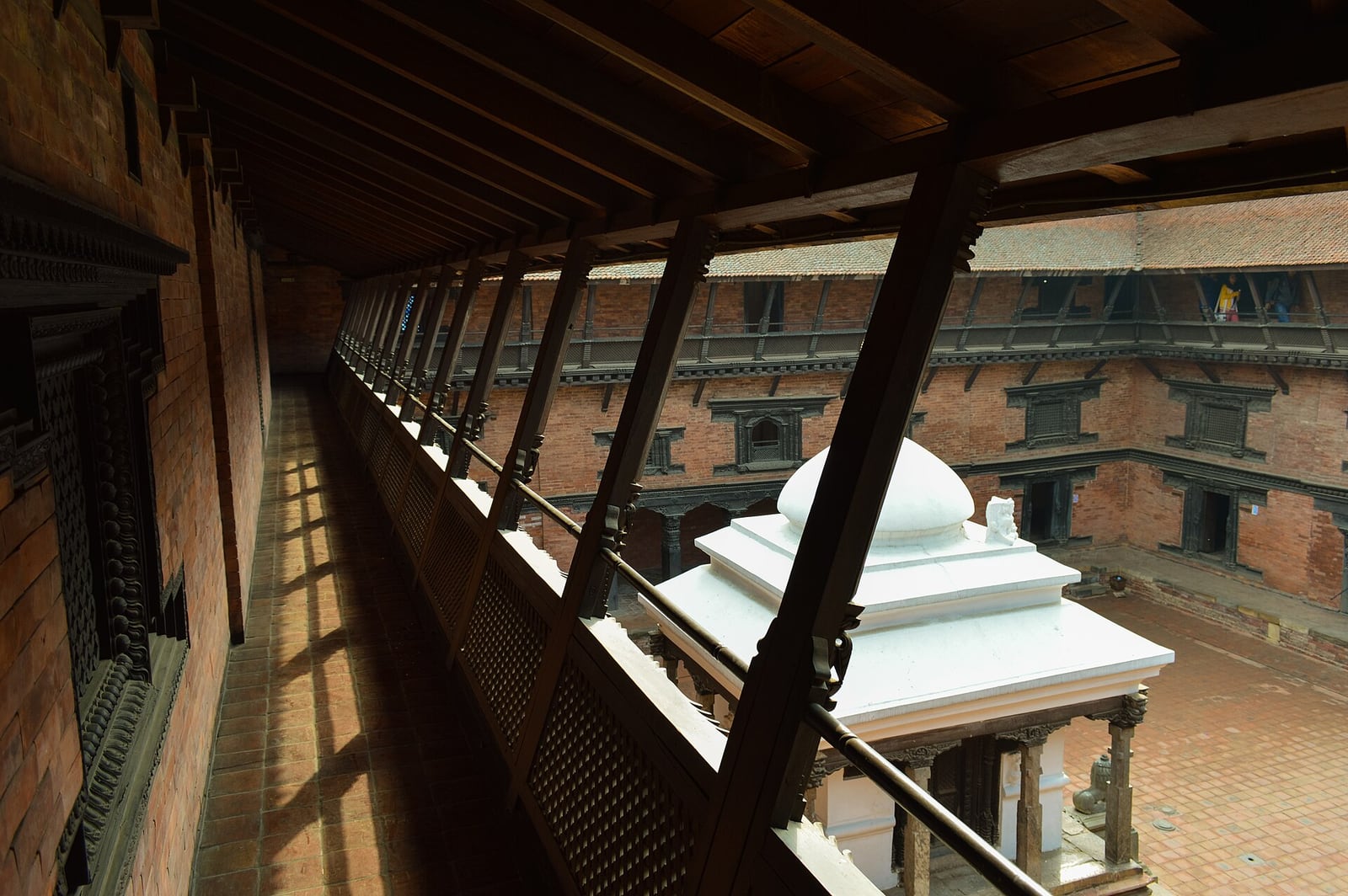
At 8:15 a.m., Patan Museum asks for a small act of resistance. The gilded entrance opposite Krishna Mandir has brought you out of Lalitpur's loudest architectural conversation, but do not hurry toward a display case. Step into Keshav Narayan Chowk, move out of the doorway, and wait for three minutes.
The white shrine in the center will stop looking like an ornament. Carved timber galleries will begin to separate from the red brick behind them. Other visitors will reveal which passages are circulation and which edges can hold a pause. Only then is it time to enter the museum.
That reversal—courtyard first, collection second—is the whole visit. A Kathmandu Post account of the palace restoration treats its courts, changing light, architecture galleries, and conversion from palace to museum as one experience rather than a shell around the collection [1]. The answer is not to add another attraction. It is to give this one place two and a half to three hours, using its courtyard to connect palace architecture, sacred art, metalworking, restoration, and present-day worship.
The best first window is 08:15–10:45. That is an editorial recommendation, not a special session: the Department of Archaeology's 2025 museum leaflet lists an 08:00 opening, and recent visitor accounts repeatedly notice the calm courtyard and unusually legible interpretation [2][7]. Arriving just after opening leaves room to look before the square's visual intensity turns the museum into an afterthought.
Find the door, then change speed
Maps may label the wider precinct Patan Durbar Square, but the older local name Mangah, or Mangal Bazaar, carries the sense of a center [9]. Use Patan Museum as the final map pin. Once in the square, find the stone mass of Krishna Mandir and face across toward the palace. The museum entrance is the gilded doorway opposite it [8].
That gives the first four local moves. Name the museum, not merely the square, to your driver. Use Krishna Mandir as an orientation point. Cross to the gilded door. Keep the admission ticket after entering. The ticket is broader than one room: the museum's current fee page says a single admission covers Keshav Narayan Chowk, Mul Chowk, Sundari Chowk, the Bhandarkhal tank, and the architecture galleries [6]. Some areas can still close for conservation, ritual, or events, so ask the desk what is open rather than treating the list as a promise of unrestricted access.
For an ordinary visit, the current official pages show admission categories but no required timed-booking system, while a May 2026 visitor review describes buying the ticket at the entrance [2][6]. Treat this as a walk-up visit, not a guaranteed queue-free one. Arrive in the first half-hour, have the correct visitor category ready, and ask about same-day closures before leaving the desk.
The September 2025 fee schedule makes the core spend unusually clear: NPR 1,000 for other foreign visitors; NPR 500 for citizens of SAARC and BIMSTEC countries and China; NPR 30 for Nepali adults; and NPR 15 for Nepali students [6]. Transport, guides, events, and purchases are separate. For the museum itself, therefore, a defensible budget is NPR 15–1,000, determined by eligibility rather than bargaining.
Let the courtyard explain the museum
Keshav Narayan Chowk is not just an attractive holding area. Nepal Tourism Board dates the courtyard's present form to 1734. Patan Museum says the joint Nepal–Austria restoration project began in 1982, and the museum opened in 1997 [5][8]. Those dates turn the visible timber, brick, and metal into evidence of several different acts: royal construction, later damage and alteration, conservation decisions, and a modern museum fitted into a palace.
Make the fifth move here: take one slow lap at ground level before climbing. Begin from the shade, look back toward the gilded entrance, then walk the perimeter without cutting between anyone and the central shrine. Use the photograph above as a recognition aid—the dark upper arcade and pale central structure should make the geometry legible—but do not expect a 2014 photograph to report today's access or ritual conditions [10].
The shrine matters because the courtyard has not been emptied of religious life. A November 2025 Kathmandu Post report describes how daily worship at the Keshav Narayan temple resumed in 2020 after a gap of more than 40 years, through discussion among local residents, priests, the ward, and the museum [4]. In other words, a museum ticket does not convert every threshold into a photo set.
Stand along the shaded arcade, not directly in front of the shrine door. If worship is under way, give it physical and acoustic room. Watch from a respectful distance; do not photograph a priest or devotee without permission. Even when nothing ceremonial appears to be happening, keep the central approach clear. The useful lesson is not that visitors have stumbled onto a performance. It is that conservation and worship can occupy the same courtyard on different terms.
Now look upward. The restored galleries do more than frame the sky: they control the transition from bright court to dark timber passage, from palace scale to the close reading of an object. That is why entering a gallery immediately would have been a loss. The building has already supplied the museum's first label.
Read three processes, not every object
Patan Museum's great strength is interpretation. Nepal Tourism Board credits art historian Mary Slusser with extensive labels that explain the Hindu and Buddhist art rather than leaving it as a procession of beautiful, anonymous deities [8]. A Nepali Times account similarly describes bilingual labels and eight themed galleries, with metalworking techniques placed alongside iconography [3].
The scale still invites a common mistake: trying to prove value by photographing everything. Use a narrower sequence instead. Choose three label-led encounters:
First, find one cast-bronze figure and read until you can identify the basic logic of lost-wax casting: a model is formed, encased, lost in firing, and replaced by metal. Second, find one object or label explaining repoussé, in which metal is worked from the reverse to raise a relief. Third, choose one iconography label and use attributes, gesture, posture, or accompanying figures to work out why the deity has been identified that way [3].
This is the sixth move: make three notes before making three photographs. Record one material process, one visual clue, and one question. The exercise slows the collection down and prevents sacred imagery from becoming a wall of generic “ancient art.”
It also returns the galleries to Lalitpur. The museum is not describing vanished techniques in a place detached from them. Nepal Tourism Board emphasizes that metalworking remains a living Patan tradition [8]. When a label distinguishes casting from hammered relief, it is giving you a vocabulary for looking at the city's workshops and shrines without pretending that every metal surface was made in the same way.
After the three objects, take the seventh move: find the western lattice-window corner and pause if the space is open and seating is available. Nepali Times describes this as a place to look back toward Krishna Mandir and the square [3]. Do not occupy it for a portrait session if others are waiting. Use the view to reverse the museum's entrance logic: the monument that first helped you find the gilded door now appears through the palace's timber screen.
Then return to Keshav Narayan Chowk. A five-minute courtyard reset between gallery clusters is more useful than pushing through fatigue. Check whether the sun has reached a carving that was in shade, whether worship has changed the center's circulation, and whether your mental map of the upper galleries now matches the building outside them.
One ticket is not a scavenger hunt
Mul Chowk, Sundari Chowk, the Bhandarkhal tank, and the architecture galleries may be included, but inclusion is not an instruction to harvest them all [6]. The eighth local move is simply to ask a staff member which secondary space best extends what you just noticed. If your three labels concentrated on metal technique, an architecture display may add less than another careful look at how carved wood and brick meet in Keshav Narayan Chowk. If the central shrine raised questions about palace ritual, a currently accessible adjoining court may be the better extension.
Keep the hierarchy firm: Keshav Narayan Chowk is the anchor; other spaces are optional context. Allow 45 minutes for courtyard, ticket, and orientation; 75–90 minutes for selected galleries; 15 minutes at the lattice window and other pauses; then hold 20–30 minutes for one open secondary space or a return to the collection. That produces a visit of roughly 155–180 minutes without inflating it into a full palace inventory.
The official 2025 leaflet lists the museum as open daily from 08:00 to 18:30, with winter hours of 08:00 to 17:30 from November 2 through January 30. It lists closures on Holi/Fagu Purnima and Krishna Janmashtami and explicitly tells visitors to check the museum website for updates [7]. Follow that advice. Festival observance, conservation, or a current notice can outrank a PDF timetable.
For a late visit, count backward rather than trusting the nominal closing time. Enter no later than 15:30 in the long-hours season or 14:30 in the winter schedule if you want the full slow circuit. The early window remains better because it places the museum before, rather than after, the square's sensory and photographic demands.
Four ways visitors lose the place
Mistake one: stopping at the palace facade. The square is visually complete enough to make entry feel optional, yet the restored courts and architecture galleries are part of the palace's meaning, not an afterthought [1]. Better: find Krishna Mandir, turn toward the gilded door, and let the museum be the morning's single anchor.
Mistake two: treating the courtyard as a shortcut to the “real” collection. This erases the restoration history, palace circulation, and active shrine before the first label can explain them. Better: take three quiet minutes and one perimeter lap, keeping the shrine approach clear.
Mistake three: attempting total coverage. Eight themed galleries plus the additional spaces on one ticket can turn attention into a completion game [3][6]. Better: read one casting label, one repoussé label, and one iconography label deeply; use a staff recommendation for any extension.
Mistake four: trusting a search-result hours snippet. The official leaflet has seasonal hours and festival closures, while the museum homepage carries current notices [5][7]. Better: check the homepage the same day, arrive at least three hours before closing, and confirm open spaces at the ticket desk.
The visit in one glance
- Best time: 08:15–10:45, extending to about 11:15 if an additional courtyard or architecture gallery is open.
- Expected spend: NPR 15–1,000 for admission according to the visitor categories published in September 2025; confirm the category and price at the entrance [6].
- Queue and reservation: ordinary admission appears to be walk-up; buy at the gilded-door entrance, arrive soon after opening, and ask about closures or events before proceeding [2][6].
- Navigation cue:
Mangal Bazaar / Patan Durbar Square -> Krishna Mandir -> gilded doorway opposite -> ticket desk -> Keshav Narayan Chowk[8][9]. - Where to stand: in the shaded perimeter arcade, outside doorways and away from the central shrine's approach. Pause at the western lattice window only if it is accessible and you are not monopolizing the space [3][4].
- What to do: courtyard lap, three label-led objects, lattice-window pause, courtyard reset, then one staff-recommended extension.
- Same-day check: homepage notices, seasonal closing time, festival closure, open secondary spaces, and whether worship or an event changes circulation [5][7].
Patan Museum succeeds when the collection stops floating free of its place. The courtyard gives a bronze deity a palace, a workshop city, a restoration history, and a living ritual neighbor. The labels give the carved and cast surfaces names precise enough to see them again outside. Begin before the first display case, and Keshav Narayan Chowk will remain more than the beautiful room you crossed on the way to the art.
Sources
- The Kathmandu Post, “Restoring the most beautiful courtyard in Nepal” (January 21, 2018) — local architectural reporting on the restored palace courts, their changing light, adaptive reuse, and the architecture galleries within the museum visit.
- Wanderlog, “Patan Museum” — current aggregation of Google and Tripadvisor visitor reports, including recent 2025–2026 observations on the courtyard, labels, visit length, and walk-up ticket purchase.
- Nepali Times, “A portal into Patan's past and present” (March 30, 2024) — local reporting on the themed galleries, bilingual interpretation, lost-wax and repoussé techniques, and the western lattice-window viewpoint.
- The Kathmandu Post, “In Patan, forgotten ancient rituals are returning to life” (November 15, 2025) — recent local reporting on the Keshav Narayan shrine and the community-led restoration of daily worship in 2020.
- Patan Museum, official homepage — museum authority account of Keshav Narayan Chowk, the Nepal–Austria restoration that began in 1982, and current visitor notices.
- Patan Museum, “Entrance Fee” — official admission categories, September 2025 prices, and the spaces covered by one-door admission.
- Department of Archaeology, Nepal, “Explore Museum” (2025) — official museum leaflet with Patan Museum's regular and winter hours, festival closures, and same-day verification advice.
- Nepal Tourism Board, “Patan Museum” — official tourism account of the gilded entrance, the 1734 courtyard, the 1997 museum opening, interpretive labels, and Patan's living metalworking tradition.
- Patan Museum, “History” — official account of the Mangah/Mangal Bazaar name and the palace and museum chronology.
- Wikimedia Commons, “File:Interior courtyard of Patan Museum (12679516375).jpg” — source page and CC BY 2.0 license information for Francisco Anzola's documentary photograph.