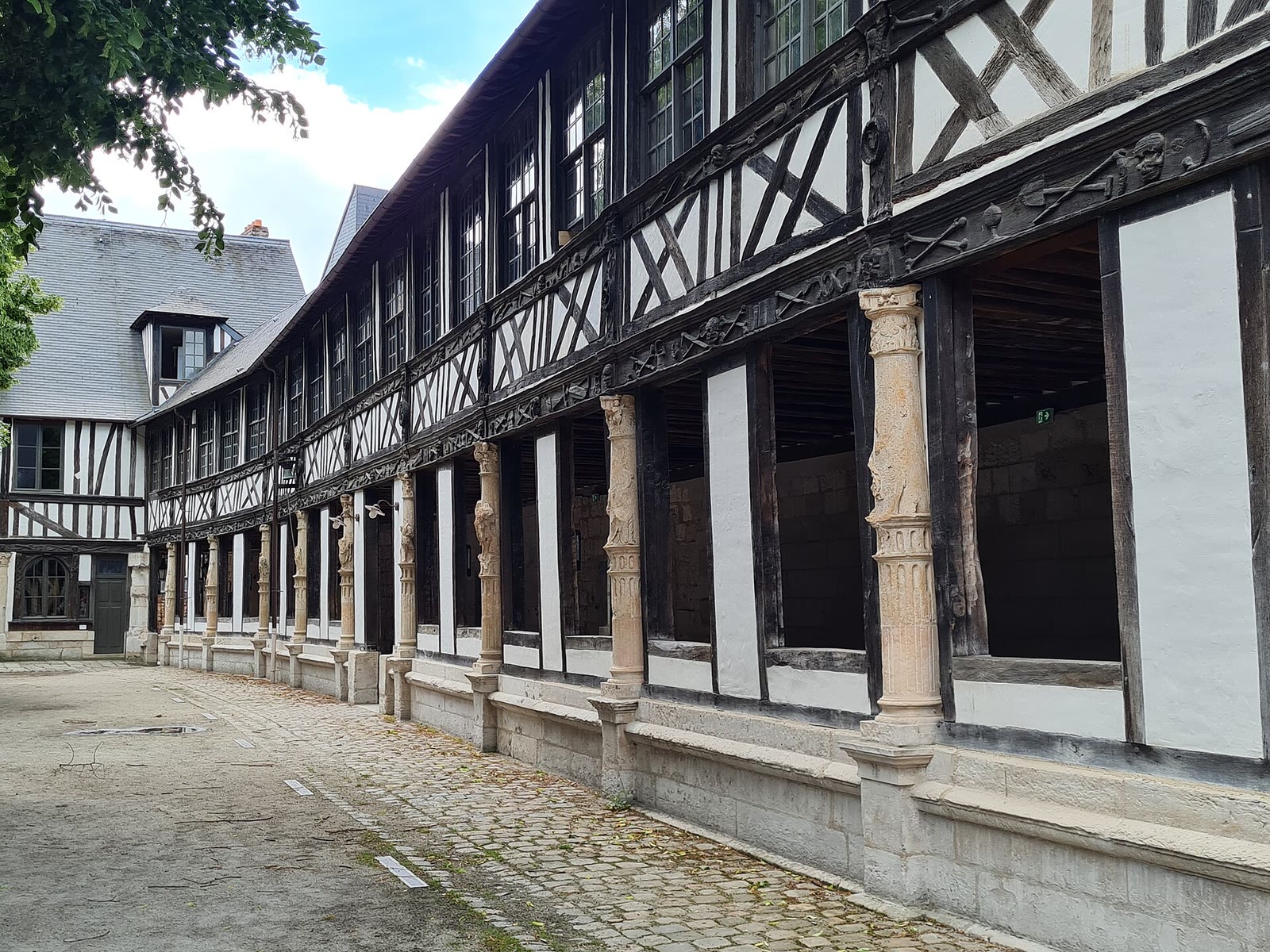
At 186 rue Martainville, the useful landmark is not a tower or a grand portal. It is a dark opening under a timber-framed house, beside a small blue Aître Saint-Maclou sign. Cross it and the shopfront street gives way to a pale courtyard enclosed by wood, stone and rows of windows. Only when you look beneath those windows do the details resolve: skulls, long bones, a coffin, a shovel, liturgical vessels. Rouen has placed one of its most direct meditations on death behind a doorway that can look like service access.
Do not visit it as a cabinet of Gothic shocks. The better portrait is of a place that has kept changing jobs without erasing the old one: parish cemetery, ossuary, school, fine-arts campus, restored cultural court and public shortcut. A Rouen neighborhood writer recalls hesitating at the passage because it looked private, then finding a remarkable court inside; a separate community-review digest repeatedly emphasizes the calm enclosure and the carved details [6][7]. Both observations point to the same local move: let the Aître interrupt a walk through Rouen, then give the interruption more attention than its size appears to demand.
The cleanest free visit is a weekday from 09:10 to 10:00. That window is editorial advice, not a promised quiet period. The tourism office currently lists the courtyard as open 09:00–19:00 every day, except January 1, May 1 and December 25; ordinary self-guided access is free, and its own suggested visit duration is 45 minutes [4]. Arrive after the gate should be open but before the interpretation desk becomes the reason for your timing. If you want the audioguide, use a different plan: arrive at 10:00 on a staffed day and check its seasonal collection hours before setting out [5].
Enter by the address, not by the spectacle
The first move is to save the full address—186 rue Martainville—and look for the number plate and blue site sign, not for an open square. From the TEOR T1, T2 or T3 and bus F1 or 6 stop at République, stay on rue Martainville until the street wall opens into the covered passage [4]. A map pin can announce arrival while you are still facing tables, façades and shop signs. The threshold in the photograph of the entrance is visually modest by design; walking past it is a more plausible visitor error than getting lost across town.
Pause just inside, then walk to the middle of the court before looking up. This second move gives the four sides a shape. Three galleries were ordered in 1526 so older bones could be lifted from graves and stored in ventilated attics, making ground available for new burials. The south wing did not close the rectangle until 1652 [1][2]. What now reads as a single courtyard therefore records at least two construction moments and two different needs.
The French word in the name is part of Rouen’s texture. Aître descends from the Latin atrium: first an interior court, later the court beside a church, and in medieval usage a cemetery. Saint-Maclou’s crowded parish created a new burial ground in the mid-fourteenth century after its churchyard could no longer hold the dead; plague waves in the fifteenth and sixteenth centuries intensified the pressure [1]. Calling the site simply a “plague cemetery” flattens that longer parish history. It was an urban burial system before it became an attraction.
Read the wood before the stone
The third move is to begin with the horizontal timber beam beneath the upper storey. Follow it slowly rather than collecting isolated skulls. The carvings mix human bones with the tools of burial—pick, shovel and coffin—and objects used in funeral rites. They are not Halloween ornament laid over a neutral building. They label what the galleries did: the upper levels held displaced remains while the ground below continued receiving burials [1].
Then shift down to the stone columns. This fourth move separates two related visual systems. On the west gallery, the surviving danse macabre arranges lay society in hierarchy; on the east, it turns to the clergy. Each pairing brings a living figure into contact with death, and the procession refuses to grant rank an exemption. The north side adds Adam and Eve, Cain and Abel, and pairs of sibyls [1]. A complete lap is therefore not a hunt for the “creepiest” carving. It moves through a Christian argument about mortality, judgment and social equality.
Take the first lap without a screen. On the second, use interpretation. The adult audioguide is currently listed at €5 and the child version at €3, with the latter designed for ages 7–12 and lasting 30–45 minutes [4][5]. From May through August, collection is scheduled Tuesday–Sunday, 10:00–12:45 and 13:45–17:30, with last pickup at noon and 17:00. From September through April, ordinary pickup contracts to weekends, expanding during Zone B school holidays [5]. The fifth move is to distinguish those desk hours from the broader free-courtyard hours. “Open” does not mean every layer of interpretation is staffed.
If you prefer a guide, the published rhythm is Sunday at 15:00 with online booking [4][5]. Do not build a trip around an old quoted price: the tourism listing marks its guided-tour figure as based on the previous year [4]. Verify the live booking page instead. For the courtyard alone, there is no timed-entry ritual and no reason to buy access from an intermediary.
A school was not an interruption to the story
The sixth move is to look at the upper windows after studying the funerary carvings. They explain why the building does not feel like a preserved ruin. A charity school for boys arrived in 1661, soon joined by a girls’ school. Extra floors were added to three galleries between 1745 and 1766 as enrolment grew. After other educational uses, Rouen’s School of Fine Arts occupied the complex from 1940 to 2014 [2]. For more than a century, teaching and burial activity overlapped. Education was not merely the site’s modern afterlife; for a long period, it shared the address with the dead.
That coexistence changes the mood. The court is quiet, but it is not sealed. Today it contains art and craft galleries, a restaurant and events, and the public may cross it freely [3][4]. Keep resident doors, the covered walks and the central circulation line clear. Sit only where furniture or signs invite it. The seventh move is behavioral: treat the Aître as a working courtyard whose historical fabric is visible, not as an empty stage waiting for your portrait.
The same restraint belongs underfoot. Archaeological work during the recent restoration found burials across the courtyard and galleries—not in one neat “plague pit.” Excavation also recovered coffin traces, shroud pins, ceramics and coins. A dental-pulp test from one person found DNA fragments close to Yersinia pestis, while the site’s own account says further analysis was needed to confirm the finding [3]. Evidence is strongest when it narrows the claim: burial was dense and repeated here; one laboratory signal does not license a theatrical story about every person beneath the court.
Leave by the restored opening
The eighth move is to resist retracing your steps. The large restoration begun after 2016 used the building’s 1880 state as its principal reference, started construction in May 2018, and reopened a blocked connection between rue Martainville and rue Géricault. Roughly 30 specialist firms across 15 trades worked on a project budgeted at €14 million before tax [3]. Exit north through that recovered passage if it is open and not restricted by an event.
This is more than route efficiency. Entering from Martainville and leaving toward Géricault lets the building perform its oldest linguistic trick in reverse: an atrium became a cemetery, and the cemetery has become a court again. The restored route ties the tourist-heavy timber façades to the everyday street network around Eau de Robec and Saint-Ouen. The site stops being a spooky cul-de-sac. It becomes city fabric.
Four mistakes that shrink the place
Mistake one: searching only for a monumental entrance. The rue Martainville opening can read as a passage through a building. Better: use number 186, the blue sign and the dark timbered threshold as the recognition chain [4][6][8].
Mistake two: making the visit a skull scavenger hunt. That loses the difference between the beam’s occupational symbols and the columns’ social procession. Better: read one horizontal run of timber first, then compare west and east stone figures [1].
Mistake three: assuming the posted daily hours guarantee every door and service. The tourism listing publishes the ordinary 09:00–19:00 span but also warns that the day’s hours are not guaranteed [4]. Better: check the official event feed on the morning of a public holiday or major event, and treat the audioguide desk as a separate schedule [4][5].
Mistake four: photographing the court as if nobody uses it. The galleries now hold active cultural and hospitality tenants, while local and community accounts describe a calm place discovered within the neighborhood rather than an abandoned set [3][6][7]. Better: take the wide frame from the court’s open center, step aside for crossings, then leave through the north passage.
The go details
- Anchor: Aître Saint-Maclou only. The Martainville-to-Géricault crossing is the method, not a second attraction.
- Best window: weekday 09:10–10:00 for a free, unhurried lap; arrive at 10:00 on a staffed day if the audioguide matters. The quietness of either window is not guaranteed [4][5][7].
- Published free-access hours: daily 09:00–19:00, with January 1, May 1 and December 25 listed as closures. Recheck holidays and event days [4][5].
- Expected spend: €0 for the courtyard; currently €5 adult / €3 child for the audioguide. Allow 40–50 minutes so the carved sequence does not collapse into a doorway photo [4][5][7].
- Queue and reservation reality: no timed reservation is published for free courtyard access. Sunday’s 15:00 guided visit should be booked online; audio pickup follows narrower seasonal desk hours [4][5].
- Transit and door cue: TEOR T1/T2/T3 or bus F1/6 to République, then 186 rue Martainville; enter beneath the timber frame beside the blue site sign [4][6][8].
- Where to stand: orient yourself from the open center, then move under the galleries to see the carvings without blocking the cross-court line.
- Etiquette: keep tenant entrances open, do not touch the wood or stone, and ask before photographing inside any resident gallery.
- Exit: use the restored rue Géricault passage when available; if an event closes it, return through Martainville without forcing a service door [3].
The Aître Saint-Maclou does not ask Rouen to choose between memory and use. Its carvings still state what the galleries once held. Its windows remember centuries of pupils. Its restored doors serve people making, eating, crossing and looking now.
That is why the right ending is not another skull photograph. It is the north passage. Walk out and let the old cemetery return you to the city.
Sources
- Aître Saint-Maclou, “A cemetery with galleries” — official English-language history of the fourteenth-century burial ground, 1526 ossuary galleries, funerary beam carvings and west/east danse macabre.
- Aître Saint-Maclou, “A place of education” — official chronology of the 1652 south wing, schools from 1661, eighteenth-century additions and the fine-arts school’s 1940–2014 occupancy.
- Aître Saint-Maclou, “La nouvelle vie du lieu” — official account of the archaeological work, 1880 restoration reference, 2018–2020 works, reopened cross-passage, project scale and current residents.
- Rouen Tourisme, “Aître Saint-Maclou & Galerie des Arts du Feu” — current official tourism listing for free-courtyard hours, exceptions, prices, visit duration, Sunday tours, address and transit stops.
- Aître Saint-Maclou, “Visite audioguidée” — official seasonal desk hours, last collection times, child-audio duration and languages, and Sunday guided-visit timing.
- Rouen à la folie, “Quartier Saint-Maclou” — local Rouen neighborhood blog used for the easily mistaken private-looking passage and the experience of discovering the court from rue Martainville.
- Wanderlog, “Aître Saint-Maclou” — Google and Tripadvisor community-review digest used for recurring visitor observations about the calm courtyard, carved details, active art space and free access.
- ScheWo, “2025 05 28 Rouen Aître Saint-Maclou Eastern Gallery,” Wikimedia Commons — source page for the real May 2025 photograph, resized from the 4,032 × 3,024 original; CC BY-SA 4.0.