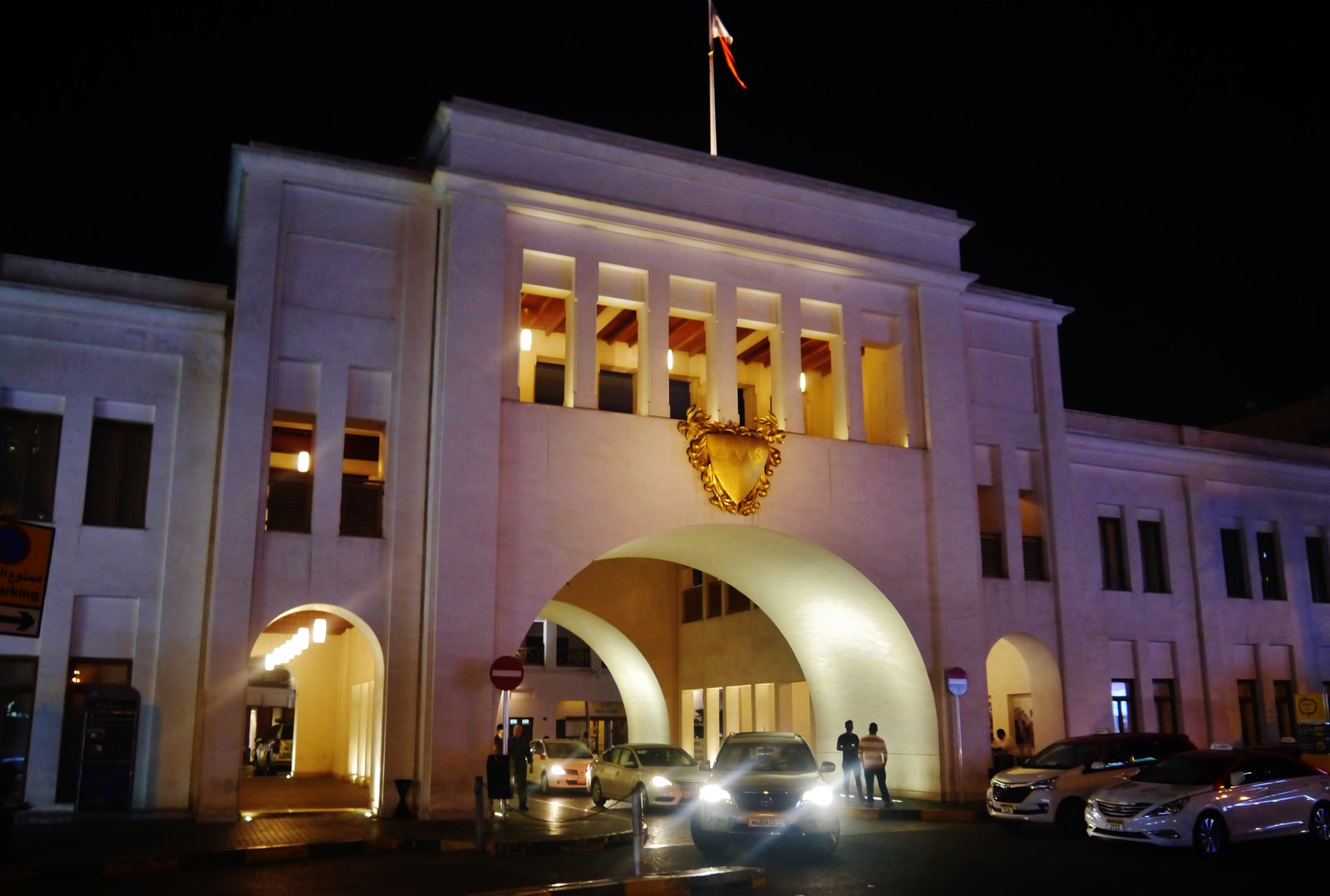
Arrive 30–45 minutes before local sunset, stand on the north side of Bab Al Bahrain and look south through the central arch. On this article’s publication day, August 15, 2026, that means roughly 17:30–17:45 before an 18:14 sunset [12]. Beyond the gate, the first lane of Manama Souq is already gathering light. Behind you are broad roads, parking structures and the towers around Bahrain Financial Harbour. The useful fact is the one the present city hides: when this gateway was completed in 1949, the sea was close enough to belong to the view.
The water did not retreat naturally. Land reclamation from the 1950s onward separated the building from the coast, leaving a gate named for Bahrain several urban blocks inland. A Bahrain Authority for Culture and Antiquities design brief later described the sea as “physically absent” from the square and asked architects to restore its memory [1][2]. You do not need a reconstruction to feel the gap. You need dusk, when the white façade brightens and the two sides of the arch become legible as different Manamas: former port in front, old market behind.
Keep this visit to one anchor: Bab Al Bahrain itself. The souq is context, not a second attraction to conquer. Allow 75–90 minutes and finish roughly 30–60 minutes after sunset. A local Bahrain guide recommends arriving from 16:00 onward, when traders are resetting after the midday lull and the heat begins to ease [4]. The culture authority lists the building’s Saturday–Thursday visiting periods as 09:00–12:30 and 16:00–20:00 [1]. Starting before sunset lets you see both the unlit threshold and the night room without gambling on the final minutes of an interior service. In mid-August, the resulting window is about 17:30–19:00; in winter, move the entire sequence earlier with sunset [12].
Begin on the side where the water used to be
The first local move is to approach the gate from Customs Square, not to materialize inside the souq. Save “Bab Al Bahrain Station” as the transit cue. The current A1 timetable names a stop of exactly that name, so a bus rider can step off with the façade nearby instead of navigating outward through the market [8]. Drivers should use a designated facility rather than hunt for a curb beneath the landmark: Amakin lists 516 spaces at Bab Al Bahrain 1 & 2 on Road 1507 [9]. Capacity is not a promise of an empty bay, especially on event nights.
Stop where the whole white front fits into view, but stay outside the direct archway line. This is the second move: look through before walking through. The building once contained government offices and faced the water; today its ground-floor functions include visitor information, while the souq begins behind it [1][3]. That reversal gives the façade its tension. What looks like a ceremonial monument was built as working urban equipment—a customs-era hinge between arrivals and commerce.
The square does not disguise how much that equipment has been edited. An official restoration account says later additions were removed to recover the earlier façade, while the authority’s competition brief records a larger argument over traffic, pedestrian arches, parking and how to make the space public again [2][3]. Do not try to solve that history by guessing which stone is “authentic.” Read the arrangement instead: one large center opening, two smaller pedestrian passages, a hard-surfaced square and a sea that survives only as orientation.
On a hot evening, the pre-sunset start is a sequence, not a weather guarantee. A September 2025 community review still found the souq difficult without air-conditioning or wind, even after daytime [5]. Carry water, use shade while the sun is up and shorten the outdoor pause if the paving is radiating heat. “After four” is the better local rhythm; it is not a claim that Gulf summer has become cool [4][5].
Let the arch remain a working threshold
The third move is to enter through a side opening if signs or barriers direct pedestrians there. The 2020 photograph above records vehicles and walkers sharing the gateway on that particular night [10]; it is evidence of a working passage, not a current traffic instruction. Follow the layout you find. Do not stand in the center opening for a symmetrical portrait, and do not step backward into a movement lane while framing the crest.
Pause under the building only after you are clear of through-traffic. Recent visitors note historical photographs beneath the porch, a small detail easy to miss when the gateway is treated as a selfie wall [5]. This is the fourth move: give those images a minute, then compare their water-facing Manama with the road-and-tower city outside. The most city-specific texture here is not an ornamental motif. It is the impossible old sightline.
The building’s clocks and the market’s clocks are not identical. The culture authority publishes split Saturday–Thursday hours for Bab Al Bahrain, while independent souq businesses keep their own patterns; its page does not list Friday, so verify rather than copying the weekday schedule across [1]. A current local guide favors the market from 16:00 onward, and late-2025 community reviews describe the lanes as relaxed, illuminated and active in the evening [4][5]. Treat 20:00 as the conservative cutoff for anything inside the official building, not as a guarantee that every shop behind it will remain open until then.
That distinction is the fifth move: ask “is the gate building open?” and “is this shop open?” as separate questions. It prevents two common disappointments—arriving late for the visitor function because the lanes are still lively, or assuming one locked door means the entire district has shut.
Make one short crossing, then come back
Walk south through the arch and stay on the first clear market spine for 10–15 minutes. The official project description counts more than 30 shops along the main façade and walkway before the deeper mall and souq branches are added [3]. You do not need to inventory them. Notice how perfume, textiles, jewelry, sweets, travel services and cafés compress behind a building that once received goods from the water [1][3].
The sixth move is to keep the phone map in reserve. On this short out-and-back, the illuminated arch is a better reset point than a blue dot among narrow lanes. Turn around while you can still reconstruct every corner. This is deliberately different from “getting lost in the souq,” a travel cliché that transfers the cost of your wandering to shopkeepers, companions and closing-time staff.
If you buy something, compare before negotiating. Community reports do not produce one universal bargaining rule: one recent reviewer experienced an easy, unpressured stroll, while another recommended bargaining after comparing the displayed price [5]. A current local thread adds a sharper boundary, describing the souvenir shops on the road from Bab Al Bahrain as convenient but slightly overpriced and pointing instead to the Made in Bahrain shop for local artists’ work [13]. The seventh move is therefore to separate browsing from intent. Ask before handling a delicate object, settle the price before payment, and bargain only when you are genuinely prepared to buy. The architecture route requires no purchase.
A Bahrain-based social group scheduled a 2025 souq evening from 18:00 to 22:00, combining a short walk with food and a café [6]. The same post says the group’s simple activities generally cost BD2–5; it does not price this particular event or an individual visit. Its useful evidence is social scale: the market can be the connective tissue between a meeting and a sit-down, not the whole evening’s performance. The architecture walk itself costs BD0. If you arrive and leave by public bus, the current official fare makes a round trip BD0.550 with a GO Card or BD0.600 with paper tickets, excluding the cost of obtaining a card [11].
Do not photograph people as atmosphere without asking. Frame the arch, light, shop thresholds and signs freely from public circulation space; request permission before making a person or a staffed counter the subject. Keep greetings brief when a shop is busy, and move aside before checking directions. These are small courtesies, but they preserve the night room for people who are working inside it.
Return when the façade has taken the light
The eighth move is to leave the souq by the same arch 60–75 minutes after you began, then cross back to the north-side viewing area without blocking the passage. In the August 15 example, that means roughly 18:45–19:00, after civil twilight; move the clock with the season [12]. Now the front elevation should carry more light than the sky. The route has reversed the building’s historical logic: instead of arriving from the sea and continuing into commerce, you have gone inland first and returned toward water that is no longer there.
Stand off-axis for five quiet minutes. Let other people cross the center of the frame. The photograph’s moving vehicles, bright doorways and small human figures are useful because they stop Bab Al Bahrain from becoming an isolated postcard [10]. At night, the gateway works as a room precisely because nobody owns its center for long.
Special events can change that balance. A December 2025 local discussion described a parade temporarily stopping entry at the main gate and producing heavy evening traffic; another community meetup recommended parking away from the immediate entrance and approaching by pedestrian bridge [6][7]. The lesson is not to avoid event nights automatically. It is to check the official and local event feeds before departure, then choose knowingly between an ordinary threshold and a programmed crowd.
Four mistakes that erase the doorway
Mistake one: stopping at the front-facing night photograph. Recent community accounts make the evening lanes—their light, smells and relaxed strolling—part of the experience rather than scenery hidden behind the façade [5]. Better: see the north side before dusk, cross once, then return after dark so the missing-sea axis becomes perceptible [1][2][5].
Mistake two: assuming “after four” means cool. A September 2025 visitor still found the unventilated evening difficult, even while air-conditioned shops offered relief [5]. Better: begin before sunset for the light sequence, but carry water, use shade and shorten the exterior pause when the paving still holds heat [4][5].
Mistake three: driving to the arch and expecting an immediate curb space. The designated Bab Al Bahrain garages are large, but local event reports show how quickly the surrounding roads can become the bottleneck [7][9]. Better: use Bab Al Bahrain Station when the bus works for your route, or park once on Road 1507 and finish on foot [8][9].
Mistake four: buying the first front-road souvenir without comparison. A current r/Bahrain thread warns that the convenient souvenir strip can run slightly high and separately recommends the Made in Bahrain shop for work by local artists [13]. Better: browse first, compare provenance and price, and buy only if the object—not the pressure of a quick market stop—earns the decision [5][13].
The go details
- Anchor: Bab Al Bahrain only, viewed from Customs Square, beneath the arch and from the first souq spine.
- Best window: Saturday–Thursday, starting 30–45 minutes before sunset and ending 30–60 minutes after it. On August 15, 2026, that is approximately 17:30–19:00; shift earlier in winter, and verify Friday separately because the official listing omits it [1][4][12].
- Expected spend: BD0 on foot. A bus round trip is currently BD0.550 with a GO Card or BD0.600 with paper tickets, excluding card acquisition and optional purchases [11].
- Time needed: 75–90 minutes, including one 10–15-minute out-and-back behind the gate.
- Queue and reservation reality: no ticket or reservation is published for crossing the gate. Event controls, not ordinary admission, are the condition most likely to interrupt the route [1][7].
- Transit cue: use the live Bahrain Bus planner and “Bab Al Bahrain Station”; the A1 timetable currently serves the named stop [8].
- Driving cue: Bab Al Bahrain 1 & 2, Road 1507; Amakin lists 516 spaces, but recheck live access on event nights [7][9].
- Where to stand: north of the façade and off the central axis. Keep all marked pedestrian and vehicle paths clear, then use the illuminated arch as the navigation cue for the return.
- Etiquette: follow current barriers, ask before photographing people or counters, compare prices before bargaining and do not turn the center opening into a private portrait set.
Bab Al Bahrain is often introduced as the entrance to a market. Dusk reveals the more interesting sentence: it is also an exit toward a coast Manama has moved beyond. Walk through once, come back, and allow the absent water to complete the room.
Sources
- Bahrain Authority for Culture and Antiquities, “Bab al Bahrain” — official destination page for the 1949 construction, former government and seafront setting, visitor function, souq relationship and split visiting hours.
- Bahrain Authority for Culture and Antiquities, “Bab Al Bahrain Square Competition: What” — official design brief on land reclamation since the 1950s, the absent sea, public-space use, pedestrian arches and traffic through the gateway.
- Bahrain Authority for Culture and Antiquities, “Bab Al Bahrain” infrastructure project — official restoration account and description of the building’s main walkway, 30-plus shops and visitor gallery.
- Bahrain Confidential, “What To Expect at Manama Souq? A Guide For the First-Time Visitor” (September 12, 2025) — recent local guide used for the after-16:00 arrival rhythm and evening conditions.
- Tripadvisor, “Bab el-Bahrain Souk” — community-review stream, including 2025 reports on the porch photographs, heat, evening lights, relaxed browsing and differing bargaining experiences.
- r/Bahrain, “Bahrain Hangouts: Food & Game Night in Manama Souq” (October 2025) — local-community evidence for an 18:00–22:00 social window, the group’s general BD2–5 activity range and pedestrian-bridge approach.
- r/Bahrain, “Manama Nights” (December 2025) — local-community report of parade controls at the main Bab Al Bahrain entrance and event-related evening traffic.
- Bahrain Public Transport Company, A1 all-stops timetable — current official route data naming Bab Al Bahrain Station; use the live planner for the travel date.
- Amakin, “Bab Al Bahrain 1 & 2” — official operator page for the Road 1507 location and 516-space parking capacity.
- Zairon, “Manama Bab al-Bahrain bei Nacht 3,” Wikimedia Commons — source page for the real February 23, 2020 night photograph, resized from the 4,574 × 3,082 original; CC BY-SA 4.0.
- Bahrain Ministry of Transportation and Telecommunications, “Bus Fares and GO Cards” — official 275-fils GO Card fare, 300-fils paper fare and 700-fils daily cap; updated October 6, 2025.
- Timeanddate.com, “Sunrise and sunset times in Manama, August 2026” — date-specific solar table showing 18:14 sunset and 18:38 end of civil twilight on August 15.
- r/Bahrain, “Looking for unique Bahrain souvenirs” (August 2026) — current local recommendations distinguishing slightly overpriced front-road souvenir shops from Made in Bahrain’s local-artist goods.