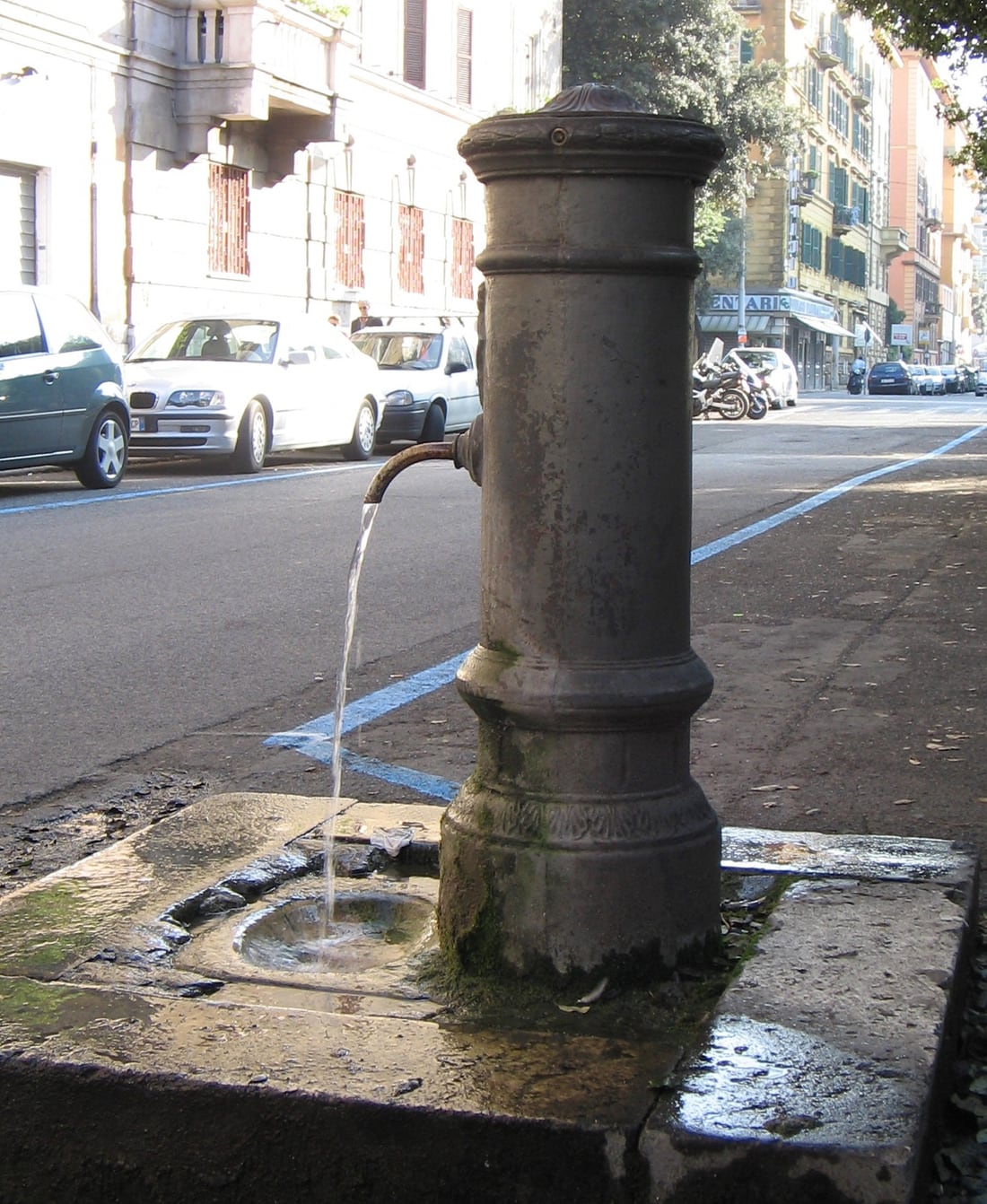
The useful detail is easy to miss: a small hole on top of a curved metal spout. Cover the outlet below it and the water rises into a drinking arc. In a recent discussion on Rome’s local subreddit, a visitor described discovering the trick by watching someone else; a respondent who grew up in the city remembered learning it as a child.[1] A piece of street furniture had become legible in a single gesture.
This is the nasone, the “big nose” of Rome’s pavements. Its ordinary shape deserves a close look. The water falls where a bottle can catch it, while the second opening serves someone carrying nothing at all. Roma Capitale’s own account describes the same technique as an everyday Roman habit.[2] You can learn it between appointments, without turning the city into another itinerary.
Find the little fountain beside the famous building
For a recognisable starting point, look for the separate drinking fountain in Piazza della Rotonda, beside the Pantheon. Its dragon-shaped outlets preserve an earlier version of the object. Turismo Roma identifies it among the surviving examples of the design that preceded the plain curved spout.[4] Look for the small freestanding column, rather than treating the square’s ornamental basin as your refill point.
The difference gives the stop its interest. Rome introduced these public drinking fountains in 1874; the original cast-iron columns stood roughly 1.2 metres tall and carried three decorated outlets. The later simplification produced the projecting nose that supplied the nickname.[4] The familiar version looks almost anonymous until you notice how deliberately it accommodates a passing body and an outstretched hand.
I would make this a 10–15-minute pause, with time to look at the dragon mouths and then stand aside. 08:00–10:00 is my suggested daylight window for fitting it into a morning walk, not a published quiet period or an opening restriction. The street fountains normally run 24 hours a day, as the local magazine Wanted in Rome explains.[5] There is no booking or ticket; if someone is filling a bottle, the practical queue is simply to wait your turn.
Let the water show you the angle
At a conventional nasone with the small upper hole, test the stream before leaning over it. This is the advice worth extracting from the community discussion: users describe markedly different pressures, and the visitor who learned the trick also reported accidentally spraying their own face.[1] Cover the lower outlet briefly, watch where the arc lands, then move towards the water. Keep your mouth clear of the metal.
For a bottle refill, leave the main outlet open and hold the bottle beneath the falling stream. A 500–750 ml bottle is my suggested starting size for a short city walk, not a prescription for how much water anyone needs. The point is to bring a container you will actually carry. If the ornate fountain you have stopped at lacks the familiar upper hole, fill from its drinking spout; the finger trick depends on the fitting, not the name.
Acea confirms both the mechanism and the supply: the drinking water comes from the same network that serves Roman homes.[6] That is a more useful assurance than a stranger’s enthusiastic taste verdict. Read any notice at the individual outlet, and skip anything marked non potabile. The July 2026 community discussion makes the same distinction between designated drinking points and decorative fountains.[7]
Two avoidable mistakes emerge from these local accounts: passing a usable fountain and buying another bottle because you do not recognise it, and assuming every visible pool of water is a drinking source.[5][7] Carry a refillable bottle and identify the outlet. A third, smaller mistake is putting your face into an untested jet; let the first arc fall harmlessly before taking a sip.[1]
Keep the next refill close
Wanted in Rome recommends locating fountains on a map instead of repeatedly buying water along the sightseeing routes.[5] For current navigation, Acea’s site provides an address search and points to its Acquea app.[6] Search near where you already plan to walk. I would cap a speculative detour at about 5 minutes each way: a public convenience should not become a quest across town, especially if the mapped outlet is temporarily unavailable.
The refill itself costs €0. If you already have a bottle, allow €0–3 for water during this short outing, with the upper figure a personal contingency for a shop purchase, not a quoted price or a charge at the fountain. Transport and any sightseeing admission are separate. Take the water you need, then move your bag and yourself clear of the outlet before looking at your phone.
One contributor to the July discussion, identifying themselves as Roman, described familiar nasoni punctuating daily dog walks; another remembered drinking from them since childhood.[7] Those accounts explain something the map cannot. The fountain becomes useful through repetition: the one near home, the one on the way back, the one you recognise before you are thirsty.
After the dragon mouths in Piazza della Rotonda, the plain metal noses become easier to notice. The reward travels with you. At the next one, you already know where to put the bottle—and, if you have left it behind, where the second stream will appear.
Sources
- r/rome, “Turn public water spigot into drinkable fountain!” (2026) — community accounts of learning the upper-hole technique, childhood familiarity and variable water pressure; anecdotal observations.
- Simona Trombini, “Fontanelle romane: lupi, draghi e nasoni,” Roma Capitale, 17 July 2025 — municipal account of drinking technique, everyday use and historic fountain designs.
- Carlo Morino, “Nasone,” photographed 16 October 2005, Wikimedia Commons — photograph, camera metadata and public-domain dedication; the current file incorporates a 2021 crop.
- Turismo Roma, “I Nasoni, le fontanelle di Roma” — official visitor information on the 1874 introduction, original dimensions, changing spout design and Piazza della Rotonda example; checked 19 October 2026.
- Wanted in Rome, “Where to find Rome’s Nasoni drinking fountains,” 23 August 2023 — local community magazine on day-and-night operation, finding fountains and avoiding repeated bottled-water purchases.
- Acea, “Custodiamo nasoni e fontanelle, patrimonio di acqua e storia” — operator information on the spout mechanism, drinking-water supply, address search and Acquea app; checked 19 October 2026.
- r/rome, “You don’t really need to keep buying bottled water in Rome,” 12 July 2026 — recent community confirmation of refill use, resident routines and the distinction between drinking outlets and decorative fountains; anecdotal observations.