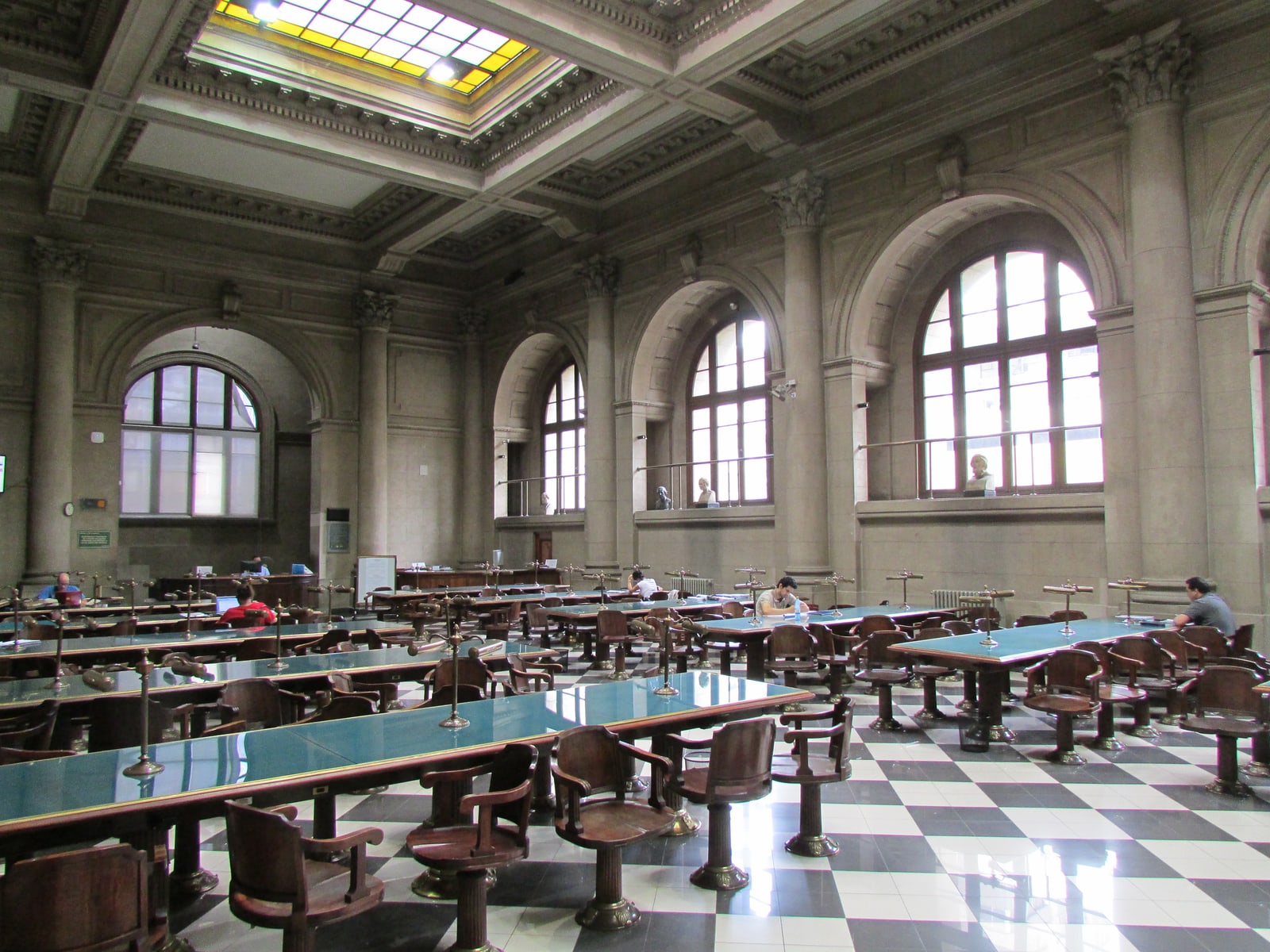
The most revealing view of Santiago’s Biblioteca Nacional includes a desk. In the Sala Gabriela Mistral, long green-topped tables stand beneath arched windows, with individual lamps marking out places to work. The room comes down to the scale of a notebook, a pair of elbows, an afternoon. Eduardo Testart’s photograph catches that relationship beautifully: a monumental interior arranged around the ordinary business of reading.[3]
This is also how the building appears in local recommendations. In an r/Santiago discussion about places to study, a regular visitor points to the quiet upstairs reading room and adds a practical instruction: bring a coin for the lockers.[2] It is a useful way into a national institution. Admiration can begin at the entrance, but participation requires somewhere to put your backpack.
Begin at Alameda 651, the address on Avenida Libertador Bernardo O’Higgins. Santa Lucía, Metro Line 1, is the useful arrival point; local operator Turistik puts the walk from the station at about two minutes. Use the library’s Alameda entrance. The accessible entrance is at the Alameda–Mac Iver corner.[5][4] The street address matters more than a general search for “Santiago library”: make sure the destination is Biblioteca Nacional.
Santiago Adicto’s architectural portrait explains the scale of the arrival. Gustavo García del Postigo designed the building, begun in 1913 and partially inaugurated in 1925, as a grand civic institution. Its intended western wing never materialised; the gardens towards Mac Iver occupy that side instead. Inside, marble, wood flooring and overhead light give the rooms their ceremonial weight.[1] The unfinished plan is worth remembering as you enter: even this imposing national façade belongs to a building shaped by compromises.
For a first visit, I would choose 10:00–11:30 on a Monday or Thursday. That is a suggested ninety-minute allowance for looking and reading, not a forecast of empty seats. Hours checked on 20 October 2026 are 09:15–18:00 Monday–Thursday, 09:15–17:00 Friday, and 09:15–14:00 Saturday. General reading-room service ends fifteen minutes before the building closes; the last material requests are earlier still. On Monday–Thursday, that means 17:15 for the last request and 17:45 for returns.[4]
An ordinary visit is free. Allow CLP 0–5,000, excluding transport: zero covers entry, while the upper figure is an optional personal allowance for a refreshment, not a quoted café price.[5] Separately, carry a small CLP 100 coin. The locker system returns it when you retrieve your belongings. Staff are not obliged to provide change.[4][6]
Arriving with only cards and a full daypack is the first avoidable mistake. The local study recommendation flags the lockers because bags cannot accompany you into the reading rooms.[2] Sort your things before going upstairs: leave the bag, keep your notebook and identification handy. The regulations allow laptops, wallets and phones in the rooms; silence the phone before taking a seat, and keep food and drinks outside.[6]
Ask for the Sala Gabriela Mistral. It connects readers with the Chilean collection and the Fondo General.[3] That second name carries a remarkable history. The library describes a collection assembled through donations and acquisitions, but also through unclaimed customs material and books captured from the frigate María Isabel in 1818.[10] A quiet catalogue heading can conceal the movements of a young republic. You need not inspect a rare volume to appreciate that the room gathers very different routes by which books reached Santiago.
Choose an available reading place and let the room settle around you. Expect a working library’s hush. In a June 2026 local discussion, one reader admired the Nacional while finding its chairs uncomfortable.[7] That is an individual experience, but it supplies a second useful correction: a spectacular room does not promise an armchair afternoon. Try a shorter reading session before committing to hours. A visit can succeed with a few pages and a sustained look.
Requesting collection material takes another step. Bring a passport or other accepted identity document and ask staff to help with reader registration and the catalogue; a request directs you to the relevant service desk.[6] The distinction is practical: time spent enjoying the public rooms and time spent consulting a particular book need different preparation. Leave room for the latter rather than arriving near the final request cutoff.
Check the cultural programme before choosing your day. The library advertised its first Week of Magazines for 14–16 October 2026, with workshops, discussions and archive visits, free but requiring registration.[9] Those dates have passed; the programme shows another way the collections become public. A special event can offer a different encounter with the building, provided you arrange it separately from an ordinary reading visit.
Do not build this visit around joining a group tour on arrival. The library’s current guided-visit page says 2026 places are full, with the next booking calendar opening in March 2027. Its regular programme serves organised groups and requires confirmation.[8] Plan an independent visit, and use the information desk to establish which public rooms you can enter that day.[4]
Before leaving, spend a moment looking along the tables again. A national library has to preserve things beyond any one reader’s lifetime. Here, that long responsibility also makes room for someone who simply needs a quiet hour in central Santiago. Take the architecture seriously enough to sit down.
Sources
- Santiago Adicto, “Biblioteca Nacional de Chile” — local architectural portrait, building history, unbuilt western wing, interior materials and Metro arrival; operational hours checked against the library’s own page.
- r/Santiago, “Lugares para estudiar,” 19 January 2025 — a self-described regular visitor recommends the upstairs reading room and bringing a locker coin; anecdotal local evidence.
- Eduardo Testart, “BNCL — Sala Gabriela Mistral (Vista hacia el Fondo General),” Wikimedia Commons — photograph taken 20 January 2015, room identification and institutional collaboration, CC BY-SA 4.0.
- Biblioteca Nacional de Chile, “Planifica tu visita” — entrances, accessible approach, opening hours, request cutoffs and small locker coin; checked 20 October 2026.
- Turistik, “Biblioteca Nacional de Santiago” — Santiago operator’s account confirming free admission and the short walk from Santa Lucía; its older hours are superseded by source 4.
- Biblioteca Nacional de Chile, “Reglamento de acceso a las colecciones y uso de los servicios,” approved 25 November 2025, posted January 2026 — sections 3–4 on lockers, identification, reading-room conduct, registration and requests.
- r/Santiago, “Lugares para leer?”, 17 June 2026 — recent local discussion distinguishing the Nacional’s visual appeal from one reader’s experience of its chairs.
- Biblioteca Nacional de Chile, “Hacer una visita guiada (CUPOS COMPLETOS 2026)” — organised-group reservation conditions, full 2026 calendar and March 2027 reopening; checked 20 October 2026.
- Biblioteca Nacional de Chile, “Biblioteca Nacional será sede de la Primera Semana de las Revistas 2026,” 8 October 2026 — recent programme for 14–16 October, with free activities requiring registration; cited as a past programme, not an upcoming invitation.
- Biblioteca Nacional de Chile, “Fondo General” — origins of the collection, including donations, acquisitions, unclaimed customs material and books captured from the frigate María Isabel in 1818.