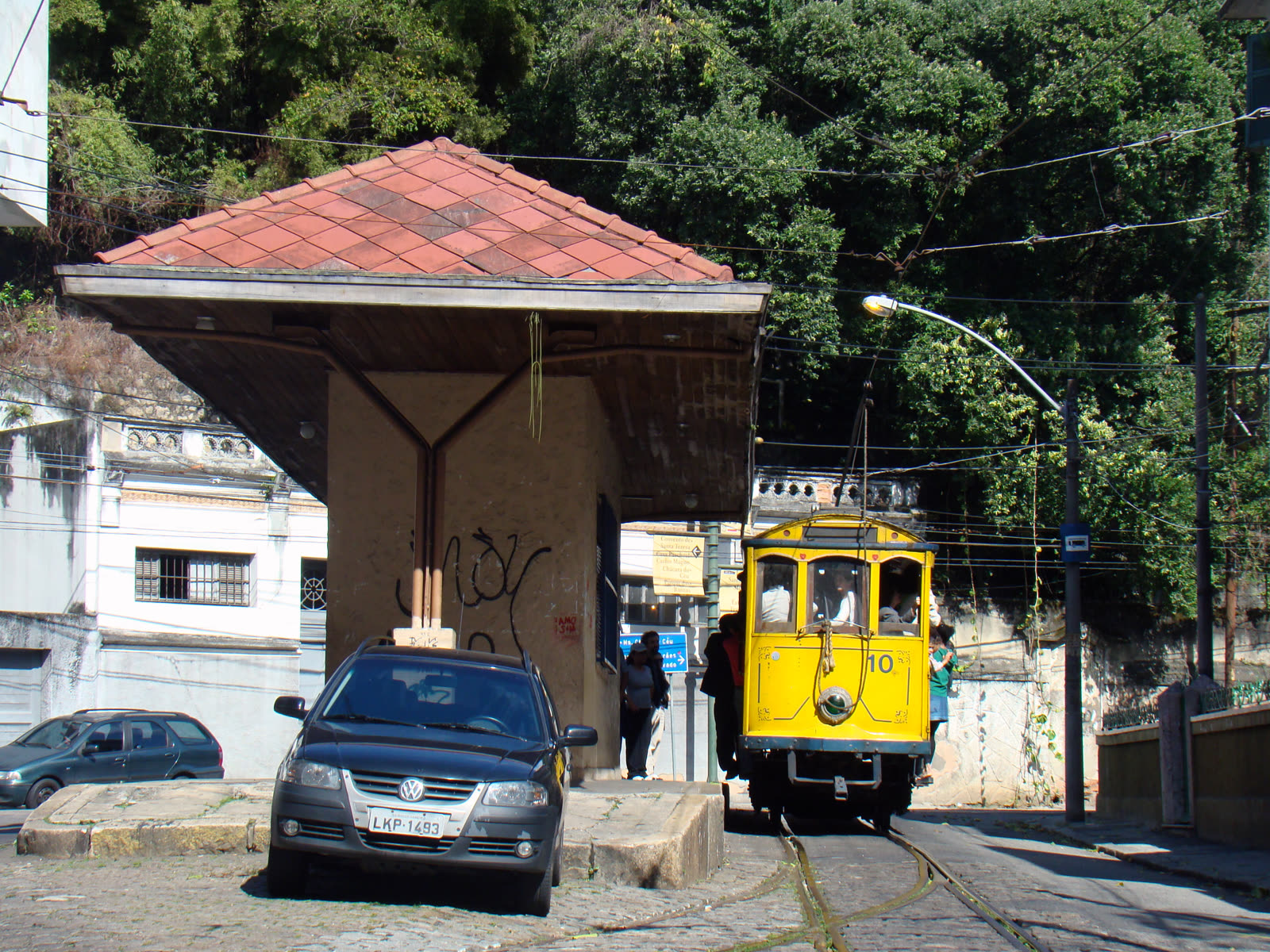
Santa Teresa gets mis-sold to visitors as a loose bohemian hill where you ride the famous yellow bonde, drift for a while, maybe drink something, then improvise the rest. That script wastes the neighborhood's best mechanical advantage. The cleaner move is more exact than that. Board the tram at Carioca, get off at Curvelo instead of treating the ride as a full novelty loop, then walk the short remainder to Parque Glória Maria and let the terrace finish the read of Santa Teresa before you head back down.[1][2][3]
That sequence works because the bonde is not a frictionless sightseeing toy. The official Bondes de Santa Teresa page says weekday service runs from 8:00 to 18:30, weekend and holiday service from 9:00 to 17:00, the tram circulates roughly every 15 minutes, each car holds 32 people, and ticket sales can be closed before 16:00 on busy days because of crowding.[1] The same page adds the operational details non-locals regularly miss: there is no advance ticket sale, tickets are sold only at the Carioca station except occasional Curvelo sales when available, and the accepted payment methods are cash, debit card, and credit card, but not Pix.[1] Once you know that, the route stops looking like an all-day vague roam and starts looking like a timed urban mechanism.
Curvelo is the right early exit because it turns the ride into a transfer of altitude rather than a closed attraction. Riotur's current Santa Teresa bonde page identifies Curvelo as the first stop, and explicitly says Parque Glória Maria and Museu da Chacara do Ceu sit nearby on foot.[2] That matters more than the usual heritage language. The bonde's real value is that it saves your legs for the part of Santa Teresa where you should be moving slowly and looking outward, not for the queue or the track mileage itself.
Image context: the cover uses a real Wikimedia Commons documentary photograph of the Santa Teresa tram at Curvelo. That is the right lead image because this article is not about the tram as a generic Rio icon. It is about one exact neighborhood handoff, where the yellow car leaves you on the slope and the rest of the ritual happens on foot.[8]
Why getting off at Curvelo beats riding the whole loop
The usual visitor mistake is to confuse duration with payoff. Because the bonde is famous, people assume the correct move is to stay on it as long as possible, or to treat the entire line as the experience. The stronger local reading is narrower. Riotur's Santa Teresa guide frames the tram as a way into a neighborhood of steep streets, mirantes, ateliers, and old houses rather than as a sealed destination of its own.[5] Curvelo is where that framing becomes useful. You have already crossed the Arcos, climbed enough to feel the neighborhood detach from Centro, and arrived close to the cultural terrace that gives the hill its best panoramic explanation.[2][5]
This also fixes the queue problem. A Rio local replying to a visitor itinerary on r/riodejaneiro said the weekend version should be done early in the morning because the line gets worse later.[7] Recent TripAdvisor reviews say the same thing in rougher terms, with visitors describing waits of one to two hours when they show up at the wrong time, even though the ride itself is short.[6] That is why the full-loop fantasy is weak. When the platform is already thickening, the smart play is to ride up only once, exit cleanly, and spend the rest of the time on Santa Teresa itself.
Why Parque Glória Maria is the real second act
Parque Glória Maria, the former Parque das Ruinas, gives the tram ride the payoff it cannot produce alone. The municipal culture page states that the site sits in the ruins of the former house of Laurinda Santos Lobo, the Belle Epoque patron nicknamed the "marechala da elegancia," and that the rebuilt structure now combines ruin walls with later glass-and-steel intervention while opening wide panoramic views over Guanabara Bay and the city center.[3] That is the non-tactical detail that makes this stop specific to Rio. Santa Teresa is not only pretty hillside atmosphere. It is a place where patronage, performance, architecture, and topography keep touching one another.
The operational rule matters here too. The same culture page says the park opens from 9:00 to 18:00, Wednesday through Monday.[3] In other words, this is not an endless evening roam. It is a daylight-to-late-afternoon ritual with a hard edge. If you want the terrace and the tram in one compact movement, you have to respect the park's clock as much as the bonde's queue.
Riotur's Santa Teresa itinerary helps explain why the pair works so well. It describes Santa Teresa as a historic hill above central Rio, occupied in the 19th century, with European-style mansions, lanes, stairways, and a tram installed in 1872 that still operates as both local transport and tourist attraction.[5] That whole description risks becoming brochure fog until you actually hold the two anchors together. The bonde gives you the climb. The park gives you the terrace. The neighborhood becomes legible in the seam between them.
8 local moves that make this Santa Teresa run land
- Start at Carioca, not by wandering uphill first. The official boarding logic is built around the Carioca station on Rua Lelio Gama, and that is where the ticket system actually works for visitors.[1][2]
- Use a weekday shoulder or a weekend opening hour. Weekdays give you the broadest operating window, while local and review feedback both say weekends get slower once the line builds.[1][6][7]
- Treat the published 15-minute rhythm as a useful cadence, not as a promise of zero waiting. Capacity is only 32 people per car, so small timetable gaps become big queue gaps quickly.[1]
- Buy only when you are physically at the platform and ready to go. There is no advance sale, and the official site is blunt that ticket sales require the passengers to be present on the platform.[1]
- Bring card or cash, not Pix. The official site lists debit, credit, and cash, and explicitly says Pix is not accepted.[1]
- Leave at Curvelo on purpose. Riotur identifies it as the first stop and places Parque Glória Maria nearby, which is exactly what turns the tram from attraction into access tool.[2]
- Keep the park for the long pause. The terrace is where Santa Teresa stops feeling like a branded neighborhood and starts reading as a hill above the city center with real depth.[3][5]
- Remember the Tuesday dead zone. Parque Glória Maria is open Wednesday through Monday, so a Tuesday run needs a different second act.[3]
Non-local trapline: 4 common mistakes and the better move
Mistake 1: showing up at 15:45 and assuming the official closing hour means tickets are guaranteed
Better alternative: work backward from the crowd rule, not the last posted hour. Officially, sales can stop before 16:00 on heavy days because of capacity.[1]
Mistake 2: treating the tram as a complete experience by itself
Better alternative: exit early at Curvelo and hand the route over to the hillside. The neighborhood gains force when the tram is only the first act.[2][5]
Mistake 3: planning to pay with Pix because "everywhere in Brazil takes Pix"
Better alternative: follow the official payment list and bring a card or cash. The bonde site explicitly says no Pix.[1]
Mistake 4: turning Santa Teresa into an open-ended night crawl
Better alternative: keep it a daytime or late-afternoon ritual. Parque Glória Maria has a hard 18:00 closing time and gives the route a cleaner boundary than vague evening drift.[3]
Concrete go details
- Best window: weekday 9:30-11:30 a.m. for the calmest all-in version, or right after 9:00 a.m. on weekends if you want the tram before the line thickens.[1][6][7]
- Expected spend: R$20 for the bonde ticket; the park itself is a municipal cultural space rather than a paid terrace stop.[1][3]
- Queue and reservation reality: no reservations, no advance tickets, and a real risk that sales stop before 16:00 if the platform backs up.[1]
- Where to stand or sit: board at Carioca, stay alert for Curvelo, then give your real pause to the park terrace rather than to the platform or the full line.[1][2][3]
- Navigation cue:
Carioca station / Rua Lelio Gama -> Curvelo stop -> short walk uphill to Parque Glória Maria -> descend toward Centro once the terrace has done its work.[1][2][3] - Numeric anchors worth keeping: 8:00, 18:30, 9:00, 17:00, 15 minutes, 32 people, 16:00, R$20, 18:00, Wednesday-Monday, 19th century, and 1872.[1][3][5]
Santa Teresa does not need a bigger itinerary than this. One yellow car, one deliberate early exit, one terrace, one hard clock. That is enough to make the hill stop behaving like a tourist mood board and start behaving like Rio.
Sources
- Bondes de Santa Teresa, "Informacoes" / official operating page (used for hours, capacity, no-advance-sale rule, ticket-sale cutoff risk before 16:00, Carioca-only ticketing, payment methods, and fare).
- Riotur, "Os Bondinhos de Santa Teresa" (used for the Rua Lelio Gama starting point, the Curvelo first-stop framing, nearby access to Parque Glória Maria, and the 2025 Paula Mattos branch note).
- Secretaria Municipal de Cultura do Rio de Janeiro, "Parque Glória Maria" (used for the Laurinda Santos Lobo context, panoramic-view framing, address, and Wednesday-Monday 09:00-18:00 opening hours).
- Visite Santa Teresa, "O Bonde" (local neighborhood guide used for the weekday/weekend operating rhythm and the tram's continuing neighborhood role).
- Riotur, "Roteiro Santa Teresa" (used for the 19th-century neighborhood framing, the 1872 tram date, and the larger Santa Teresa cultural/topographic context).
- TripAdvisor, "Bondinho de Santa Teresa" (used as a recent review/community source for present-day queue behavior; page crawled in April 2026 with recent 2026 visitor reports).
- Reddit
r/riodejaneiro, "Check out my itinerary" (local/community advice used for the weekend early-morning queue correction). - Wikimedia Commons, "File:Bondinho de Santa Teresa (3725740423).jpg" (documentary photographic source for the lead image used in this article).