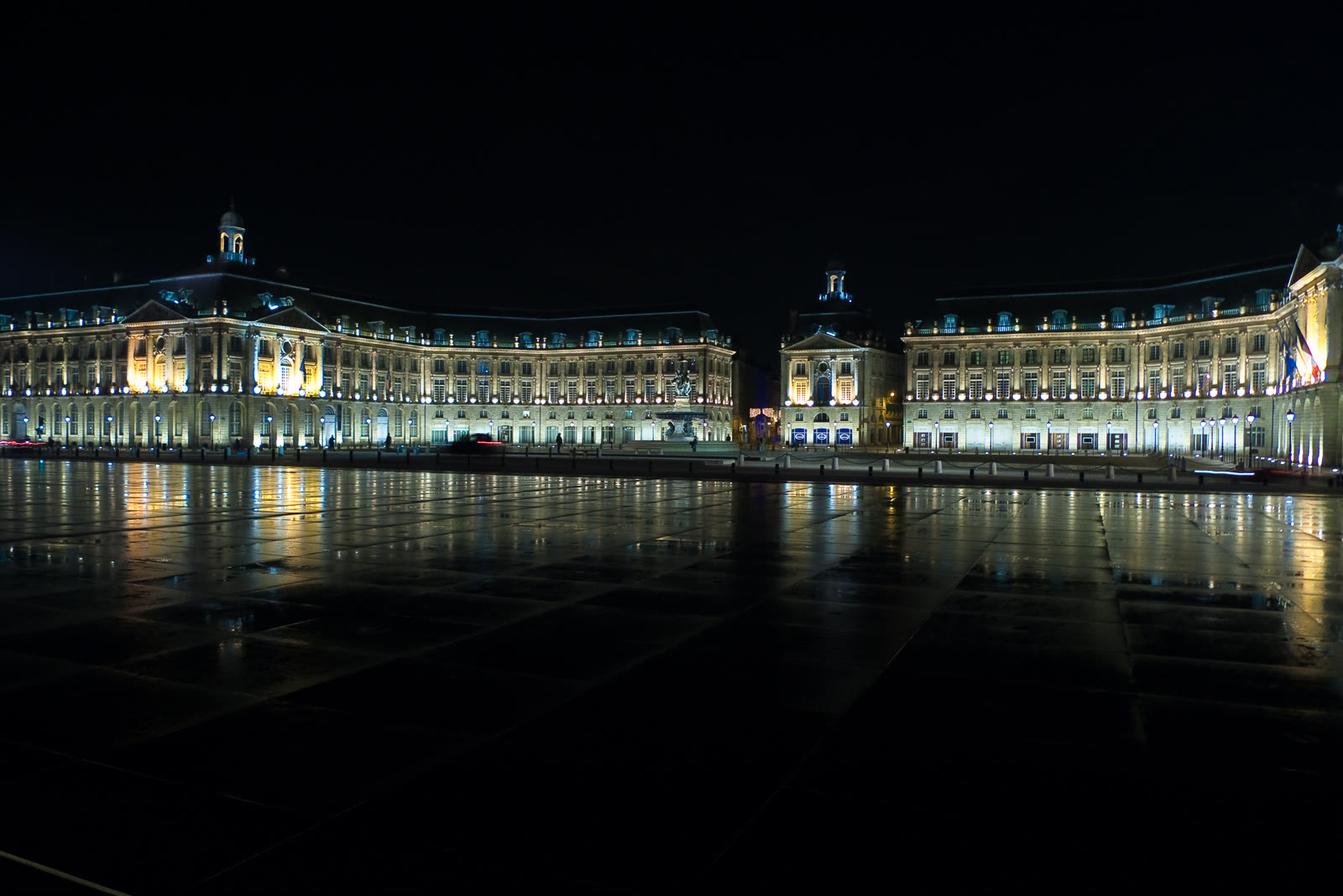
Bordeaux is easy to misuse at night. Visitors slide inland too fast, turn the old center into a bar-hopping blur, and miss the city move that actually recalibrates the evening. Go to Place de la Bourse after dinner, stay on the river side long enough for the Miroir d'eau to cycle back from mist to reflection, and let the left-bank quay become your whole night room instead of only your first photo stop.[1][2][3][4][5][6][7]
That works because this is not just a pretty square with a clever foreground. Bordeaux Tourism's official page is explicit about the mechanism: the Miroir d'eau sits between Quai de la Douane and Quai Louis XVIII, spreads just 2 cm of water across a granite slab, stores its water in an 800 m3 underground reservoir, and uses around 900 injectors to generate the fog effect before the mirror surface returns.[1] The same page also sets the seasonal rule that visitors regularly get wrong: outside the winter maintenance period, it operates every day from 10:00 to 22:00, but from November through April it is out of service.[1] That alone should change how you plan the evening. This is a live urban installation with a clock, not a permanent sheet of water waiting for you at any hour of the year.
Place de la Bourse gives the shallow water its real force. The city's own heritage page dates the square's construction to 1728, with Ange Gabriel taking over in 1745, and the official tourism page frames the ensemble at 1735-1755 as the decisive break that opened Bordeaux outward from its walled medieval form toward the river.[1][2] The Fountain of the Three Graces arrived later, in 1869.[2] That chronology matters because the night room is not only reflective surface plus lights. It is a river-facing classical facade built to perform openness, then doubled by a twenty-first-century plane of water that exaggerates that openness after dark.
Image context: the cover uses a real Wikimedia Commons night photograph of Place de la Bourse and the Miroir d'eau. It is the correct documentary image here because the article is not about generic Bordeaux atmosphere. It is about one precise evening geometry: facade, water, tram-scale quay, and river edge held in one shallow frame.[8]
Why this works better as a night room than as a checklist stop
The first advantage is scale discipline. Promenade Corajoud, the official riverfront landscape running between Pont de Pierre and Pont Jacques Chaban-Delmas, is open 24/7 and explicitly includes the Miroir d'eau on the left bank among Bordeaux's emblematic waterfront points.[3] That means you do not need to solve the whole city in one evening. You only need to keep your walk on the quay long enough for the facade, the square, and the water to start behaving as one sequence.
Local advice points in that direction too. In a recent r/bordeaux thread answering a traveler with just one day in town, one local recommended almost exactly this river-led order: walk the Garonne, hit Place de la Bourse for "Bordelaise vibes," then continue north toward Quinconces and Jardin Public because the center is compact and rewards wandering on foot.[6] That is the right instinct. Bordeaux at night gets better when you stop cutting inland every few minutes and let the quay hold your attention longer than your camera does.
The second advantage is that this room has a clear temperature and crowd logic. A June 2025 city article about staying cool in Bordeaux calls the Miroir d'eau the biggest water mirror in the world at 3450 m2 and repeats the current 10:00-22:00 operating window.[4] Even when you are not there to cool off, that municipal framing is useful. The place is designed for public use, lingering, and repeated return. You do not have to "do" it once and leave.
Why the best version starts late but not too late
What you want here is not midnight. What you want is the period when the square is illuminated, the water installation is still running, and the quay has stopped feeling like an afternoon attraction but has not yet thinned into a transport-only corridor. In practical terms, that means aiming for roughly 20:30 to 21:45 during the warm months, so you still catch the Miroir d'eau before the 22:00 shutoff while the stone facade and black river beyond it are already doing their work.[1][4]
This timing also avoids a common Bordeaux mistake: overextending the night southward just because the map looks compact. A local safety thread on r/bordeaux is blunt that late-night caution matters more around Capucins, Saint-Michel, and station-adjacent streets than on the central river promenade, especially for visitors walking alone after midnight.[7] That does not mean the center is dangerous by default. It means the calm version of a Bordeaux night is right here already. You do not improve this route by forcing a second act somewhere sketchier simply because the city center seems small.
8 local moves that make this Bordeaux night room actually land
- Arrive after dinner, not at sunset's first minute. The route gets cleaner once the facade is fully lit and the Miroir d'eau is still operating inside its 10:00-22:00 window.[1][4]
- Stay on the river side of Place de la Bourse first. The square only starts reading properly once you keep the facade and the water in one plane instead of stepping inland immediately.[1][2]
- If the basin is in mist mode when you arrive, wait it out. The official page makes clear that fog and reflection are part of one programmed sequence, so leaving on the mist phase means missing half the point.[1]
- Keep one short northbound walk on Promenade Corajoud in reserve. The waterfront is a 24/7 public promenade, and extending a little toward Quinconces keeps the room from collapsing into a single-photo stop.[3][6]
- Dress for shallow splash and slick stone, not for a museum floor. The water is only 2 cm deep, but that is still enough to change your pace and footing.[1]
- Treat the square as a place to pause, not only to cross. The whole design logic of Place de la Bourse was river-facing openness; the best reading comes from staying long enough to feel that axis instead of merely tagging it.[1][2]
- Use the winter closure rule as a planning boundary. If you come between November and April, do not build the evening around a reflection that will not be running.[1]
- Let the quay be the night's spine. Recent local advice keeps returning to the river walk because Bordeaux's compact center becomes legible faster from the Garonne edge than from an inland zigzag.[3][6]
Non-local trapline: 4 common mistakes and the better alternative
Mistake 1: treating the Miroir d'eau as a one-minute photo prop
Better alternative: stay through at least one full atmosphere change. The official installation is designed around alternating fog and mirror effects; if you leave immediately, you only experienced half the room.[1]
Mistake 2: turning up in winter and expecting the water mirror to be active
Better alternative: remember the maintenance season. Officially, the Miroir d'eau is out of service from November through April.[1]
Mistake 3: cutting inland too early because the old center looks denser on the map
Better alternative: hold the quay longer. Promenade Corajoud and recent local advice both support the river-led version of central Bordeaux as the cleaner walk.[3][6]
Mistake 4: pushing the night farther south just to "do more city"
Better alternative: end the calm version where it is strongest. Local safety advice is much less anxious about the central quay than about some station-side and far-southern late-night stretches.[7]
Concrete go details
- Best window: roughly 20:30-21:45 in the warm season, so the facade is fully lit and the Miroir d'eau is still running before the 22:00 stop.[1][4]
- Expected spend: EUR 0. This is a public square, public waterfront, and free urban installation.[1][3]
- Queue and reservation reality: none. The real variables are crowd density and whether you arrived during the active operating season.[1][4]
- Where to stand or sit: first pause on the river side of Place de la Bourse facing back toward the facade, then drift north along the quay for the second pause once the room has widened.[1][3]
- Navigation cue:
Place de la Bourse -> stay on the Miroir d'eau side of the square -> short northbound drift on Promenade Corajoud toward Quinconces -> return only after the room has flattened into reflection.[1][3][6] - Numeric anchors worth keeping: 2 cm, 800 m3, 900 injectors, 10:00, 22:00, November-April, 1728, 1745, 1735-1755, 1869, 24/7, and 3450 m2.[1][2][3][4]
Bordeaux has bigger nights than this and noisier ones. Very few are better proportioned. One royal square, one shallow sheet of water, one long quay, and one hard closing time are enough to give the city its evening width.
Sources
- Bordeaux Tourism & Conventions, "The Water Mirror of Bordeaux" / "Le miroir d'eau de Bordeaux face à la place de la Bourse" (official page covering the 2 cm water depth, 800 m3 reservoir, 900 injectors, 10:00-22:00 operating hours, winter maintenance closure, and the 1735-1755 square chronology).
- City of Bordeaux, "Place de la Bourse" (official heritage page covering the 1728 start date, Ange Gabriel's 1745 takeover, and the 1869 Three Graces fountain).
- City of Bordeaux, "Promenade Corajoud" (official riverfront page covering the left-bank/right-bank promenade and 24/7 opening).
- City of Bordeaux, "Un été au frais à Bordeaux" (published June 25, 2025; recent official confirmation that the Miroir d'eau is 3450 m2 and runs daily from 10:00 to 22:00 in season).
- Google Maps community listing, "Miroir d'eau Bordeaux" (current place-status and community-photo layer used here as a live local confirmation surface).
- Reddit
r/bordeaux, "Day in Bordeaux" (published February 4, 2026; recent local/community advice recommending the Garonne walk, Place de la Bourse, Quinconces, and Jardin Public as one compact sequence). - Reddit
r/bordeaux, "Are there no-safe areas of Bordeaux to avoid" (published February 27, 2025; local/community safety discussion distinguishing calmer central areas from rougher late-night zones farther south and near the station). - Wikimedia Commons, "File:Bordeaux place bourse nuit 01.jpg" (documentary photographic source for the lead image used in this article).