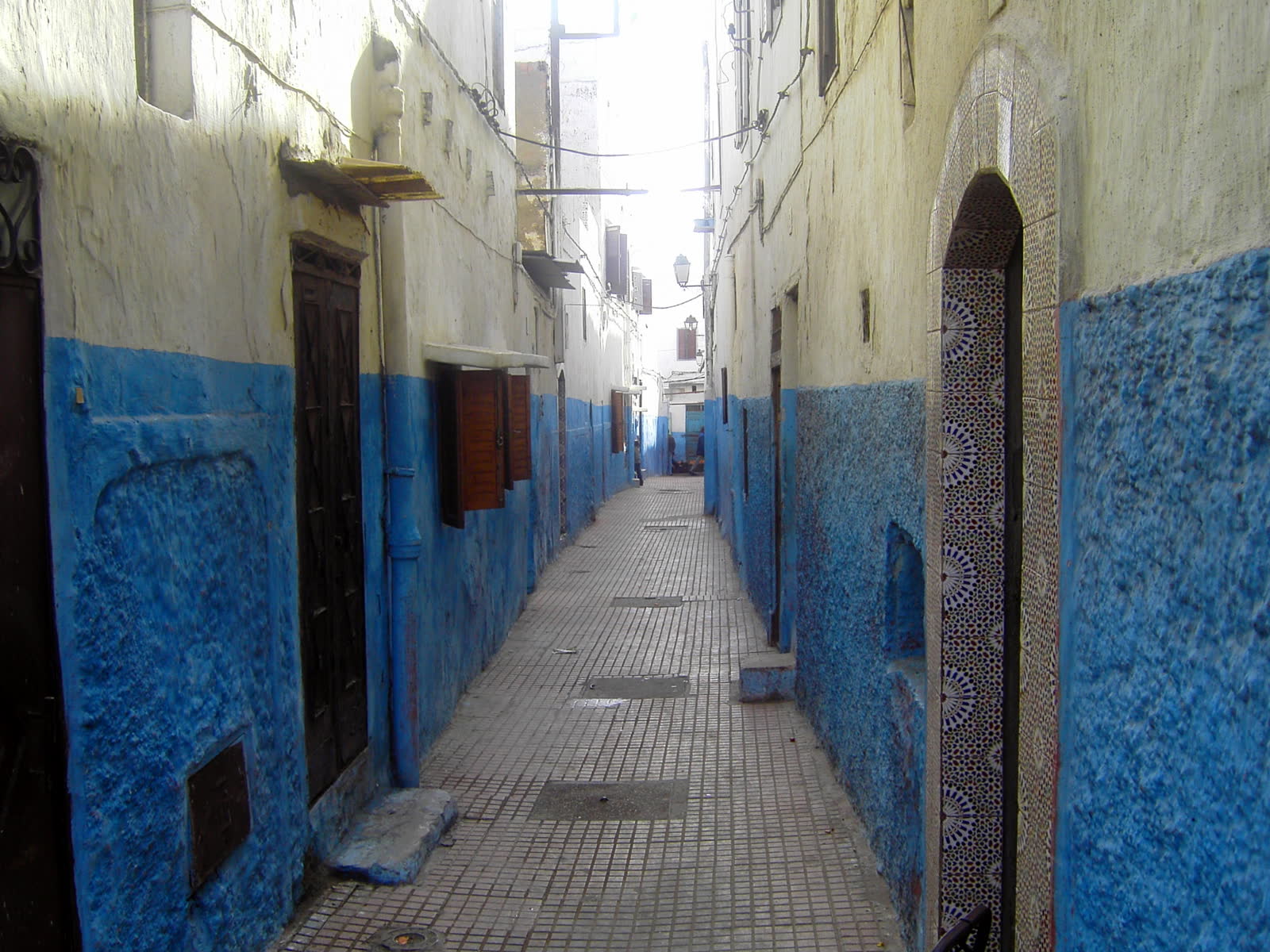
Rabat rewards the visitor who resists turning the old city into a checklist. The cleanest move is smaller: enter the Kasbah des Oudayas early, walk the blue-and-white lanes slowly, pause in the Andalusian Garden, then finish at the high edge where the Bouregreg, Salé, and the Atlantic all come into view. It is a one-hour place portrait, not a tour of every monument in the capital.
The official Rabat tourism page gives the practical skeleton. The kasbah sits on the left bank of the Bouregreg, about a 15-minute walk from downtown Rabat, and the visitor page lists daily hours of 9:00-20:00.[1] It also names the essential sequence: the imposing Almohad gate, the narrow streets, the Andalusian garden, the museum, older mosques, and the Café Maure terrace overlooking the river mouth, ocean, and Salé.[1] That is enough. If you keep the frame to the kasbah and its edge, the place reads as a raised neighborhood rather than a photo backdrop.
The reason this hour works is that Oudayas is both enclosed and exposed. UNESCO's listing for "Rabat, Modern Capital and Historic City" describes the capital as a meeting of Arabo-Muslim heritage and twentieth-century planning, with older parts dating back to the 12th century and including Almohad ramparts and gates.[2] The kasbah gives that argument a bodily form. One minute you are inside tight white walls with blue lower courses and small residential doors; a few turns later the city opens toward Salé and the river traffic below.
Image context: the cover uses Carlos ZGZ's Wikimedia Commons photograph of a blue lane inside the Kasbah des Oudayas. It is a real documentary street photograph, not an illustration, route diagram, or generated image.[7]
The One-Hour Frame
Start after sunrise if you can, or at opening if you want the official-hours version. A recent r/rabat reply to a visitor question says simply: "The Oudayas, especially after sunrise."[5] That local cue is more useful than a generic "go early" rule. The blue lanes are narrow enough that a handful of tour groups, photo shoots, and cafe-bound walkers can change the feel of the place. Early light lets you see the painted walls and worn stone before the kasbah becomes a stop between Hassan Tower, Chellah, and the medina.
Use the main gate as a threshold, but do not treat it as a queue for a single picture. Visit Rabat calls out the Almohad gate as the ceremonial entrance to the site.[1] A recent El País Rabat-in-24-hours guide adds a useful practical distinction: Bab Oudaya is the most spectacular entrance, but the normal pedestrian passage may be the smaller adjacent opening rather than the monumental gate itself.[6] That matters on the ground. Do not stand in the way trying to make the "correct" gate behave like a museum portal. Step through, then let the first quiet lane set your pace.
Once inside, keep your route deliberately simple. Take the climbing lanes toward the garden and viewpoint, not every side alley. This is a residential quarter as much as a heritage site; the better local move is to look without turning every doorway into content. In practice: walk close to the wall when residents pass, keep voices low in the narrowest stretches, ask before photographing people, and save longer pauses for corners, the garden, or the platform edge.
The garden is the reset point. Rabat 24's local listing places the Jardins Andalous inside the kasbah by the medina and frames it as a named local stop rather than an incidental courtyard.[3] Visit Rabat is more descriptive: it names the garden as one of the kasbah's core treasures, paired with the museum, riads, and older mosques.[1] Use it that way. The garden is where the route slows down before the view opens. If the lanes are getting crowded, the pause keeps you from marching through the kasbah as if it were a corridor.
What Locals Know Before Visitors Do
The first local move is to keep the route short. Rabat is often described by residents as a city to walk and enjoy rather than rush; a recent r/rabat guide for visitors says exactly that after listing Oudayas, Hassan Tower, Chellah, the beach, marina, and medina.[4] For Oudayas, that means the kasbah is not the prelude to five more old-city tasks. It is the task.
The second move is to use the viewpoint as a finish, not as a random interruption. The official tourism page points from Café Maure's terrace toward the Bouregreg mouth, the Atlantic, and Salé.[1] El País names the Plateforme du Sémaphore as a natural panoramic stop over the river, twin city, and small boats crossing between banks.[6] Either way, the payoff is spatial: Rabat makes more sense when you see that the old quarter is not buried in the city, but lifted above a river mouth facing another city.
The third move is to avoid food-plan sprawl. Yes, mint tea and almond pastries at the terrace are part of the classic rhythm, but do not let the cafe become the whole itinerary. If there is a table without a wait, take it. If not, keep moving and protect the hour. The stronger memory is the sequence of gate, lane, garden, edge.
The fourth move is to approach from the center on foot if heat, mobility, and lodging location allow. The 15-minute downtown cue from Visit Rabat is not just a distance fact; it tells you the kasbah can be folded into a morning walk without a taxi negotiation or full-day driver.[1] If you are coming from farther away, use a drop-off outside the old-city edge and walk in rather than asking a car to solve the last few tight turns.
The fifth move is to treat Friday prayer time, school groups, and hot midday light as real constraints. The kasbah has mosques and residents, not just visitor lanes.[1] When the rhythm changes, slow down, move aside, and let the neighborhood go first.
The sixth move is to keep your exit clean. After the viewpoint, either descend toward the medina side for a market walk or return through the garden and gate. Do not drift until the route becomes a confused search for the next attraction. The kasbah's value is that it compresses Rabat's older layers into a legible loop.
Non-Local Trapline
Mistake 1: arriving at noon for blue-wall photography. The better move is after sunrise or at opening. The lanes are quieter, the light is gentler, and you are less likely to turn a living quarter into a traffic jam.[5]
Mistake 2: treating Bab Oudaya like a normal open doorway. The better move is to admire the monumental gate, then use the actual pedestrian flow. Recent visitor guidance notes that the dramatic gate is ceremonial in practice and that visitors normally enter beside it.[6]
Mistake 3: trying to combine every Rabat landmark into one old-city sprint. The better move is one compact Oudayas hour, with Hassan Tower, Chellah, the marina, or the medina handled as separate decisions.[4]
Mistake 4: stopping in the narrowest lanes for long photo sessions. The better move is to keep moving inside residential passages and pause in wider spots: the garden, the platform, cafe terrace, or gate area.
Concrete Go Details
Best window: after sunrise for quiet streets, or 9:00-10:30 if you want to align with the posted opening time.[1][5]
Route shape: Bab Oudaya area -> blue residential lanes -> Andalusian Garden -> Cafe Maure / Plateforme du Semaphore viewpoint -> return through garden or descend toward the medina.[1][3][6]
Expected spend: 0 dirhams for the walk itself; cafe money only if you sit for tea and pastries at the terrace.[1]
Queue/reservation reality: no reservation for the walk; the practical bottlenecks are narrow-lane congestion, cafe-table availability, midday heat, and whether you arrive behind a tour group.
Navigation cue: keep climbing gently until the lanes give way to garden shade or open river air. If you are still only seeing shopfronts and traffic, you are probably outside the one-hour frame.
Local etiquette cue: walls and doors are beautiful, but the kasbah is residential. Photograph architecture freely; be careful with people, doorways, and children.
Numeric anchors worth keeping: 15 minutes from central Rabat on foot, posted 9:00-20:00 daily hours, a 12th-century heritage layer, a 60-75 minute route with pauses, and a 0-dirham baseline if you skip the cafe.[1][2]
The point is not that Oudayas is hidden. It is famous enough to be obvious. The useful trick is to make it small again: a gate, a lane, a garden, a high edge, and a clean exit before the old city turns into a list.
Sources
- Visit Rabat, "The Kasbah of the Oudaias" (official visitor page used for daily hours, 15-minute downtown walking cue, gate/garden/cafe sequence, and river-ocean-Salé viewpoint framing).
- UNESCO World Heritage Centre, "Rabat, Modern Capital and Historic City: a Shared Heritage" (World Heritage listing used for the 12th-century older-city layer, Almohad ramparts/gates, and Rabat's old/new urban context).
- Rabat 24, "Jardins Andalous (Kasbah des Oudayas)" (local listing used to confirm the Andalusian Garden as a named stop inside the kasbah).
- Reddit / r/rabat, "Visiting Rabat? Here are the places you shouldn't miss" (recent local/community thread used for the slow-walk framing and visitor-priority context around Oudayas, Hassan Tower, Chellah, beach, marina, and medina).
- Reddit / r/rabat, "Wich part of Rabat should I visite?" (recent local/community advice used for the after-sunrise Oudayas timing cue).
- El País / Lonely Planet, "Rabat en 24 horas: un capital administrativa, pero también cultural y estética," May 7, 2026 (recent travel report used for Bab Oudaya entry nuance, Plateforme du Sémaphore, Bouregreg/Salé view, and Andalusian Garden route context).
- Wikimedia Commons, "File:Ruelle bleue, Kasbah des Oudayas (Rabat, Maroc) (15561666480).jpg" (documentary photographic source page for the cover image by Carlos ZGZ).