Medellín is easiest to flatten into three visitor reflexes: Poblado, Comuna 13, and a cable-car view. The better first correction is quieter and more local: ride Metro Line A to Universidad, cross into Jardín Botánico before midday, and let the Orquideorama set the pace for the northern museum-and-park district. It is a compact move, but it changes the city read. Medellín stops being only nightlife, hillside spectacle, or comeback narrative, and becomes a place where ordinary public infrastructure, shade, plant collections, families, students, and architecture share the same walkable edge.[1][2][3]
The official visitor page keeps the logistics simple: the garden currently opens 9:00 a.m. to 4:00 p.m., entry is free through the city's public-formation program, and the site closes for maintenance on the first business day of the week.[1][2] That schedule makes the local tactic obvious. Do not save the garden for a vague late-afternoon leftover. Go early enough that the light is useful, the paths are still breathable, and a sudden event closure or maintenance day does not wreck the plan. The whole route works because it has a hard frame: Universidad station, garden entrance, Orquideorama, lagoon-and-shade loop, then a decision about Parque Explora or the Metro back out.[2][3]
The spatial cue is unusually clean. Medellín's official tourism guide places the garden on Calle 73 No. 51D-14, directly beside Parque Explora, and says the most practical low-friction arrival is Metro Line A to Universidad, followed by a short walk to the main entrance.[2] A local Medellín guide describes the larger north-city cluster in the same terms: Jardín Botánico sits with Parque Norte, Universidad station, the Planetarium, Parque Explora, and Parque de los Deseos, so the district works as a civic campus rather than as one isolated garden.[3] That is why the route should begin on the train. A taxi drops you at a gate; the Metro shows why the garden belongs to a wider public corridor.
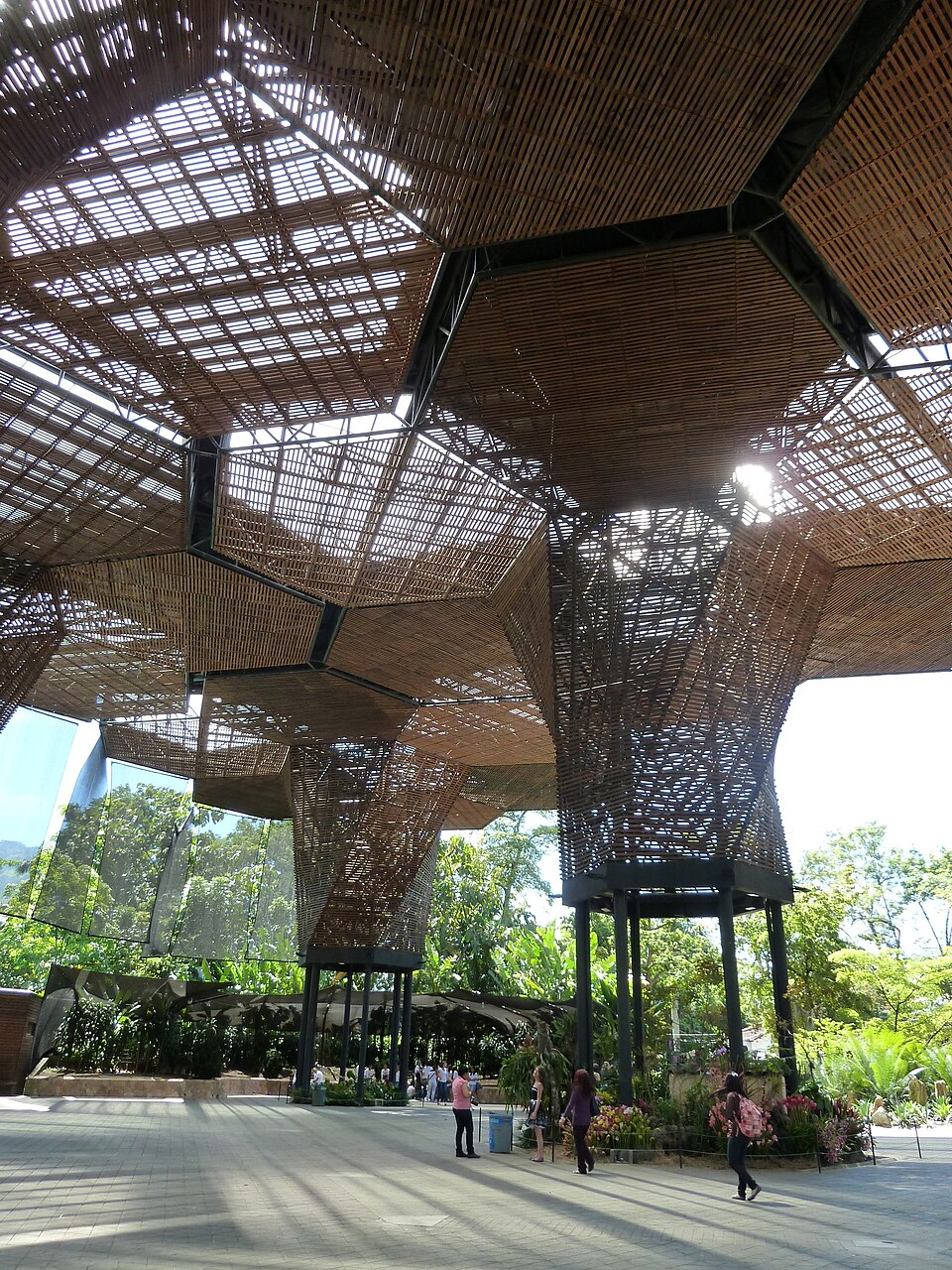
Image context: the cover uses einalem's 2011 Wikimedia Commons photograph of the Orquideorama inside Jardín Botánico. It is a real documentary photograph of the route's main recognition cue rather than a generated visual, route graphic, or decorative Medellín skyline.[8]
The Garden As A Public Room
The Orquideorama is not just the photogenic roof you walk under after checking the map. The architects' project sheet lists the Medellín Orquideorama as a 2006 work for Jardín Botánico, with about 4,000 square metres of surface.[7] The local visitor page describes it as an architectural place for flower exhibitions and notes that under the structure are living collections that include orchids, bromeliads, carnivorous plants, ferns, and related planted areas.[3] Those details matter because they keep the place from becoming "a nice park." The canopy is a climate device, event room, garden shelter, and city landmark at once.
Use it that way. Enter, orient, then slow down under the canopy before chasing every path. Look up at the repeated wooden modules, then look down at the planting beds and the way people occupy the shade. Medellín rewards this kind of pacing because the city often sells visitors motion: escalators, cable cars, nightlife streets, timed tours. Here the useful move is stillness. The Orquideorama gives you a local pause that is architectural without requiring museum behavior.
Wanderlog's Google-review-backed page for the Orquideorama gives a useful community signal: a 4.8 score across 7,321 reviews, with the repeated appeal coming from the garden's peacefulness, plant life, butterflies, free entry, and wooden architecture.[4] Treat those reviews as mood data, not as instructions to wander aimlessly. The stronger local reading is that people value the garden because it is generous and undramatic. It gives Medellín a shaded civic interior in a city where sun, rain, traffic, and hillside logistics can quickly turn small plans into work.
Local Moves That Keep It From Becoming Filler
The best window is 9:00-11:30 a.m. on a Tuesday-to-Friday morning, after confirming the maintenance closure and any special-event dates. That is an inference from the official 9:00-4:00 schedule, the first-business-day maintenance rule, and the fact that the garden's free-entry model can make weekends feel more social than contemplative.[1][2][3] If you arrive at opening, do the Orquideorama first, then the quieter plant paths. If you arrive near lunch, reverse your expectations: you are taking a shaded public break, not mastering the whole garden.
Bring identification if you have it handy. The local Medellín guide says visitors may need passport or ID for entry registration and points to a pre-registration form as a time saver.[3] That is the kind of small friction that first-timers miss because the headline says free. Free does not mean frictionless; it means the cost barrier is low enough that the operational details matter more.
Dress for walking rather than for a cafe stop. The same local guide recommends sunscreen or a hat, comfortable shoes and clothing, and a picnic blanket if you intend to sit in the garden.[3] That is sensible, but keep the picnic modest. The garden is not a beach, and the Orquideorama is not a private backdrop. Sit where the landscape invites stopping, keep paths clear, and let families and school groups move through without having to step around your bag.
Use Universidad station as the navigation anchor even if you are staying elsewhere. From Poblado, the taxi can look easier on a map, but the Metro route teaches a more useful city habit: Line A connects the tourist south, downtown, and the northern public-culture belt in one readable spine.[2][3] The trip also helps you avoid overbuilding the day. Once you are at Universidad, your decision tree is short: garden first; Parque Explora only if you still have time, energy, and curiosity; Metro back before the afternoon feels spent.
Keep the food plan secondary. Medellín.co notes In Situ, Café del Bosque, La Estación, and nearby food options around the garden, with menu examples in the 30,000-80,000 COP range for In Situ.[3] That is useful if weather turns or you need a seated pause, but this route is not a restaurant hunt. The best version is non-food-primary: Orquideorama, garden paths, shade, architecture, and the Universidad district's public rhythm.
What Locals Are Quietly Correcting
Recent community advice in r/medellin is helpful because it pushes against the most overmarketed version of the city. In a discussion about quieter culture, nature, and coffee plans, a local-leaning commenter recommended staying away from the hardest party zone and named the Botanical Garden, Parque Explora, and Parque Arví as relaxed nature-oriented choices inside or near the city.[5] In another recent tourism thread, a respondent warned that some headline attractions, especially Comuna 13, can feel crowded and tourist-trap heavy, then suggested looking beyond the default checklist.[6] The lesson is not "skip the famous places." It is that Medellín works better when at least one plan is not optimized for spectacle.
Jardín Botánico is that plan if you keep it tight. Do not pair it with every north-side attraction just because they are close. Parque Explora, the Planetarium, Parque de los Deseos, and Parque Norte can turn the district into an all-day family circuit, but the garden itself deserves a slower first pass.[2][3] The local move is to choose a main room and an optional room. Main room: Orquideorama and garden. Optional room: Explora or a cafe. Anything more becomes checklist behavior again.
The neighborhood texture is part of the point. Universidad is not the polished tourist bubble of the south, and it is not a hillside lookout. It is a working station area where students, families, museum visitors, event staff, and commuters share space. That makes the garden useful as a Medellín calibration tool. You are close to science museums and amusement infrastructure, but the best first signal is still a free public garden with a large timber canopy, shaded paths, and enough ordinary use to feel lived in.
Non-Local Trapline
Mistake 1: treating Jardín Botánico as a filler hour before a bigger attraction. The better move is to make the Orquideorama the anchor, then add Parque Explora only if your time and attention still make sense.[2][3][7]
Mistake 2: arriving late because the garden is free. The better move is to use the 9:00-11:30 morning window and remember the 4:00 p.m. closing frame. Free places can still close early, fill with events, or lose their best light.[1][2]
Mistake 3: assuming Poblado habits transfer everywhere. The better move is to ride Line A to Universidad, carry small essentials, keep your phone use normal rather than theatrical, and move with station flow instead of acting like the district is a private tour set.[2][3]
Mistake 4: making the day too food-centered. The cafes and restaurant are useful backups, but the route's value is public space, botany, shade, and architecture. If lunch becomes the point, you have turned a good city read into an ordinary meal stop.[3]
Concrete Go Details
- Best time window: 9:00-11:30 a.m., ideally Tuesday-Friday after checking event and maintenance closures.[1][2]
- Route shape:
Metro Line A -> Universidad station -> Jardín Botánico entrance -> Orquideorama -> lagoon / shaded paths -> optional Parque Explora or Metro return.[2][3] - Expected spend: 0 COP for garden entry under the current free-entry program; optional cafe or restaurant spending if weather or timing calls for it.[1][3]
- Queue/reservation reality: no normal paid ticket, but special events, entry registration, ID checks, and first-business-day maintenance can matter more than price.[1][3]
- Where to stand or sit: pause under the Orquideorama edge, not in the path; use benches, lawn edges, or cafe seating when you need a longer stop.[3][4]
- Navigation cue: if you can find Universidad station and Parque Explora, you can find the garden; keep those two names in your transit plan rather than relying on a taxi pin alone.[2][3]
- Numeric anchors worth keeping: 9:00, 4:00, Calle 73 No. 51D-14, 2006, 4,000 square metres, 4.8, 7,321 reviews, 30,000-80,000 COP, and 0 COP entry.[1][2][3][4][7]
The small win is that this plan refuses to make Medellín perform. It gives you a public route with a station, a garden, a canopy, and a clear exit. That is enough. Under the Orquideorama, the city becomes less cinematic and more useful, which is often the better way to start reading it.
Sources
- Jardín Botánico de Medellín, "Horarios de visita" (official visitor-hours page used for the 9:00 a.m.-4:00 p.m. schedule, free-entry framing, and maintenance-closure caution).
- Medellín.Travel, "Jardín Botánico" (official city tourism guide used for address, Universidad Metro access, nearby Parque Explora context, current hours, free entry, and event-closure caution).
- Medellin.co, "Jardín Botanico Medellin" (local guide used for the north-city culture cluster, Orquideorama role, plant collections, ID/pre-registration note, clothing advice, food options, and Universidad station directions).
- Wanderlog, "Orquideorama Jardín Botánico, Medellin, Colombia" (Google-review-backed community page used for review volume, rating, hours cross-check, and visitor sentiment around free entry, plants, butterflies, and wooden architecture).
- Reddit / r/medellin, "'Dry' Recommendations for Medellín: Culture, Nature & Coffee (No Clubbing/Bars)" (recent community thread used for local-style quiet/nature recommendations and the Botanical Garden/Parque Explora/Parque Arví cluster).
- Reddit / r/medellin, "Tourism suggestions" (recent community thread used for the caution that some default tourist plans can feel crowded or traplike, and for the broader family/culture attraction context).
- PLAN:B Arquitectos, "Orquideorama" project sheet (architecture source used for project year, client, location, and approximately 4,000-square-metre surface).
- Wikimedia Commons, "File:Orquideorama.jpg" (documentary photographic source page for the cover image by einalem, photographed July 8, 2011).