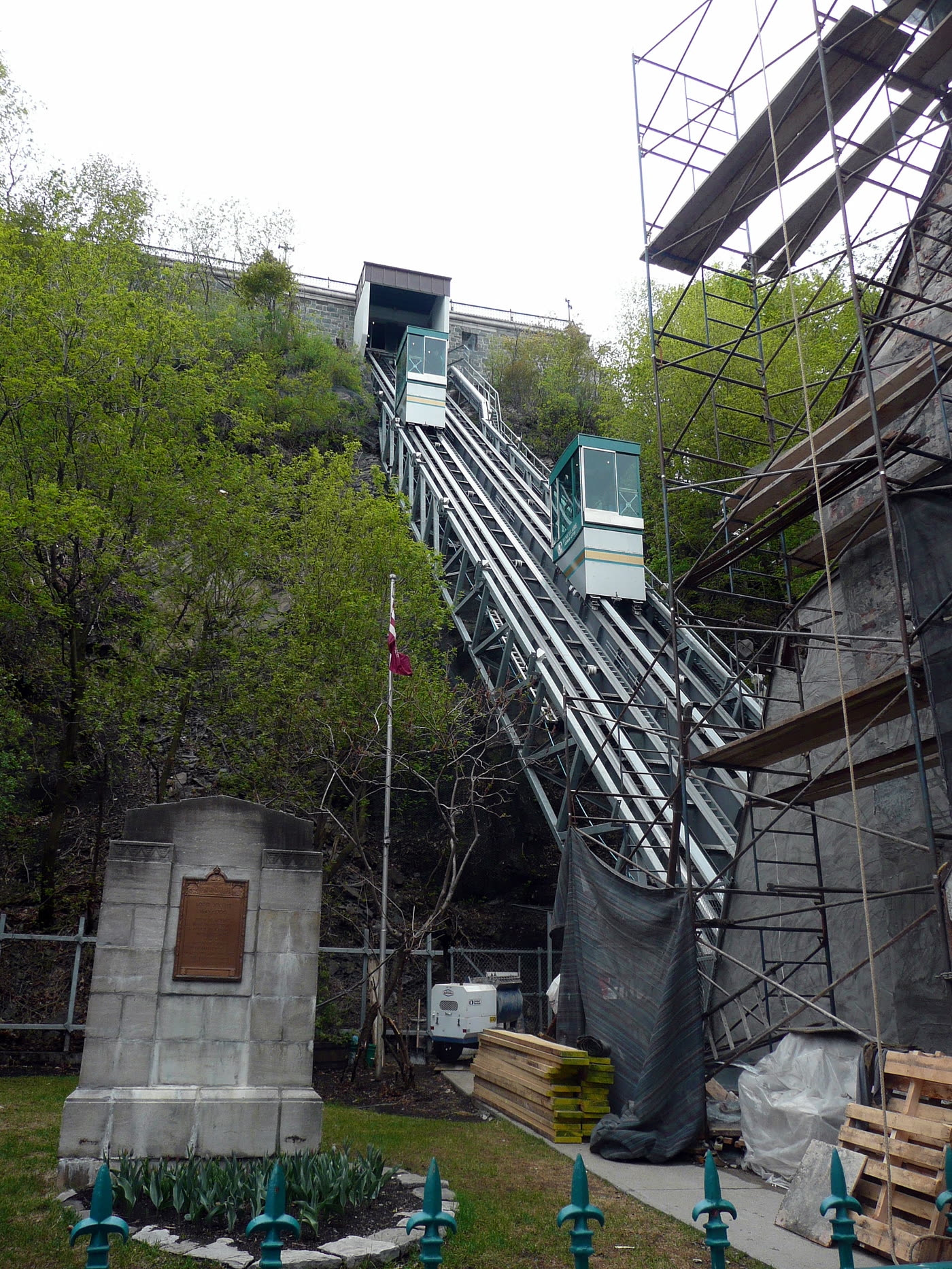
The cleanest first-time Québec City move is smaller than most itineraries make it sound. Do not begin by arguing with Cap Diamant on foot. Start in Petit-Champlain, enter the Old Québec Funicular through the Louis Jolliet House, ride up once, and let Dufferin Terrace finish the explanation.[1][3][5] That sequence matters because Old Québec is not hard in the usual big-city way. It is hard in a topographic way. Upper Town and Lower Town can stay disconnected in your head for too long if you force yourself to solve them with stairs first.
The official facts make the route almost unnaturally compact. The funicular's current price-and-schedule page says it is open every day from 9 a.m. to 9 p.m., charges a single rate of $6 per person each way, is cash only, and does not even use advance tickets because you simply pay the operator on arrival.[1] The main site adds the shape of the device: the line stays open all year round, climbs 59.4 metres, and covers a 64-metre course.[2] That is not a major transport segment. It is a precisely useful vertical correction.
The upper landing gives the route its second half. Visit Québec City describes Dufferin Terrace as the long wooden promenade beside the Château Frontenac, public since 1838, with the St. Lawrence River spread in front of it.[4] The same page also reminds you that the terrace is not only scenic frontage: it sits over the ruins of Forts-et-Châteaux-Saint-Louis, where governors lived for more than 200 years.[4] This is the right kind of Québec City detail because it turns a stroll into a structural reading. What looks like a postcard deck is really a public ledge built over political and military ground.
Petit-Champlain below keeps the route from turning into pure panorama. The official district guide places the quarter at the foot of the cliff, close to the old port, and ties it directly to Samuel de Champlain's settlement in 1608. It also notes that the lower funicular entrance sits inside the house built in 1683 for Louis Jolliet, and that the district still offers the alternative most visitors remember too well: several staircases, including the Breakneck Stairs, if you want to climb the hard way.[5] That is why this article keeps the route narrow. One entrance, one ride, one boardwalk. Québec City does not need a bigger opening move.
Image context: the cover uses a real documentary photograph from Wikimedia Commons showing the funicular on the cliff face. That is the right image for this article because the route depends on one exact visual fact: Lower Town and Upper Town are connected here by a visible machine, not by vague "old world charm."[11]
Why the evening shoulder is the clean version
The best working window is usually 6:45 to 8:15 p.m. from spring through early autumn, and earlier in the cold months.
That timing works because the upper and lower halves of the route want different things. Dufferin Terrace is long enough to absorb a lot of people, but it reads best once the busiest sightseeing churn has loosened and the boardwalk starts behaving more like a public promenade than a sightseeing conveyor.[4][10] The funicular's current 9 p.m. closing time is what makes that window operationally useful rather than aspirational.[1]
Recent local and community signals line up with that logic. A March 2026 heritage-guide piece from Voilà Québec calls the ride one of those small pleasures many visitors miss, gives the crossing at about 68 seconds, and describes the upper emergence onto Dufferin Terrace as one of Old Québec's most dynamic vantage changes.[6] Recent r/quebeccity threads do the same job in a less polished voice. One current itinerary thread still groups the funicular, Terrasse Dufferin, and Petit-Champlain as the core Old Québec sequence, while another visitor thread says the clean move is to ride up so you do not spend your best energy on the stairs.[7][8]
That last point matters more than it sounds. The local trick is not saving effort for its own sake. The local trick is preserving your first clean read of the city. If you climb first, you arrive at the top already slightly broken into fragments: steps, breath, slope, detours, the feeling of having earned a view. If you ride first, you arrive ready to read the terrace and the river line in one calm pass.[5][6][8]
8 local moves that make this place portrait land
- Start in Petit-Champlain, not at the château. The route works because Lower Town comes first and the cliff lift explains the city in the right order.[3][5]
- Use the funicular as the upward move. Recent community advice still points to riding up instead of spending the opening minutes on the stairs.[7][8]
- Bring cash and decide in advance whether you are riding one way or both ways. The current official fare is $6 each way, paid directly to the operator, so the clean spend is either $6 up and stairs down or $12 if you want the machine both ways.[1]
- Aim for the evening shoulder instead of mid-afternoon crush. The funicular remains open until 9 p.m., which keeps the route usable once the terrace begins to thin out.[1][4]
- Stay on Dufferin Terrace for 20 to 30 minutes, not an entire evening. The boardwalk is long enough to pace a little, find your angle, and let the river settle into the view without turning the stop into dead time.
- Stand past the immediate château frontage before you judge the terrace. The full promenade reached 430 metres after the 1879 expansion, so give yourself a little distance before deciding where the cleanest reading is.[4]
- Keep the fort-ruins fact in mind while you walk. The terrace is more interesting once it stops being only a photo rail and starts acting like a public lid over older state ground.[4]
- If you do return on foot, choose stairs after the terrace, not before it. Petit-Champlain and the stair network are better as a descent problem than as your first orientation test.[5][8]
Non-local trapline
Mistake 1: treating the funicular as a cute extra after you have already solved Upper Town
Better move: make it the opening hinge. This route is about reading the cliff connection early, not adding it after the city has already flattened into attractions.[2][5][6]
Mistake 2: climbing first because "the view should be earned"
Better move: save your legs for later and keep your attention intact. Recent community advice still favors riding up, precisely because the stairs burn energy without improving your first read of the place.[7][8]
Mistake 3: stepping off the car, taking one château photo, and leaving immediately
Better move: give Dufferin Terrace enough time to separate into layers: boardwalk, river, Lévis side, fort history, and the line back down to Petit-Champlain.[4][6][10]
Mistake 4: treating the route as if the terrace and lower district were unrelated attractions
Better move: hold the two anchors together. The point is not funicular plus terrace as two checkboxes. The point is one steep link that turns Upper and Lower Town into one legible urban section.[3][5][8]
One-screen logistics card
- Anchor 1: Old Québec Funicular, lower entrance in the Louis Jolliet House, 16 rue du Petit-Champlain.[3][5]
- Anchor 2: Dufferin Terrace, beside Château Frontenac.[4]
- Best window: roughly 6:45-8:15 p.m. in the warmer months; shift earlier in winter.
- Ride hours: 9 a.m.-9 p.m., every day.[1]
- Price logic: $6 per person, each way, cash only; pay the operator on arrival.[1]
- Useful dimensions: 59.4 metres of height, 64 metres of course, about 68 seconds of riding time.[2][6]
- Expected spend: $6-12 depending on whether you ride one way or round-trip.[1]
- Queue / reservation reality: no reservation layer and no pre-bought ticket; any wait is just the live line at the station.[1][9]
- Where to stand: use the first minute on the terrace to clear the heaviest château-front crowd, then read the boardwalk outward rather than stopping at the first gap in the railing.[4][10]
- Navigation cue:
Petit-Champlain -> Louis Jolliet House -> Old Québec Funicular -> Dufferin Terrace -> optional stairs or same funicular back down
Québec City has grander historical arguments than this one and bigger iconic surfaces than this one. What it does not have in large supply are tiny routes that explain the whole vertical split so fast. One cabin, one cliff, one boardwalk: that is enough.
Sources
- funiculaire.ca, "Price & Schedule" - official fare-and-hours page showing daily 9 a.m.-9 p.m. operation, $6 single rate each way, cash-only payment, pay-on-arrival operation, and child/wheelchair notes.
- funiculaire.ca, "Home" - official site page noting year-round operation plus the line's 59.4-metre height and 64-metre course.
- funiculaire.ca, "History" - official history page on the 1879 opening, 1907 electrification, 1945 fire, 1978 panoramic renovation, 1998 rebuild, and Louis Jolliet House entrance.
- Visit Québec City, "Dufferin Terrace" - official city page on the promenade's river view, 1838 public opening, 1879 extension to 430 metres, and Forts-et-Châteaux-Saint-Louis history below.
- Visit Québec City, "Explore the Petit-Champlain" - official district guide covering the 1608 settlement context, 1683 Louis Jolliet House, the funicular link, and the Breakneck Stairs alternative.
- Voilà Québec, "The Old Quebec Funicular: The Oldest in North America" (March 20, 2026) - local heritage-guide article giving the 68-second ride time, the top/lower access pattern, and the route's dynamic view logic.
- Reddit, r/quebeccity, "Help planning an itinerary for Quebec city" (published 2026-04) - recent local/community thread grouping the funicular, Dufferin Terrace, and Old Town as the classic compact sequence.
- Reddit, r/quebeccity, "Quebic city- furnicular, ride it just for fun? And nearby site seeing?" (published 2025-11) - recent local/community thread recommending the ride up so visitors do not waste their opening move on the climb.
- Google Maps search, "Old Quebec Funicular" - current place-status and community-review surface for the lower station; accessed 2026-04-30.
- Google Maps search, "Dufferin Terrace Quebec City" - current place-status and community-review surface for the terrace; accessed 2026-04-30.
- Wikimedia Commons, "File:Quebec City Funicular (2934434847).jpg" - documentary cover photograph source.