Providence is easy to flatten into campus gates, one museum, and a quick downtown meal. The East Side gets sharper if you stop trying to "cover" it and instead let one old street do the work. The clean version is simple: walk the north half of Benefit Street in the late-day shoulder, optionally step into the Providence Athenaeum if it is open, then finish with the short rise to Prospect Terrace for sunset.[1][3][5] That sequence turns old Providence from a list of preserved facades into a working hillside sentence.
The street matters because its beauty is not only visual. The Mile of History Association's account is blunt about the underlying timeline: the road was cut through the old home lots in 1756-58, renamed Benefit Street in 1772 because it was meant for the "common benefit of all," and later became dense with civic, religious, and residential buildings that made it the governmental and cultural spine of old Providence.[2] Just as important, the preservation story is not presented as innocent nostalgia. The same local account says the 1950s-1960s rescue of the district, including the 1956 founding of the Providence Preservation Society and the 1967 College Hill Plan, saved buildings while also displacing lower-income, mostly African American residents.[2] That tension is part of the street now. If you read Benefit Street only as a charming colonial set, you miss the cost of how that charm was stabilized.
The route works because the old spine and the overlook sit almost on top of each other. GoProvidence's neighborhood page treats College Hill and Benefit Street as one walkable zone, flags Prospect Terrace as the strongest city view, and notes that the Providence Athenaeum opened at its current Greek Revival home on Benefit Street in 1838.[1] The Mile of History Association's visitor page gives the second anchor its proper role: Prospect Terrace, founded in 1869, stands on Congdon Street at the easterly edge of the district, offers the downtown panorama, and is specifically the right place to catch sunset.[5] That is the local scale this outing wants. One old street, one library if the door is open, one final rise.
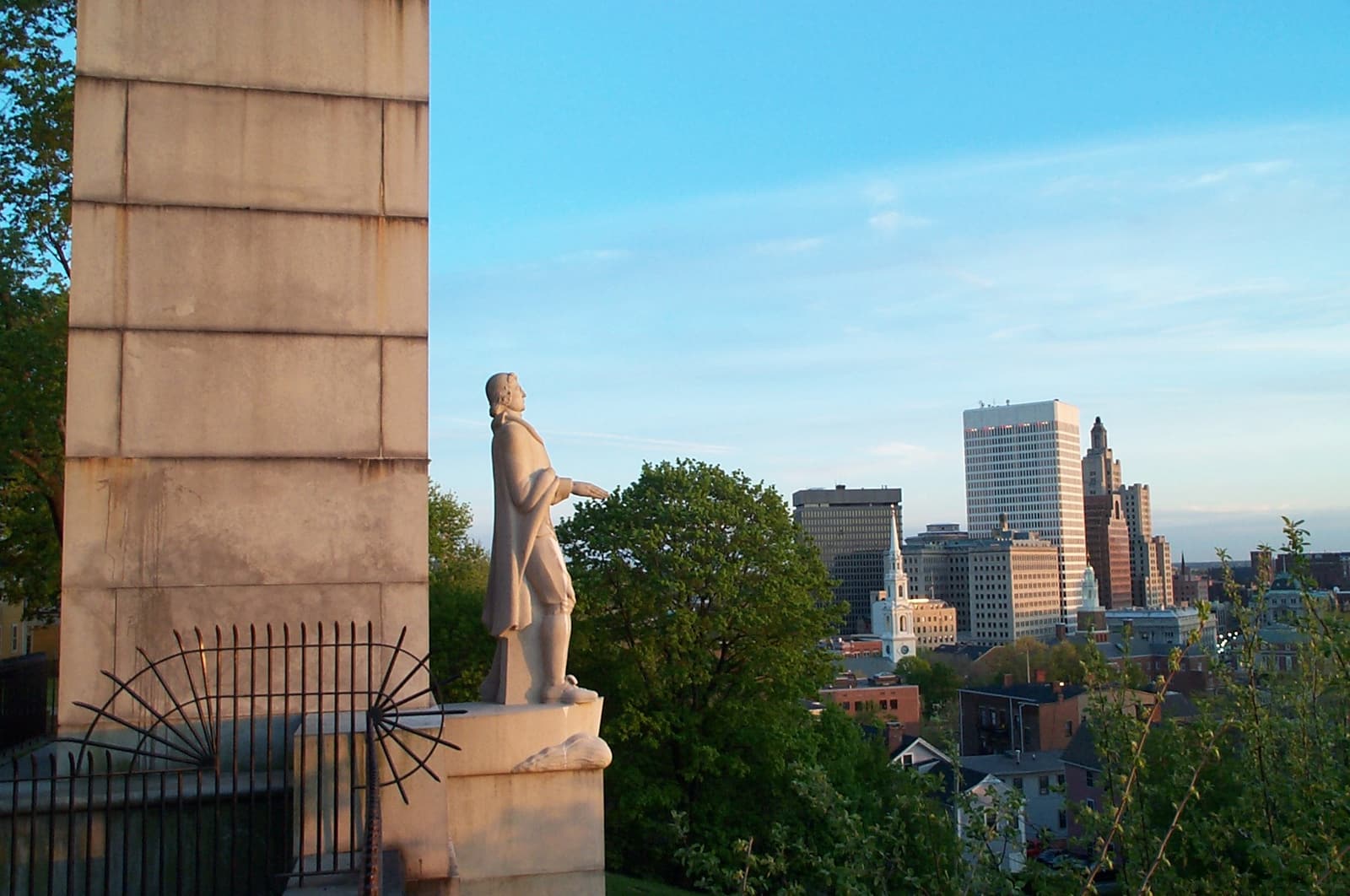
Image context: the cover uses a real Wikimedia Commons photograph of Prospect Terrace instead of a generic skyline crop or a staged interiors shot. That is the right recognition cue because this piece depends on one visual fact: the neighborhood does not finish on Benefit Street itself; it finishes a level above, with Roger Williams and the city held in the same frame.[10]
Keep the route to the north half, not the full mile
Benefit Street is famous because it is long. This route is good because it refuses to use all of it. GoProvidence and the Mile of History material both make clear that the street is thick with institutions, plaques, and eighteenth- and nineteenth-century houses.[1][2] That is exactly why the smarter move is to keep to the north half and walk it slowly rather than turning the whole mile into a completionist project.
The local Reddit advice is surprisingly aligned on this point. In a July 2025 thread about cheap, walkable things to do, one Providence user's recommendation was not an all-day heritage march but a compact College Hill sequence: walk Benefit Street, take in Brown and College Hill, then go to Prospect Terrace at sunset.[8] A December 2025 thread about what the city feels like to visitors gives the same pairing in even plainer language: Benefit Street is the walk for old houses, Prospect Terrace is the small park with the view.[9] The combination keeps the route specific. Benefit Street gives you the grain; Prospect Terrace gives you the release.
Use the Athenaeum as a timed interior pause
The Providence Athenaeum is the one indoor detour that strengthens rather than weakens this walk. Its own visitor page says admission is pay-what-you-can with a suggested $5 donation, regular hours are Tuesday-Saturday 10 a.m.-6 p.m. and Sunday 11 a.m.-5 p.m., and street parking becomes noticeably easier after 5 p.m. and on weekends.[3] The tours page adds the operational detail that matters most for route discipline: the main self-guided tour takes about 25 minutes, with another 10-15 minutes for the supplemental stops.[4]
That is the perfect scale. If you enter too early in the day, the library becomes the outing and the street turns into preamble. If you arrive in the last workable hour, the Athenaeum acts as a controlled interior pause inside the street's larger rhythm. You get the Greek Revival calm, the shelves, and the old-library hush, then step back onto Benefit Street before the walk has lost its slope.[1][3][4]
Save Prospect Terrace for the final climb
Prospect Terrace only works if it remains the second anchor, not the opener. The Mile of History Association page calls it a perfect sunset stop and lists current public hours as 7 a.m.-9 p.m. daily.[5] The National Park Service sharpens the historical layer: Prospect Terrace is the final resting place of Roger Williams and Mary Williams, and the monument now on the site was dedicated on June 29, 1939 as part of the city's long attempt to honor its founder.[6] This is not just a skyline bench. It is a civic overlook loaded with Providence origin story.
The National Park Service directions page gives the useful movement cue for people arriving from below: from the Roger Williams National Memorial side, the walking path goes up Meeting Street, then up the stairs, then left onto Congdon Street.[7] Even if you approach from Benefit Street rather than North Main, that is still the right kind of thinking. You want a short, deliberate uphill finish, not a random wander through side streets until the park happens to appear.
Google Maps' current place surface and local Reddit comments both reinforce the same practical truth: people use Prospect Terrace as a late-light stop, a skyline pause, and a "just go there and sit" place, not as a formal monument visit that demands a program.[8][9] The route gets better once you accept that simplicity.
8 local moves that make this street read correctly
- Start on Benefit Street, not Thayer Street. Thayer gives you student energy; Benefit gives you Providence's older civic texture and gets you to the overlook with less noise in the middle.[1][2]
- Keep to the north half. The full Mile of History is real, but this microcosm works because it compresses the best part into a walk you can still feel in your legs and attention span.[1][2]
- Use the Athenaeum only if the clock is right. On Tuesday-Saturday, the sweet spot is entering roughly 45-60 minutes before closing; on Sunday, shift earlier because the library closes at 5 p.m..[3][4]
- Treat the self-guided tour as a cap, not a challenge. The official tour already tells you the main loop is about 25 minutes. Take the number seriously and leave while the street still has light.[4]
- If mobility matters, use the rear College Street entrance to the Athenaeum. The library's own page notes the Benefit Street front comes with granite steps while the rear entrance does not require stairs.[3]
- Hold your longest outdoor pause for Prospect Terrace, not for random plaques. The street is full of details, but the walk only resolves once you climb that last block and let the skyline gather below Roger Williams.[5][6]
- Use late-day parking logic if you are not arriving on foot. The Athenaeum notes that street parking becomes materially easier after 5 p.m. and on weekends.[3]
- If you are coming from downtown rather than already being on the hill, borrow the NPS stair logic. Head uphill and use the Meeting Street stair rise instead of letting the final climb dissolve into guesswork.[7]
Non-local trapline
Mistake 1: walking the whole Mile of History as if more frontage automatically means a better East Side outing
Better move: keep the route tight and uphill. This piece works as one street microcosm, not as a mileage badge.[1][2]
Mistake 2: visiting Prospect Terrace first and then descending onto Benefit Street
Better move: save the overlook for the end. The city should open after the old houses, not before them.[5][6]
Mistake 3: letting the Athenaeum eat the entire evening
Better move: use the official 25-minute self-guided timing as a discipline tool, then go back outside while the street still has usable light.[3][4]
Mistake 4: reading Benefit Street as pure preservation triumph
Better move: carry the preservation politics with you. The neighborhood was restored, but local historical sources are clear that the process also displaced residents.[2]
Concrete go details
- Best window: 60-90 minutes before sunset on Tuesday-Saturday if you want the Athenaeum plus the terrace finish; on Sunday, start earlier because the library closes at 5 p.m.[3][5][8]
- Expected spend: $0 for the walk alone, or $5 if you treat the Athenaeum's suggested donation as part of the stop.[3]
- Queue and reservation reality: none for the walk, none for standard library entry, and the main self-guided library loop is about 25 minutes with another 10-15 if you add the supplemental stops.[4]
- Where to stand: keep moving on Benefit Street, then take the longer stop at Prospect Terrace where Roger Williams, the First Baptist Church, and the downtown towers sit in one field of view.[5][6]
- Navigation cue:
Benefit Street north half -> Providence Athenaeum at 251 Benefit if open -> continue uphill through College Hill -> Prospect Terrace on Congdon Street for the last-light finish.[3][5][7] - Numeric anchors worth keeping: 1756-58, 1772, 1838, 1869, 1939, 7 a.m.-9 p.m., 10 a.m.-6 p.m., 11 a.m.-5 p.m., 25 minutes, 10-15 minutes, $5.[2][3][4][5][6]
Providence has bigger views and louder neighborhoods than this one. That is not the point. The point is that old Providence still reads best as an uphill sentence: brick sidewalks, preservation arguments, one nearly two-century-old library, and then the short final climb where the whole city drops into place.
Sources
- GoProvidence, "College Hill & Benefit Street Providence" (official tourism page covering the walkable neighborhood, Prospect Terrace as the strongest city view, and the Providence Athenaeum's 1838 opening on Benefit Street).
- Mile of History Association, "Who we are" (local historical overview covering Benefit Street's 1756-58 construction, 1772 renaming, 1956/1967 preservation campaigns, and the displacement costs of restoration).
- Providence Athenaeum, "Plan Your Visit" (official visitor page covering the suggested $5 donation, current public hours, entrances, and the note that parking becomes easier after 5 p.m. and on weekends).
- Providence Athenaeum, "Tours" (official page covering the 25-minute self-guided tour, 10-15 minute supplemental stops, and group-tour logistics).
- Mile of History Association, "Explore the Mile of History" (local visitor guide covering Prospect Terrace's 1869 founding, sunset panorama, 7 a.m.-9 p.m. daily hours, and the Athenaeum's suggested-donation entry).
- U.S. National Park Service, "Prospect Terrace" (official page covering Roger Williams's final resting place, the 1939 monument dedication, and the park's civic significance).
- U.S. National Park Service, "Directions to Prospect Terrace" (official walking directions using the Meeting Street stairs and Congdon Street approach).
- Reddit / r/providence, "Must see/do things" (published 2025-07-13; local/community advice to walk College Hill and Benefit Street, then go to Prospect Terrace at sunset).
- Google Maps search, "Prospect Terrace Providence" (current community-review and place-status surface for the overlook; accessed 2026-05-10).
- Wikimedia Commons, "File:Prospect Terrace Park Providence Rhode Island.jpg" (documentary cover photograph source).