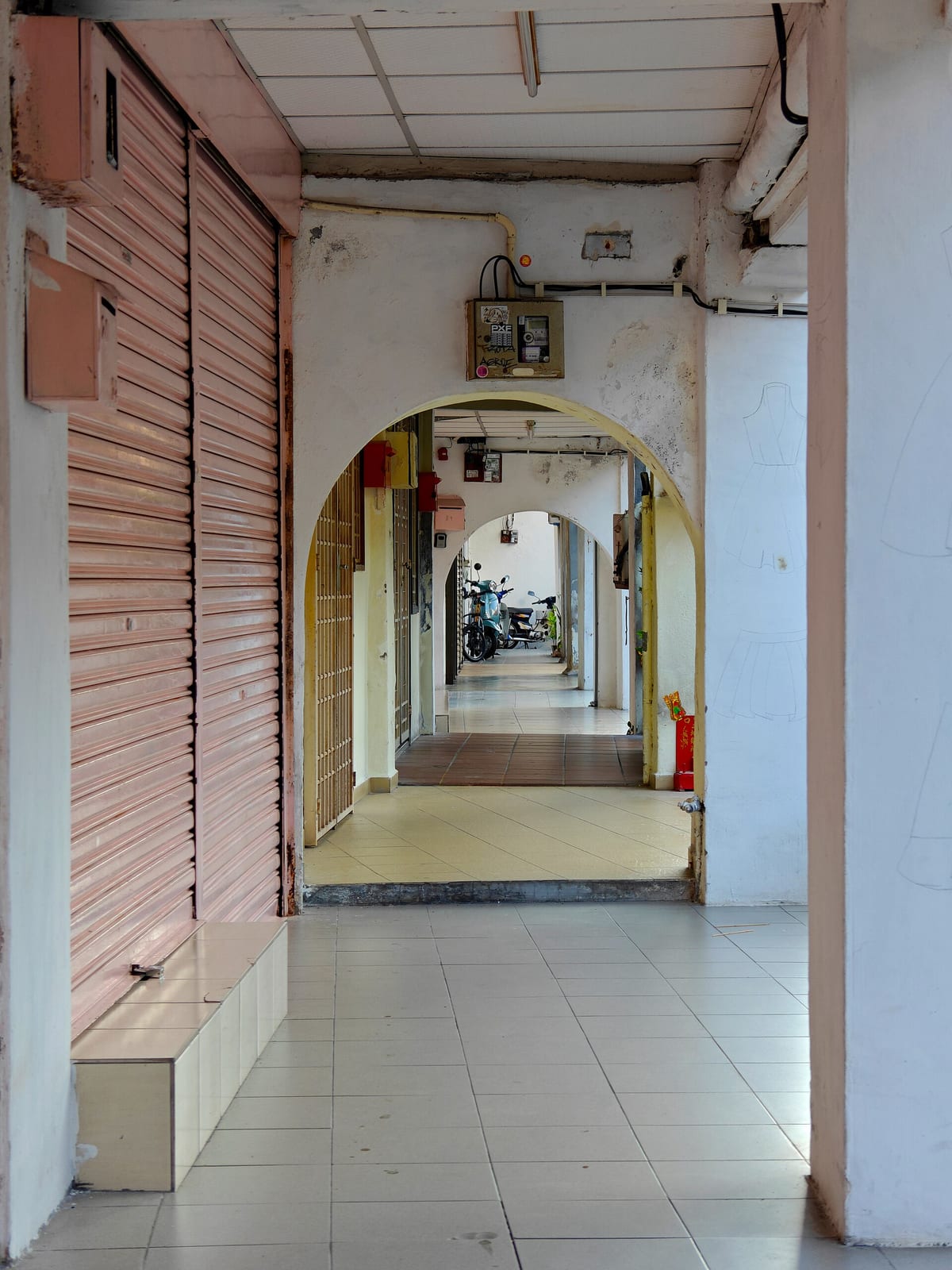
In George Town, the sidewalk does not always run beside the building. It runs through it.
An upper floor projects over the ground level. Columns land at the street edge. Behind them, a covered passage crosses one shophouse frontage, then another, then another. This is the five-foot way: a shaded public walkway assembled from a row of privately occupied buildings. George Town World Heritage Incorporated describes it as shelter from heat and rain, but also records the condition anyone walking here actually meets—shop displays, barriers and motorcycles can interrupt the route [1].
That makes the five-foot way a better key to Lebuh Armenian than its famous murals. The paintings encourage a sequence of stops: find, queue, pose, move on. The arcade teaches movement itself. A clear bay becomes a tiled step, a shutter becomes a doorway, a parked motorcycle forces a decision, and the public path must be rediscovered one threshold at a time.
Keep the experiment small: one 300-metre street, two shophouse rows, one return pass. Begin at Lebuh Pantai between 07:15 and 07:45, walk west along Lebuh Armenian to the Armenian Park area, cross only at a proper junction, and return on the opposite side. Allow 45–60 minutes and budget RM0. The street needs no ticket or reservation; the value is in noticing where the sidewalk goes [4][6].
Arrive before the mural becomes a queue
The first local move is to begin before the shopfronts and photo lines fully claim the street. A current local guide puts Lebuh Armenian's most resident-scale interval at roughly 07:00–09:00 and warns that weekend tour groups become noticeable by about 10:00 [4]. Recent r/Penang advice makes the same point more loosely: an hour of morning walking around Armenian Street and Armenian Park is enough to catch the town's energy and the small discoveries that disappear inside a checklist [6].
Start from the Lebuh Pantai end because the junction is a clean recognition cue on the current Penang visitor map [3]. If you are coming from Komtar, allow about 15 minutes on foot; the local guide recommends walking rather than searching for dedicated parking [4]. Penang Global Tourism's 2026 guide also shows the free Central Area Transit bus in the heritage core, but tells visitors to recheck schedules and fares before choosing transport [3]. Use the bus if its live route suits you. Do not make an old route diagram the fragile first link in a dawn walk.
The second move is a camera-down first pass. For the first 10 minutes, do not hunt for Children on a Bicycle, the steel-rod caricatures or a souvenir. Stay under the overhang whenever the passage is clear. Notice what changes at every property line: floor level, tile, column shape, ceiling height, shutter, altar, stool, merchandise, drain. The covered line looks continuous from across the road; under the roof, it is a chain of local decisions.
Read the threshold, not just the façade
George Town's official shophouse guide identifies six main styles, from Early Penang buildings of the 1790s–1850s through Early Modern examples of the 1950s–1970s. The details change—lime plaster, Chinese brackets, European capitals, reinforced concrete—but the five-foot way recurs across much of that chronology [1]. It is not decorative trim. It is part of the building type.
The third move is therefore to look sideways as well as forward. A façade gives you a period style; a threshold shows you how the building works today. George Town World Heritage Incorporated notes that many shophouses still combine business and residence [1]. A rolled shutter may mean a shop has not opened. A chair may belong to someone waiting outside their own home. An altar or doorway is not spare space for a bag while you frame a picture.
This is the city-specific texture that the UNESCO label can flatten if read too quickly. George Town entered the World Heritage List with Melaka in 2008 as a living trading-city landscape shaped by Malay, Chinese, Indian and European exchange. UNESCO singles out the range of shophouses and townhouses, but it also emphasizes daily life and continuing coexistence, not architecture emptied of occupants [2]. On Lebuh Armenian, “living heritage” is as ordinary as a gate opening into the route you thought was yours.
The fourth move is to yield at those openings. Walk single file when the arcade narrows. Let a resident, delivery or customer complete the threshold crossing before you continue. If a shop display occupies part of the way, do not rearrange it. If a motorcycle blocks the passage, do not squeeze against a doorway or touch the bike. Stop, look back for moving traffic, step into the street only when it is clearly safe, and regain the covered way at the next open bay [1]. The road is a short detour, not the default sidewalk.
Let an obstruction explain the system
Calling the five-foot way “public” can create the wrong kind of confidence. It does not guarantee a clean, regulation-width corridor from end to end. The official heritage body explicitly describes blockage by merchandise, physical barriers and motorcycles [1]. The useful response is not indignation or passive surrender. It is to see the path as negotiated infrastructure: public in purpose, parcelled by property, and maintained unevenly through daily use.
The fifth move is to count only three interruptions on the outward walk. At each one, identify what has taken the space and how pedestrians respond. Do people wait? Step down? Switch sides? Pass in single file? Three is enough. After that, stop auditing and rejoin the street's pace. This is a travel exercise, not an accessibility survey, and one morning cannot establish how every threshold works at every hour.
The photograph above preserves the same lesson without pretending to map Lebuh Armenian. It shows an actual George Town five-foot way in 2024: a long visual tunnel made from many separate arches, with changes in tile and level underfoot and motorcycles visible in the path ahead [8]. Its quietness is useful. The architecture promises continuity; objects and occupancy decide the route.
The sixth move is to cross at the Armenian Park end and make the return along the opposite shophouse row. Do not zigzag for every mural. A single crossing lets the second side correct the first: one arcade may be clearer, one more residential, one brighter where a corner breaks the shade. Buy, browse or photograph on this return pass, after the street has already registered as a spatial system.
Keep the mural queue out of the walkway
Lebuh Armenian is not secretly free of tourism. The cited 2025 Tripadvisor reviews describe a narrow, busy street and the difficulty of photographing its best-known murals without other visitors in the frame [5]. The current local guide supplies the timing: it recommends early morning and notes that the street itself is free and always accessible even though individual businesses keep their own hours [4].
The seventh move is to treat any mural photograph as a two-minute stop. Wait against a wall where you are not sealing the arcade. Decide on the frame before you reach the front. Take it, then release the space. If the queue projects across a doorway or five-foot way, skip the picture and return later. The art was commissioned for George Town Festival in 2012 to interact with the street; it does not turn the street into a studio [4].
There is another reason to keep the plan live. The official 2026 George Town Festival calendar placed programming on Armenian Street and Armenian Park from 7–9 August, with additional evening activity on Armenian Street from 3–7 August [7]. Those dates have passed, but they supply a current operating lesson: this street can become a venue. Check the heritage body's event calendar shortly before visiting. If barriers, a procession, performance setup or community event has changed the route, let the event own its space and choose another morning.
The eighth move is to leave before the street asks for a verdict. Lebuh Armenian can feel too touristy at 11:00 and almost private at 07:20; both impressions are partial. Finish the return pass by about 08:30, when shutters and deliveries are making the thresholds legible but the local guide's late-morning crowd transition has not yet compressed them [4]. You have read one operating hour, not discovered the “real” street once and for all.
Four visitor mistakes, corrected under the roof
Mistake one: treating the street as a mural checklist. That produces a sequence of façades while the city's most characteristic pedestrian device sits under the upper floors. Better: follow the local emphasis on walking and small discoveries—keep the first pass camera-down and stay with the arcade [4][6].
Mistake two: assuming “five-foot way” means five clear feet. The name describes the building-and-walkway type, not a guaranteed unobstructed channel: the heritage guide records physical obstructions, while visitor reports describe a narrow street made tighter by crowds [1][5]. Better: expect displays, thresholds and motorcycles; detour safely without moving someone else's property.
Mistake three: treating the shophouse row as a heritage set. Many buildings still combine residence and business, UNESCO's case for George Town depends on living culture as well as form, and the local guide stresses respect for residents [1][2][4]. Better: yield at doors, ask before photographing people or interiors, and never use a threshold as equipment storage.
Mistake four: arriving at peak hour for an empty-street photograph. The current local guide flags the late-morning crowd transition, while the cited 2025 reviews confirm that crowding makes uncluttered mural photographs difficult [4][5]. Better: use 07:15–08:30 for the two-pass walk, or accept that people—not a clean frame—are the street's dominant subject later in the day.
The go details
- Anchor: Lebuh Armenian's five-foot ways, from the Lebuh Pantai end toward Armenian Park and back. The murals are cues, not a second itinerary.
- Best window: a non-event weekday, 07:15–08:30. The current local guide describes 07:00–09:00 as the quieter, more local interval and heavier weekend pressure by about 10:00 [4].
- Time needed: 45–60 minutes—one camera-down outward pass, one junction crossing, one slower return. A recent local community suggestion also treats an hour as a useful morning walk around Armenian Street and the park [6].
- Expected spend: RM0 for the street. A trishaw is optional, not necessary; recent local guidance gives RM20–40 as a typical offer to confirm before riding [4]. Shop and café spending is entirely separate.
- Queue and reservation reality: no admission, booking or opening gate. The local guide warns of heavier weekend pressure after the early window [4]; the cited 2025 reviews describe crowding and difficulty isolating the best-known murals in a photograph [5].
- Navigation cue:
Lebuh Pantai junction -> Lebuh Armenian five-foot way -> Cannon Street area -> Armenian Park -> cross at the junction -> opposite arcade -> return. Penang's 2026 visitor map labels Lebuh Armenian, Lebuh Pantai and the free CAT circuit [3]. - Where to walk: under the shophouse overhang while the path is clear. At an obstruction, stop, check traffic, make the shortest safe road detour and re-enter the arcade; do not move displays or motorcycles [1].
- What to wear: shoes that handle tile, small steps and uneven thresholds. Carry water and a compact rain layer; a wide umbrella is awkward inside a narrow shared passage.
- Etiquette: yield at doors, keep photo stops to the wall edge, ask before photographing people or interiors, and treat homes, altars, chairs and shutters as occupied city—not props.
- Live check: consult the current GTWHI calendar before going. The August 2026 festival used Armenian Street as programmed space, and future events can change the morning's flow [7].
The five-foot way is easy to miss because it does not announce itself as an attraction. It simply keeps recurring: roof, column, tile, threshold, gap; roof, column, tile, threshold, gap. Follow that rhythm for one street and George Town stops looking like a collection of photogenic façades. It becomes a city built around a productive ambiguity—the sidewalk belongs to everyone, passes through many people's buildings, and works only because each new bay renegotiates the line.
Sources
- George Town World Heritage Incorporated, “Shophouses” — official heritage guide to six shophouse styles, mixed residential-commercial use, five-foot-way purpose and common obstructions.
- UNESCO World Heritage Centre, “Melaka and George Town, Historic Cities of the Straits of Malacca” — inscription history, living multicultural heritage and the significance of George Town's shophouses and townhouses.
- Penang Global Tourism, Penang 2026 Suggested Itineraries and George Town Map — current official visitor map, walking guidance, tourist-information hours and free CAT bus context.
- VisitPenang Editorial, “Armenian Street George Town — Complete Guide” (updated May 3, 2026) — recent local guidance on street length, morning timing, crowd transition, access, walking time, parking and trishaw prices.
- Tripadvisor, “Armenian Street” — cited 2025 visitor reports on narrowness, crowding and the difficulty of photographing murals without other visitors in the frame.
- r/Penang, “Quiet pockets around George Town” (May 2026) — recent community advice placing Armenian Street and Armenian Park inside a one-hour morning walk for atmosphere and small discoveries.
- George Town World Heritage Incorporated, George Town Festival 2026 Calendar — primary schedule showing recent August programming on Armenian Street and Armenian Park.
- Wikimedia Commons, “Five foot way in George Town, Penang.jpg” — authorship, date and original dimensions for HundenvonPenang's real March 22, 2024 photograph; this copy was resized and JPEG-optimized under the CC BY-SA 4.0 license