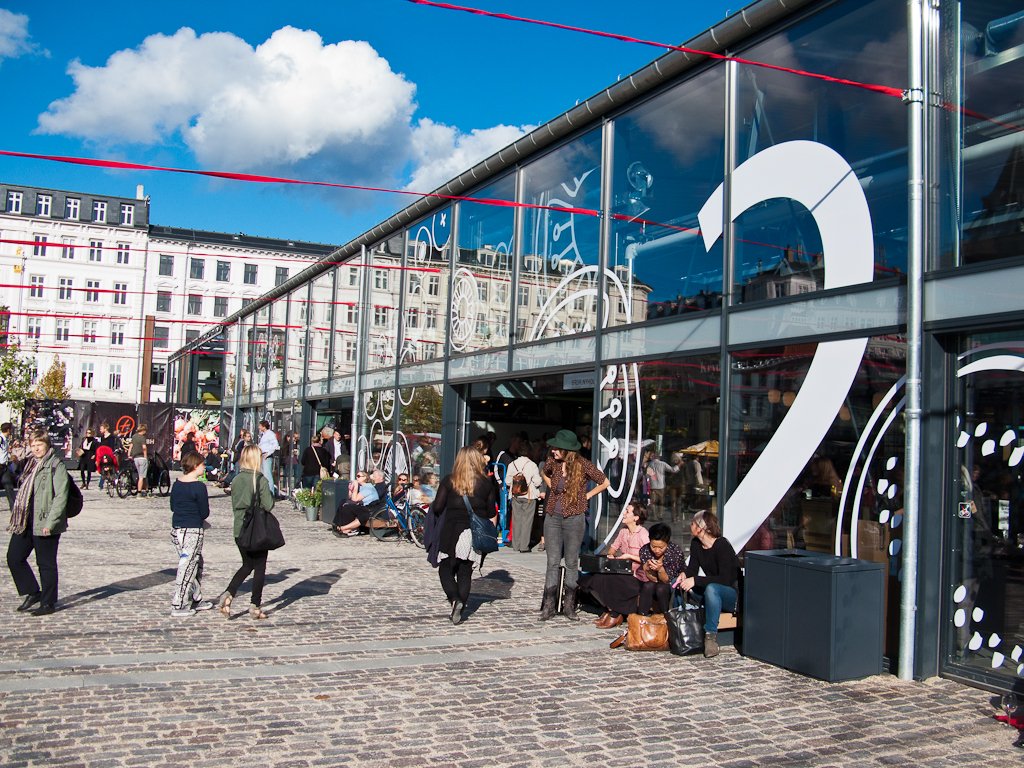
At Nørreport — Copenhagen's most-used transit interchange, where the S-Tog and Metro lines converge under the same square — two long glass-and-steel pavilions face each other across a strip of Israels Plads. This is Torvehallerne, a covered food market that opened in September 2011 and has since become one of the few places in Copenhagen that works equally well as a quick weekday stop and a slow Saturday expedition.[1][3]
The reason this location matters for travel is simple: Nørreport sits at the convergence of multiple S-Tog lines and both Metro lines, with dense bus connections on its outer edges.[2] Torvehallerne is therefore not a destination you specifically "go to" so much as one that intersects with almost any path through the central city. Visitors coming from the main train station, heading toward the Nørrebro neighborhoods, looping toward Rosenborg Castle garden, or catching a Metro connection will pass through Nørreport. The market is five minutes from the station exits.
Two pavilions, one square
Torvehallerne consists of two parallel rectangular structures. Each is a large glass-and-steel volume — transparent walls, an industrial-grade roofline, the architecture deliberately uncluttered so that vendor stalls and produce become the visual texture inside rather than the building itself.[1]
Between the pavilions runs an open outdoor strip. In spring and summer this lane fills with seasonal stalls: flower vendors, seasonal produce carts, a few quick-service operations. In cooler months the outdoor segment thins and functions more as a covered passage between the two halls than as a market street in its own right. You move between them freely regardless of season, and the pavilion interiors are always warm.
The surrounding square — Israels Plads — was redesigned as part of the same urban project that introduced the market.[3] The square has a distinctive hard-paved surface, a roller-skating oval, open benches oriented toward the pavilions, and a sense of civic scale that many Copenhagen squares lack. Torvehallerne did not simply occupy the square; the square was remade around the market's presence, and the two reinforce each other: outdoor seating spills from the market onto the plaza in good weather, and the pavilions close off the square's wind from one side.
Inside the pavilions: what the vendor mix tells you
Each pavilion holds a dense arrangement of stalls, with a mix weighted toward specialty food and premium produce rather than mass-market grocery.[1] What a deliberate pass through Torvehallerne typically surfaces:
- Fresh produce: seasonal vegetables and fruit, sourced with attention to variety and provenance, often Nordic or locally grown — not the undifferentiated pile of a supermarket
- Flowers: multiple flower stalls concentrated near the pavilion entrances; at their peak from late March through June, they are the market's strongest visual argument for itself
- Coffee: specialty roasters with proper espresso bars; Torvehallerne was one of the early nodes in Copenhagen's now-established specialty coffee circuit, and the quality has held[1]
- Smørrebrød and prepared lunch: open-face rye bread with various toppings — herring, shrimp, roast beef with pickled vegetables — alongside warm prepared dishes suited to eating while standing at the market benches
- Fish and meat: specialist fishmongers and butchers occupying sections at the back of each hall
- Cheese, wine, and specialty grocery: structured around a northern European and continental range, with a few stalls that function as focused import shops
The character of the market is specific: prices run higher than a Copenhagen supermarket, quality is measurably higher, and the vendor density is tight enough that comparison between adjacent stalls is easy without covering much ground.[1] The market does not try to be cheap. It is positioned as a showcase for what the Danish food retail chain has become since roughly 2010 — specialty-led, provenance-conscious, tilted toward quality over volume.
Rhythm: when to arrive and what changes
Torvehallerne's daily rhythm follows Nørreport's.[2] The market wakes with the morning commuter pulse — coffee queues form early, and the flower stalls do strong morning business before 10:00. By late morning the foot traffic is heavier but still manageable. Midday on Saturday is the peak period: full queues at the most popular stalls, people eating at standing height in the outdoor strip, the produce section thick with weekend shoppers who have planned their afternoon cooking around the market's stock.[1]
Weekday visits in the late morning or early afternoon offer the most efficient window. Stalls are fully staffed, queues are shorter, and the space is readable rather than saturated. Saturday morning before noon is the other high-quality window — the market reaches full weekend energy before the midday crowd locks the best stalls.
Most vendors open around 10:00.[1] Closing times vary by stall and season; the interior operators typically wrap up between 18:00 and 19:00 on weekdays, earlier on Saturdays. Check the official website for current stall-by-stall hours before planning around a tight evening window.[1]
Getting to Torvehallerne from Nørreport
The simplest access is through the Nørreport station exits facing Israels Plads. Once at station level, the glass pavilions are visible immediately.[2][3]
Transit options that reach Nørreport include:
- Metro: M1 and M2 lines stop at Nørreport
- S-Tog: all S-Tog lines through central Copenhagen stop at Nørreport
- Bus: several city bus lines stop at the square edges — check Rejseplanen for current route numbers[5]
From Copenhagen Central Station (Hovedbanegården), the S-Tog ride to Nørreport takes roughly five minutes. Walking from the pedestrian shopping street Strøget takes around ten minutes through the old town. From the airport, the Metro M2 runs direct to Nørreport.[2]
Four practical moves
Use the S-Tog from Central Station if you are time-pressed — five minutes is faster than navigating tourist foot traffic on the walking routes, and it deposits you at the market square directly.[2]
Prioritize the outdoor strip in spring and early summer — the flower stalls between the pavilions peak between late March and June, and they are the strongest spontaneous buy in the market at that time of year.[1]
Treat the market as a lunch anchor, not a snack stop — the smørrebrød vendors and warm-food operators are best approached with twenty minutes to stand and eat at the market benches, not rushed from a commuter schedule.
Come back on Saturday morning before noon if your first visit is weekday — the full weekend market character (outdoor sellers active, full produce range displayed, family crowd pacing rather than commuting) is a different experience that rewards the second visit if the schedule allows.[1]
What Torvehallerne is not
A useful frame for setting expectations: Torvehallerne is not a street food hall, not a cheap lunch option, and not an undiscovered locals-only secret. It is a well-known, well-designed premium food market in the geographic center of Copenhagen's transit system. Its value lies in the concentration of quality within a small space and the legibility of the vendor types — not in price or in the fiction of discovery.
The market is understood by Copenhageners as a place for premium grocery shopping and fast-good lunches, and by visitors as a reliable stop that does not require planning. Both readings are correct.
Pocket route card
- Location: Israels Plads, at Nørreport station — M1/M2 Metro, all S-Tog lines through central Copenhagen.[2][3]
- From Central Station: 5-minute S-Tog ride.[2]
- Opens: around 10:00 most days; stalls vary — check official site for current hours.[1]
- Peak crowd: Saturday midday; best window is Saturday before noon or weekday late morning.
- Best season for outdoor strip: late March to June — flower stalls and seasonal carts are strongest.
- Spend floor: coffee from around DKK 40–60; smørrebrød from DKK 90–130; produce at supermarket-plus pricing.
- Recognition cue: two parallel glass-steel pavilions facing each other on Israels Plads, immediately north of the Nørreport station exits.[3]
Sources
- Torvehallerne — official market website (vendor information, opening overview, stall-level hours).
- Wikipedia — Nørreport station (transit lines served, station layout, position as Copenhagen's most-used interchange).
- Wikipedia — Israels Plads (square history, redesign context, market's civic setting on the square).
- VisitCopenhagen — official Copenhagen tourism guide (city context, cultural framing of major market and transit stops).
- Rejseplanen — Danish national journey planner (current transit routing to Nørreport from Central Station, airport, and city neighborhoods).
- Wikimedia Commons — Torvehallerne 2011-09-09.jpg (article hero image source; free media file showing the newly opened pavilions on Israels Plads).