At São Bento, Porto puts its pictures where people have trains to catch. Jorge Colaço’s tiled scenes fill the entrance hall with historical processions, rural work and the evolution of transport. Beyond them, the railway continues its less ceremonial business. In its October 2026 anniversary account, Infraestruturas de Portugal describes regional and suburban passengers still passing through a building inaugurated in 1916.[1] The pleasure of a visit comes from seeing those two kinds of movement together.
Begin by stepping out of the route between the doors and the platforms. From a clear patch beside a wall, the room becomes easier to read: granite divides the painted surfaces, while blue-and-white scenes and coloured decoration occupy different heights. The railway’s heritage inventory describes precisely this vertical arrangement.[2] You can let your gaze travel without making someone else negotiate around you.
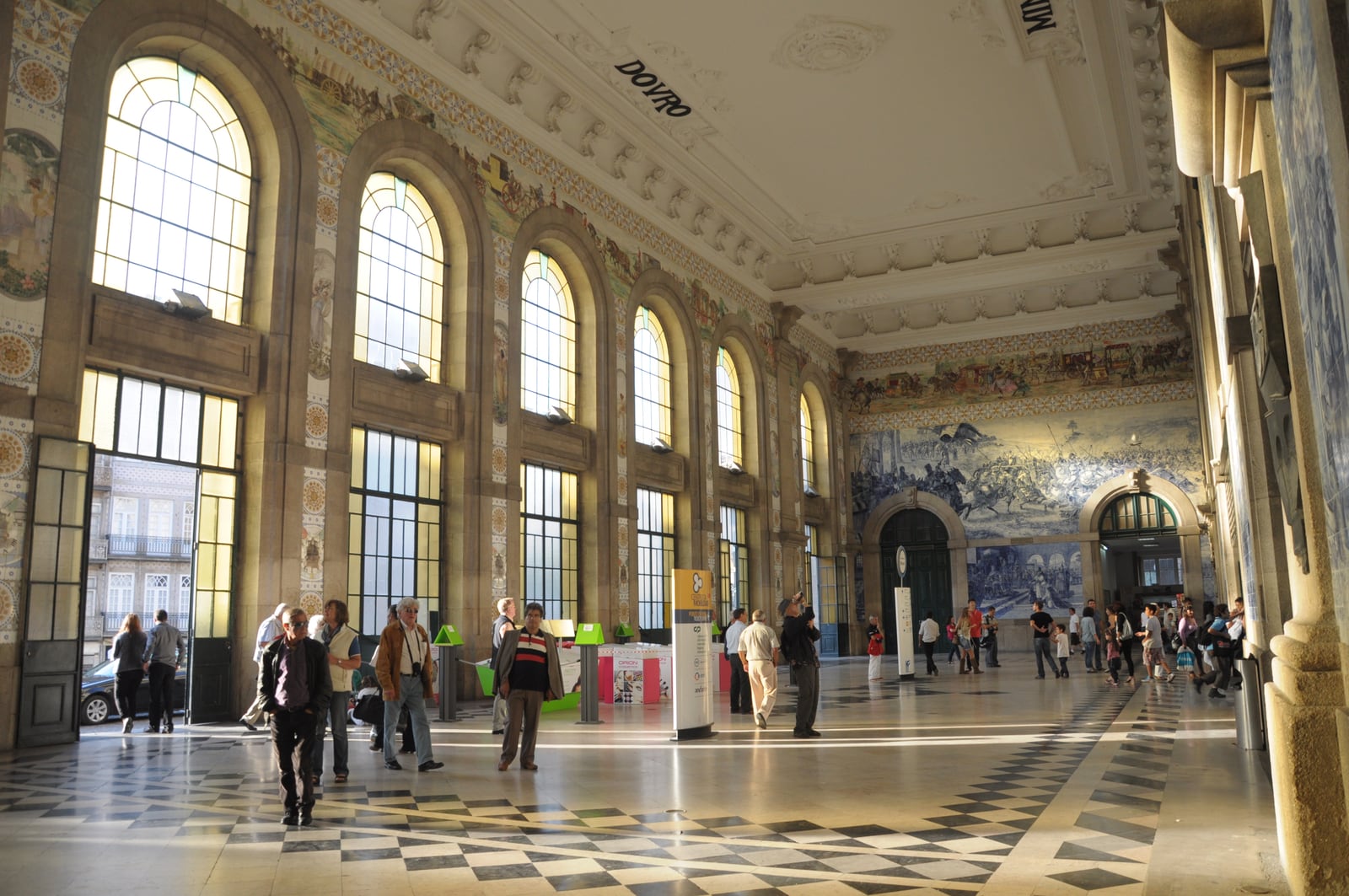
Look above the blue
The building occupies the site of the former São Bento de Ave-Maria convent. Its name preserves that earlier use even though the railway transformed the ground beneath it. A temporary wooden passenger station opened in 1896; construction of José Marques da Silva’s permanent building began in 1903.[2] That sequence helps explain the ambition of the hall. Rail travel had reached central Porto before the city acquired this monumental room for receiving it.
Colaço’s tiles, made at the Sacavém factory, combine national history and myth with scenes of work and regional customs.[2] Give one visible scene a sustained look before trying to absorb the whole room. Then raise your eyes to the coloured transport frieze. Agenda Cultural do Porto identifies its progression towards the railway.[3] Inside an operating station, that subject has a particular wit: painted travel ends where your own journey can begin.
There is a current complication worth knowing before you come. On 15 August 2026, Momento do Porto reported that some panels remained behind protective coverings installed in 2023, associated with the nearby Metro Pink Line works. The report found no official date for complete removal.[5] It is evidence of an interrupted view, not proof of exactly which surfaces will be exposed on your visit. Readily available photographs can show a more complete room than the one awaiting you. Check recent conditions if a particular panel is your reason for travelling, and let the visible sections determine your circuit.
Find a pause, leave a passage
For a short visit, the local cultural guide suggests 20–30 minutes and favours early morning over the middle of the day.[3] A sensible planning window is 08:00–09:00 on a weekend: an editorial suggestion within the opening hours, rather than a promise of an empty hall. The operator currently lists 04:20–00:55 on weekdays and 05:20–00:55 at weekends. These are station hours; they do not guarantee that every staffed service is open.[6] All times here are Porto local time, checked on 5 November 2026.
The viewing budget is €0. There is no admission reservation or museum queue for the public atrium; you can enter without buying a train ticket. Any tour, onward transport or purchase is separate.[3] Keep the visit’s small scale: arrive, find somewhere unobstructive to stand, look closely, and move when the room needs the space.
That last adjustment has a local reason. In an r/portugal discussion, a self-described Porto student who regularly changes between metro and train complained about tour groups standing across the connection. Another regular traveller thought the obstruction less severe, particularly at a side entrance; the original poster disagreed.[4] The disagreement is useful. No particular doorway can be treated as a permanently quiet viewing spot. Watch the actual flow before stopping, and keep your companions together to one side rather than spread across it.
The same account suggests a better approach to photographs. Choose your framing from a place where people can pass, then wait for a gap. Do not turn the doorway into a tripod position, or retreat backwards into the route while looking at a screen. If you have a train to catch, finish looking before your boarding margin becomes an argument with a tour group.[4] Those are practical responses to a shared room, not a demand to rush through it.
For navigation, use Praça de Almeida Garrett as the railway entrance landmark. São Bento’s metro stop serves Line D, while the tiled hall belongs to the railway building above ground.[3] Allow the last few steps to reveal which door is clear instead of committing to a photograph’s approach. Once inside, look up, look across, and occasionally look behind you. The room gives its most convincing portrait of Porto when the people passing through remain part of the view.
Sources
- Infraestruturas de Portugal, “Estação de Porto-São Bento celebra 110 anos no coração da cidade,” 5 October 2026 — anniversary account, tile subjects and continuing railway use.
- IP Património, “Estação de Porto – São Bento” — convent site, construction chronology, architect, tile production and the hall’s decorative arrangement.
- Agenda Cultural do Porto, “Estação de São Bento: azulejos, história, horários e comboios,” updated 20 July 2026 — local cultural guide to free access, visit length, timing, transport and passenger etiquette.
- r/portugal, “Turistas nas estações de comboio,” October 2024 — a Porto commuter’s account and replies about visitor groups obstructing routes; anecdotal and contested, not a crowd survey.
- Momento do Porto, “Azulejos de São Bento continuam cobertos: a proteção provisória já dura mais de três anos,” 15 August 2026 — local reporting on protective coverings and the absence of a confirmed removal date.
- Infraestruturas de Portugal, Porto-São Bento station information, checked 5 November 2026 — operational opening hours.
- Ruialbuquerque, “Estação de São Bento – Atrio de entrada,” 25 September 2011, Wikimedia Commons — original photograph and CC BY-SA 3.0 attribution.