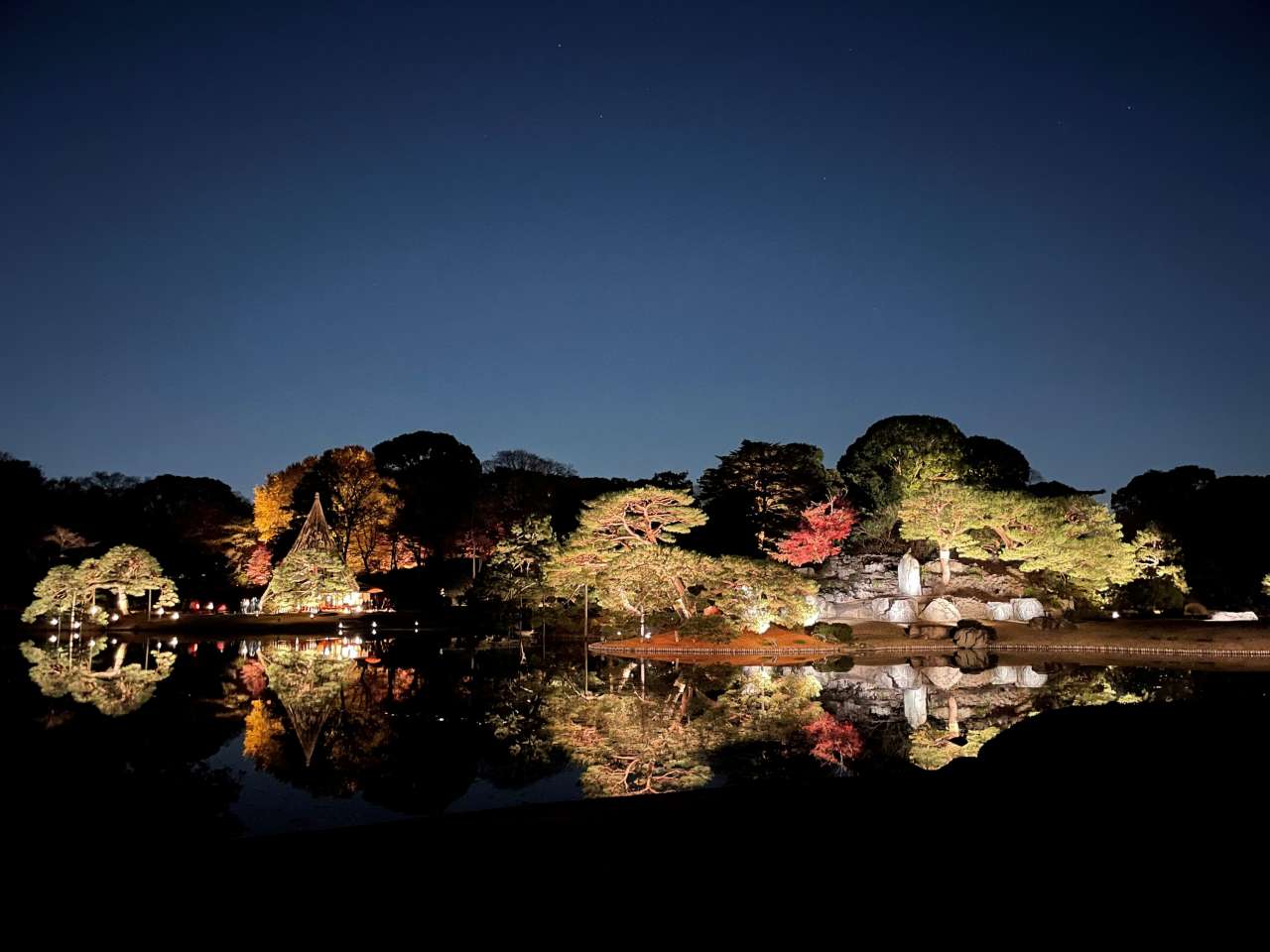
Rikugien’s autumn evening begins with an empty hour. The Tokyo garden closes at 17:00, then admits a new audience at 18:00. During the special night opening, trees emerge from the darkness and the pond catches their illuminated shapes. The interval matters: an afternoon visit cannot simply stretch into an evening one.[7]
For November 25–December 6, 2026, this is a chance to encounter an old garden through a temporary arrangement of light. It is also a shared outing, with ticket lanes, people taking photographs and staff keeping everyone moving. Making room for those practicalities leaves more attention for the water.[1][5]
Wait for the leaves as well as the lights
As checked on November 3, 2026, Walkerplus’s foliage report still classified Rikugien as green in its November 2 update. Its usual peak window runs from late November into mid-December, with weather able to shift the timing. Check the latest colour report before choosing a date; a confirmed lighting programme cannot promise a particular shade of maple.[2]
The attraction has deeper roots than its autumn photographs suggest. After receiving the Komagome estate in 1695, Yanagisawa Yoshiyasu directed the excavation of a pond and the construction of hills over seven years. The garden’s 88 named scenes evoke places celebrated in poetry, including Wakanoura in present-day Wakayama. Its landscape was composed to carry associations beyond the ground underfoot.[3]
That history changes the pleasure of looking across the pond. An island, a slope and a stretch of shore can suggest a much larger journey. After dark, when the unlit ground recedes, it becomes easier to attend to the relationships between those separate forms. Leave a little time for looking without making a photograph: the view need not become a souvenir immediately.
The evening has its own entrance
The Japanese blogger Futatsuki describes entering through the main gate and leaving through Somei Gate after an autumn visit. That distinction remains useful: the 2026 night entrance is the main gate only, while both gates serve as exits. A convenient-looking gate beside the station is therefore a poor arrival target.[4][6] From JR Komagome’s south exit, the garden gives a seven-minute walk to the main entrance; Sengoku Station is a ten-minute alternative.[3]
Budget ¥1,000–1,200 per adult for admission, excluding transport and refreshments. The lower price is the online advance ticket; same-day tickets cost ¥1,200 online or at the main gate, where payment is cash only. Online buyers use a priority lane, including those buying on the day. Sales are capped, so settle the ticket before travelling.[1]
Choose the date carefully, buy the advance ticket by 23:59 the previous day, and keep the actual mobile ticket accessible. Staff operate it on your screen; a screenshot or printout is not accepted. A daytime ticket or annual pass does not replace the special night ticket.[6]
For a first visit, my suggested window is 18:00–19:20, with extra time outside that allowance for entry. This is a pacing recommendation, not a promise of a quiet opening hour. GO TOKYO confirms 19:30 last admission and 20:30 closing.[7] Arriving near the cutoff compresses both the garden and any queue into the same shrinking evening.
Move beyond the first photograph
Futatsuki’s account of December 4, 2024 records arrival at 18:55 and departure at 20:15. The entrance and staged photo areas felt busiest; farther inside, people spread out. The account is evidence of one evening, not a forecast for 2026. Its useful suggestion is spatial: continue beyond the first cluster when the marked route allows.[4]
A separate Japanese account on note, by Haru, describes staff dividing photographers and through traffic into different sides of a path. Despite the crowd, the writer noticed people proceeding calmly. The lesson survives even if this year’s route changes: listen to the steward at the particular bottleneck, step into the designated viewing space, then make room for the next person.[5]
It is easy to let the first attractive branch become the whole visit. The queue lends it importance; another person’s camera supplies an apparently authoritative angle. Once everyone has made the same stop, however, the garden is still waiting farther along. A brief photograph followed by an unhurried walk can be more satisfying than defending one position.
At the pond, look towards Nakanoshima, the central island, from the permitted waterside route. The lighting draws together stones, pines and the slopes behind them, with their reflections extending the scene downward. The island itself is closed to visitors.[6] Treat the opposite shore as part of the composition rather than a destination to reach.
Stay long enough to feel the season
Bring a warm outer layer even after a comfortable afternoon. Futatsuki recalls becoming cold after roughly an hour outdoors; waiting and looking use a different pace from crossing the city.[4] This is a small preparation that buys a less hurried final pause.
The garden’s normal daytime admission is ¥300 for an adult.[3] Choose daylight if your main interest is reading the terrain and seeing the planting continuously. The night visit offers a different emphasis: selected trees, reflections and the intervals of darkness between them. Some areas close at night, and wheelchair users should ask staff for the available detours.[6]
When you are ready to leave, follow the signed exit towards Somei Gate if returning to Komagome. The gate that could not admit you can now shorten the return.[4][6] Outside, the evening resumes its ordinary scale. For a little while, a pool of light on the pavement may still invite the same patient attention as a tree beside the water.
Sources
- Tokyo Metropolitan Park Association, “Special Night Viewing of Autumn Leaves at Rikugien,” September 3, 2026 — dated announcement, admission prices, online priority lane and photographs explicitly identified as showing the previous year. Checked November 3, 2026.
- Walkerplus, “Rikugien autumn foliage: viewing season and illumination details” — local Japanese seasonal listing, including the November 2, 2026 green-leaf report and usual peak window. Checked November 3, 2026.
- Tokyo Metropolitan Park Association, “Rikugien” — official garden history, poetic landscape, daytime admission and station approaches. Checked November 3, 2026.
- Futatsuki, “When are Rikugien’s autumn leaves at their best? A firsthand account of the illumination and crowds,” December 3, 2025, updated January 14, 2026 — Japanese personal account of a December 4, 2024 visit: crowds, visit length, warmth and exit choice; historical event dates.
- Haru, “I went to Rikugien’s autumn illumination: very crowded!” note, November 30, 2024 — Japanese community-platform diary describing stewarded photography and walking lanes and calm movement through a busy garden.
- Tokyo Metropolitan Park Association, “Rikugien Gardens: Special Nighttime Viewing in Autumn,” 2026 event site — ticket deadlines and phone requirements, entrance and exit gates, island lighting, restricted areas and accessibility detours. Checked November 3, 2026.
- GO TOKYO, “Special Night Viewing of the Autumn Leaves at Rikugien Gardens,” updated October 1, 2026 — official tourism confirmation of event dates, opening hours and last admission.