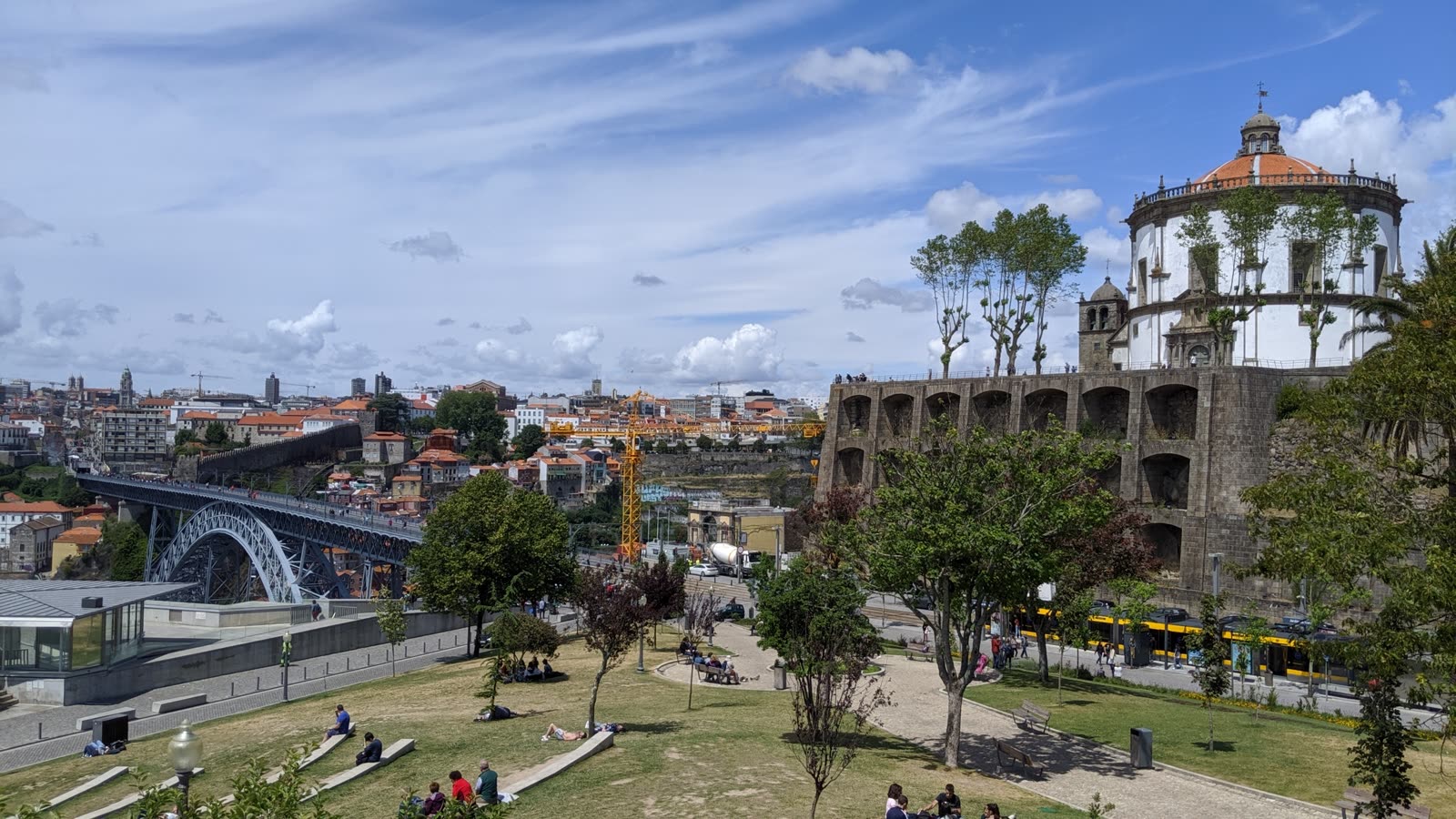
Porto's river postcard collapses when everyone tries to read it from the same railing. Around sunset, the upper deck of Dom Luis I Bridge becomes a compression chamber of phones, halted bodies, and stalled walking. The cleaner move is to leave the bridge as background and use two Gaia-side anchors instead: step out at Jardim do Morro for the first social read of the Douro, then climb to Serra do Pilar once the lawn has done its job.[1][3][4][5][6][7]
This is a strict two-anchor night room, and both anchors are non-food. Jardim do Morro is the public spill zone beside Line D and the bridge approach; Serra do Pilar is the older and calmer second room above it, where the river opens back out into architecture, stone, and distance.[1][3][4] The sequence matters more than the individual places. The garden receives the city at full public volume. The monastery terrace edits that volume back down.
Image context: the cover uses a documentary Wikimedia Commons photograph that holds both anchors in one frame, which is exactly why it fits this article. The route depends on the relation between the garden below and the monastery terrace above, not on one isolated viewpoint.[8]
Why this two-step sequence works better than camping at one lookout
Serra do Pilar is not just "another nice view." The official Visit Porto page gives it real spatial weight: construction began in 1538, ended around 1670, the church and cloister are both circular, and the cloister carries 36 Ionic columns, a unique form in Portugal.[1] More important for this route, the same page describes the terrace as a platform from which you can read the riverside areas of Porto and Gaia all the way toward Arrabida Bridge, while still keeping the Cathedral, Dom Luis I, Fontainhas, and Sao Joao Bridge in one sweep.[1] Jardim do Morro gives you the social foreground; Serra gives you the geographic sentence.
The arrival logic is equally practical. Metro do Porto's current scheduled-frequencies PDF, valid since 9 September 2024, shows Line D first trains at 06:00 from both Hospital Sao Joao and Vila d'Este, with last trains at 01:03 and 00:56 respectively.[3] On weekday evenings the service bands widen and tighten across the night, ranging from about 8-15 minutes in the busier shoulders to around 10-20 minutes later on.[3] That matters because it lets this route stay flexible after dark. You do not need to trap yourself on the bridge, and you do not need to leave early out of taxi anxiety.
Recent local confirmation helps too. Porto Secreto's 9 July 2025 report on the return of "Music in Jardim do Morro" describes the garden as an active summer evening stage with free events, including 6 p.m. and 9:30 p.m. slots, and notes that the series has existed since 2017.[5] That is useful because it confirms what current community-review surfaces still show: Jardim do Morro remains a living civic room, not a dead scenic patch preserved for visitors.[5][6]
Anchor 1: Jardim do Morro should open the night, not consume all of it
Jardim do Morro is strongest on first contact. You surface from the metro or arrive off the bridge, the whole river appears quickly, and the city still feels socially loose enough to breathe. That first read is worth taking seriously. Stay long enough to watch how the Douro, the bridge deck, and the cathedral line up, but do not make the common mistake of turning the garden into the entire plan.[4][6]
The useful local move here is to resist the most obvious centerline. The more visitors pile toward the bridge-facing edge, the more the space starts behaving like an outdoor waiting room. Current Google Maps review patterns matter because they expose this exact behavior in real time: same-day visitors treat Jardim do Morro as a sunset meeting point, which is what gives it energy, and also what makes it deteriorate fastest once the light peaks.[6] Keep the garden as a first room and it works beautifully. Overstay, and it becomes friction.
That is why I would keep the first pause to roughly 15-20 minutes. The number is an operating suggestion inferred from route geometry and present community patterns, not a municipal rule, but it fits the site. Jardim do Morro is where the night should begin at public volume, not where it should get stuck.[5][6][7]
Anchor 2: Serra do Pilar is where the night resolves
Serra do Pilar should be the longer pause because it does a different job. The monastery terrace takes the same river and stretches it back out. The bridge becomes one part of a wider field instead of the whole performance. Stone replaces lawn. The skyline stops acting like a backdrop and starts behaving like a topographic system.[1][7]
This is also where Porto's older texture returns. The monastery's circular forms, its long build from 1538 to 1670, and the terrace's broader sweep all change the tone of the evening.[1] The garden is for the first pulse. Serra is for the second read.
There is also a clean exit option once Serra has done its work. The official Teleferico de Gaia page says the aerial lift connects the upper and lower levels of Gaia in a 6-minute ride.[2] That makes it useful as a downhill release when knees, rain, or schedule matter. The important sequencing point is to use it after Serra do Pilar, not before. If you ride down too early, you cut the route's altitude logic in half.
8 local moves that materially improve the route
First, arrive by Line D and come out on the Gaia high side. The route is better when Jardim do Morro is your arrival room rather than an accidental detour after the bridge.[3][4]
Second, keep Jardim do Morro short, around 15-20 minutes, unless there is a specific event you actually want to stay for.[5][6]
Third, if you are chasing sunset, reach the garden about 30-40 minutes before that day's sunset instead of landing at the exact moment everyone else does. This timing is an inference from the route plus current review patterns, not an official city instruction.[6][7]
Fourth, once the lawn starts tightening, move uphill. A good working rule is to head for Serra do Pilar around 10-15 minutes after sunset or as soon as the garden stops feeling permeable.[1][6][7]
Fifth, make Serra do Pilar the longer dwell. It carries the wider geography, the older material setting, and the calmer second act.[1][7]
Sixth, treat the 6-minute Gaia aerial lift as an exit tool rather than the main attraction. It is there to save effort, not to replace the terrace sequence.[2]
Seventh, keep Metro D in reserve for the return. With final trains at 01:03 from Hospital Sao Joao and 00:56 from Vila d'Este, the route has enough late elasticity that you do not need a panicked retreat.[3]
Eighth, if there is an event night in Jardim do Morro, accept that the garden is the noisy room and shift earlier to Serra. Recent local coverage is explicit that the site still hosts programmed summer concerts with 6 p.m. and 9:30 p.m. starts.[5]
Non-local trapline: 4 common misses and the cleaner alternative
Mistake 1: walking straight onto the bridge and treating Jardim do Morro as overflow
Better alternative: let Jardim do Morro be the first anchor and let the bridge remain a background object rather than a bottleneck you have to solve.[4][6]
Mistake 2: staying in the garden until the whole slope behaves like one static crowd
Better alternative: use the garden for first light, then move to Serra do Pilar once the social room has peaked.[1][6][7]
Mistake 3: coming up by car or rideshare and adding road friction to a route that works best on rails
Better alternative: use Metro D for the high-side arrival and keep the route tied to its actual topography.[3][4]
Mistake 4: treating the cable car as the event and the monastery terrace as optional
Better alternative: finish the high route first, then decide whether the 6-minute descent is useful for your knees or your clock.[1][2]
Concrete go details
- Best window: on a weekday, reach Jardim do Morro about 30-40 minutes before sunset, shift to Serra do Pilar about 10-15 minutes after sunset, and keep the whole sequence around 45-70 minutes. This timing is an inference from route geometry plus current community patterns.[6][7]
- Expected spend: EUR0 for the walk itself if you are already on the Gaia high side; otherwise add normal Metro do Porto fare and, only if useful, the optional aerial-lift ticket.[2][3]
- Queue and reservation reality: no reservations, no ticket gates for the viewpoints; the real bottleneck is crowd compression around the garden and bridge-facing centerline, while Serra usually functions as the cleaner second room.[5][6][7]
- Where to stand: in Jardim do Morro, use an outer edge or side-lawn position for the first read; in Serra do Pilar, hold the terrace for the longer second pause.[1][6][7]
- Navigation cue:
Line D -> Jardim do Morro -> shift uphill to Serra do Pilar -> optional Gaia Aerial Lift down to the riverside.[1][2][3][4] - Numeric anchors worth keeping: 1538, 1670, 36 columns, 06:00, 01:03, 00:56, 8-15 minutes, 10-20 minutes, 6 minutes.[1][2][3]
Porto has no shortage of river views. This one earns its place by using two rooms instead of one crush point. Jardim do Morro takes the first public surge. Serra do Pilar gives the river back its depth.
Sources
- Visit Porto, "Serra do Pilar" (official monument page with construction dates, circular church and cloister, 36 Ionic columns, and terrace view description).
- Visit Porto, "Teleferico de Gaia" (official page in Portuguese; states that the aerial lift connects Gaia's upper and lower levels in a 6-minute ride).
- Metro do Porto, "Timetable Scheduled / Frequencies" PDF valid since 9 September 2024 (official Line D frequency bands and first/last trains).
- Metro do Porto, "Maps and Timetables" (official landing page for the system map and timetable documents used to orient the Gaia-side high route).
- Porto Secreto, "5 open-air concerts will spread 'Music in Jardim do Morro' this summer in Vila Nova de Gaia - and access is free" (published July 9, 2025; recent local confirmation that Jardim do Morro remains an active evening civic room with 6 p.m. and 9:30 p.m. programming).
- Google Maps search, "Jardim do Morro Vila Nova de Gaia" (current community-review and same-day crowd-timing surface; accessed 2026-04-03).
- Google Maps search, "Serra do Pilar Vila Nova de Gaia" (current community-review surface for terrace timing and dwell patterns; accessed 2026-04-03).
- Wikimedia Commons, "File: Monastery of Serra do Pilar and Jardim do Morro.jpg" (documentary photograph used for the cover image).