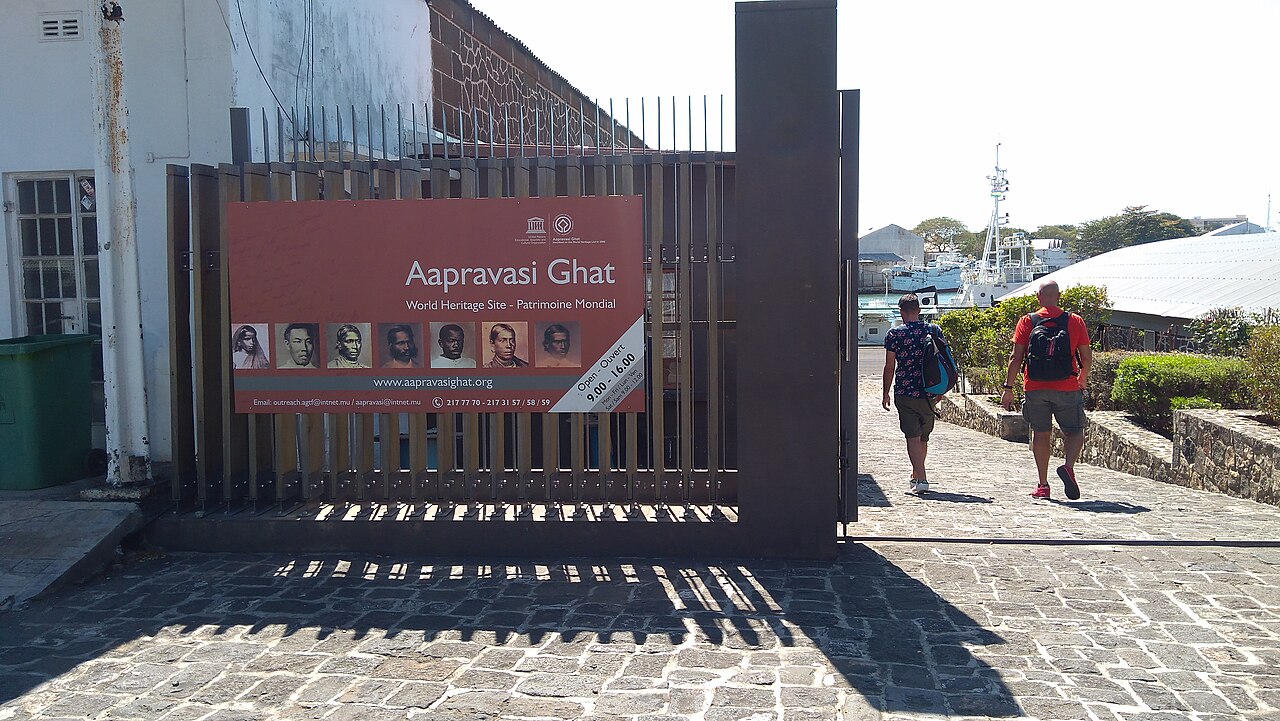
Port Louis offers its most consequential street lesson in a space small enough to cross before the morning warms. At Aapravasi Ghat, 14 surviving steps lead into the remains of an immigration depot. About 5–10 minutes away, three stone-and-iron arches open into the Central Market, still commonly called the Bazaar [2][3][11].
Do not reverse that sequence on a first visit. The market can absorb attention through colour, bargaining, produce, and pressure. Aapravasi Ghat gives those transactions a longer history: who arrived at this port, under what conditions, and how a district of lodging, transport, shops, and exchange formed around them. The useful route therefore has only two anchors—Aapravasi Ghat first, Central Market second—and it remains non-food unless current conditions and your own appetite make one purchase sensible.
Use Tuesday to Friday, 09:00–11:15. Be at the Ghat when it opens, allow about an hour there, take the short handoff through Immigration Square, then give the market 30–45 minutes. The Ghat is officially open Monday through Friday from 09:00 to 16:00, Saturday from 09:00 to 12:00, and closed on Sundays and public holidays. Admission is free [1]. Tuesday to Friday is an editorial comfort window, not an extra official opening rule: it avoids the Saturday noon deadline and puts the walk after the road rush that a current local discussion places roughly around 07:30–09:00, while leaving enough morning for the market [8].
Move one: let the strict clock choose the first door
Arrive at the Quay Street entrance five minutes before 09:00. If you are driving, do not hunt for a space at the gate: the site says it has no visitor parking and points drivers toward Granary or Le Caudan Waterfront instead [1]. Better still, arrive by bus at Immigration Square and make the harbor-facing entrance your first coordinate. Caudan is parking or an exit, not a third attraction.
Self-guided entry does not require a reservation. A guided visit does require advance arrangement and depends on staff availability [1]. That distinction matters because a visitor who waits for an improvised tour can waste the best part of the morning. Enter on your own unless a guide was already confirmed.
The current route through the site begins with the Beekrumsing Ramlallah Interpretation Centre, or BRIC. Give it 30–40 minutes, then allow another 20 minutes for the World Heritage property. The site's own plan-your-visit page rounds that sequence to about one hour [1]. This is not padded museum time. It is the minimum structure that makes a small, fragmented place legible.
Move two: earn the photograph of the steps
Do not go straight to the 14 steps. First learn what the surviving masonry cannot show by itself.
The depot was built in 1849 beside the harbor, within the wider system that moved almost half a million indentured laborers through Mauritius between 1834 and 1920. UNESCO records a World Heritage property of only 1,640 square metres, surrounded by a 28.9-hectare buffer zone; less than half of the depot complex that existed in 1865 survives [3]. A 2025 UNESCO account gives the human scale more sharply: over 462,000 people passed through the depot, most arriving from India, with smaller groups from China, Madagascar, Comoros, Mozambique, and Southeast Asia [5].
“Contract” must not soften that history. The Aapravasi Ghat Trust Fund's education material says agreements were generally for five years and records abuses serious enough that emigration from India to Mauritius was suspended from 1839 to 1842 [4]. Read the lists, regulations, testimonies, and reconstructed journey before looking for a heroic staircase. The steps matter because people climbed them into a coercive labor system, not because their stone makes an elegant ruin.
Only then go outside. Walk the surviving route once without taking out a phone. On the second pass, stop where the steps, road, warehouses, and harbor can occupy the same mental frame. The road that cut through the depot's setting and the missing portions of the complex are evidence too [3]. A tight crop of old stone would make the site look complete; the honest view includes the infrastructure that displaced and surrounded it.
Move three: use the missing footprint as the handoff
At the exit, pause facing the port. The photograph above catches the right tension: the heritage sign announces a protected place while ships remain visible behind it [12]. This was not a remote reception camp. It operated inside a working harbor and beside a commercial city.
Now leave the museum rather than lingering for a second circuit. Use the current marked pedestrian route from Quay Street around the road approaches toward Immigration Square and Farquhar Street. An OpenStreetMap foot route between the two anchors is only a few hundred metres; allow 5–10 minutes because live crossings, traffic, and construction outrank a map estimate [11]. Never improvise a crossing of motorway approaches to save a minute.
Immigration Square is the connective tissue, not a third stop. The Aapravasi Ghat heritage trail identifies it as the former Old Immigrants Yard, used by people preparing to leave Mauritius or return to India. The same official trail describes the surrounding nineteenth- and twentieth-century district as a cosmopolitan commercial centre with Chinese, Indian, and European shops. It explicitly carries that story onward to the Central Market [2].
Listen during the crossing. A July 2026 local discussion says street conversation is mainly Mauritian Creole and French, with some English used in shops and hotels [8]. That is community observation, not a language guarantee. Let the city's actual register set your pace: greet before asking, use the language you share, and do not turn overheard speech into content.
Move four: read the three arches before entering
Stop outside the Central Market long enough to see all three arched gates. The heritage trail describes their stone frames and wrought-iron floral work, and presents the Bazaar as Mauritius's oldest market. It also links its early traders to Madras, Pondicherry, and Tranquebar, and its continuing trade to vegetables, spices, medicinal herbs, meat, and religious goods [2]. The arches are not decoration around an exotic interior. They are civic infrastructure announcing that trade belongs in the street's history.
Take one exterior photograph from a place that does not obstruct an entrance. Then put the phone away. The market's meaning arrives through movement: porters clearing a line, shoppers changing counters, voices crossing languages, and goods shifting from bulk display to household quantity. If the entrance is congested, wait at the edge rather than stopping inside the gate.
Move five: make one complete loop before buying
Walk the produce level first and treat the upstairs craft area as optional. Mauritius's official tourism site describes fresh produce and spices below, with crafts and souvenirs above [6]. That description is useful orientation, not a promise that every stall or floor will be operating when you arrive.
Give the first circuit 10–15 minutes and buy nothing. Recent review-platform entries portray the same room in very different ways: lively and worthwhile to some visitors, crowded, sales-heavy, or overpriced to others [7]. Those impressions are not a vote that settles the market's character. They are a reason to observe before choosing a counter.
Keep your bag in front where aisles tighten. Step fully aside before checking a map. Ask before making a close portrait of a vendor or shopper. The goal is not to behave invisibly—visitors are visible—but to avoid making somebody else's workday perform for your camera.
Move six: separate looking from agreeing
If you want one purchase, compare two stalls first. Ask for the item, unit, weight, and final total before anything is packed. Carry small Mauritian-rupee notes, keep the exchange visible, and stay courteous if you decline. A May 2026 r/mauritius discussion includes a local warning that some tourist-facing quotes rise when a visitor is identified as unfamiliar with normal prices; review surfaces also repeatedly mention bargaining and sales pressure [7][9]. Both are anecdotal signals, not evidence that every vendor behaves alike.
Set your own optional ceiling before entering: MUR 0–500 is a discipline for this walk, not a published price range. The required spend is MUR 0 because the museum is free and market browsing costs nothing [1]. A self-imposed ceiling prevents an uncertain conversion or a fast sales interaction from deciding the rest of the morning. If no object survives the first loop and the price question, buy nothing.
Move seven: inspect the present without freezing it in time
Do not turn the market automatically into breakfast. In a May 2026 interview, Port Louis's mayor said the market had closed for deep cleaning in March after leptospirosis concerns and described intensified rodent control, waste measures, and plans for recurring deep cleans [10]. That report is a dated account of intervention, not proof of either permanent danger or permanent resolution.
Use present-tense evidence: visible cleanliness, temperature control, turnover, handwashing, and your own risk tolerance. If conditions do not persuade you, skip eating without treating the market as a failed stop. Its architecture, circulation, languages, produce economy, and place in the old immigration district already carry the route. If you do buy food, make it an ordinary decision rather than the article's compulsory finale.
Move eight: leave while the two anchors still speak to each other
Finish after one market circuit and, at most, one purchase. Do not add Chinatown, the waterfront mall, the citadel, and a taxi panorama to “make the morning worth it.” This route is already complete when the market's three arches recall the depot's 14 steps.
Before leaving, stand outside the gate once more and reverse the story. The Ghat showed an administrative system sorting human movement at the port. Immigration Square showed that movement becoming lodging, return, and commerce. The Bazaar shows exchange continuing as everyday urban work. A 2025 UNESCO report describes contemporary descendants and neighborhood groups as participants in keeping the Ghat's memory alive [5]. That is why the final view should not make the market a cheerful resolution to indenture. The living district and the memorial site coexist; neither cancels the other.
The visitor trapline
Mistake one: saving Aapravasi Ghat for later. Its clock is stricter than the market's, especially on Saturday, and it is closed Sunday and public holidays [1]. Better: enter at 09:00, then let the market absorb whatever flexibility remains.
Mistake two: collecting the 14-step photograph without the interpretation centre. The surviving property is too small and incomplete to explain the system by appearance alone [1][3]. Better: spend 30–40 minutes in BRIC before the 20-minute site circuit.
Mistake three: accepting speed as a price. Allowing an item to be packed before the unit, weight, and total are clear turns social pressure into a purchase. Better: loop once, compare two stalls, agree the whole number, and keep the option to walk away [7][9].
Mistake four: treating either alarm or appetite as an obligation. A dated sanitation report should prompt a current check, not a permanent verdict; a travel itinerary should not force a meal [10]. Better: keep the anchor non-food and decide from the room in front of you.
A compact go plan
- Best window: Tuesday–Friday, 09:00–11:15. The Saturday version must respect the Ghat's 12:00 closing; do not use Sunday or a public holiday [1].
- Expected spend: MUR 0 required; MUR 0–500 optional, as a self-set cap for one market purchase. Transport, parking, and a pre-arranged guide are separate.
- Queue and reservation reality: self-guided museum entry is free and needs no booking. Guided visits require advance contact and availability. Market conditions are walk-in and variable [1][7].
- Navigation cue:
Aapravasi Ghat/BRIC on Quay Street -> marked pedestrian route by Immigration Square -> Farquhar Street -> the Central Market's three arched gates[2][11]. - Where to stand: first where the Ghat's remains, road, and harbor share a view; later outside the market where all three arches fit without blocking an entrance.
- Pacing: 30–40 minutes in BRIC, 20 minutes at the surviving property, 5–10 minutes for the handoff, and 30–45 minutes in the market [1][7][11].
- Same-day check: official Ghat notices, weather, live crossings, market access, visible hygiene, and any price before packing. Review-platform hours for the market vary, so do not build a deadline from one listing [7].
Fourteen steps are not much of a monument if measured only as stone. Three gates are not much of a city if measured only as architecture. Walk the short seam between them and both numbers expand: one records how an empire moved labor through a port; the other frames the ordinary bargaining, carrying, speaking, and choosing through which Port Louis remains a city.
Sources
- Aapravasi Ghat Trust Fund, “Plan Your Visit” — official opening hours, free entry, visit sequence and duration, guided-visit policy, accessibility, and parking guidance.
- Aapravasi Ghat Trust Fund, “Heritage Trails” — official route context for Immigration Square and the Central Market, including the market's gates, trading history, and current goods.
- UNESCO World Heritage Centre, “Aapravasi Ghat” — official property size, buffer zone, construction date, migration period, surviving fabric, road impact, and statement of significance.
- Aapravasi Ghat Trust Fund, Education Kit for Teachers — primary educational material on five-year agreements, early abuses, the 1839–1842 suspension, and the wider indenture system.
- UNESCO, “Aapravasi Ghat: How a UNESCO World Heritage site keeps the memory of indentured labour alive” (updated November 12, 2025) — recent account of migration numbers, origins, the 14 steps, and community memory work.
- Mauritius Now, “Port Louis Market” — official tourism overview of the market's produce, spice, craft, and souvenir areas.
- Wanderlog, “Marché Central” — current review-platform aggregation for visit duration, opening-time variability, crowding, pricing, and sales-pressure reports.
- r/mauritius, “I am looking for some advice for visiting” (July 2026) — current community discussion of Port Louis road-rush timing, street languages, and combining Aapravasi Ghat with the market district.
- r/mauritius, “First time in Mauritius—what should I carry or be cautious about?” (May 2026) — local community warning about tourist-facing price variation; used as anecdotal, not universal, evidence.
- Le Mauricien, “Aslam Hossenally, Lord-maire: ‘Faire de la capitale un moteur de l'entrepreneuriat local’” (May 6, 2026) — local reporting on the market's March closure, deep cleaning, pest control, waste, and congestion.
- OpenStreetMap, pedestrian directions between Aapravasi Ghat and the Central Market — route geometry used only for the short walking estimate; live crossings take priority.
- Wikimedia Commons, “Aapravasi ghat museum, Port Louis, Mauritius.jpg” — source page, authorship, date, license, and camera metadata for the real photograph used as the cover.