Cork lets you play a landmark. Inside St Anne's Church in Shandon, eight numbered ropes are connected to six tonnes of bells overhead. Choose a printed tune, pull gently, and the sound leaves the tower before you do. There is no headphone version: a first attempt becomes part of a residential neighbourhood's day.
That is what makes St Anne's more than another climb to a view. The tower is a public instrument with a narrow social contract. Visitors are trusted to sound real eighteenth-century bells, but the church asks them not to overplay; only 24 people may be in the tower at once; and the final ascent contracts to less than half a metre near the belfry [1][2]. The best visit is small in scale: one tune, one slow climb, one close reading of a clock that Cork affectionately calls the Four-Faced Liar.
The timing is unusually good. Major repairs to the bell supports, clock mechanism, four faces, stonework and 300-year-old doors formally finished in late March 2026. The restoration did not correct the clock's famous disagreement: its faces still show slightly different times and meet only on the hour [4]. Allow 45–60 minutes for the church, ropes, 132 steps and possible wait. St Anne's is the only anchor.
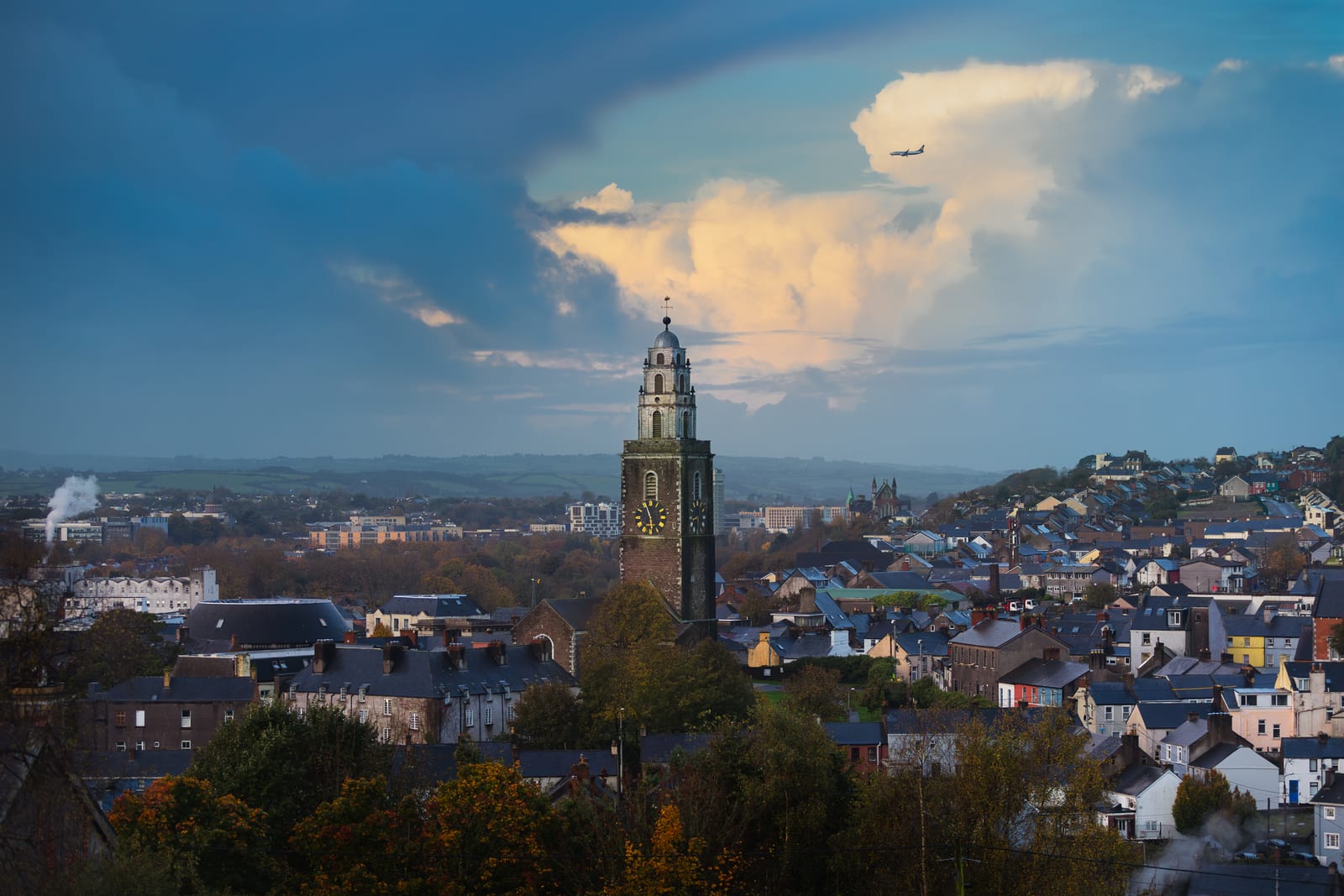
Image context: the cover is Adam Podstawczynski's real photograph made on October 28, 2023, before the 2025–26 restoration. It places the tower among Shandon's steep roofline, with two clock faces visible beneath the pale belfry and gold salmon weather vane. Current access, price and restoration status come from current sources rather than the older photograph [1][4][7].
Arrive with enough day left to wait
First local move: navigate to the church, not merely to “Shandon Bells.” The exact destination is St Anne's Church, Eason's Hill, Shandon, T23 YN88. The official visitor page estimates a 5–10-minute walk from Patrick Street, though the uphill finish deserves a little more time if you are carrying anything [1]. Let the tower do the last part of the navigation: look for dark red sandstone, pale limestone above it, black-and-gold clock faces and the salmon turning over the dome [3].
The postcode matters because “Shandon Bells” also appears in the names of unrelated Cork businesses. Once the hill steepens, keep aiming for the church rather than the nearest matching commercial pin. The small park beside St Anne's is the useful arrival room: stop there, look at the four-sided tower from below, then find the visitor entrance on Eason's Hill.
Second local move: use the opening hour, not the closing hour. From June through September, the current schedule is 10:00–16:30 Monday–Saturday and 12:00–16:30 Sunday, with last tower entry at 16:00 [1]. A Tuesday–Thursday arrival around 10:00–11:15 gives the largest buffer for weather, church use and the next available climb. This is a planning window, not a promise of an empty tower. A recent Google-review digest records an uncrowded weekday-afternoon visit, but the church's live notice and the 24-person limit control the day [1][6].
Sunday has a different rhythm. Worship begins at 10:15, while visitor hours start at noon [1]. Do not turn up during the service expecting the tower experience. St Anne's is an operating Church of Ireland parish before it is an attraction.
Third local move: understand the queue before buying. Individuals and families do not need an advance reservation, and there are no timed slots. Groups of more than 10 must pre-book; large weekend group bookings are not accepted. When the 24-person tower limit is reached, the queue simply waits [1]. Keep the hour flexible rather than wedging the climb between two fixed bookings.
The current plan-your-visit page lists an adult tower-and-church ticket at €8, seniors and students at €6, children aged 5–15 at €3, and a two-adult/two-child family ticket at €17; cash and cards are accepted [1]. A tower subpage still displays lower legacy prices, so let the current plan page or live checkout—not an old search snippet—set the budget [1][3].
Fourth local move: solve the bag and bathroom problem below. There are no public toilets on site. Large backpacks, shopping bags, unsuitable footwear, walking sticks and crutches are not allowed on the climb; the church can sometimes hold coats or bags at staff discretion [1]. Use facilities before Eason's Hill, wear secure shoes and keep both hands free. If a half-metre passage, loud bell chamber, 132 steps, heart or breathing condition, or claustrophobia makes the tower a bad fit, decide at ground level. The church interior has step-free access from St Anne's Park with staff assistance, but the tower has no lift [1].
Play one tune as if the street can hear it
Fifth local move: read the numbered music before touching a rope. St Anne's eight bells hang fixed; an Ellacombe chiming apparatus lets a visitor move each clapper with its numbered rope. Choose one of the supplied tunes, find its number sequence, then rehearse the rhythm silently. Pull one rope at a time, from the centre gently toward you. Because the bell itself does not swing, the note answers without the delay a novice may expect [2].
Do not yank harder to make the melody clearer. The apparatus converts sequence and timing, not strength, into music. The church's most useful instruction is to play at the pace you would sing [2]. If hearing protection is offered, take it before moving toward the belfry; the ropes may feel domestic, but the sound source above them weighs six tonnes [2][3].
Sixth local move: make one short attempt and leave the instrument ready. Pick a compact, familiar tune rather than the most ambitious sheet. Play it once. If a note goes astray, finish the phrase instead of restarting three times. The official guidance asks visitors to respect residents and avoid excessive playing [1][2]. That request is not quaint etiquette. Openings in the tower send your practice into actual streets and homes.
Shandon's name comes from Sean Dún, “old fort,” and its community-run walking project describes the quarter through residents, businesses, congregations and cultural groups rather than through one attraction alone [5]. The bells belong to that lived place. They were cast by Abel Rudhall in 1750, first sounded for a wedding in 1752, and were adapted to the fixed Ellacombe system in the late nineteenth century [2]. Visitors have been allowed to play them since that era. The rare privilege survives because participation has remained bounded.
The neighbourhood also hears more than anonymous notes. Francis Sylvester Mahony, writing as Father Prout, turned the Bells of Shandon into a poem and song of remembered Cork; his family rests in the graveyard beside the church [2]. Local responses to the 2026 restoration treated the renewed sound and deliberately imperfect clock as civic continuity, not as a newly installed tourist effect [4]. A restrained tune is therefore not a lesser experience. It is the form that lets the experience stay public.
Let the clock disagree on the way up
Seventh local move: climb by floors, not by a number. The route rises through five levels: bell ropes, pendulum and clock mechanism, belfry, then the outside balcony [3]. Pause at the displays and landings. Let descending visitors clear the tight section before entering it, and never stop in the narrowest passage to take a photograph. The official average for the tower alone is 15–20 minutes, but that assumes steady movement rather than a race [3].
At the clock, resist the urge to identify the “correct” face. Look at how one mechanism has to speak through four exposed dials. Cork's nickname—the Four-Faced Liar—comes from their small disagreements. The 2025–26 conservation involved specialist clock work, yet the restored faces were intentionally left to converge only on each hour [4]. Accuracy was not the only heritage value. The quirk is a resident habit of looking up and knowing that the tower tells time with character rather than perfect consensus.
Eighth local move: wait before entering the belfry. The final passage runs among the bells themselves. If a tune starts above, remain at the broader landing until the sound settles, use the available hearing protection, and follow staff instructions [1][3][6]. This is where the attraction stops being an illustration of sound and becomes physical: metal, timber supports and enclosed air.
The fresh restoration matters most here. Specialist work repaired deteriorated bell-support beams as well as the clock; cleaned stone and conserved doors were the visible edge of a project whose central task was to let weight and vibration remain safe [4]. The proper response is not to test how loudly the system can answer. It is to notice how much fabric must cooperate for one numbered pull downstairs to become a note over Cork.
Ninth local move: reach the parapet before reaching for the phone. The balcony sits 36.6 metres above ground. Step fully out of the doorway, orient, and only then choose a frame [3]. The tower itself provides the first city lesson: its north and east sides are red sandstone, while the south and west use pale ashlar limestone, a pairing often linked to Cork's red-and-white sporting colours [3]. Below, the northside falls toward the River Lee; roofs crowd the slopes because the hill, not a flat sightseeing grid, shaped the quarter.
Weather can cancel this reward. Tower access may change for wind, rain, a service or another church use [1]. Check the live venue page the same morning. If the climb closes, do not argue that a paid ticket should outrank the building's conditions. The bells, clock and balcony are one working system; the visit succeeds only when that system can safely receive you.
The visitor trapline
Mistake one: treating the bells as a warm-up for the view. Local recommendations repeatedly pair the climb with the chance to play, while the church treats careful ringing as the tower's living practice [2][5][6]. Better: give the rope room your attention, play one short sequence gently, then climb.
Mistake two: arriving at 16:20 because the summer page says 16:30. Last entry is 16:00, the 24-person cap can create a wait, and weather or worship can change access [1]. Better: arrive near opening and keep the next hour uncommitted.
Mistake three: assuming an old tower means an ordinary staircase. The route has 132 steps, a sub-half-metre pinch point, no lift and no public toilet; current visitor reports also emphasize how narrow the stone stair becomes [1][6]. Better: use facilities first, leave the large bag below and make an honest mobility or claustrophobia decision before buying.
Mistake four: playing until the tune sounds perfect. The ropes operate six tonnes of bells in a lived neighbourhood, and the venue explicitly asks for restraint [1][2][5]. Better: rehearse the numbers silently, play once at singing pace, accept the human version and leave the ropes for the next person.
A compact go plan
- Anchor: St Anne's Church, Shandon Tower and Bells; the park, clock, rope room, belfry and parapet are parts of one place, not separate stops.
- Best window: Tuesday–Thursday, 10:00–11:15 in June–September, after a same-morning weather and church-use check. Sunday visitor access begins at 12:00 after the 10:15 service [1].
- Time budget: 45–60 minutes, including a possible capacity wait, church interior, one tune and the climb. The official tower-only average is 15–20 minutes [1][3].
- Expected spend: current adult tower-and-church admission €8; cash and card accepted. Check the live plan page for concessions and any revision [1].
- Queue and reservation reality: no timed slot and no essential pre-booking for individuals or families; maximum 24 in the tower; groups over 10 must arrange ahead [1].
- What to do: choose a numbered melody, pull one rope at a time gently, stop after one attempt, then follow the five-floor sequence to the balcony [2][3].
- Where to stand: centre yourself at the Ellacombe ropes without leaning on them; wait on a broad landing rather than in the narrow stair; clear the balcony doorway before taking a photograph.
- Navigation cue:
Patrick Street -> uphill to St Anne's Church, Eason's Hill, T23 YN88 -> dark-and-pale tower with black-and-gold clocks and salmon weather vane -> visitor entrance[1][3]. - Before the door: toilet, secure footwear, small bag, free hands, weather, live hours and your own comfort with 132 steps, loud bells and a passage under 0.5 metres [1].
St Anne's offers a kind of access most landmarks refuse: the visitor can alter the city for a few seconds. The bargain is restraint. Enter early, learn the numbered language, give Shandon one brief tune, then climb through the mechanism that carried it outside. On the hour, the four faces agree. Your version of the melody does not have to.
Sources
- St Anne's Church Shandon, “Plan Your Visit” — current seasonal hours, last entry, ticket prices, payment, individual and group booking rules, 24-person cap, access limits, visitor etiquette and facilities.
- St Anne's Church Shandon, “The Shandon Bells” — official history of the eight bells, six-tonne weight, Ellacombe apparatus, numbered-rope technique, resident etiquette and Father Prout connection.
- St Anne's Church Shandon, “The Shandon Tower” — official floor sequence, 132-step climb, 36.6-metre balcony, clock mechanism, tower materials and typical tower duration.
- Steven Fox, “Shandon bells ring out after restoration.” Cork Independent (April 1, 2026) — recent local reporting confirming completed work on the bells, supports, clock, faces, stone and doors, including preservation of the Four-Faced Liar's disagreement.
- Walking Shandon, “The Shandon Historic Quarter” — resident-and-business community project on the Sean Dún name, the tower's place in the quarter and the local framing of visiting Shandon.
- Wanderlog, “St Anne's Church Shandon Bells & Tower” — review-platform digest with 2025 Google visitor reports on weekday crowd conditions, the narrow stair, ringing experience, hearing protection and city view; current logistics are checked against the venue site.
- Wikimedia Commons, “Church of St. Anne, Shandon.jpg” — Adam Podstawczynski's real October 28, 2023 morning photograph of the tower in Cork's northside roofline, used as the article image.