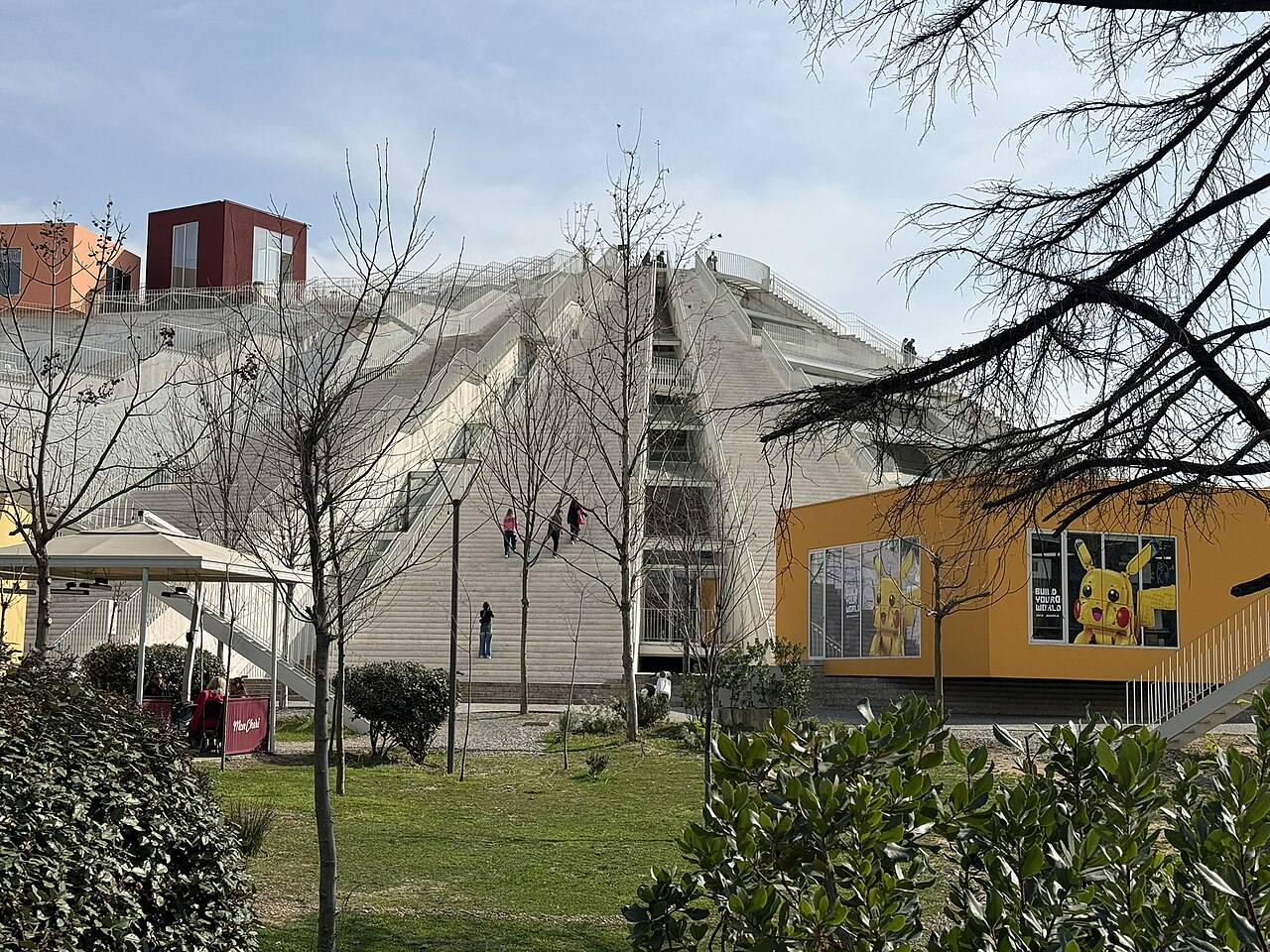
Tirana is easy to flatten into color: painted facades, cafe terraces, traffic, mountains, construction cranes. The sharper first read is one object. Use the Pyramid as a public staircase, not as a monument to tick off. It sits on the main boulevard, close enough to Blloku and Skanderbeg Square to fold into a normal walk, but strange enough to interrupt the city with a question: what happens when a former dictatorship showpiece becomes a place people climb after school, between errands, or before a night out?
The official tourism story is clear about the building's burden. Visit Tirana describes the Pyramid as a symbol of Albania's controversial history, originally erected as a mausoleum-like museum for Enver Hoxha, then pushed through lives as fair center, theater, cultural center, bar, disco, and television studio before it fell into near unusability.[1] Albania's national tourism agency gives the current version the cleaner visitor headline: built in 1988, transformed after reconstruction into a contemporary cultural and technology center, and now one of the capital's most symbolic buildings.[2]
The local move is to hold both facts at once. Do not arrive only for a selfie on white steps, and do not arrive only for a solemn history lesson. The useful Tirana read is the conversion itself. MVRDV, the architecture office behind the renovation, says the 2018-2023 project reused the concrete structure as an open sculpture in a new park, adding colored boxes for cafes, studios, workshops, start-up offices, classrooms, and youth technology programs across 11,835 square meters.[3] That is why the Pyramid works better as an object lens than as a museum stop: its meaning is in use, not in stillness.
Image context: the cover is a real 2026 Wikimedia Commons photograph of the renovated Pyramid. It matches the article because the practical experience is the climbable exterior, visible stair geometry, park edge, and box-like new rooms rather than an abstract skyline view.[6]
Start Low, Then Climb Slowly
Begin on the park side, not from the top of the boulevard. Give yourself 35-45 minutes for the object before you decide whether to continue to Blloku, Skanderbeg Square, or the river edge. The mistake is to climb immediately, snap the view, and leave. First read the ground: the colored boxes, the cafe edges, the teenagers and families crossing the site, the way the building now behaves less like a sealed pyramid than a piece of public furniture.
Then climb. MVRDV's important intervention was not merely cosmetic. Steps were added to the sloping facades so people can walk over what had once been a state monument, and a western-side lift gives roof access for people who cannot or do not want to climb.[3] That changes the etiquette. You do not need to perform the climb as a conquest. Move to the side when faster walkers come up behind you, pause at landings rather than blocking the narrow flow, and save the longer look for the top.
The best window is late afternoon into early evening, roughly 17:30-19:30 in warm months. Midday turns the white surface into glare, and late night reduces the urban-reading value. At the shoulder hour, the Pyramid has enough people to show its everyday use but not so many that every landing becomes a photo queue. Recent traveler reviews still emphasize the top as the payoff, including mixed notes that the view is worthwhile even when the interior or services feel less polished.[4] Treat that as a useful boundary: this is a public-space stop first, not a full-service attraction.
Use The Exit As The City Lesson
The Pyramid's strongest trick is that it points in several Tiranas at once. The boulevard side carries state scale: ministries, formal axes, civic ceremony. The Blloku side carries post-1990 social life: cafes, bars, apartment blocks, and the once-restricted district that now functions as one of the city's default meeting zones. A recent r/tirana visitor thread puts the Pyramid in the same practical mental map as Bunk'Art, the main square, the lake park, Air Albania Stadium, and Blloku, which is exactly how many visitors will use it: not as a standalone monument, but as a hinge between central stops.[5]
That hinge is the local payload. Exit toward Blloku if you want the city to turn social. Exit toward the boulevard if you want the state axis and Skanderbeg Square. Exit toward the Lana River if you want the softer walking connection and a break from the main-car corridor. The distance is short enough that the route feels trivial on a map, but Tirana changes mood quickly block by block. The Pyramid lets you feel that change without needing a grand itinerary.
8 Local Moves
- Arrive from the boulevard, leave toward Blloku. The sequence turns official Tirana into social Tirana in one compact walk.[2][5]
- Do the ground loop before the roof. The colored boxes and park edge explain the reuse better than the skyline does.[3]
- Use the stairs as a shared path. Pause at landings, not in the moving line; the building works because people can keep flowing across it.[3]
- Go late afternoon, not hard noon. The recommended 17:30-19:30 window gives better light, less glare, and more everyday use.
- Budget low. The exterior climb and park read can be free; spend only if you choose a cafe or event inside one of the active boxes.[3]
- Do not over-plan the next stop. Keep 10-15 minutes loose after the descent so the exit direction can follow the mood: Blloku, boulevard, or river.
- Check the stairs before committing. Heat, rain, or crowded landings can make the lift or a partial climb the smarter version of the visit.[3]
- Keep the history in the frame. The point is not that the old symbolism disappeared; it is that public use now sits on top of it.[1][3]
Non-Local Trapline
Mistake 1: treating the Pyramid as a quick viewpoint.
Better alternative: spend the first 10 minutes at ground level. The reuse logic is in the boxes, park, youth-program spaces, and cafe edges, not only in the roof view.[3]
Mistake 2: expecting a conventional museum experience.
Better alternative: treat it as an adaptive-reuse public space. Official tourism sources describe culture, technology, innovation, youth education, and open urban use rather than a single ticketed interpretive route.[2][3]
Mistake 3: taking a car between nearby central stops.
Better alternative: walk the Pyramid as a hinge. The r/tirana visitor advice clusters it with other central sights and Blloku social stops, which is a good clue that the value is in short transitions, not transfers.[5]
Mistake 4: reading the renovation as simple erasure.
Better alternative: keep the contradiction visible. Visit Tirana's history of debate, degradation, and protests against demolition matters because the current public-stair version depends on that survival story.[1]
Go Details
Best time window: 17:30-19:30 for a first visit, earlier in winter if you want daylight on the stairs.
Expected spend: 0 lek for the exterior climb and public-space read; add a cafe budget only if you choose to sit inside or beside the active boxes.
Queue and access reality: no reservation is needed for the exterior public-space experience, but crowded landings slow the climb. Use the western-side lift or do a partial climb when heat, rain, or mobility needs make the stairs less sensible.[3]
Where to stand: start at the park edge for the full facade, pause on a side landing for the boulevard angle, and save the top for the city read rather than a long photo session.
Navigation cue: Bulevardi Deshmoret e Kombit -> Pyramid ground loop -> exterior stairs -> roof pause -> Blloku edge -> choose cafe / boulevard return / river walk.
Tirana's Pyramid is not successful because it has become pretty. It is successful because it has become ordinary without becoming neutral. People can climb it, meet around it, complain about it, photograph it, study in it, and use it as a shortcut in the center of the city. That is the cleaner first lesson: in Tirana, a landmark is most alive when it stops asking to be stared at and starts carrying the city's daily movement.
Sources
- Visit Tirana, "The Pyramid of Tirana" - local tourism page on the building's origin, contested history, reuse debates, reconstruction, and current public role.
- Albanian National Tourism Agency, "The Pyramid of Tirana" - official tourism page on the building's 1988 origin, reconstruction, cultural and technology-center role, and boulevard location.
- MVRDV, "The Pyramid of Tirana" - project page on the 2018-2023 adaptive reuse, 11,835-square-meter program, public stairs, lift, youth education spaces, and mixed-use boxes.
- Tripadvisor, "Enver Hoxha Pyramid" - recent traveler review page, including 2025-2026 comments on the climb, view, visitor expectations, and current on-site experience.
- r/tirana, "Visiting" - recent city-specific community thread placing the Pyramid among central Tirana stops, Bunk'Art, the main square, lake park, stadium, and Blloku.
- Wikimedia Commons, "File:Piramide de Tirana, Albania 05.jpg" - 2026 documentary photograph used as the article image.