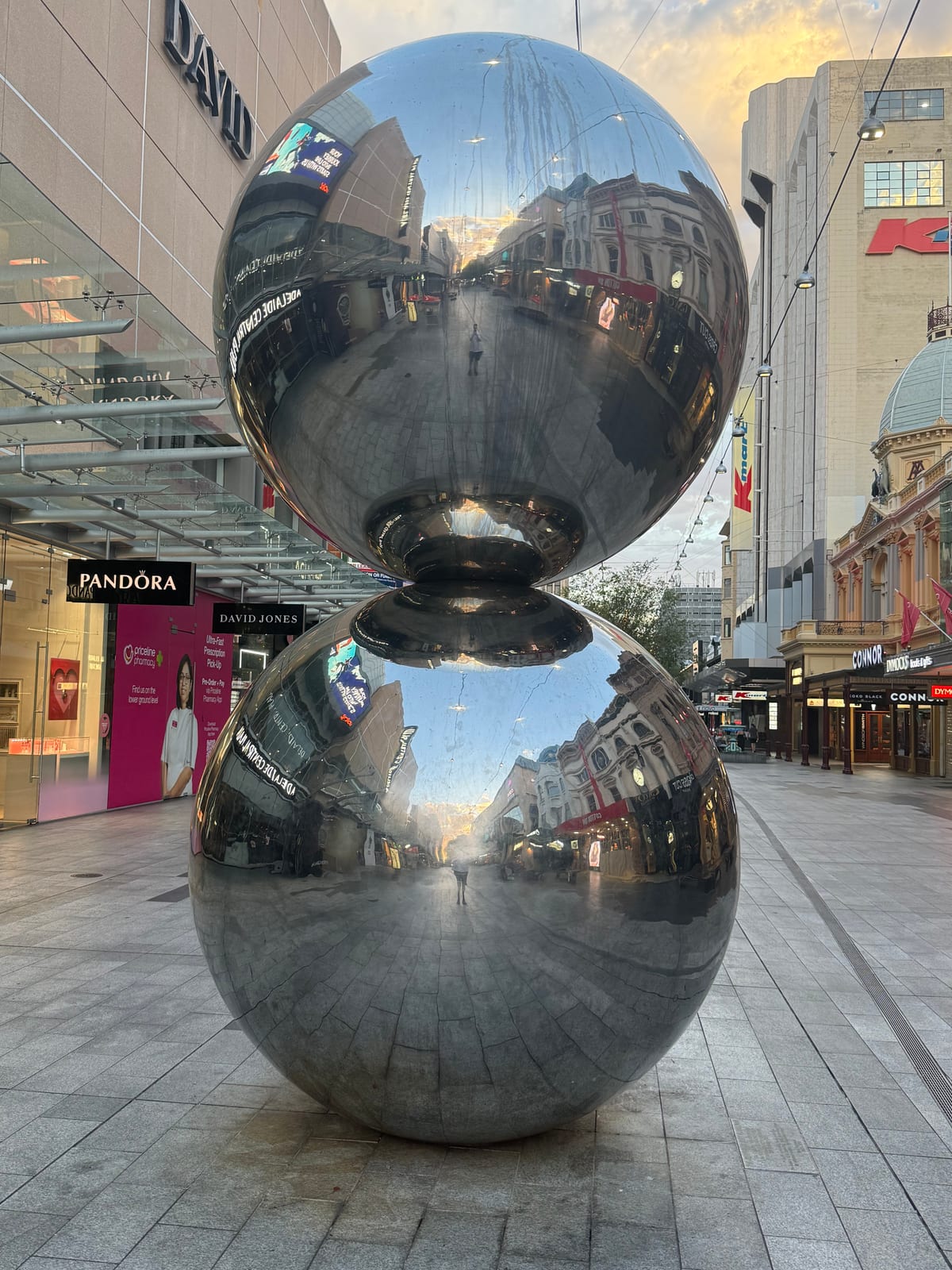
In Adelaide, “meet me at the Mall's Balls” is a complete instruction. It names no artist, gives no street number and uses none of the sculpture's official title. Yet generations of people have understood it: go to the two polished steel spheres stacked in Rundle Mall and look for the person who is looking for you [1][4].
The official work is Bert Flugelman's The Spheres: two stainless-steel balls, each 2.15 metres in diameter, balanced one above the other at 100 Rundle Mall. Together they rise a little over 4 metres outside Adelaide Central Plaza [1]. The local name supplies something the catalogue cannot. “The Mall's Balls” is not merely a joke attached to an artwork; it is a piece of civic shorthand that turns an abstract sculpture into social infrastructure.
Give the object 10–15 minutes, ideally on a weekday between 07:45 and 08:45. This is an editorial window keyed to the precinct's standard 09:00 weekday trading start, not an official session or a promise of solitude [12]. The visit costs AUD0, needs no booking and has no formal queue. From the Rundle Mall tram stop on King William Street, allow roughly 5 minutes to walk east through the pedestrian strip. Tram travel within Adelaide's CBD free zone is currently free, and the official 2026 network map places Rundle Mall directly on that city section [6][7].
As of August 30, 2026, there is an unusually good reason to look closely. Rundle Mall is marking 50 years since its September 1, 1976 opening. The anniversary reporting returns to the original promise: this was to be more than a shopping street; it was intended as a place to stroll, meet and share open-air activity [2]. The spheres arrived later, on October 5, 1977 [3]. That one-year gap matters. The mall created the public room first; the object became its most useful address.
Say the local name, then use the exact address
The first local move is linguistic. Save “The Spheres” for the art record, but say “Mall's Balls” when arranging to meet. The City of Adelaide's own visitor listing uses both names and describes the work as a popular meeting place [1]. In a local Adelaide discussion, residents remembered using the same phrase as teenagers and watching newcomers laugh before immediately understanding it [4]. The nickname is not a visitor's attempt at forced familiarity. It is the ordinary name doing ordinary work.
The second move is geographic: save 100 Rundle Mall, outside Adelaide Central Plaza, not a loose pin for “Rundle Street.” The former Rundle Street between King William and Pulteney streets became the pedestrian mall in 1976; Rundle Street continues east beyond it [3]. If arriving by tram, step from the Rundle Mall stop, face into the vehicle-free corridor and walk east. Look for two silver spheres stacked vertically, not for a conventional statue on a plinth.
Use the early window because this object is also a junction. The official accessibility guide describes the mall as an outdoor, partly covered environment with conversation, music and traffic noise; it notes that side lanes are generally quieter than the central walkway [8]. A recent local review of a walking tour notes that it starts at the Balls precisely because the point is conspicuous and easy for a group to assemble around [9]. Arriving between 07:45 and 08:45, before the published 09:00 retail start, improves the odds of a legible reflection without pretending the public corridor will be empty [12]. Later, buskers, shoppers, campaigners, school groups and friends waiting for friends become part of the image—and sometimes the entire image.
That is the third move: choose the time according to the purpose. Come early for the form and reflections. Come during the day to understand the work as a meeting point. Do not demand both solitude and public life from the same five square metres.
Read it from five paces, then one
Stop about five paces away before reaching for a phone. From too close, one sphere fills the view and the stacked construction disappears. From the middle distance, the contact between the two balls looks improbably small, the upper sphere appears to hover, and the surrounding facades bend across two different convex surfaces. The city catalogue emphasizes those elongated, distorted reflections; recent visitor reviews keep returning to the same pleasure [1][5].
The fourth move is to make one slow circuit. Start on the King William Street side, where the length of the mall can enter the reflection, then move around far enough to see Adelaide Central Plaza and the opposite shopfronts trade places in the metal. You do not need to decode a hidden symbol. Flugelman's object is strongest when it makes the familiar street unstable for a moment: paving climbs, buildings bow, and the observer appears twice, once in each sphere.
Only then step closer. The fifth move is to find yourself without centring yourself. Stand slightly off-axis and watch how other pedestrians cross the reflection. A person ten metres away can appear beside your shoulder; a shopfront behind you can surface in front. The work makes a compact model of public space: everyone shares the picture, but nobody controls it for long.
Public contact is part of the object's actual life. South Australia's government describes tourists posing, children interacting and meeting groups gathering at the steel. The artwork is conserved rather than left to fend for itself—a specialist team spent five days chemically cleaning it in 2023—but the goal was to keep it bright and available for public interaction, not to turn it into an untouchable museum object [10].
So the sixth move is light-touch and situational. Let a waiting group finish its greeting before moving in. In hot, direct sun, do not assume polished steel will be comfortable to touch. Keep bags and drinks off the work, take the close photograph, then yield. There is no rope line, which makes self-managed turn-taking more important, not less.
Use it as a meeting point once
Looking is only half the object lens. The seventh move is to use the sculpture for its adopted civic job. If travelling with someone, split for five minutes and agree to reconvene “at the Mall's Balls, on the Adelaide Central Plaza side.” That extra side cue prevents two people from orbiting the same four-metre object in opposite directions. Stand a few steps off the steel so you remain visible without becoming part of somebody else's photograph.
This small exercise explains why the work endured. Rundle Mall opened in 1976 after bitter argument over removing cars from a commercial street. About 10,000 people attended the opening, where a fountain was filled with champagne. The space later held a 1984 Boy George appearance that drew about 25,000, team celebrations and public festivals [2]. Against those crowd scales, two abstract spheres sound insufficient. In practice, they solve a human-sized problem the whole mall creates: where, exactly, inside a long public corridor should two people find each other?
The eighth move is to leave without converting the anchor into a checklist. If the central strip feels loud or congested, use one of the quieter side lanes identified in the mall's access guide, then continue your day [8]. No second monument is required. The useful afterimage is already in the spheres: an old retail street, remade as a pedestrian room, reflected around the tiny figure who came to meet someone.
Three visitor mistakes, and the better move
**Mistake one: searching only for *The Spheres. That is the correct catalogue title, but it hides the object's local function. Better: navigate to *100 Rundle Mall, then use “Mall's Balls” in the meeting message. The official and community sources agree on the nickname's practical currency [1][4].
Mistake two: arriving at peak retail time for an empty architectural photograph. Current reviews show that the reflective shot is part of the appeal, while the access guide makes clear that the mall is an active, noisy outdoor environment [5][8]. Better: use the editorial 07:45–08:45 window before standard trading begins at 09:00, or accept that daytime crowds are evidence of the sculpture working [12].
Mistake three: calling the sculpture itself 50 years old in 2026. Rundle Mall opened on September 1, 1976; The Spheres was installed on October 5, 1977 [2][3]. Better: read the sequence. First Adelaide made room for pedestrians. Then Flugelman's work gave that room a shared coordinate.
The go details
- Primary anchor: The Spheres, widely known locally as the Mall's Balls, outside Adelaide Central Plaza at 100 Rundle Mall [1].
- Best window: weekday 07:45–08:45, before the precinct's standard 09:00 retail start, for a cleaner read of the form; daytime if the meeting-point ritual matters more than the photograph [12].
- Time needed: 10–15 minutes, plus about 5 minutes on foot from the Rundle Mall tram stop.
- Expected spend: AUD0. The sculpture is outdoors, with no ticket or reservation.
- Transit move: use the free CBD tram zone, alight at Rundle Mall and walk east into the pedestrian corridor [6][7].
- Queue reality: no formal line. Wait for greetings or photographs to finish, approach from the side, and step away after your turn.
- Recognition cue: two polished 2.15-metre stainless-steel spheres, one above the other, beside Adelaide Central Plaza—not the bronze pigs or the newer giant pigeon elsewhere in the mall [1][2].
- Weather boundary: the central strip is outdoors and only partly covered; use a quieter side lane when heat, rain or noise makes lingering unpleasant [8].
The Mall's Balls do not summarize Adelaide. They perform a smaller and better trick. They turn a shopping corridor into a place where somebody can say “meet me there,” then see the city, the crowd and the person they came for arrive in the same curved surface.
Sources
- Experience Adelaide, “The Spheres” — City of Adelaide public-art record for the official and local names, artist, 2.15-metre dimensions, 100 Rundle Mall address, distorted reflections and meeting-point use.
- ABC News, “Adelaide's Rundle Mall celebrates 50th anniversary” (August 30, 2026) — current local reporting on the September 1, 1976 opening, pedestrianisation debate, public-room promise, anniversary and crowd history.
- SA History Hub, “Rundle Street” — History Trust of South Australia account of the street-to-mall conversion and the October 5, 1977 installation of Flugelman's Spheres.
- r/Adelaide, “Architects Digest thinks we're pretty nifty!” (July 31, 2024) — local community discussion documenting the Mall's Balls as a teenage meeting instruction and a visitor's first encounter with the local name.
- Tripadvisor, “The Mall's Balls Statue” — review platform with 2025–2026 visitor reports on the reflective surface, photo angles, landmark function and current on-site condition.
- Adelaide Metro, “Free and special services” — current operator boundary for fare-free CBD tram travel.
- Adelaide Metro, Adelaide trams (effective January 26, 2026) — current official network map placing Rundle Mall in the city tram sequence and free-travel area.
- Rundle Mall and City of Adelaide, Access Guide: Rundle Mall (2025) — recent official guidance on the outdoor, partly covered environment, sound levels and quieter side-lane alternatives.
- Adelaide Insider, “Welcome to Adelaide Walking Tour” (July 2026) — recent local review/listing confirming that the tour meets at the Mall's Balls at 100 Rundle Mall because the point is easy to find.
- WE ARE.SA, “Meet the team helping to maintain the ‘Mall's Balls’” (October 4, 2023) — South Australian government account of Artlab's five-day chemical clean and the conservation goal of continued public interaction.
- Wikimedia Commons, “File:Mall's Balls, Adelaide, January 2026 03.jpg” — DaHuzyBru's January 8, 2026 documentary photograph used as the article image (CC BY-SA 4.0).
- Rundle Mall, “Opening Hours” — current official precinct page listing a standard 09:00 retail start and noting that individual store hours can vary.