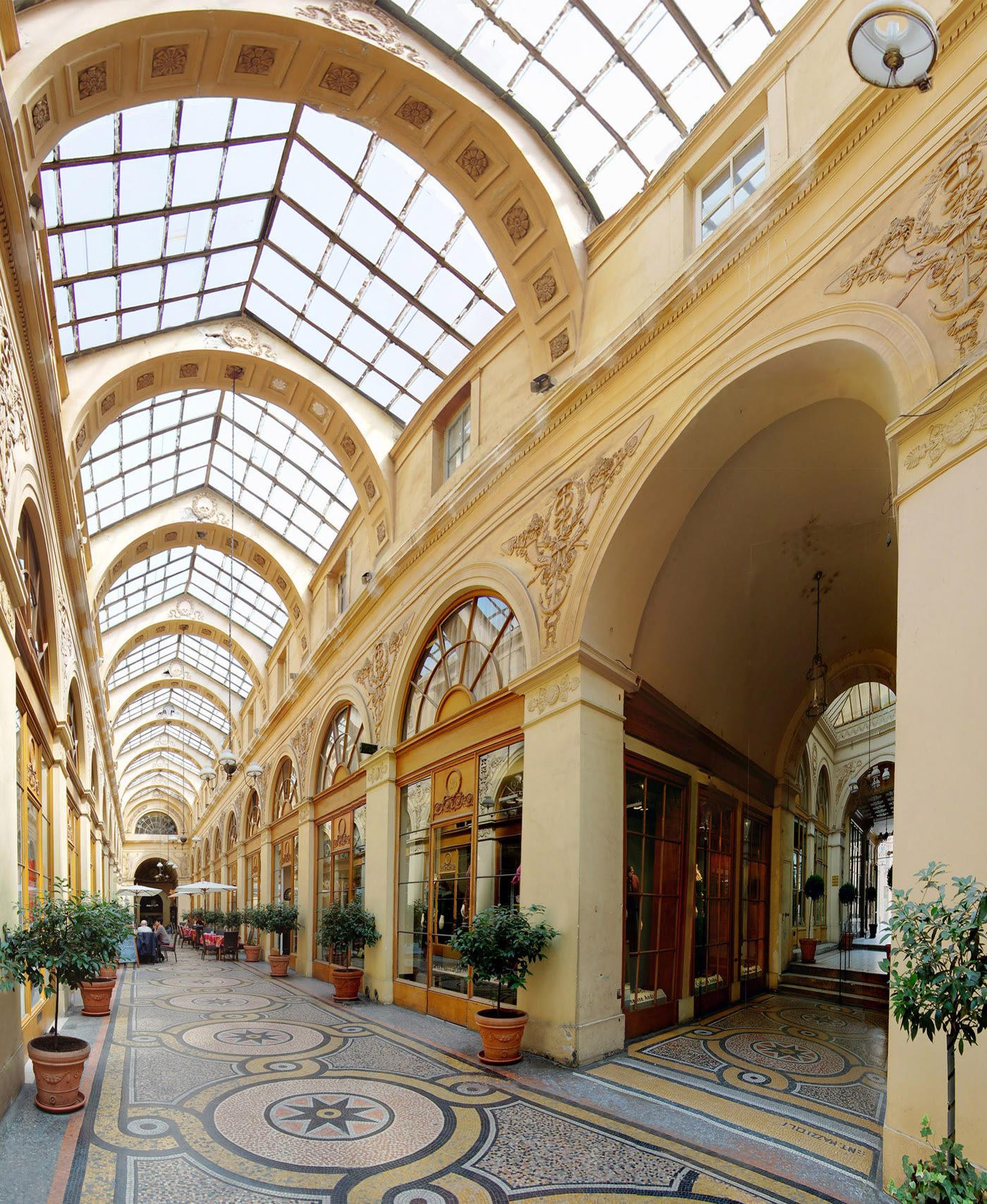
Rain improves some cities by forcing you indoors. Paris gets more interesting when the weather narrows the walk without ending it. On a damp Right Bank day, the clean move is to use two covered passages that do different jobs: Passage des Panoramas first for motion, noise, and appetite; Galerie Vivienne second for symmetry, light, and deceleration.[1][2][3]
This is a tight two-anchor run. Both anchors are non-food. Both are old Paris technologies for bad weather. And the sequencing matters. Passage des Panoramas, opened in 1799 and still free to enter from 6am to midnight, is the older, narrower, more crowded machine.[1][4] Galerie Vivienne, built in 1823 and running 176 metres under its glass roof, is the calmer, more polished room, with free access generally from 8:30am to 8pm on the gallery's own guidance.[2][3][5]
Place-specific texture is what turns this from a shelter trick into a Paris read. These passages were not built as nostalgia objects. They were nineteenth-century weather infrastructure: lit, commercial shortcuts that let people move through the city without surrendering to mud, carriage spray, or raw winter street exposure.[3][4] In Panoramas the result is compressed energy; in Vivienne it becomes a composed interior street with mosaic discipline and a bookish aftertone from Librairie Jousseaume, which has been there since 1826.[3][5][8]
Anchor 1: Passage des Panoramas - let the weather collapse the city for you
Start at the Boulevard Montmartre side if the pavement is wet and the boulevard is still running hot. Panoramas is only 133 metres long, but it absorbs more city signal per minute than most longer Paris walks because everything is close to the body: restaurant fronts, old signwork, stamp-and-postcard specialists, theatre spillover near the Theatre des Varietes, and one of the earliest gas-light experiments in Paris, introduced here in 1816-1817.[1][4]
The point is not to dine immediately. The point is to let the passage compress the street into something readable. If you stop for a full sit-down lunch at the first open table, the route loses its shape and becomes generic refuge behavior. Keep the first pass to 15-20 minutes. Look up, clock the narrow width, feel how quickly the noise level drops once you clear the boulevard entrance, and keep moving.[4][6]
Google Maps review streams back up the practical version of this: Panoramas is easy when treated as a through-route with selective pauses, and annoying when treated as a single static room, especially around lunch and dinner pinch points.[6]
Anchor 2: Galerie Vivienne - the second room should slow you down
Then pivot south-west to Galerie Vivienne. The cleanest first impression is the Rue des Petits-Champs entrance, which the gallery's own recent visitor guide recommends because it gives you the strongest depth read immediately, with the longest visible stretch of mosaics and glass overhead.[2]
Vivienne is different in almost every useful way. It is longer at 176 metres, more formal in proportion, and quieter in tone.[3][5] The rotunda and the monumental glass canopy are the main event, but the floor matters just as much: the mosaic pattern gives the gallery its walking rhythm, and the shopfronts hold the line instead of shouting over it.[3][5] This is the point in the sequence where you stop rushing and let the weather become background.
The gallery's own November 2025 advice is unusually operational: weekday mornings between 8:30 and 10:30 give the softest light and the lowest crowd load, while weekends bring a much denser flow.[2] That is the useful edge. If the rain is light and you want atmosphere, late afternoon works; if you want the architecture to feel almost private, morning wins.
8 local moves that materially improve the walk
First, start in Panoramas and finish in Vivienne, not the other way round. The older, noisier passage is better as an opening compression chamber; Vivienne works better as release.[1][3][4]
Second, enter Panoramas from Boulevard Montmartre on wet days. The transition from noisy boulevard to covered corridor is the whole point of the first anchor.[1][4]
Third, keep the Panoramas stop short on first pass. Give it 15-20 minutes, then move. Long indoor stalling turns the passage into generic shelter and blurs the sequence.[4][6]
Fourth, treat restaurant density in Panoramas as friction, not as the goal. The cleaner move is to read the passage first and only decide on coffee or lunch after Vivienne.[6]
Fifth, use Rue des Petits-Champs for your Vivienne entry. That entrance gives the strongest first-perspective payoff and matches the gallery's own visitor advice.[2]
Sixth, look up before you photograph the floor. In Vivienne, the ceiling rhythm and rotunda structure explain the passage better than a mosaic close-up alone.[3][5]
Seventh, choose one of two weather windows: weekday 8:30-10:30 for low-friction architecture, or rainy 17:00-19:00 for more atmosphere before the Right Bank dinner wave fully thickens.[2][6][7]
Eighth, keep the whole sequence to 50-75 minutes unless you are adding a deliberate bookstore or cafe stop. The passages reward density, not marathon lingering.[2][8]
Non-local trapline: 3 common mistakes and cleaner alternatives
Mistake 1: using covered passages only as emergency rain backup
Better move: use the rain as the editorial logic of the walk. These spaces were built for bad-weather movement; the weather is part of the route, not an interruption.[3][4]
Mistake 2: doing Galerie Vivienne first because it looks prettier in photos
Better move: let Panoramas roughen your eye first. Vivienne lands harder when it comes second.[1][2][3]
Mistake 3: showing up on a Saturday afternoon and expecting hush
Better move: go on a weekday morning if you want architecture, or rainy late afternoon if you want atmosphere with tolerable flow. The gallery's own recent guide explicitly warns that weekends are the crowded case.[2][6][7]
Concrete go details
- Passage des Panoramas: opened 1799, about 133 metres long, generally open 6:00-24:00, free entry.[1]
- Passage des Panoramas lighting milestone: gas illumination introduced in 1816-1817.[4]
- Galerie Vivienne: built 1823, inaugurated 1826, about 176 metres long, generally accessible 8:30-20:00, free entry.[2][3][5]
- Galerie Vivienne heritage status: listed as a historic monument in 1974.[5]
- Best low-friction architecture window: weekday 8:30-10:30.[2]
- Best atmosphere window in wet weather: roughly 17:00-19:00 before dinner density peaks.[2][6][7]
- Expected spend: EUR0 if you keep it as a walk; add a deliberate cafe or bookstore stop only after the sequence is complete.
- Queue/reservation reality: no ticketing or reservations; the only real friction is restaurant clustering in Panoramas and weekend photo congestion in Vivienne.[2][6][7]
- Navigation cue: enter Panoramas from Boulevard Montmartre, exit toward Rue Saint-Marc/Rue Vivienne, then aim for the Rue des Petits-Champs entrance at Galerie Vivienne.[2][4]
Portable takeaway artifact: the wet-day Paris covered-passage card
| Condition | Start | Pace | Decision rule | Why it works |
|---|---|---|---|---|
| Weekday rain, architecture-first | Passage des Panoramas | Quick first pass, slower second pass | Be inside Vivienne by 10:30 | Lower crowd load, cleaner ceiling-and-floor read.[2] |
| Late-afternoon drizzle, atmosphere-first | Passage des Panoramas | Dense first room, calm second room | Keep Panoramas brief; let Vivienne absorb the longer pause | Better contrast between the two passages.[2][6][7] |
Paris has many better-known wet-day answers. Few are as portable as this one. Two passages, one weather condition, and a clear sequence are enough to turn drizzle from nuisance into structure.
Sources
- Paris je t'aime, "Passage des Panoramas" (1799 opening; 133 metres; free entry; general access 6am-midnight).
- Galerie Vivienne, "Preparer sa premiere visite a la Galerie Vivienne sans pieges" (2025-11-05; weekday 8:30-10:30 soft-light window; weekend crowd warning; Rue des Petits-Champs entrance advice).
- Galerie Vivienne, "Histoire de la Galerie Vivienne" (1823 construction, 1826 opening, 176-metre length, all-weather shortcut logic, general access 8:30-20:00).
- Passages et Galeries, "Passage des Panoramas" (weather-shelter function, 1816-1817 gas-light milestone, Theatre des Varietes adjacency).
- Passages et Galeries, "Galerie Vivienne" (176-metre length, rotunda and glass roof, 1974 historic-monument listing).
- Google Maps community listing, Passage des Panoramas, Paris (recent review stream on crowding and restaurant pinch points; accessed 2026-03-24).
- Google Maps community listing, Galerie Vivienne, Paris (recent review stream on entry choice, crowd timing, and photo-flow behavior; accessed 2026-03-24).
- Paris ZigZag, "Cette librairie se cache dans un passage couvert depuis 1826" (Librairie Jousseaume context inside Galerie Vivienne).
- Wikimedia Commons, "File:GalerieVivienne1.jpg" (documentary photograph used for the cover image, David Pendery, 2011).