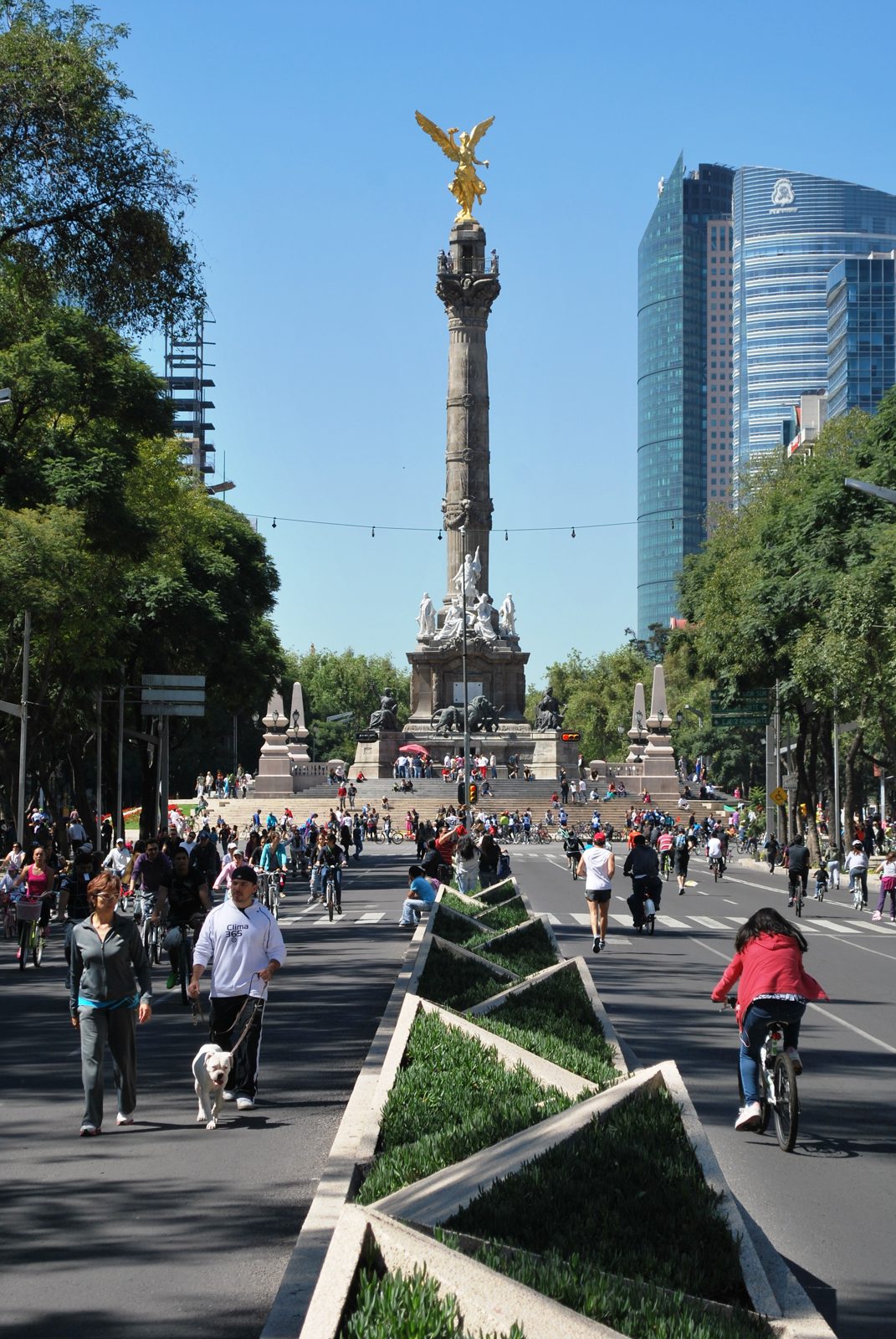
On most days, Paseo de la Reforma is a pressure corridor: protest avenue, commuter funnel, ceremonial axis, and traffic problem at once. On Sunday morning it turns into something else. The clean first reading is not the full citywide loop. It is one weekly handoff: start at the Angel de la Independencia, let the car-free stream pull you west, and leave the boulevard at Chapultepec's Puerta de los Leones.[1][2][8] The cover image documents exactly that Sunday version of Reforma, with riders running under the Angel instead of under traffic lights.[9]
This is a ritual piece, not a fitness piece. Muévete en Bici runs every Sunday except the last Sunday of the month, generally from 08:00 to 14:00, and the city says the program draws roughly 90,000 people on an average weekend.[1] In 2025, the program closed the year with more than 4.4 million attendees across 40 rides.[3] Those numbers matter because they explain why a short, legible segment works better than vague ambition. The full route can stretch to 61 kilometres.[2] Your morning does not need all of it.
Anchor 1: the Angel is for timing, bike access, and commitment
The Angel works best as a start signal, not as a photo stop that delays the ride. If you arrive with your own bike, or with ECOBICI already set up, the best move is to roll early and let the first hour do the work. If you still need wheels, the city runs a free bike-loan point through INJUVE at Glorieta del Ahuehuete from 09:00 to 12:30; loans last 60 minutes and require an INE or passport.[1]
That one operational detail separates a smooth morning from a messy one. ECOBICI remains perfectly usable if you are already inside the system, but the official pricing page makes the timer clear: each trip is designed around a 45-minute use window, and a 1-day pass costs MXN123.[4] Community advice from Mexico City riders is consistent on the practical version: if you are visiting, do not discover bike-access friction at the curb, and if you want the cleanest Reforma run, do it before 10:00.[5][6]
Anchor 2: Puerta de los Leones is where the boulevard becomes a park
The correct finish is not "wherever you get tired." It is Puerta de los Leones, the monumental threshold into the first section of Bosque de Chapultepec. That gate gives the ride a proper ending because it changes the city's texture in one move: asphalt rhythm gives way to trees, shade, and pedestrian park tempo. The gate itself belongs to the old ceremonial grammar of the avenue. According to INAH, the entrance was inaugurated on 19 September 1910 for the independence centennial, and the bronze lions now seen there were installed in 1986 as replicas of the original sculptures.[8]
That historical seam is why this handoff reads so well. Reforma is the city's staged civic line; Chapultepec is its release valve. If you keep chasing kilometres after the gate, the ritual dissolves into generic exercise. If you stop at the gate, reset, and decide what to do next only after you are inside the park, the sequence holds.
8 local moves that materially improve the run
First, treat 08:15-10:00 as the high-yield window. The official program hours are long, but local riders repeatedly point first-timers toward the earlier band for a cleaner Reforma read.[1][5]
Second, start at the Angel and finish at Puerta de los Leones even if the full route is longer. The citywide scale can reach 61 km; the useful first pass is much shorter.[2][8]
Third, if you still need a bike on arrival, use the Ahuehuete loan point instead of improvising a payment setup on the sidewalk. The official loan terms are simple: 09:00-12:30, 60-minute loans, and ID or passport.[1]
Fourth, if you are already using ECOBICI, remember the timer. The system is built around 45-minute trips, so either dock before entering deeper into Chapultepec or switch to a walk once you cross the gate.[4]
Fifth, check @MiBiciCDMX or same-day local coverage the night before. Special Sundays do alter the route. On 8 March 2026, for example, local coverage confirmed a shortened 36-km version with Reforma and Chapultepec removed from the usual Sunday script.[7]
Sixth, do not make the morning depend on the last Sunday of the month. Local clarification from Mexico City riders is blunt: the regular open-streets format runs on Sundays except the last one, when the city shifts to Cicloton logic instead.[6]
Seventh, use the Angel as a meet point, not a lingering plaza stop. The ride gets better once you leave the roundabout and let the avenue become movement rather than monument-viewing.[5]
Eighth, let the gate decide the transition. Once the stone lions appear ahead of you, stop thinking about the boulevard as a ride to maximize and start thinking about the park as the next room.[8]
Non-local trapline: 3 common mistakes and cleaner alternatives
Mistake 1: arriving late and treating the event like an all-day ride
Better move: remember that the official window is 08:00-14:00, and the cleaner local reading tends to come early, especially before 10:00.[1][5]
Mistake 2: assuming every Sunday uses the same route
Better move: check the route the night before. The last Sunday changes format, and exceptional dates can remove Reforma entirely.[6][7]
Mistake 3: making the ride depend on last-minute bike setup
Better move: bring your own bike, preconfigure ECOBICI, or use the city's Ahuehuete loan point with ID. The real friction is access, not ticketing.[1][4][6]
Concrete go details
- Official schedule: every Sunday except the last Sunday of the month, usually 08:00-14:00.[1]
- Full event scale: up to 61 km on citywide Sunday route versions.[2]
- Program scale: about 90,000 average users per weekend; more than 4.4 million attendees in 2025 across 40 rides.[1][3]
- Free bike-loan option: Glorieta del Ahuehuete, 09:00-12:30, 60-minute loans, INE or passport required.[1]
- ECOBICI option: 45-minute trip timer; MXN123 for a 1-day pass.[4]
- Best first-pass window: roughly 08:15-10:00 if your goal is rhythm rather than a crowded recreation strip.[1][5]
- Expected spend: MXN0-123 before coffee, depending on whether you use the free loan or a 1-day ECOBICI pass.[1][4]
- Queue/reservation reality: no reservations; the real variables are bike access and same-week route changes.[1][6][7]
- Where to ride: hold the Reforma stream westward, then let Puerta de los Leones be the clean moment to peel into Chapultepec's first section.[8]
- Navigation cue: when the lion-flanked gate and tree canopy open ahead, the boulevard phase is over.[8]
The point of this Sunday run is not mileage. It is reading how Mexico City changes character when one of its hardest-working avenues stops serving cars and starts serving bodies. The Angel gives the ritual its civic face. Puerta de los Leones gives it an ending.
Sources
- SEMOVI, "Muévete en Bici" (every Sunday except the last; usual 08:00-14:00 window; about 90,000 users per weekend; Ahuehuete loan point; 09:00-12:30; 60-minute loans; INE or passport requirement).
- SEMOVI, "El primer Paseo Dominical Muévete en Bici 2025 contará con ruta de 61 km y el regreso del préstamo gratuito de bicicletas" (61-km route version; return of free bike loans).
- SEMOVI, "Muévete en Bici cierra 2025 con más de 4.4 millones de asistentes" (4.4 million attendees across 40 rides in 2025).
- ECOBICI, "¿Ya conoces el sistema de cobros de ECOBICI?" (45-minute trip window; 1-day pass MXN123).
- r/MexicoCity, "Itinerary Help 4 days" (community advice on Sunday riding, free bike options, and doing Reforma before 10:00).
- r/MexicoCity, "Clarification on Paseo Dominical" (community clarification that the regular open-streets ride is not on the last Sunday; route-check and bike-access advice for visitors).
- Chilango, "Gran Rodada y Paseo Dominical en CDMX: rutas y horarios del 8 de marzo" (March 8, 2026 route modification to 36 km, without Reforma or Chapultepec).
- INAH, "La Puerta de los Leones reabre su portón" (1910 inauguration at Chapultepec's first section; 1986 replica lions).
- Wikimedia Commons, "File:PaseoAngelBicylistsDF.jpg" (2011 documentary photograph used for the cover image).