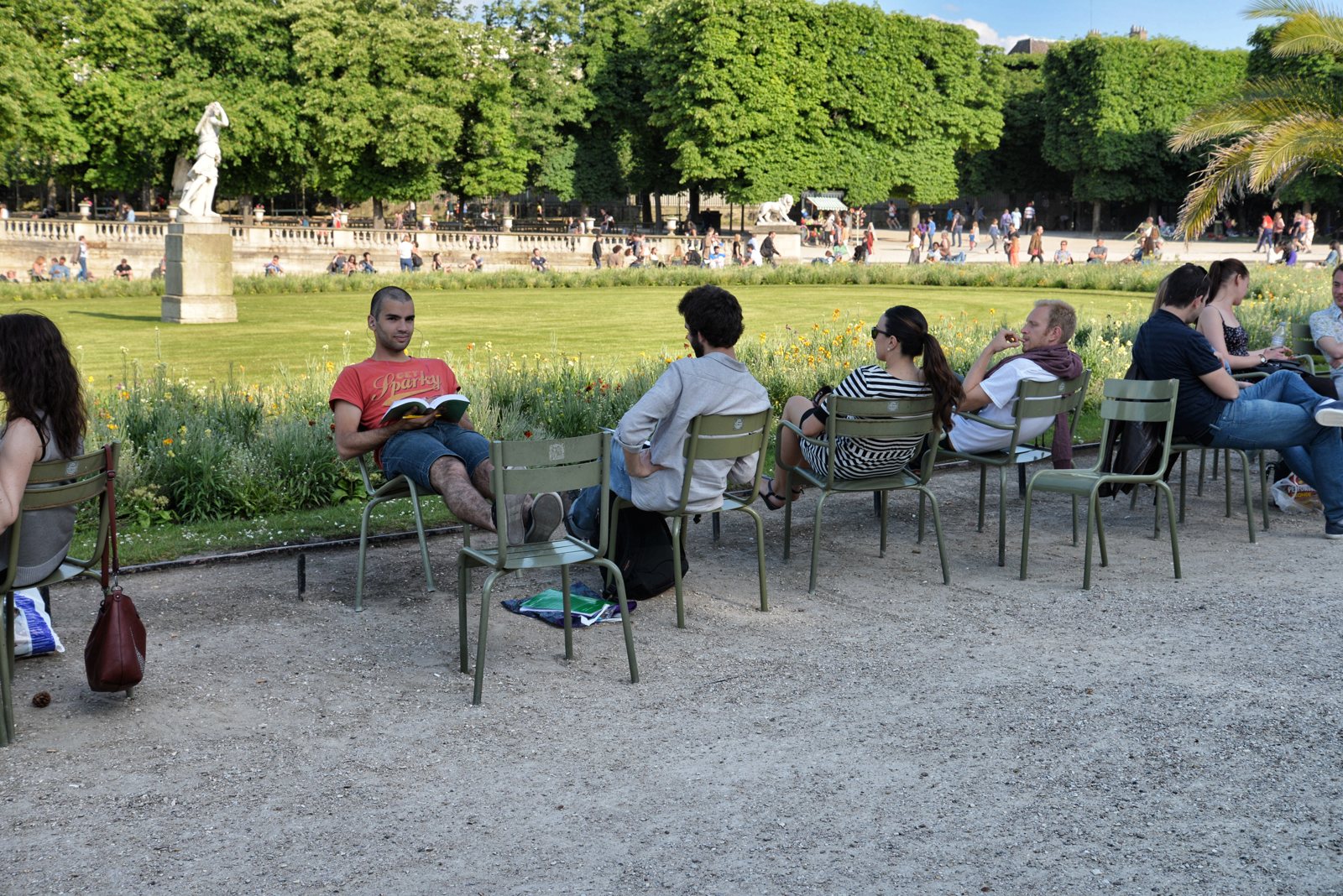
If you want one Paris move that quietly upgrades an ordinary walk, use one object as your planning spine: the movable green Sénat chair in the Jardin du Luxembourg.
The useful local logic is not merely “sit in a pretty park.” It is understanding that the chair is portable, scarce in the best light, governed by actual garden rules, and powerful precisely because it lets you re-cut the park into different moods without leaving it.
This guide keeps a strict two-anchor scope:
- The Grand Bassin edge for sun, spectacle, and people-watching.
- The Medici Fountain side for shade, quiet, and a slower second act.
A place-specific texture detail matters here: Parisians still call the garden the Luco, and that nickname fits the way people use it—less as a monument to be “covered” than as a familiar public room you return to when the light is right.[7][8]
Image note: the hero photo shows the movable green chairs in use at the Luxembourg Gardens, which is exactly the operating object this article is built around.
Anchor 1: the chair is the real control surface, not the lawn or the path
The first thing worth knowing is that these chairs are not decorative leftovers. The Senate’s own heritage page says there are about 4,500 movable seats in the Luco, while the figures page gives the current total more precisely as 4,517 seats and chairs, alongside about 3,500 bench-equivalent places.[3][4]
That number sounds abundant until weather turns good. Local coverage makes the lived reality clearer. Paris ZigZag describes the familiar scramble as soon as the sun appears, when people effectively have to compete for the chance to spend a few hours in one of the famous green seats.[7] Sortiraparis makes the same social fact visible in softer language: this is one of the most prized Paris gardens for both residents and visitors, and lounging in the chairs is part of the point rather than an incidental perk.[8]
The chair also has a historical logic that changes how you read the place. The Senate notes that the current model dates to 1923, that the Senate imposed this standardized type in 1955, and that use only became free in 1974 after the institution repurchased the remaining concession stock.[3] So the chair is not just a pleasant object. It is an old Paris habit with governance, continuity, and a very literal public-use history built into it.
Even the weight matters. The official heritage note gives the steel versions at 7.3 kg for the chair, 9.6 kg for the armchair, and 13.5 kg for the recliner.[3] That explains why these seats feel movable but never flimsy. They are light enough to re-angle your afternoon, heavy enough to resist both theft and wind. In other words, they were designed for exactly the kind of micro-positioning that visitors often ignore.
Anchor 2: the Grand Bassin and the Medici Fountain are two different chair worlds
The garden is large enough to contain separate atmospheres without becoming logistically messy. The Senate’s figures page puts the Luxembourg Garden at 25.72 hectares, with 21.75 hectares open to the public, and records 6.2 million visitors in 2022.[4] Official history material describes the garden’s current form as the outcome of centuries of reshaping, while the practical result today is that you can move only a short distance and end up in a very different social rhythm.[5]
That is why the best chair strategy is not to sit once and stay loyal to that first choice. It is to use the chair as a switching device between two park rooms.
At the Grand Bassin, the chair works like a front-row ticket. This is the brighter, more visible Luxembourg: palace-axis views, children’s sailboats, statues, open sky, and the kind of social theater that makes Paris park culture feel performative in the best way.[4][8] It is where first-timers usually want to be, and often where they overstay.
At the Medici Fountain, the chair becomes something else. Paris’s own 2025 fountain history note reminds you that the Medici fountain began as a royal grotto commissioned in the 1630s by Marie de Medici, then was displaced and reworked during the Haussmann era into a basin about 50 meters long.[6] The point on the ground is not only heritage. It is that the atmosphere there stays more enclosed, more tree-filtered, and better suited to reading, conversation, or simply cooling the pace after the basin-side brightness.[6]
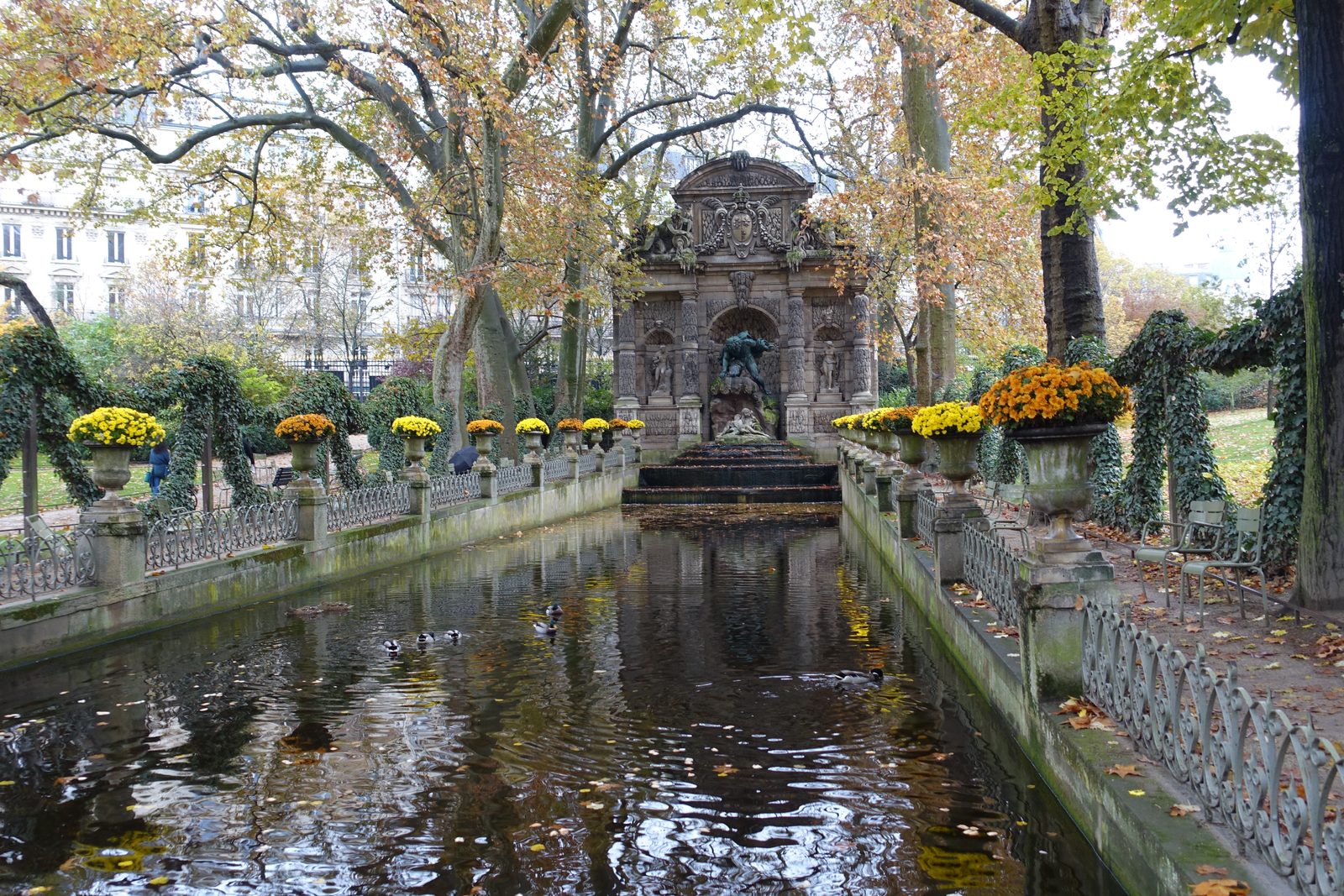
Once you understand those two chair worlds, the Luco stops being “a nice garden” and starts behaving like a highly efficient afternoon machine.
8 local moves that make the Luxembourg chair actually useful
First, check the day’s opening window before you build the stop into your route. The gates do not follow one static schedule; the Senate adjusts them every fortnight with daylight. For 1–15 March, the garden opens at 7:30 am and closes at 6:15 pm; from 16 March to the last Saturday of the month it closes at 6:30 pm; after the last Sunday in March it stays open until 7:30 pm.[1] A lot of sloppy Paris planning comes from assuming parks behave like plazas.
Second, treat the first chair you see as a decoy. Do one slow basin-edge scan first. The chair is movable; your job is to choose angle, exposure, and crowd density before you commit.
Third, around the Grand Bassin, use the chair for a defined bright-hour session rather than an indefinite occupation. The official garden regulation explicitly says that in periods of heavy attendance, users may not occupy more than one chair or armchair per person, and that around the Grand Bassin the seats must remain along the lawns for safety.[2] That means the best local behavior is subtle: adjust your angle, but do not sprawl, annex, or drag the chair into improvised front-row territory.
Fourth, if the basin edge feels overclaimed, do not fight the whole garden for one better rectangle of sun. Switch rooms. The move is to pivot toward the Medici side earlier than a non-local would.
Fifth, use the basin first and the fountain second, not the reverse, on bright-weather afternoons. The Grand Bassin is where the high-demand chairs get claimed fastest, while the Medici side works better as a decompression zone once you have already had the big-view version of the park.[6][7][8]
Sixth, build your sit-time around the garden’s actual crowd physics rather than around a sightseeing checklist. The Luco has 4,517 movable seats, but it also absorbs millions of visitors per year.[4] When weather is generous, abundance and scarcity happen at the same time.
Seventh, if you want a long reading block, favor the quieter second act near the fountain instead of trying to force literary calm out of the basin edge. The local habit is not “find the single best seat and defend it.” It is “reposition when the park changes character.”[6][7]
Eighth, remember that closure is operational, not symbolic. The official regulation says temporary closure can happen, and ordinary closing is announced by prolonged whistle blasts; staying after gate closure is prohibited.[2] If you are building this into a dusk walk, leave margin instead of assuming that a famous Paris garden will indulge one more photograph.
Non-local trapline: 3 common mistakes and better alternatives
Mistake 1: treating the chair like a bench
Visitors often sit in the first acceptable spot and then mentally freeze the furniture in place.
Better alternative: read the chair as an instrument. Scan once, claim once, then re-angle or relocate when the light, wind, or crowd changes.
Mistake 2: trying to win the Grand Bassin for the whole afternoon
Local sources are clear that sunny-chair demand is part of the culture of the place.[7][8]
Better alternative: use the basin as the vivid first act, then move to the Medici side when the social density starts costing you calm.
Mistake 3: over-occupying space on a good-weather day
The official rule is blunt: in strong affluence, one chair per person; around the basin, keep chairs along the lawns.[2]
Better alternative: optimize orientation, not territory. The Paris move is not dominance. It is precision.
Time window, spend range, crowd reality, where to sit, and one navigation cue
The cleanest version of this non-food Paris run usually fits 60–120 minutes if you keep the scope disciplined: one bright session by the Grand Bassin, one shaded second session near the Medici Fountain, then leave.
Expected spend:
- Garden entry: free[2]
- Chair use: free since 1974[3]
- Optional café or kiosk spending is variable and outside the core route logic.
Crowd and reservation reality:
- No reservation system saves you here.
- The real scarcity is premium chair position during good weather, especially on the basin side.[7][8]
- The garden itself is large—25.72 hectares—but the desirable social pockets concentrate fast.[4]
Where to sit:
- At the Grand Bassin, choose for angle and spectacle: a chair with open view, but still placed legally along the lawn edge.[2]
- At the Medici side, choose for duration: quieter light, more enclosure, less need to keep scanning everyone else’s movements.[6]
One navigation cue prevents most first-timer drift: if the park starts feeling too monumental and exposed, that means you are still in your basin phase. Your quieter second act is not deeper into the same scene; it is the Medici Fountain pivot.
Pocket route card
If you want the whole article compressed into one portable sequence, use this version:
- Best operating window: morning or late-afternoon shoulder light, after checking the current fortnight opening table.[1]
- Object to optimize around: the movable green Sénat chair, not the path and not the bench line.[3]
- First anchor: Grand Bassin for visibility, sun, and public-life energy.
- Second anchor: Medici Fountain for the slower, shadier, longer sit.[6]
- Key etiquette rule: one chair per person in heavy affluence; around the basin, keep the seat along the lawns.[2]
- Budget floor: €0 for entry and seating.[2][3]
- Main local mistake to avoid: trying to make one chair position do the work of the entire park.
Sources
- Sénat — Luxembourg Garden opening hours (fortnight daylight schedule, including March opening/closing bands)
- Sénat — Practical information and garden regulation (free entrance, access, prohibited behavior, one-chair-per-person rule in strong affluence, Grand Bassin seat-placement rule, closing procedure): https://jardin.senat.fr/en/practical-information.html and
- Sénat — The Seats (4,500 movable seats, 1923 model date, 1955 standardization, 1974 free-use change, seat weights)
- Sénat — The Luxembourg Garden in figures (6.2 million visitors in 2022, 25.72 hectares, 4,517 seats, 3,500 bench-equivalent places)
- Sénat — History of the Garden (approximately 23 hectares in historical presentation, present shape after Haussmann-era transformations)
- Ville de Paris — “Fontaine, raconte-moi des histoires” (updated June 12, 2025; Medici Fountain origin as a grotto in the 1630s, later move and ~50 m basin)
- Paris ZigZag — “Petite histoire des chaises du Luxembourg” (local history and present-day sunny-weather chair scramble; updated Feb. 21, 2023)
- Sortiraparis — “Le Jardin du Luxembourg, un écrin exotique au cœur de Paris” (local usage framing, “Luco” nickname, chair-lounging as part of the garden’s lived appeal; updated July 8, 2024)
- Actu Paris — “L’histoire des chaises iconiques du jardin du Luxembourg à Paris” (local press confirmation of 4,500 chairs, 1843 chair-installation history, 1923 icon status)
- Wikimedia Commons image source (hero)
- Wikimedia Commons image source (Medici Fountain photo)
Editor’s Pick Review
This article takes today’s merged standard/add-on editor-pick slot because it is the strongest 24-hour candidate under the updated quality and image-policy rubric. The piece does an unusually clean city-travel job: it turns one concrete Paris object, the movable Luxembourg chair, into a complete route logic with two tight anchors, local etiquette, official operating rules, numeric constraints, and a real non-food payoff. The visual set is fully policy-compliant after the stricter review: documentary, place-specific, and immersive, with no analytical diagram or abstract support graphic. The Chinese edition also preserves the same object-lens argument with natural cadence, stable place terminology, and enough local texture to make the Luco feel like a lived public room rather than a translated itinerary.