Many famous city buildings reward you for looking at them. Oodi rewards you more for understanding how to use it.
This Helsinki place portrait stays tight and practical. The building matters architecturally, but the higher-yield travel move is to treat it as a free civic room in the middle of the city: part station spillover, part living room, part reading terrace, part weatherproof reset button.
This guide keeps a strict two-anchor scope:
- Kansalaistori / main entrance for arrival, entry sequence, and first-read orientation.
- Third-floor Book Heaven for pacing, where to linger, and what kind of visit Oodi should actually become.
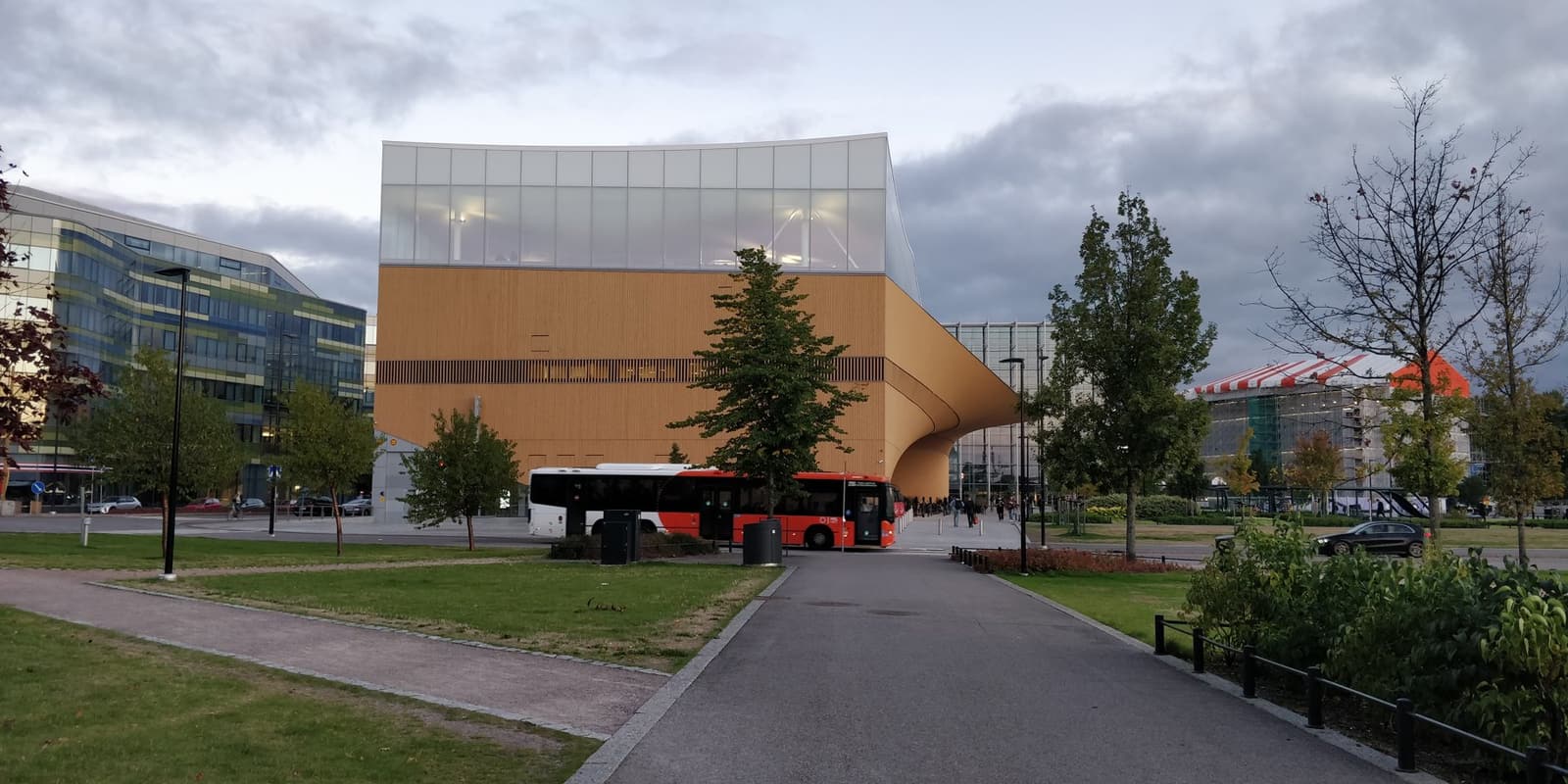
Image note: the hero image shows Oodi’s exterior massing and curved wooden facade from the north, the visual cue that makes the building easy to recognize before you even step onto Kansalaistori.
A place-specific texture detail matters here. Oodi sits opposite Parliament House and was designed as a public, open, safe, and free-of-charge city space in the heart of Helsinki, after ALA Architects won the open international architecture competition in 2013.[5] That origin story still explains the building better than any “must-see architecture” label does.
Anchor 1: Kansalaistori entrance — where the building becomes legible
Oodi is close enough to Helsinki Central Railway Station that many first-time visitors drift into it without deciding what kind of stop they want. The official arrival page makes the location logic plain: Oodi stands at Töölönlahdenkatu 4, on Kansalaistori Square, opposite Parliament House, with the railway station in the immediate vicinity.[1]
The building also gives you more than one way in. Oodi has three entrances: the main entrance on Kansalaistori, one on Eero Erkon katu at the end of Rautatientori, and one on Töölönlahdenkatu by Töölönlahti.[1] That matters because the easiest first visit is not “whichever door appears first,” but the Kansalaistori side, where the facade and square explain the building’s scale before the busy lobby begins to swallow your attention.
Public-transport access is unusually forgiving. The official arrival page lists:
- metro: Rautatientori
- tram at Kaivokatu: lines 3, 5, 6, 7, 9
- tram at Lasipalatsi: lines 1, 2, 4, 10
- bus: Rautatientori and Elielinaukio
- train: Helsinki Central Railway Station[1]
That density is why Oodi works so well as a real urban pause rather than a standalone sightseeing errand. You do not need to “go out of your way” to reach it; in central Helsinki, it often is the way.
Opening hours are also generous enough to make the stop easy to absorb into a day that already has museums, shopping, or rail travel attached. Oodi’s current standard hours are 08:00–21:00 Monday to Friday and 10:00–20:00 Saturday to Sunday.[1][6]
Anchor 2: Book Heaven — where you decide whether this is a photo stop or a usable room
Oodi’s floor plan is the key to getting value out of the visit.
The official floor guide splits the building into three floors with deliberately different moods: a fast, active first floor; a more tool- and work-oriented second floor; and a quieter top floor called Book Heaven.[2][5] If you do not understand that sequence, Oodi can feel like a beautiful but slightly confusing lobby. Once you do, the building becomes intuitive.
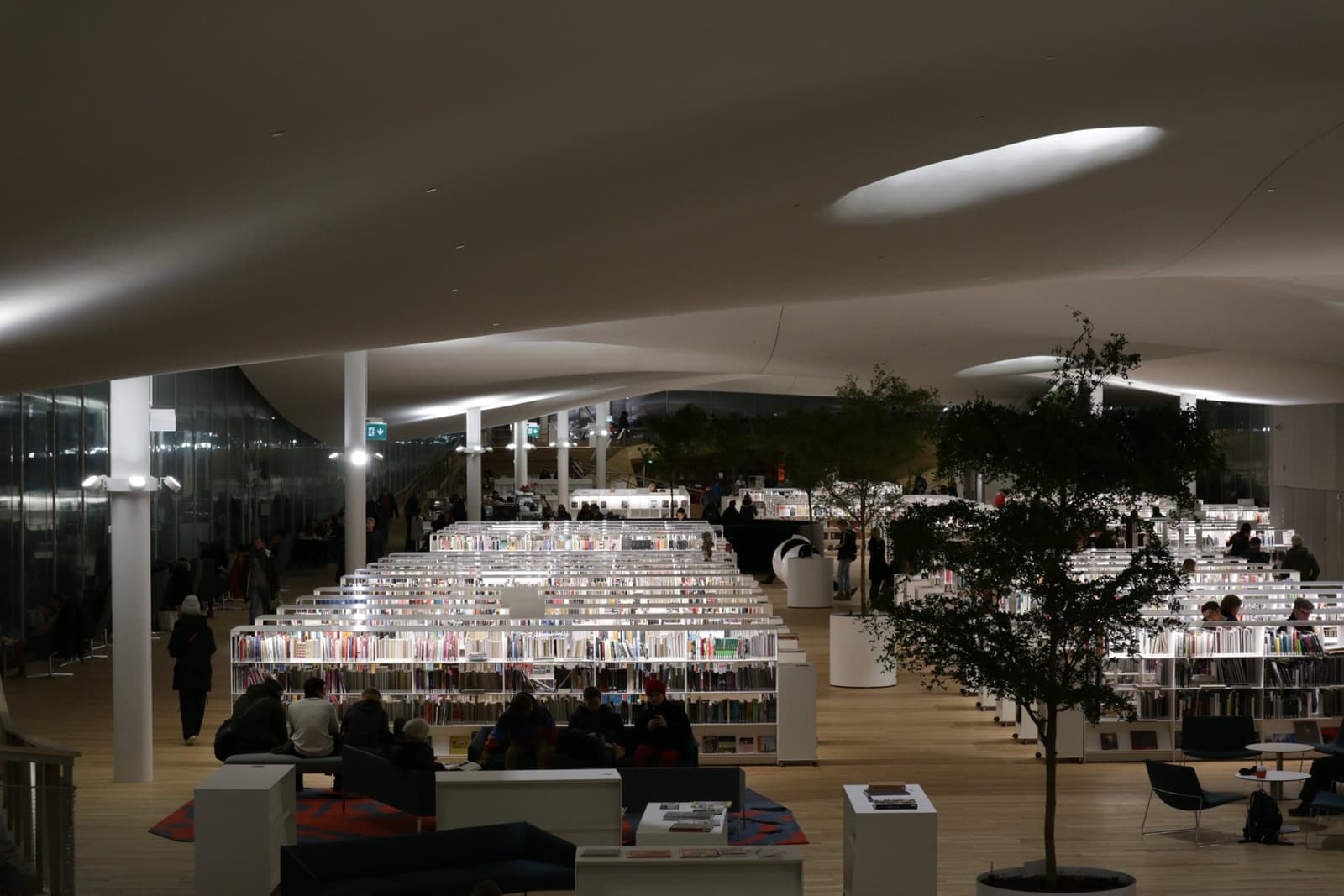
The third floor is where the place settles. The floor guide describes it as the level with 7 reading oases, 100,000 books, the children’s section, a café, and the Citizens’ Balcony.[2] The tourist-services page adds a little more practical texture: over 180 magazines, 40 newspapers, reading spots across the floor, and balcony access from spring to autumn.[4]
That is why the right Helsinki move is usually not to hover downstairs too long. The first floor is meant to be transitional; the third floor is where the building becomes emotionally readable.
8 local moves that make Oodi work better
First, enter from Kansalaistori on the first visit even if another entrance is technically closer. The square-facing approach gives you the cleanest exterior read and the least confusing mental map for the floors that follow.[1][5]
Second, decide early whether this is a 20-minute architecture stop or a 90-minute civic-room stop. Oodi can do both, but the building feels muddled if you drift between them.
Third, travel light. Oodi’s FAQ is explicit: there is no luggage storage in the building, and the nearest lockers are at Helsinki Central Station and Kamppi Shopping Centre.[3] If you arrive with a rolling suitcase, fix that before you try to enjoy the space.
Fourth, use the first floor quickly and intentionally. It is the transition floor: returns, latest books, cinema, Helsinki-info, café, and event spaces all cluster there.[2] It is useful, but it is not where the visit should get stuck.
Fifth, go to the third floor sooner than instinct tells you. Book Heaven is where the pace changes, where the reading oases appear, and where the balcony and skyline begin to do their work.[2][4]
Sixth, use the second floor only if you have a purpose. It is excellent for working and making things, but many services there require advance reservation via Varaamo, and some require a library card.[4] If you are not booking a printer, workspace, or workshop tool, it is fine to treat the second floor as a short look rather than the main event.
Seventh, do not expect to camp with huge bags, loud food, or casual pet access. Oodi allows only guide dogs, permits only small personal snacks in public areas, and asks visitors not to block passageways or disturb services during photography.[3]
Eighth, use the building’s free basics fully: all three floors are free to enter, the Wi-Fi is open as “Helsinki – Helsingfors,” and the lavatories are free.[3][4] In travel terms, that makes Oodi one of the best zero-cost reset spaces in central Helsinki.
Non-local trapline: 4 common mistakes and the better move
Mistake 1: treating Oodi as a facade photo and leaving after the lobby
Better move: run the building in sequence—quick first floor, optional second-floor glance, then a real sit-down upstairs in Book Heaven.[2]
Mistake 2: arriving straight from the station with luggage and hoping the building will sort it out
Better move: use Central Station or Kamppi lockers first, then come back light.[3]
Mistake 3: assuming the second floor is the main tourist zone
Better move: remember that the second floor is a tool-and-work floor; the emotional center of the building is upstairs.[2][4]
Mistake 4: treating Oodi like an anything-goes content set
Better move: keep photos small-scale, avoid blocking stairs and guidance routes, and stay away from the north end of the third-floor children’s section if you are shooting pictures.[3]
Time window, spend reality, crowd shape, and one navigation cue
A clean first Oodi visit usually fits 45–90 minutes. A quick architecture-and-balcony pass can be closer to 20–30 minutes; a reading-and-reset visit can easily stretch past 90 minutes.
Spend reality is unusually favorable:
- entry to all 3 floors: free[4]
- Wi-Fi: free[4]
- lavatories: free[3]
- balcony / reading access: free[2][4]
So the true spend floor is €0 on site unless you add café time or public transport.
Crowd shape is built into the building rather than hidden in rumor. The first floor is officially the most active and transitional zone; the top floor is the unwind zone.[2][5] If the lobby feels busy, that does not mean the whole building is “too crowded” — it often means you have not gone high enough yet.
One navigation cue solves most first-timer friction: square first, stairs second, balcony last. Read the exterior from Kansalaistori, get your bearings on the way up, then let the third floor become the actual visit.
Pocket route card
If you want the whole article compressed into one portable card, use this version:
- Best use case: a free central-Helsinki reset between station, museum, and downtown errands.
- Best first entrance: Kansalaistori main entrance.[1]
- Opening hours: 08:00–21:00 Mon–Fri, 10:00–20:00 Sat–Sun.[1][6]
- Floor logic: 1st floor transition → 2nd floor tools/work → 3rd floor Book Heaven.[2][5]
- Carry rule: no luggage storage inside; use Central Station or Kamppi lockers first.[3]
- Stay rule: if you only have time for one real pause, make it the third floor.
- Recognition cue: the curved wooden facade facing Kansalaistori, with Parliament opposite.[1][5]
Sources
- Oodi — Arrival page (address, three entrances, transit connections, opening hours)
- Oodi — Floors (three-floor logic, Book Heaven, reading oases, facilities by level)
- Oodi — FAQ (no luggage storage, free lavatories, guide-dog rule, photography etiquette, pram and accessibility notes)
- Oodi — Oodi’s services for tourists (published 4 Feb 2025; free entry, open Wi-Fi, balcony season, third-floor collection details, reservation boundaries)
- Oodi — Architecture page (2013 competition, public/free civic-space design intent, three-atmosphere concept, Parliament-facing urban role)
- Oodi — Home page (current opening-hours display and current institutional context)
- MyHelsinki — Oodi, Helsinki Central Library (local city-guide framing and location on Kansalaistori)
- Google Maps community listing — Oodi, Helsinki Central Library (current local listing surface)
- Wikimedia Commons image source (hero exterior)
- Wikimedia Commons image source (third-floor interior)