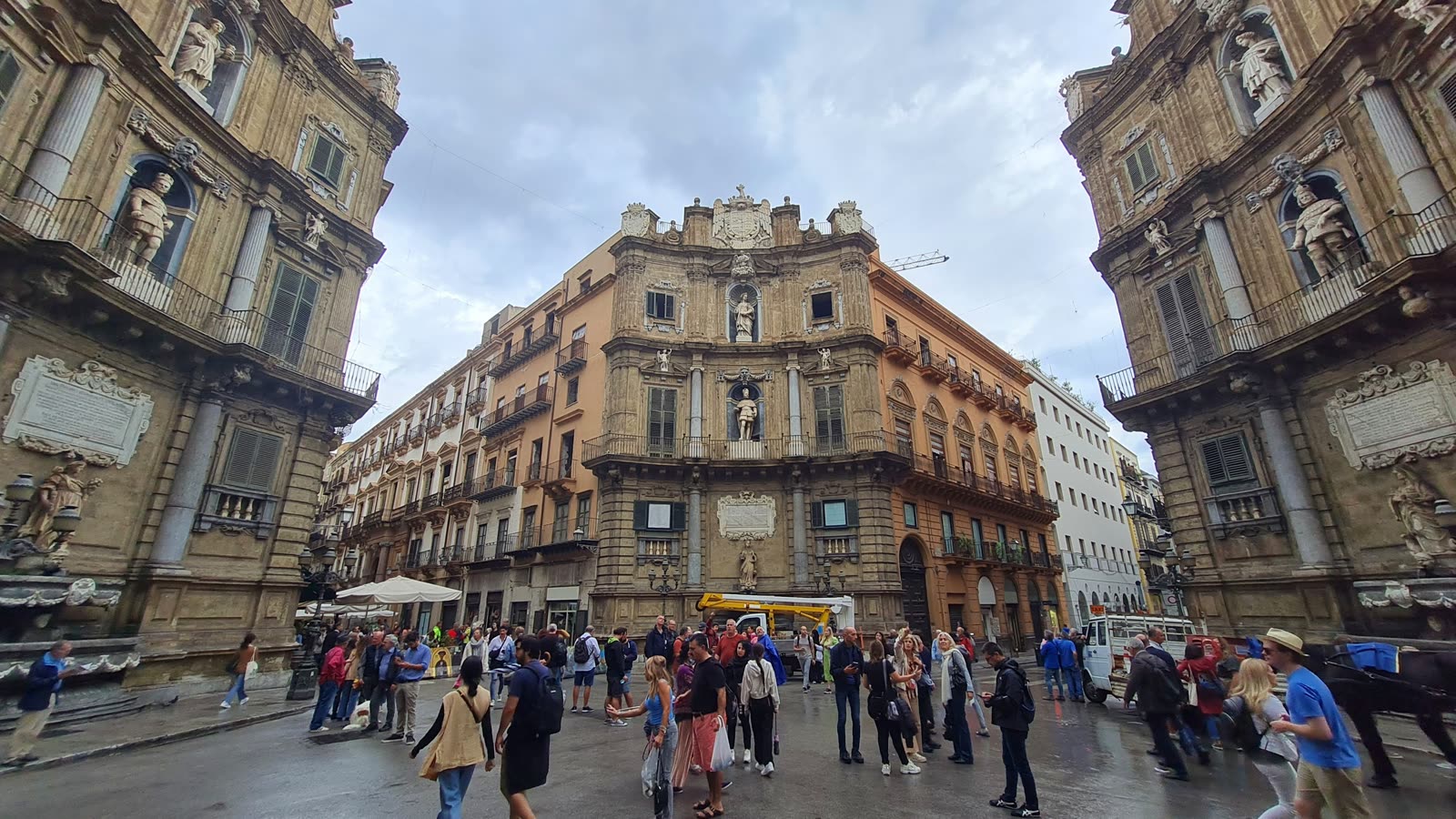
Palermo's old center is loudest when you try to collect it. The cathedral, markets, Norman churches, opera house, street food, and seafront all begin competing for one afternoon. A cleaner first read is much smaller: hold Quattro Canti after the heat and tour rhythm loosen, then step one minute south to Piazza Pretoria. Treat the pair as a night room rather than as two checklist stops.
The route has only two anchors. Quattro Canti, officially Piazza Vigliena, is the crossing of Via Maqueda and Corso Vittorio Emanuele, the intersection that split the city into four historic mandamenti: Capo or Monte di Pietà, Albergheria or Palazzo Reale, Kalsa or Tribunali, and Loggia or Castellammare.[1] Piazza Pretoria is the adjoining room, dominated by the fountain Palermo bought, dismantled, moved, and reassembled from a Florentine villa.[2] If you give both spaces 45 to 70 minutes, they explain more about central Palermo than a faster sweep through five landmarks.
Start at Quattro Canti, but do not stand in the exact center unless the traffic and crowd allow it. The city tourism page gives the architectural logic: the four curved cantoni were begun in 1608 under Giulio Lasso, continued by Mariano Smiriglio, and completed in 1621. The lower order carries the seasons, the middle order the Spanish kings, and the upper order Palermo's patron saints; the site also acquired the name Teatro del Sole because at least one corner catches sunlight in every season.[1] After dark, that solar nickname becomes a useful negative. The sun is gone, but the theater remains. Street musicians, tour groups, residents crossing home, and people taking the same photograph all pass through one small civic machine.
The move is to rotate slowly rather than look once. Take one corner, read the season and saint stack, then cross only when the pedestrian flow gives you space. Repeat from a second corner. This is not about completing all four like a museum label exercise. It is about noticing that the crossing is both symbol and infrastructure. The same official page notes that the street level of Via Maqueda was lowered in 1856 for water drainage, with basins added below each fountain.[1] That detail changes the place. Quattro Canti is not only Baroque theater; it has been adjusted to keep the city working.
Then leave before the crossing turns into a traffic island in your head. Walk south on Via Maqueda to Piazza Pretoria. The official Palermo page says Fontana Pretoria was made in 1554 by Francesco Camilliani for a Florentine villa, bought by the Palermo Senate for 20/30,000 scudi, shipped in 644 pieces, and reassembled in altered form by Camillo Camilliani.[2] Its tiers, stairs, statues, mythological bodies, monsters, animals, harpies, sirens, and four river figures make the piazza feel almost overfull.[2] That is the point. Quattro Canti organizes the city into four clean civic slices; Pretoria immediately breaks that order into marble abundance.
Piazza Pretoria also carries the better caution for visitors: do not reduce the fountain to the nickname. The official page records that the exposed nude figures troubled citizens enough to give the site the name Piazza della Vergogna, and that the fence was added in 1858.[2] The shame label is memorable, but it can make the fountain seem like a one-joke monument. Stand back instead. Include Palazzo delle Aquile, Santa Caterina, and the small approach from Quattro Canti in the same view. The square works because civic power, church walls, imported Renaissance sculpture, and tourist curiosity sit too close to one another to become polite.
The local scale is already written into the city's own guided-walk structure. Palermo Welcome's daily UNESCO-monuments route meets at Piazza Bellini at 10:30, moves on foot through Piazza Pretoria and Quattro Canti, and takes about 2 hours.[3] You are not copying that tour at night; you are borrowing its lesson. These spaces are best understood on foot, in a compact chain, without turning the old center into a transport problem.
That is the first visitor trap. Do not drive into the old center for this. A Reddit Sicily thread about visiting Palermo gives the practical local-community version bluntly: several respondents advise skipping a rental car in the city because parking, traffic, and the ZTL make the historic center easier on foot, by taxi, or by public transport.[5] The better move is to enter from lodging, Teatro Massimo, Piazza Bellini, or the station side on foot, then keep the route short enough that you never need to solve parking while the light is good.
The second trap is outsourcing the crossing to a horse carriage. A May 8, 2026 BlogSicilia report describes horse-drawn carriages still moving through the heart of Palermo, including Via Roma, the Cassaro, Teatro Massimo, and Quattro Canti, while criticizing the practice and the stalled move toward alternatives.[4] Whatever your position on the local politics, it is a useful travel signal: the carriage loop is a visible tourist shortcut through the same streets. For this route, walk. Quattro Canti makes sense when your own pace has to negotiate the crossing.
The third trap is photographing Pretoria from the first open angle and leaving. Tripadvisor's current review surface is useful less for ratings than for crowd behavior: recent visitors describe Piazza Pretoria as central, busy, passed repeatedly, and worth seeing from more than one position, with September 2025 reviews still treating it as an active old-center hinge rather than a dead monument.[6] Use that as permission to circle once. If the fountain is dry or gated, the square still works; the relationship between the fountain, town hall, churches, and Quattro Canti is not turned off.
The fourth trap is doing this at midday in summer unless you have no choice. A 2026 Trip.com attraction page gives rough visitor timing of 30 minutes for Quattro Canti and 1 hour for Fontana Pretoria, which is about right only if you are moving deliberately rather than chasing every adjacent church.[7] In June, the better window is 20:00-21:30: late enough for heat and tour buses to soften, early enough that shops, passersby, and families still give the streets a lived rhythm. In cooler months, shift earlier to the blue-hour edge.
The local moves are small. Arrive on foot. Keep the visit to two anchors. Read Quattro Canti from at least two corners, not the middle alone. Step into Piazza Pretoria by the short Via Maqueda move, not by detouring through a market first. Circle the fountain once before deciding on photos. Treat carriage offers as background, not the route. Keep your phone and wallet controlled in crowd compression. Use Piazza Bellini or Teatro Massimo as your entry cue, depending on where you are sleeping. Leave by a different street than the one you used to arrive so the grid starts to make sense.
Concrete plan: begin at Teatro Massimo if you want a longer approach down Via Maqueda, or at Piazza Bellini if you want the tight version. Expected spend is EUR0 for both public spaces; add money only if you choose a church terrace, guided walk, drink, or taxi afterward.[1][3] Queue reality is mostly crowd compression, not tickets. Navigation cue: Teatro Massimo or Piazza Bellini -> Quattro Canti corners -> Via Maqueda south -> Piazza Pretoria fountain circuit -> exit toward Piazza Bellini, Kalsa, or the Cassaro.
Palermo rewards the restraint. One crossing and one fountain are enough when you let them keep their pressure. Quattro Canti divides the city with almost theatrical clarity. Piazza Pretoria answers with imported marble, civic awkwardness, and too many bodies for a modest square. Together, after dark, they let the old center feel less like a list and more like a room you have finally learned how to stand inside.
Sources
- Comune di Palermo, Palermo Welcome, "Quattro Canti" - official tourism page covering the Via Maqueda / Corso Vittorio Emanuele crossing, four mandamenti, Teatro del Sole name, 1608-1621 construction, statue orders, 1856 street lowering, and free entry.
- Comune di Palermo, Palermo Welcome, "Fontana Pretoria" - official tourism page covering the 1554 Camilliani fountain, Florentine origin, 20/30,000-scudi purchase, 644-piece transfer, reassembly, river figures, shame nickname, and 1858 fence.
- Comune di Palermo, Palermo Welcome, "AGT - Monumenti Unesco" - official walking-tour listing with Piazza Bellini meeting point, 10:30 start, walking format, Piazza Pretoria and Quattro Canti sequence, and two-hour scale.
- BlogSicilia, "Palermo ostaggio delle carrozze: nel 2026 i cavalli continuano a trascinare il passato" (May 8, 2026) - recent local report on horse-drawn carriages still circulating through central routes including Via Roma, the Cassaro, Teatro Massimo, and Quattro Canti.
- Reddit r/sicily, "Trip to Palermo" - local/community advice thread on avoiding rental-car friction inside Palermo because the old city is walkable and parking/ZTL conditions are awkward.
- Tripadvisor, "Piazza Pretoria, Palermo" - current traveler-review surface, including 2025 review signals on the square as a busy central crossing repeatedly passed through by visitors.
- Trip.com, "2026 Palermo Attraction: Quattro Canti Travel Guide" - recent visitor-facing timing surface listing Quattro Canti and Fontana Pretoria together with rough suggested visit durations.
- Wikimedia Commons, "File:Quattro canti (Palermo) 01.jpg" - real 2022 photograph by Derbrauni used as the article image.