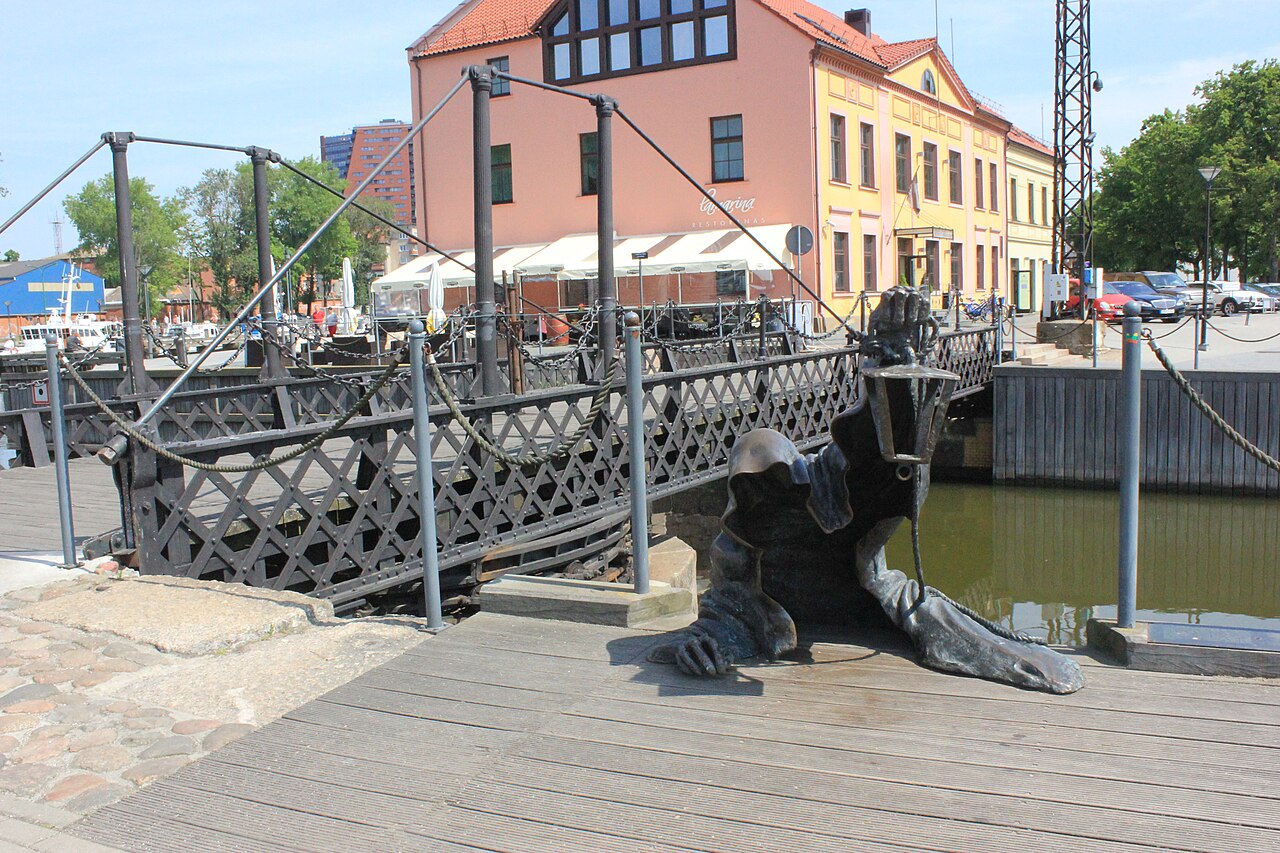
Klaipėda is easiest to misread when you treat it as a soft prelude to the Curonian Spit. The port city then becomes a corridor: cruise terminal, a few old-town streets, maybe a ferry plan, then out. The better first move is smaller and more mechanical. Start at the Swing Bridge, usually called the Chain Bridge, and let that hand-wound piece of iron explain the city before you widen the walk.
This is an object lens, not a full old-town itinerary. The anchor is the bridge over the castle canal between Žvejų Street 20 and 22, plus the castle-moat edge immediately around it.[1][2] Stand there for a few minutes and Klaipėda stops behaving like a generic Baltic old town. You can see water management, port access, German-era memory, technical heritage, a cruise-route shortcut, and a working pedestrian hinge all compressed into one object.
The official tourism page gives the essential facts: the bridge was built in 1855, made of riveted iron, decorated with chains, and known before World War II as the Kettenbrücke. It is still manually operated; two people turn it so boats can enter the former moat of Klaipėda Castle.[1] The heritage guide adds the deeper local logic. Citizens needed a bridge in the second half of the 18th century, after the castle lost strategic importance and merchants began using the moat for logs. A channel linked the moat to the Dangė River; an earlier wooden bridge and a later portal bridge preceded the swing bridge, whose ship opening is described as 1.2 meters.[2]
That background matters because the bridge is not just cute machinery. It is a surviving compromise between walking and water. On foot, it makes the old town and cruise-terminal side feel close. When it turns, it reminds you that the canal is not decoration. Boats and yachts still need the cut, and the city still lets a small interruption govern the sidewalk.[1][2]
Use the bridge first, then the castle edge. Klaipėda Castle Museum sits at Priešpilio Street 2, surrounded by the old district's water moats, and its summer season runs from June 15 to September 15, Wednesday-Sunday, 10:00-18:00, with ticket sales until 17:30.[3] If the museum is open, it gives the object a second register: the town's older fortification system, archaeological material, seals, documents, and a model of Klaipėda Castle and the city.[3] If it is closed, the bridge still does enough. The point is to read the moat from the outside before you drift into Theatre Square or the riverfront.
There is also a current-use clue here. Klaipėda Travel's 2026 city-founding programme put public activity at the Castle Site, with the city flag ceremony at 12:00 and educational programming from 12:30 to 20:30 on August 1.[4] That is a useful recent confirmation: the castle precinct is not only an archaeological leftover. It still works as a civic stage, which is why the bridge should be treated as a threshold into a living public edge, not as a photo prop beside a hotel.
The Local Moves
First, arrive on foot if you are already in the center or coming from the cruise-terminal side. The bridge is strongest as a short threshold, not as a destination you taxi directly to. Local walking-route advice still places the Castle Museum and this old bridge within a compact old-town loop, which is exactly the scale that suits it.[5]
Second, do not hurry the first crossing. If the bridge is closed to pedestrians for a boat movement, wait. Tripadvisor's current review surface keeps repeating the practical rhythm: visitors often find it open for walkers for most of the hour, then closed for boats for a shorter interval.[6] Treat that wait as the point. You came to see a city object choose water over foot traffic for a moment.
Third, stand on the castle side after you cross, not only on the hotel side. From there, the bridge reads less like a picturesque railing and more like a lock in the old defensive landscape. The heritage guide's coordinates and address place it precisely at the castle channel, and the moat history becomes visible when you look back across the cut.[2]
Fourth, pair it with one museum decision. If it is between 10:00 and 17:30 on a summer Wednesday-Sunday, buy the museum ticket or at least check the entrance before you wander away.[3] If you arrive outside that window, keep the visit exterior and do not waste the stop trying to force an interior plan.
Fifth, keep parking out of the center if you can. Klaipėda's own parking guidance and UNIPARK's city-zone page both describe paid red, yellow, and green zones in the city, which is enough reason not to turn a ten-minute object stop into a parking puzzle.[7][9] Walk, use the old-town loop, or fold the bridge into your arrival from the terminal.
Sixth, use the Black Ghost sculpture as a marker, not the main event. It is useful because it tells you that you are at the right harbor-castle corner; the heritage guide notes the 2.4-meter bronze sculpture was opened in 2010 and tied to the Black Man from Memel legend.[2] But the stronger reading is the relationship between sculpture, bridge, and moat, not a single selfie.
Seventh, if you are heading onward to Smiltynė or the Curonian Spit, do not let that next trip erase this one. The local route articles often fold the bridge into movement toward ferries and waterside walking.[5] That is practical, but the better sequence is bridge first, canal second, ferry plan third.
Eighth, check the community surface before you promise yourself a perfect opening moment. Google Maps and Tripadvisor are useful here less for ratings than for current friction: crowding near cruise calls, whether people recently saw the bridge move, and whether visitors describe it as a quick pass or a short wait.[6][10] The object is simple; the timing is the variable.
Visitor Traps
The first trap is using the bridge only as a shortcut into town. Better: pause on both sides and let the manual rotation logic register. A bridge that requires two people to turn it is telling you that Klaipėda's old-town edge still belongs partly to boats.[1][2]
The second trap is trying to make the stop too large. Better: keep it to a 25-45 minute object-and-moat pass unless the museum is open and you want the castle layer. That gives you time to wait through one possible boat interruption, read the water, and still leave before the stop becomes a checklist sprawl.[3][6]
The third trap is assuming the prettiest angle is always the correct angle. Better: photograph the ironwork if you want, then step back far enough to include the canal, the old harbor buildings, and the castle edge. The cover image works for the same reason: it keeps the bridge and Black Ghost together rather than isolating one souvenir object.[8]
The compact go-plan is this: arrive mid-morning or late afternoon, cross once, wait if the bridge is opening, read the castle canal from both sides, then decide whether the Castle Museum fits the day. Best window: 10:30-12:00 if you want the museum option without late-day pressure, or 17:00-18:30 for a lighter waterfront read when the museum clock is less central.[3] Expected spend: EUR0 for the bridge and exterior moat; add museum admission only if you want the historical exhibits. Queue reality: no reservation logic for the bridge, only the possibility of waiting while boats pass.[1][6] Navigation cue: Cruise terminal or old town -> Black Ghost / Chain Bridge -> castle canal look-back -> Castle Museum gate -> Theatre Square or Dangė river walk.
Klaipėda rewards this scale. The city is a port, not just a painted old town. One hand-turned bridge lets you feel that in a way a broad highlights walk often misses: the sidewalk yields, the canal opens, and for a few minutes the old moat becomes working water again.
Sources
- Klaipėda Travel, "Swing (chain) bridge" - official tourism page with address, 1855 construction, riveted-iron and chain details, manual two-person operation, and maritime-heritage designation.
- Krašto paveldo gidas, "Swing (chain) bridge" - heritage guide with coordinates, moat and merchant-log context, earlier bridge history, 1.2-meter opening, 2009-2010 restoration, and Black Ghost sculpture context.
- Klaipėda Travel, "Klaipėda Castle Museum" - official page with summer-season hours, ticket-sales cutoff, address, and museum context.
- Klaipėda Travel, "The programme of the celebration of the founding of the City of Klaipėda" - recent official 2026 event page confirming Castle Site civic programming on August 1.
- Bohema Hotel, "Discover Klaipėda Old Town: walking route" - recent local walking-route article placing the Castle Museum and old bridge inside a compact old-town sequence.
- Tripadvisor, "Chain Bridge, Klaipėda" - current traveler-review surface used for practical signals on pedestrian closures, boat openings, and cruise-route behavior.
- Klaipėda Travel, "Parking in Klaipėda" - official visitor parking reference for central parking logistics.
- Wikimedia Commons, "File:Klaipeda most obrotowy 3.jpg" - real photographic source for the article image, showing Klaipėda's swing bridge and the Black Ghost sculpture.
- UNIPARK, "Parking in Klaipėda City Zones" - current parking-zone page for red, yellow, and green paid city zones.
- Google Maps search, "Swing Chain Bridge Klaipėda" - current community-review surface for recent visitor timing and crowd signals.
Editor’s Pick Review
This article takes today’s merged standard/add-on editor-pick slot because it is the strongest 24-hour candidate under the stricter curation rubric: it turns one small, real, hand-operated object into a complete city-reading mechanism, then backs that object lens with official tourism pages, heritage documentation, current local routing, parking friction, community timing signals, and a precise museum-hours decision. The image clears the updated policy especially well: it is immersive, documentary, and physically central to the route, with no analytical visual substituting for place. The Chinese edition also passes the bilingual quality gate with natural cadence, stable place terminology, low translationese, and a clear preservation of the article’s movement from bridge to moat to civic edge.