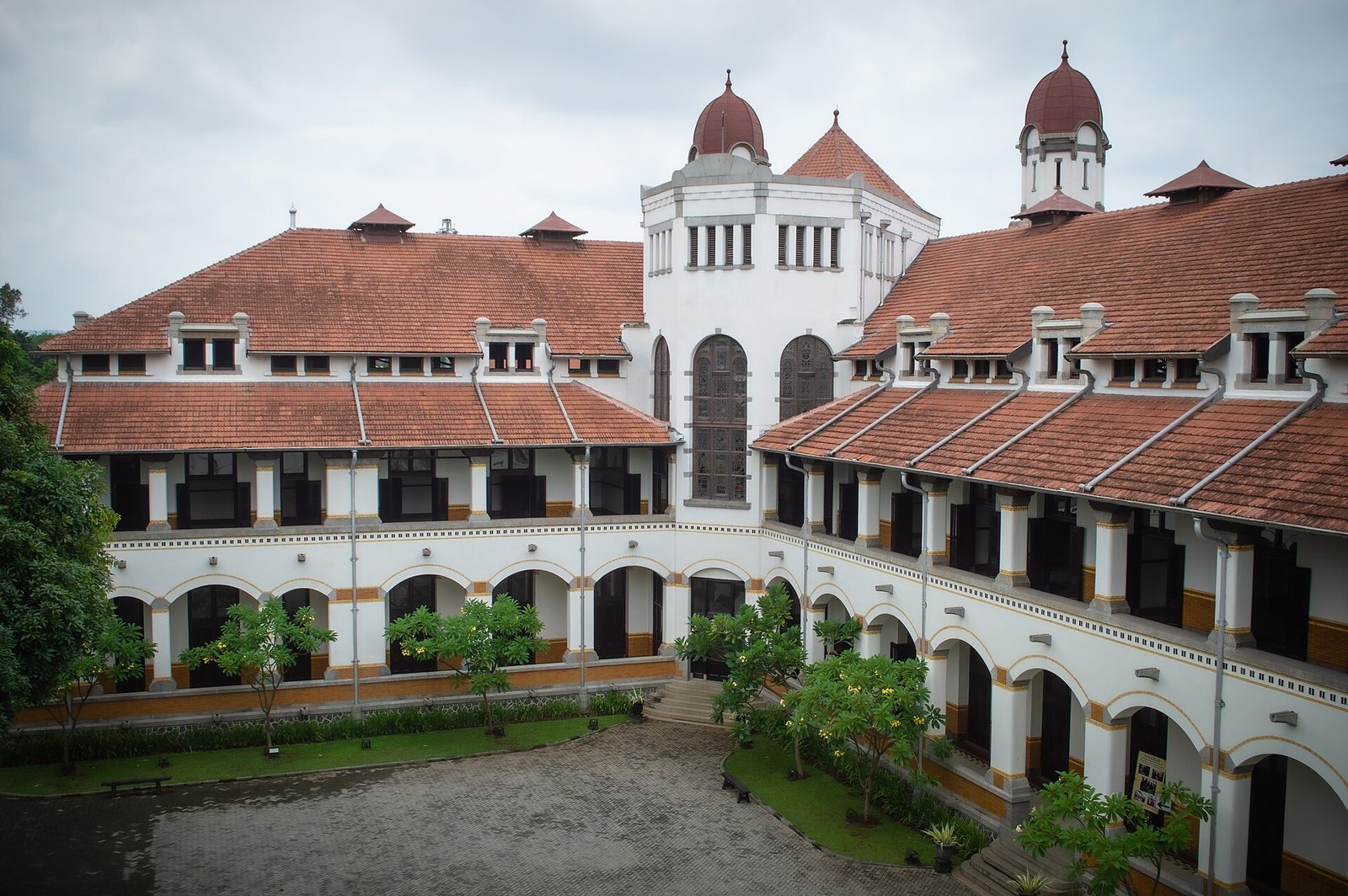
At 8:05 a.m., the first useful thing to do inside Lawang Sewu is not count the doors. Stand in the courtyard instead. Look along the white arcades, through one open bay and then the next, and notice how many layers of shade and moving air sit between the grass and the offices. Semarang's famous “thousand doors” begin to make sense as a building before they become a nickname.
The operator's account is unusually direct: KAI credits Jakob F. Klinkhamer and B.J. Ouendag with the design and says the L-shaped headquarters used its many doors and windows as an air-circulation system [1]. That fact supplies the route. Spend 90–120 minutes reading Lawang Sewu as tropical railway infrastructure, not as a haunted-house prop; then give 10–15 minutes to Tugu Muda across the traffic circle. One anchor explains how colonial transport power presented itself. The other records how Semarang chose to remember the violent opening months of independence.
Early morning is the cleanest first visit, but the published hours conflict. KAI Wisata's operator page lists 07:00–21:00 daily [1]; the live Traveloka ticket listing checked on July 18, 2026 instead shows 08:00–17:00 Monday, 08:00–20:00 Tuesday–Friday and Sunday, and 08:00–22:00 Saturday, with voucher redemption ending one hour before closing [12]. Use 08:00 as the conservative opening and verify on the day. The official base prices are Rp20,000 for Indonesian adults and university students, Rp10,000 for children and school students, and Rp30,000 for international visitors [1]. A second shoulder is around 16:00 Tuesday–Sunday, keeping daylight for the interior and the illuminated facade for the exit. Local community advice treats the heat of lower, central Semarang as a routing fact, not a comic stereotype [7].
This is a one-building visit with a monument as its coda. Resist adding Kota Lama, Sam Poo Kong, and a food circuit merely because a map makes them look collectible. Lawang Sewu rewards close attention precisely because its most photographed feature—the repeated opening—is also its operating idea.
The office behind the nickname
Lawang Sewu began as the headquarters of the private Nederlandsch-Indische Spoorweg Maatschappij. The main building rose between 1904 and July 1907; additional buildings followed from about 1916 to 1918. The complex occupies 18,232 square metres [1]. Its scale, water towers, arcades, railway collections, and grand stair were not neutral decoration. They made administration look permanent in a colonial port city whose rails reorganized movement, labor, and commerce.
That is why the stained glass deserves more than a centered portrait. KAI's description identifies work by the studio of Johannes Lourens Schouten and says its imagery joins Java's beauty and prosperity to Dutch authority, maritime Semarang, and the glory of the railway [1]. A cultural history of the building makes the sharper point: Lawang Sewu presented industrial transport as evidence of imperial order, even as railway labor helped create political forces that challenged that order [3]. The room is beautiful. The argument embedded in its beauty is power.
The building's afterlives complicate the picture. It became a Japanese transport office from 1942 to 1945, then an Indonesian railway office in 1945; KAI began a major restoration in 2009 and inaugurated the restored Building A in 2011 [1]. Across the road, Tugu Muda commemorates the Five Days' Battle in mid-October 1945; the Ministry of Culture encyclopedia dates it 15–20 October [2]. Its flame, five pointed forms, and reliefs turn struggle, suffering, attack, sacrifice, and victory into a national monument [2]. Do not collapse those layers into one ghost story. The building and monument speak from different political moments, and the roundabout forces them into the same view.
Eight moves through Lawang Sewu
1. Set the door correctly. Use Lawang Sewu, Jl. Pemuda No. 160 as the map or ride-hail destination, not “Tugu Muda.” The current place listing fixes the entrance on the building side of the junction [5], while a recent Indonesian transport guide likewise recommends naming Lawang Sewu or Tugu Muda precisely rather than using a vague Semarang drop-off [10]. Ask to be set down at the signed museum side; do not turn a busy traffic circle into your arrival puzzle.
2. Choose cool or glow before you go. For cooler air and the lightest likely crowd, enter 08:00–09:30. For warmer interiors followed by exterior lights, use 16:00–18:00 Tuesday–Sunday; Monday's live listing closes at 17:00 [12]. These are planning windows, not special sessions. The operator page publishes no mandatory timed reservation for base entry, while Traveloka offers date-based QR vouchers with a last-redemption cutoff [1][12]. On major holidays, local reporting has found a busy midday site and disorderly ticket queues, so add 20–30 minutes rather than assuming the standard rhythm [4].
3. Buy the base visit before an experience package. The official page lists the three base prices but does not promise that every basement, film, fast-track, or special tour is included [1]. Recent visitor reporting describes optional attractions and packages carrying separate charges [4][6]. Ask three questions at the desk: what is open today, what the base ticket covers, and whether the add-on has a fixed start time. The architecture and railway museum are the visit; an upsell should not become its condition.
4. Make one deliberate guide decision. If you want the building's railway and political history, ask for an on-site guide before entering the galleries. A 2024 local report put guiding at about Rp100,000, while a 2025 community review described a similar minimum for a family and found the historical and photographic help worthwhile [6][9]. Treat that figure as a planning allowance, not a guaranteed tariff; confirm the current fee. If you go alone, save the official history page and follow the sequence in this article rather than improvising a ghost hunt.
5. Read the air in the courtyard. Walk one shaded arcade slowly. At an open doorway, look across the room for the next opening; at a corner, notice how the roof vents, high windows, deep overhang, and towers work at different heights. You are not conducting a laboratory test, so do not claim that every breeze proves an architect's intention. The visible repetition does, however, match KAI's explicit account of doors and windows as circulation infrastructure [1]. Give this move 15 minutes. It is the local lesson hidden inside the name.
6. Let the stained glass interrupt the symmetry. At the grand stair, step out of the central photo line before looking up. First find the maritime and railway imagery; then ask what kind of future an early-twentieth-century railway company wanted employees and visitors to see. Only after that make the photograph. Keep voices low, do not occupy the landing for a long portrait session, and let other visitors pass. The staircase is shared circulation before it is a set.
7. Edit the museum instead of harvesting it. Choose three objects: one ticketing or calculating machine, one railway document or security, and one restoration photograph or material sample. KAI's collection list includes Edmonson equipment, calculating machines, typewriters, locomotive replicas, securities, and evidence from the restoration [1]. Three connected objects say more about administration than twenty unlabeled phone photos. If the display flow feels unclear, that is a concern in one recent community review and a good reason to use a guide or the official chronology [6].
8. Finish outside, on the Lawang Sewu side. After 75–105 minutes inside, return to the facade and face Tugu Muda. Read the monument from the safe pavement first: the pointed vertical forms and reliefs answer the railway headquarters with a post-independence language of youth and sacrifice [2]. A September 2025 local report documented disconnected pedestrian crossings and visitors making unsafe shortcuts around the junction [8]. Use only a clearly marked, currently safe crossing if you genuinely want the garden; otherwise keep the monument in view from the Lawang Sewu side. Historical completeness is not worth gambling against traffic.
The visitor trapline
Mistake one: making the supernatural story the organizing fact. Ghost lore helped turn Lawang Sewu into a domestic-tourism icon, but it can displace the histories of railway capital, colonial authority, labor, war, and restoration [3]. Better: begin with ventilation, administration, and stained glass. If you choose a horror-themed add-on afterward, you will know what it is simplifying.
Mistake two: treating “a thousand doors” as a counting challenge. The Javanese name describes abundance; counts also change depending on whether a person means door blocks, leaves, windows, or openings. One on-site account cited by Tirto distinguishes roughly 450 door blocks from 928 leaves [9]. Better: follow one line of openings and ask what it did for shade, air, movement, and office hierarchy.
Mistake three: arriving at holiday noon with a frictionless-ticket fantasy. December 2025 reporting found heavy daytime attendance, heat concerns, optional paid experiences, and a confused morning queue [4]. Better: use the conservative 08:00 opening or the late-day shoulder, keep the base museum as the core, and carry a 20–30 minute buffer on weekends and holidays.
Mistake four: crossing directly toward Tugu Muda because it looks close. The monument is visually adjacent but sits inside a complicated junction. Better: finish the historical reading from the Lawang Sewu pavement and cross only where current markings and signals make the route unambiguous [8]. A longer legal route is still the local move.
The clean visit, in one card
- Best window: 08:00–09:30 for cooler air and architectural attention; 16:00–18:00 Tuesday–Sunday for interior daylight followed by the lit exterior [7][12].
- Expected spend: Rp30,000 base admission for an international visitor, Rp20,000 for an Indonesian adult or university student, or Rp10,000 for a child or school student. Budget roughly Rp100,000 extra only if an on-site guide confirms that day's rate [1][6][9].
- Queue and reservation reality: no mandatory timed base-entry requirement appears on the operator page; Traveloka offers date-based vouchers, but holiday queues and optional packages can still change the practical visit, so check the desk before buying extras [1][4][12].
- Navigation cue:
Jl. Pemuda 160 entrance -> ticket desk -> courtyard arcade -> Building A stair and stained glass -> selected railway galleries -> courtyard -> Lawang Sewu-side view of Tugu Muda[1][5]. - Where to pause: inside the courtyard arcade, off the central stair's circulation line, and on the broad building-side pavement facing the monument. Do not stop in doorways or improvise a roundabout crossing.
- Time budget: 90–120 minutes inside, then 10–15 minutes for the facade-and-monument coda. Add 20–30 minutes on a major holiday [4][6].
- Same-day check: operator and live-ticket hours, base and guide prices, which add-ons are actually open, any event footprint, your exact pickup point, and the current pedestrian crossing state [1][4][8][12].
Lawang Sewu becomes less mysterious when its doors stop being a number, and more interesting when they become a system. They move air through a railway headquarters, frame an imperial story in colored glass, and lead into a museum maintained by the successor railway. Outside, Tugu Muda refuses to let that administrative grandeur have the final word. Read the building slowly, keep the monument at the end, and let Semarang's history remain layered rather than haunted into one easy tale.
Sources
- KAI Wisata, “Lawang Sewu” — official history, architects, site area, ventilation design, stained-glass programme, museum collections, restoration chronology, operating hours, and base admission prices.
- Indonesian Ministry of Culture History Encyclopedia, “Tugu Muda Semarang” — official account of the Five Days' Battle dates, monument history, form, reliefs, and 1953 inauguration.
- Inside Indonesia, “Haunted house, haunted history” — cultural analysis of ghost lore, colonial railway power, labor politics, and competing narratives at Lawang Sewu.
- detikJateng, “Lawang Sewu Semarang Ramai Wisatawan Siang Ini, Pengunjung: Worth It” (December 26, 2025) — recent local reporting on holiday crowds, heat, queue friction, base visits, and separately priced experiences.
- Google Maps, “Lawang Sewu” — current address, navigation target, place status, and local review surface.
- Wanderlog, “Lawang Sewu” — current aggregation of Google and Tripadvisor community reports, including visit duration, guide value, museum flow, add-on charges, and 2025 visitor observations.
- r/indonesia, “Any tips for Semarang first timers?” (February 18, 2025) — local community discussion of Semarang's heat, lower/upper-city geography, central routing, language, and visitor practicalities.
- JatengNews, “Wisatawan Keluhkan Jalur Penyeberangan di Tugu Muda Semarang” (September 13, 2025) — recent on-site local reporting on disconnected crossings, weak wayfinding, and unsafe visitor shortcuts at the junction.
- Tirto, “Menyusuri Kemegahan Lawang Sewu di Jantung Kota Semarang” (published April 13, 2024; reporting from March) — local reporting on guiding, building sequence, door-block versus door-leaf counts, museum collections, and visitor behavior.
- tiket.com, “6 Tips Transportasi Menuju Lawang Sewu yang Praktis & Anti Nyasar” (updated April 13, 2026) — recent Indonesian guidance on precise drop-off naming, public transport, parking, and Tugu Muda arrival logic.
- Wikimedia Commons, “File:Lawang Sewu Semarang Indonesia 2.jpg” — source page for Philip Nalangan's documentary courtyard photograph used as the article image.
- Traveloka, “Tiket Lawang Sewu” — live 2026 ticket listing with variable day-by-day opening hours, one-hour voucher-redemption cutoffs, contact number, recent verified reviews, and QR-voucher process.