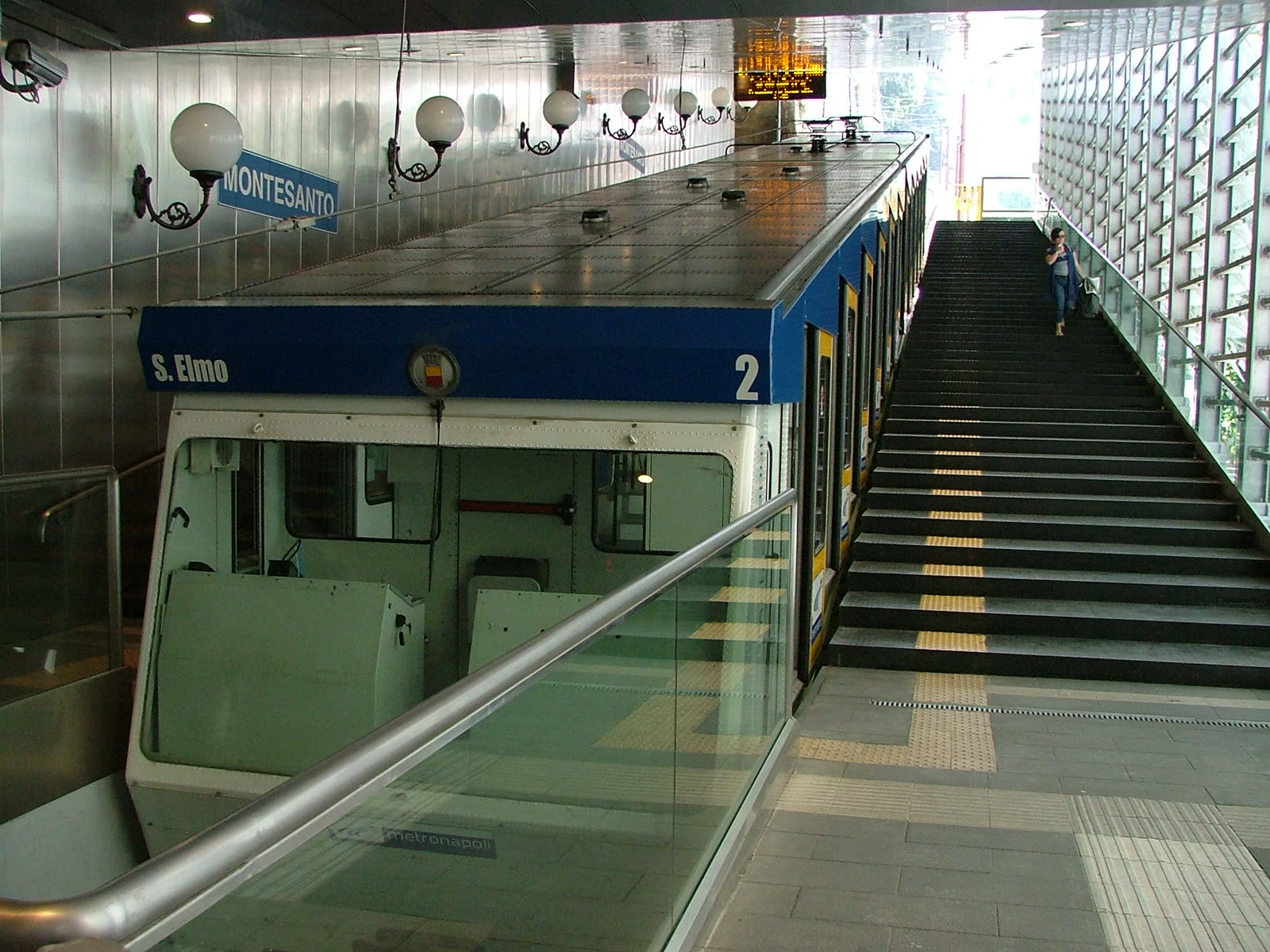
Naples gets flattened by first visits. People arrive expecting the old center to explain the whole city, then spend hours moving sideways through noise, churches, pizza queues, and traffic while the hill above them remains a backdrop. The cleaner move is vertical: take the Montesanto funicular up to Morghen, then carry the route straight into Certosa di San Martino.[1][2][3][4] One anchor is living infrastructure, still running every day from a real interchange node in Montesanto. The other is a monastery-turned-museum on the Vomero slope, with cloisters, collections, gardens, and one of the most legible terraces in Naples.[1][3][4]
That order matters because the funicular is not decorative transit. InfoPoint Napoli's local guide describes the Montesanto line as the best way to reach Castel Sant'Elmo and the Museum of San Martino from the historic center, notes that it has linked hill and center since 1891, runs daily from 07:00-22:00, and departs every 10 minutes.[1] The fare table published by ANM still prices the single urban funicular ride at EUR 1.30.[2] In other words, you are not doing a cute scenic ride; you are entering Naples through one of the city's working vertical joints.
Certosa di San Martino completes the portrait because it turns altitude into structure. The Ministry of Culture's current page gives the practical frame first: the museum opens 08:30-17:00, takes its last entry at 16:00, closes on Wednesday, and prices full admission at EUR 6 with EUR 2 reduced tickets for ages 18-25.[3] The same page makes the physical logic explicit by naming the terrace belvedere and gardens as part of the visit route, with the gardens closing an hour before sunset.[3] The institutional page for the Musei nazionali del Vomero gives the deeper reason this stop works: San Martino was founded in the fourteenth century, became a museum in 1867, and sits on the edge of the hill as both baroque interior and city overlook.[4]
Image context: the cover uses a real Wikimedia Commons photograph of the Montesanto funicular. That is the correct visual for this route because the place portrait begins with the climb itself, not with an isolated postcard view from the top.[8]
Why this uphill switch works better than a generic Vomero lookout run
The first advantage is compression. Naples is full of excellent views, but many of them arrive after too much drift. The Montesanto line solves that. Source [1] places the hill transfer directly inside a rail and metro interchange, and that is exactly why locals keep using it: this is a practical lift into another layer of the city, not a ceremonial excursion.[1] When you emerge at Morghen, you have already changed districts, air, and pace within a single ticket.
The second advantage is that San Martino gives the hill a body. Plenty of visitors do the wrong thing here and treat Vomero as a platform for photographs only. The museum pages say otherwise. San Martino is a working bundle of spaces: church, refectory, cloisters, collections, loggia, terrace, gardens, and the famous city-memory holdings anchored by the Tavola Strozzi.[3][4] The hill therefore reads best when you enter a building that has been storing Naples for centuries before you step out to look over it.
The third advantage is that the route explains Naples's older grain. InfoPoint Napoli's Petraio page is useful here because it names what the polished postcard usually hides: the Petraio stair descent nearby was shaped along an ancient alluvial course, and the surviving stair system counts 503 steps, built between the sixteenth and seventeenth centuries to connect hill and lower city.[5] That is the local texture missing from most lookout advice. Vomero is not merely "up high." It is one edge of a city that has always had to solve vertical movement in physical, improvised ways.
The current community surfaces confirm that both anchors still function as repeat-use places rather than dead heritage shells. Google Maps listings for the funicular and the Certosa remain active, reviewed, and visibly current.[6][7] That matters because this route only works if the transfer and the arrival both still feel lived rather than staged.
Use the funicular as the first room
Treat the ride as orientation, not transport filler. Naples often looks disorderly from below because too many layers overlap at once. The funicular gives you a fast edit. In one move, the center drops away, the slope takes over, and the city's hill logic stops being abstract. That is why this route starts at Montesanto instead of with a taxi dropped somewhere near the top.[1][2]
The practical gain is equally strong. A train every 10 minutes means you do not need to overplan the ascent, but the museum clock above does require discipline.[1][3] If you want the full San Martino experience rather than an exterior-only compromise, you should aim to be at Montesanto in time to reach Morghen well before the 16:00 last-entry cutoff.[3] Closing time is not the useful number here; last entry is.
There is also a behavioral gain. Starting below makes the hill feel earned. If you materialize at Vomero by car, the terrace can read as detached scenery. If you come up through Montesanto, the city unfolds as a sequence: interchange noise, short climb, monastery threshold, then the belvedere. Naples becomes legible by layers instead of all at once.
Let San Martino do the actual portrait
Once you arrive, resist the temptation to sprint straight for the view. The terrace is better after a few interior rooms, because the museum explains what the overlook is actually looking at. The Ministry's page lays out a route that includes church, refectory, cloisters, image-and-memory rooms, the Quarto del Priore, and the belvedere itself.[3] Even a partial pass through those spaces changes the terrace from scenery into evidence.
This is where the place portrait turns specific. The Certosa is not simply "a monastery with a view." Source [4] describes a complex that moves from Angevin foundations through later transformations into a dense concentration of Neapolitan baroque, then into a museum that now holds city history as well as art.[4] That layering is the point. San Martino does not sit above Naples like a detached balcony; it is one of the places where Naples has archived itself.
The terrace then lands harder. By the time you reach it, the gulf is no longer just pretty distance. It is tied back to the museum's interiors, to the boat collections, to the city-memory rooms, and to the history of a hill that kept looking down on the port, the quarters, and the shifts below.[3][4] The place portrait comes from that linkage.
8 local moves that make this Naples hill switch read correctly
First, start in Montesanto rather than improvising your way uphill. The route works because the lower-city interchange is part of the story, not just the logistics.[1]
Second, carry one simple ticket assumption into the outing. The single ANM funicular fare is EUR 1.30; if you plan to ride back down as well, think in round-trip transit cost from the start instead of buying reactively at the top.[2]
Third, build the day around San Martino's last entry, not around its closing hour. The useful number is 16:00.[3]
Fourth, do this on a day other than Wednesday if the museum is the point. Wednesday is the weekly closure.[3]
Fifth, remember that the gardens close an hour before sunset. Late golden light is attractive here, but the outdoor access has its own earlier clock.[3]
Sixth, use the terrace after at least a short interior pass. Even twenty deliberate minutes indoors makes the view read as city memory instead of background.[3][4]
Seventh, treat the nearby Petraio stairs as an optional descent, not an automatic one. They are historically rich and deeply local, but 503 steps is a commitment; ride down again if your legs or shoes say no.[5]
Eighth, keep the route to these two anchors. Adding too many Vomero boxes weakens the exact thing that makes this outing strong: one clean transit lift, one institution, one view.
Non-local trapline: 4 common mistakes and the better move
Mistake 1: taking a taxi to the top because it feels faster
Better alternative: start in Montesanto and let the ascent explain the city. The funicular is part of the local knowledge payload, not dead time.[1][2]
Mistake 2: reading 17:00 as the number that matters for museum access
Better alternative: protect the 16:00 last-entry cutoff and the one-hour-earlier garden closure logic.[3]
Mistake 3: using San Martino as a five-minute terrace stop on the way to somewhere else
Better alternative: let the museum rooms do some of the work first, then take the belvedere once the city has interior context.[3][4]
Mistake 4: treating the Petraio descent as mandatory local authenticity
Better alternative: hold it as an option. The 503-step route is beautiful and historically dense, but the smarter Naples move is the one your body can still enjoy.[5]
Concrete go details
- Best window: arrive at Montesanto around 14:30-15:15 on Tuesday, Thursday, Friday, Saturday, or Sunday, so the funicular ride, indoor rooms, and belvedere still fit comfortably before the museum clock tightens.[1][3]
- Expected spend: EUR 1.30 for a one-way funicular ride, EUR 2.60 if you ride back down, plus EUR 6 full admission or EUR 2 reduced admission at San Martino where eligible.[2][3]
- Queue and reservation reality: the funicular is frequent rather than reservation-based; the museum currently does not require booking, and groups are capped at 25 with 10-minute staggered entry spacing.[1][3]
- Where to stand: use the funicular for the city edit first, then take your longest pause at the San Martino belvedere after a short indoor pass; use Petraio only if you want the descent to become part of the portrait.[3][5]
- Navigation cue:
Montesanto interchange -> Funicolare di Montesanto -> Morghen -> Certosa di San Martino -> optional Petraio descent or return by funicular. - Numeric anchors worth keeping: 1891, 07:00-22:00, 10 minutes, EUR 1.30, 08:30-17:00, 16:00, Wednesday, EUR 6, EUR 2, 1867, 503 steps.[1][2][3][4][5]
Naples rewards appetite, but it also rewards vertical intelligence. This route works because it lets one piece of infrastructure and one institution explain the hill together. The funicular shows how the city moves; San Martino shows how the city remembers; the terrace ties both back to the gulf in one clean line.
Sources
- InfoPoint Napoli, "Funicular" (local Naples guide covering the Montesanto line's 07:00-22:00 service, 10-minute frequency, Morghen stop for San Martino, 1891 opening, and its role as the cleanest hill transfer from the historic center).
- ANM, "tabella principali tariffe maggio 24" (official fare table listing the ANM urban single ride for funiculars and urban buses at EUR 1.30).
- Ministero della Cultura, "Certosa e Museo di San Martino" (official museum page, updated 2026-02-23, covering 08:30-17:00 opening hours, 16:00 last entry, Wednesday closure, ticket prices, terrace belvedere, gardens, and current visit route).
- Musei nazionali del Vomero (official institutional page on the fourteenth-century foundation of San Martino, its museum role since 1867, and its position as one of Naples's key hilltop historical complexes).
- InfoPoint Napoli, "Scale del Petraio" (local Naples route page explaining the 503-step Petraio descent, the Morghen-side access, and the old alluvial and sixteenth-to-seventeenth-century history of the stair system).
- Google Maps community listing, "Funicolare di Montesanto".
- Google Maps community listing, "Certosa e Museo di San Martino".
- Wikimedia Commons, "File:Napoli, Funicolare di Montesanto.JPG" (documentary photograph used for the cover image).