At 10:00 on a weekday morning, the most useful sight at Oaxaca’s ethnobotanical garden may be a closed gate. Do not read it as proof that the garden is closed for the day. Read the notice, find the attendant, and ask when the next group enters.
This is a garden on a clock, not a park on demand. A local visitor guide photographed a notice at the entrance on October 13, 2025 listing short guided departures at 10:30, 11:00, 11:30, 12:00, and 17:00, Monday through Friday, with no advance booking, no charge, and a limit of 30 people [1]. A visitor on May 22, 2025 reported joining about 25 people for a 10:30 departure after being admitted at 10:15; April 2026 reports separately corroborate free entry but warn that an advertised English tour did not exist on arrival [4].
Other pages disagree. Oaxaca’s state tourism portal, published in November 2025, describes guided access from Tuesday through Sunday between 10:00 and 18:00 [8]. A February 2026 local cultural guide still lists the older pattern of longer Spanish, English, and French tours, while warning readers to verify before going [3]. Most revealingly, the garden’s own tour page no longer publishes a timetable. It explains that the garden’s former administrative body was dissolved in February 2025, that responsibility shifted under a March decree, and that tour questions now belong with the state convention and events office [5].
That conflict is not a footnote to the visit; it shapes the visit. The right plan is deliberately resilient: use one weekday morning, arrive at the correct door by 10:00, aim for the first group actually offered, expect Spanish, and hold 90 minutes from arrival to exit. If the gate gives different information, the gate wins.
The first exhibit is the changing timetable
The first local move happens before leaving your room: open the official Recorridos page, not a search-result hours card. The page may not give you a departure, but it tells you why stale schedules circulate and directs tour matters to the state convention and events office. Its footer separately lists the garden office at +52 951 516 5325, Monday through Friday, 10:00–17:00 [5]. Follow the official referral first; if it produces no answer, use the garden number only as a fallback to ask where current tour information is being handled. Ask in Spanish: “¿Hay recorridos mañana? ¿A qué hora? ¿Hay recorrido en inglés?”
Treat any answer as same-day intelligence, not a reservation. For regular individual departures, the October 2025 gate notice says there is no advance sale or booking and caps each group at 30 [1]. A June 2025 r/Oaxaca discussion shows why apparently confident online advice is insufficient: people describing recent visits disagreed over whether the experience was a long interpretive tour or a 15–20 minute escorted circuit, with one visitor recalling a group of roughly 30 [2]. The May 22, 2025 review describes a 25-person 10:30 group, while April 2026 reviews describe no-charge access, absent English interpretation, and limited information [4]. The pattern is real; the exact product is fluid.
The second move is therefore to choose a weekday 10:00 arrival rather than betting the morning on a specific language slot. That recommendation is an inference from the most granular recent notice and reports, not an official promise. The half-hour buffer lets you find the entrance, read any new sign, and join the first available group without turning the queue into a crisis.
Expect admission to be MXN 0 on the latest operational evidence [1][4]. Carry MXN 100 in cash as a contingency, not as a quoted fee, and confirm before entering. There is no reason to argue with an attendant using an article screenshot if administration, price, or access has changed. Your larger cost is time: reserve the 90-minute door-to-door block even if the escorted circuit itself lasts only 20 minutes.
Use the garden’s door, not Santo Domingo’s
The navigation cue is exact: Reforma Sur s/n, corner of Constitución [5]. Put Jardín Etnobiológico de Oaxaca into the map, then check that the pin lands on the garden’s eastern edge. Do not stop at the grand church frontage or follow museum traffic toward the entrance on Macedonio Alcalá. The garden shares the Santo Domingo complex, but its tour gate is a separate threshold.
The third move is to arrive with three short questions ready: When is the next departure? Is it still free? What language will be used? Ask all three before settling into the queue. Old listings of a daily or near-daily English tour remain online, yet a visitor arriving for one in April 2026 was told no English tour was being offered [4]. If a Spanish circuit is the only one available, decide at the gate whether the landscape itself is worth the visit without a full translation. Do not enter expecting the guide to improvise a private bilingual tour.
The fourth move is spatial. If staff admit the group to wait along the wall, take the next open place and keep the gate, path, and staff sightlines clear. Recent reviewers describe a controlled pace and firm instructions [2][4]. That can feel brusque if you expect leisure, but the useful response is not to contest the room. It is to enter knowing that you may have only one pass through it.
Bring water, a hat, and sun protection, but keep food closed and your bag compact. The official map shows toilets, a ticket point, library, greenhouse, and interior courtyards; it does not guarantee that every facility will be available to a short public group [7]. Use a restroom before queueing. Ask rather than assume if you need a pause or step-free accommodation.
Read three relationships, not a species checklist
Once inside, the fifth move is to abandon the idea of “covering” the collection. Choose three relationships to follow: one between plants and work, one between plants and water, and one between plants and the ground beneath the former convent. That small framework survives a short, minimally interpreted circuit better than a list of species names.
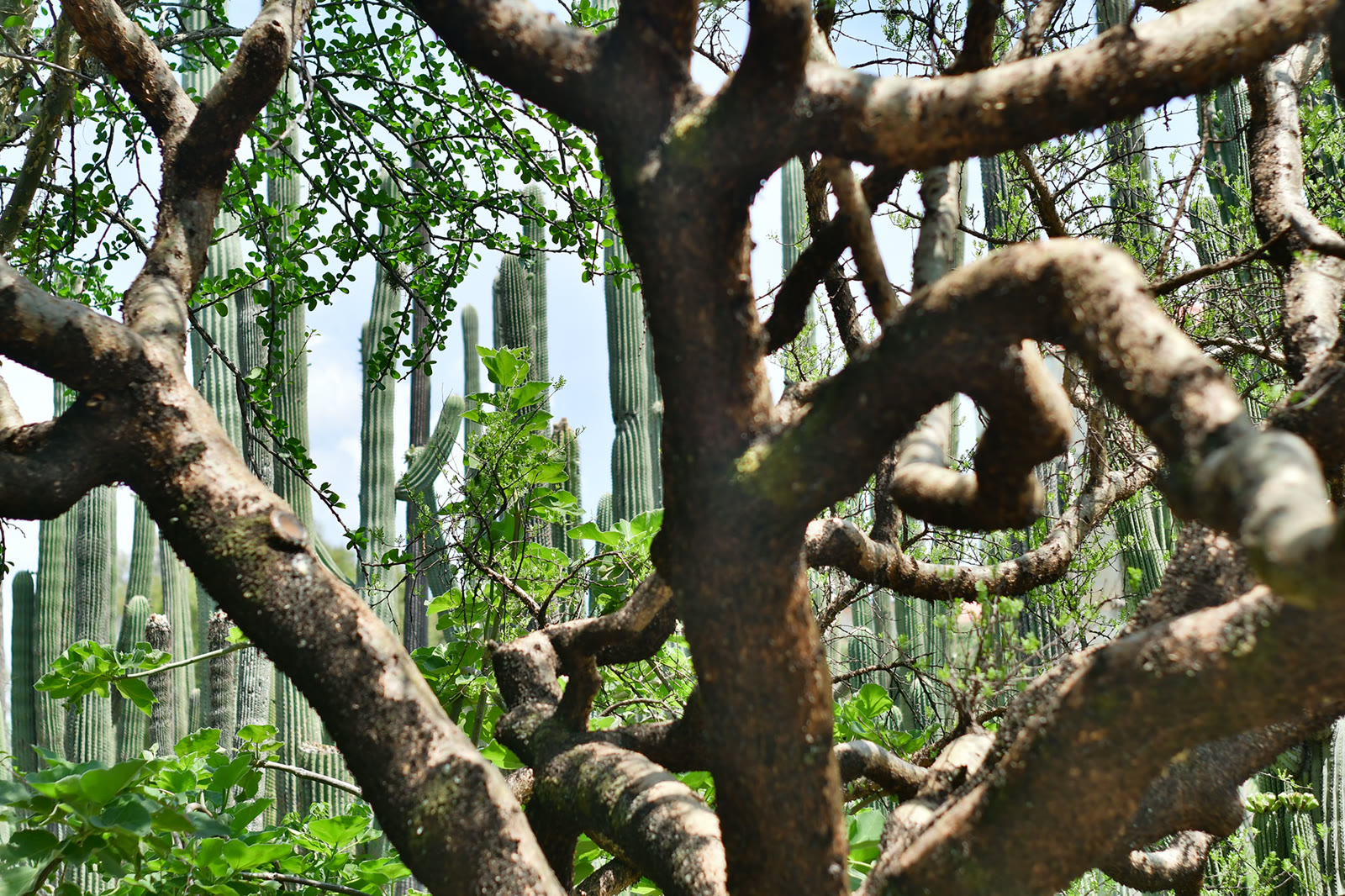
Begin with the columnar cacti. Their repetition is not merely an architect’s photogenic trick. An account based on interviews with artist Francisco Toledo and founding director Alejandro de Ávila explains that organ-pipe cacti were planted as a tight living fence around nopales associated with cochineal production. The arrangement joins a plant used as a boundary, an insect cultivated for maroon dye, and a commodity that traveled through Spanish trade into textiles and paintings far beyond Oaxaca [9]. The official photograph above catches the same visual logic: a copal’s branching shade opens onto the vertical cactus wall [10].
The sixth move is to make one photograph from within the group’s flow, then lower the phone. Do not step backward into planting, touch a cactus, delay the line for a portrait, or assume a tripod is acceptable. A local guide recommends asking before using a tripod and keeping noncommercial photography subordinate to the tour [3]. If the group moves, the photograph is finished.
Next, look for the garden’s agricultural section. Its map identifies a Cruz de Maíz, or maize cross, where maize and its relatives are surrounded by squash, chile, beans, amaranth, and edible greens [7]. This is not a decorative “three sisters” tableau exported from a generic botanical script. The garden’s mission is to show connections between Oaxaca’s natural history and cultural diversity, using plants donated by communities across the state [10]. The seventh move is to listen for use and place—food, fibre, dye, medicine, building material—rather than waiting only for a Latin name.
Water supplies the second relationship. Luis Zárate designed paths and channels that guide heavy rain away from low ground, while the thematic map moves from humid tropical forest to mountain forest, dry tropical forest, xeric scrub, limestone planting, and nopaleras [6][7]. A single guided line therefore crosses several Oaxacas compressed behind one convent wall. Notice where shade deepens, where soil or stone changes, and where the planting becomes sparse enough for hardscape to take over.
The third relationship is archaeological. Excavation during the garden’s construction exposed lime kilns that may predate the convent’s 1570 building campaign. The garden places limestone-adapted plants around them, turning the machinery that helped make mortar into part of the living collection [7]. Nearby, excavated washing basins associated with Dominican novices sit among plants traditionally used as soap [7]. The eighth move is to look down whenever the group pauses at masonry. The ruin and the planting are often one label.
One more local word brings the city into the garden. In Patio El Huaje, the map identifies a large huaje tree—the plant from which Oaxaca’s name is derived—beside Francisco Toledo’s red-water work La Sangre de Mitla [7]. The garden does not summarize the state from above. It lets the city’s own name, rain, dyes, crops, walls, and contested land reappear as material.
The garden was the alternative, not the decoration
This place portrait sharpens when you know what the garden displaced. The military occupied the Santo Domingo grounds for more than 120 years. When its departure became possible, the land was not destined naturally to become a garden: proposals included a hotel, convention center, parking, workshops, exhibition space, and a European-style formal garden [6][9].
In 1993, Toledo asked de Ávila what the site should become. De Ávila proposed an ethnobotanical garden that would show interactions between people and plants; civic advocacy followed, and a state trust was created in 1994 [6][9]. The current official history is blunt about the choice: the project emerged from civil society in opposition to a private luxury hotel with extensive parking [6].
That origin changes the apparent strictness at the gate. Restricted entry can still be frustrating, and current administration deserves scrutiny when schedules conflict or interpretation shrinks. Recent community and review sources are right to warn visitors that the present circuit may be short, Spanish-only, or more supervisory than educational [1][2][4]. But the collection itself is not leftover greenery behind a famous church. It is a civic answer about what prime central land can hold.
The ninth move is to let that answer set the pace. If your group receives rich interpretation, ask one precise question about a relationship you can already see. If the guide mainly keeps the line moving, use the three-part reading—work, water, ground—and research one plant afterward. Either way, remain on the path, keep hands off the collection, and leave with the group. The visit is not improved by winning five unsupervised minutes.
Four ways to miss the garden
Mistake one: arriving at the wrong Santo Domingo entrance. The church, museum, and garden belong to one complex, but they do not share one visitor door. Better: navigate to Reforma Sur at Constitución, confirm the garden sign, and ask for the next recorrido [5].
Mistake two: treating an online English-tour time as a booking. A February 2026 local guide reproduced a multilingual schedule, but April visitors reported that English was unavailable despite what websites said [3][4]. Better: assume Spanish, call ahead, and ask again at the gate.
Mistake three: reading broad opening hours as permission to wander in. The state tourism page gives a wide operating window, while a photographed gate notice and recent reports describe discrete, capped groups [1][4][8]. Better: arrive at 10:00 for the next actual departure and keep 90 minutes flexible.
Mistake four: trying to compensate for a short circuit with more photographs. Community reports describe a fast group and limited interpretation; falling behind only turns the collection into a conflict with staff [2][4]. Better: choose three relationships before entry, make one photograph without leaving the path, and let the cacti, channels, and excavated masonry carry the argument.
A resilient one-garden plan
- Anchor: Jardín Etnobiológico de Oaxaca only; do not dilute the visit into a Santo Domingo checklist.
- Best attempt: a normal weekday, at the Reforma/Constitución gate by 10:00, aiming for the first group actually offered after 10:30 [1][5].
- Time: hold 90 minutes from arrival to exit; the current circuit may be roughly 20 minutes, but queueing and schedule changes are the larger variables [1][2][4].
- Expected spend: current evidence points to MXN 0 admission. Carry MXN 100 in cash as a contingency and ask before entry; transport is separate [1][4].
- Reservation reality: regular individual departures are described as walk-up only, with no advance booking and a 30-person cap; source 3 says groups larger than 15 should coordinate ahead. A call or referral can verify operations but does not itself guarantee a place [1][3][5].
- Language: expect Spanish. Treat any English departure as a same-day bonus, never as the foundation of the plan [3][4].
- Where to wait: at the signed garden entrance, along the wall only when directed, never across the gate or staff route.
- What to notice: columnar cacti and cochineal-bearing nopal; the maize cross; one water-management detail; one excavated kiln or washing basin [7][9].
- Etiquette: remain on the path, do not touch plants, ask before using equipment, take photographs without delaying the group, and leave when the circuit ends [2][3][4].
- Abort condition: no confirmed departure within your 90-minute window, a language mismatch that removes the value for you, or access instructions that conflict with your mobility needs. Accept the miss and verify another day.
The garden’s most memorable geometry is a line: a line of visitors, a line of columnar cacti, a channel moving rain, a wall that once enclosed soldiers, and a civic decision that kept the ground from becoming parking. Follow the line without mistaking it for mere restriction. Oaxaca’s garden becomes legible when its guided clock, living collection, and contested site are allowed to tell the same story.
Sources
- Monte Albán Heritage Center, “Guía 2025 para visitar el Jardín Etnobotánico de Oaxaca” (updated October 13, 2025) — local visitor guidance transcribing and photographing the entrance notice, including walk-up times, 30-person capacity, free entry, and the short escorted format.
- r/Oaxaca, “Gardens in Oaxaca?” (June 20–July 4, 2025) — community discussion with recent firsthand reports of guided-only access, a roughly 30-person group, and a 15–20 minute circuit.
- Oaxaca Auténtico, “Jardín Etnobotánico de Oaxaca: Guía de Visita” (February 9, 2026) — local cultural guide to guided-only access, language schedules that require verification, photography etiquette, and the garden’s conservation purpose.
- Tripadvisor, “Jardín Etnobotánico de Oaxaca” — review platform with a May 22, 2025 report of a 10:30 group and April 2026 reports of free entry, limited interpretation, and an advertised English tour not operating on arrival.
- Jardín Etnobiológico de Oaxaca, “Recorridos” — official notice on the 2025 administrative transition and current referral for tour inquiries, plus the garden’s address and general office contact in the footer.
- Jardín Etnobiológico de Oaxaca, “Historia” — official account of the 1993 civic proposal, the hotel-and-parking alternative, the project team, and the garden’s design history.
- Jardín Etnobiológico de Oaxaca, “Mapa del Jardín” — official inventory of visitor facilities, 14 thematic planting areas, Patio El Huaje, the maize cross, lime and ceramic kilns, and excavated washing basins.
- Secretaría de Turismo del Estado de Oaxaca, “Jardín Etnobotánico de Oaxaca” (November 25, 2025) — recent official description of the guided-access garden, Santo Domingo setting, collections, and broad public-hours window.
- Jeff Spurrier, “Oaxaca’s Ethnobotanical Garden.” Garden Design — interviews and design history covering Francisco Toledo, Alejandro de Ávila, Luis Zárate, the site alternatives, ecological-cultural organization, cochineal planting, water, and archaeology.
- Jardín Etnobiológico de Oaxaca, official homepage — institutional mission, community-donated collection, and Ernesto de los Santos Reyes’s documentary photograph “Vista de columnares desde un copal.”