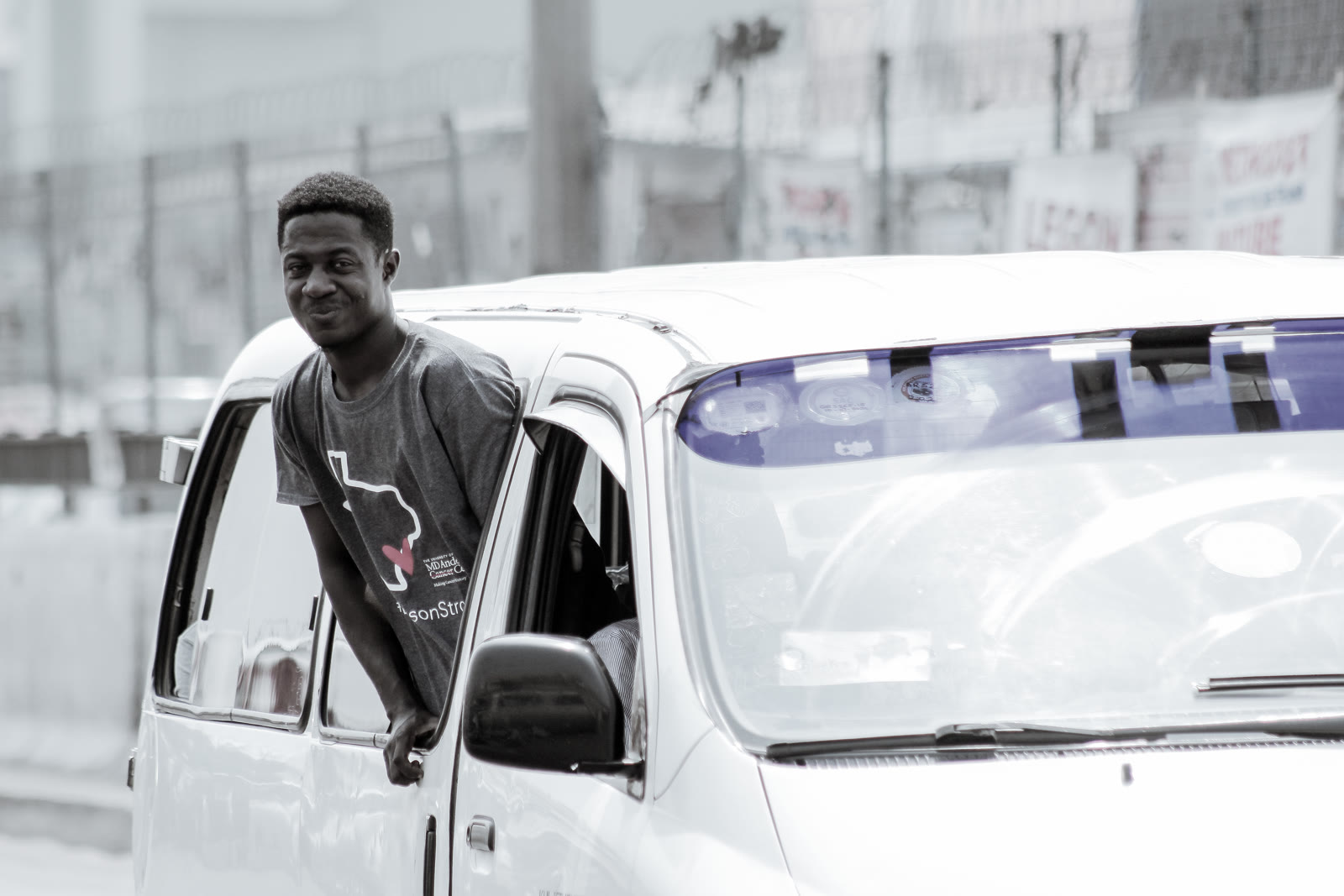
Before an Accra trotro is close enough to read, it can already have a destination. The mate—the driver’s conductor, fare collector, door operator, and street-level dispatcher—leans into view and turns one forefinger in a small downward circle. The moving hand is a route board: Circle, the vast transport node around Kwame Nkrumah Interchange.
The gesture is beautifully economical and not entirely literal. An Accra boarding guide says a circular forefinger can indicate the nearest or principal roundabout; near Nkrumah Interchange, it means Circle specifically. Victoria Okoye recorded the same downward loop while researching the city’s transport system: mates paired it with a shouted destination because many vehicles carried no useful route display [1][2]. The hand narrows the possibilities. The voice completes the address.
That pairing is the point of this close-up city ride. Go to the 37 trotro station at the Total filling station opposite MaxMart on Liberation Road, watch for the loop, confirm “Circle?” aloud, then take one Circle-bound car to its terminal. Do it between 10:00 and 11:30 a.m., carry a small cash buffer, and allow 45–90 minutes from finding the yard to stepping out at Circle. This is not a claim that the ride runs to a timetable. It is a way to learn one sign in Accra’s human routing language without pretending to have mastered the whole network.
The hand is only half the route
Accra’s trotro map is made from famous destinations, intermediate landmarks, repeated calls, and passenger memory. “Circle,” “37,” and “Accra” do more work in this system than a newcomer expects. In Okoye’s field account, Circle means the Kwame Nkrumah hub; 37 points to the station by 37 Military Hospital; and “Accra” can mean the central Tema Station rather than the entire city [2]. The words are compact pieces of operational geography.
The first local move is therefore to listen before signaling. Spend five minutes at the 37 station’s safe interior edge, clear of the vehicle path. Watch which movement accompanies “Circle,” but do not stand in front of a van or step into the lane to flag it. The local boarding guide warns that a stopped vehicle may pull away abruptly; visibility to the mate matters, but occupying the driver’s path is not the way to achieve it [1].
The second move is to let the mate repeat the answer. A downward loop can point to a principal roundabout in another context, and Accra contains more than one place called a circle. Make the gesture if it helps attract attention, then ask “Circle?” before touching the door. If the mate names a route you do not recognize, do not board on the strength of your own hand sign.
This call-and-response is not a quaint survival of a system that has failed to acquire an app. It is the dispatch layer. The mate recruits passengers, identifies the route, collects fares, remembers who requested which stop, tells the driver when to halt, and manages the door [1][2]. A route label detached from that conversation would omit much of how the service actually coordinates itself.
It also explains a specifically Accra form of place knowledge. On board, formal names often yield to landmarks and durable nicknames. The local guide gives Sankara for Ako Adjei and UTC for Accra Central [1]. Knowing every official street name is less useful than saying one locally legible destination at the right moment.
Find the right 37 before finding the right car
The third move happens in the map search. Do not enter only “37 Station” and assume the result is unique. The local route guide identifies two trotro stations around 37. The more visible west- and northbound yard sits within the Total filling station opposite MaxMart on Liberation Road; its listed destinations include Circle. The other lies along El Wak Road and serves a different directional mix, even though Circle also appears among its possible destinations [1].
Use the Total/MaxMart description as the door. If arriving by taxi or ride-hail, show the driver those words and keep the pin subordinate to what is visible on the street. On arrival, ask one stationary person—station worker, vendor, security guard, or waiting passenger—“Circle car?” A Ghana community thread makes this ordinary rather than embarrassing: residents advise newcomers to reach a major node such as 37 or Circle and ask for the exact vehicle, sometimes with someone walking them to it [5].
Go after the morning rush, not during it. Ghana News Agency reported Accra’s heaviest trotro pressure from 07:00–09:00 and 16:30–20:00, with terminal queues at times exceeding one hour [4]. The 10:00–11:30 window is an inference from those local pressure points, not a guarantee of an empty seat. If the yard is still forceful or confusing, observe the signal and leave by the transport you arrived in. The object lesson does not require winning a scrum.
There is no reservation to make. Trotros generally fill and leave rather than hold to published departure and arrival times [9]. The fourth move is to replace “When does it depart?” with two answerable questions: “Circle?” and “How much?” Ask both before boarding. Then accept that the wait depends on how quickly the car fills and how Ring Road traffic is moving.
Cash is another message passed through the room
Budget GHS 10–15 for this short urban leg, but treat that as a cash buffer rather than a quoted tariff. A local 2025/26 route overview placed many Accra trotro journeys in a wider GHS 5–25 band [3]. More importantly, fare conditions are moving: Ghana’s 2026 Ministry of Transport budget records a 15% reduction negotiated for May 2025, while on July 28, 2026 the national broadcaster reported that unions had suspended a proposed 30% increase pending the next fuel-pricing window [6][7]. An exact number printed here could age before the hand signal does.
The fifth move is to carry the buffer in low denominations—ideally a mix that does not require change from one large note [1]. Ask the mate’s price in the doorway. If it sounds inconsistent with what others are paying, ask a waiting passenger before entering rather than turning the vehicle into a fare dispute [5]. A current community-powered fare app can provide a second opinion, but its own listing says user reports may differ from official prices [8]. Let same-day station information outrank a screenshot.
Once seated, keep the money accessible and your bag on your lap. The local onboard guide describes a collection call of “Front”: front passengers begin handing over fares while people behind ready theirs. Cash and change may travel through other passengers in a daisy chain. The sixth move is to pass what reaches you promptly, remember the denomination you gave, and listen for the mate calling it back [1]. The social circuit is part of the payment system.
The seventh move is physical. Take an available seat without blocking the sliding door. Grip a stable rail or seat back immediately, and do not assume the driver will wait until everybody is settled [1]. If the vehicle, door, or driving feels unsafe, get off before departure. A local ride is not a test of endurance.
Let Circle announce itself twice
After boarding, tell the mate “Circle” once more. Then watch the route through the same vocabulary the car uses. The mate may call major intermediate places; riders answer, reposition, pass money, or prepare to leave. Okoye observed that peak traffic can produce route variations, which is why a spoken confirmation of the destination matters more than memorizing a line on a map [2].
The eighth move is to resist navigating every second on your phone. Keep it put away unless you need a discreet location check, and read the cabin first: who is making room, whether change is moving toward you, and which stop the mate has just announced. Ghana News Agency describes the trotro as a social room as well as a vehicle—route chants, political or football conversation, vendors at stops, and slogans on rear windows all travel together [4]. The texture is not decorative. It is evidence that information moves person to person.
Circle should arrive first as a repeated call and then as a change in scale. One local guide counts five trotro stations around the interchange—two purpose-built and three makeshift—so “Circle” is a destination without being a single neat platform [1]. The ninth move is to remain seated until the mate indicates the terminal or confirms that this is your stop. Do not jump out early simply because a map dot appears close.
At the end, move clear of the door before checking directions. If Circle is not your real destination, make the next leg by a method you already understand; this article is deliberately one ride, not an invitation to improvise a multi-transfer day. What you should carry forward is smaller and more useful: the loop means something, but only inside a conversation.
Four ways a visitor breaks the conversation
Mistake one: going to a generic 37 pin. There are two documented station areas, and the name alone does not choose the right yard [1]. Better: use Total filling station opposite MaxMart on Liberation Road, then ask for the Circle car.
Mistake two: treating the finger loop as a guarantee. The circular gesture is context-dependent and can refer to a principal roundabout [1]. Better: let the loop attract the mate’s attention, then confirm “Circle?” aloud.
Mistake three: waiting for a timetable or numbered bay to explain the system. Vehicles fill, mates call, and departure intervals flex [2][9]. Better: arrive in the shoulder window with 45–90 minutes, ask where the car is loading, and abandon the ride if the crowd exceeds your comfort.
Mistake four: quoting yesterday’s fare or producing one large note. Official fare policy, proposed increases, and user-reported payments do not always move together [6][7][8], while the local onboard guide warns against paying with a large note [1]. Better: carry GHS 10–15 in small notes, ask before boarding, and compare with another passenger when uncertain [5].
The compact go plan
- Object: the trotro mate’s downward forefinger loop for Circle, always paired with verbal confirmation [1][2].
- Ride anchor: 37 trotro station at the Total filling station opposite MaxMart on Liberation Road to Circle [1][3].
- Best window: 10:00–11:30 a.m. on a normal weekday, after the reported 07:00–09:00 peak and well before the 16:30–20:00 pressure period [4].
- Time: allow 45–90 minutes from locating the correct yard to arrival; there is no reservation or dependable fixed departure time [4][9].
- Expected spend: carry GHS 10–15 in low denominations for one leg, confirm the actual fare before boarding, and treat app figures as community reports rather than authority [3][7][8].
- Seat and payment: sit without blocking the door, hold on before the vehicle moves, ready cash when the mate begins collection, and pass other passengers’ money or change promptly [1].
- Navigation cue: use
Total opposite MaxMartat 37, not a generic station pin; at the far end, wait for the mate to confirm Circle. - Etiquette: ask rather than bluff, keep luggage compact, keep the phone discreet, and do not obstruct boarding while making photographs.
- Abort conditions: an unclear destination, a fare not stated before boarding, unsafe driving or vehicle condition, a crowd beyond your comfort, or same-day transport disruption.
- Exit: step clear at Circle before consulting the next map. Do not turn one successful signal into an unsourced chain of transfers.
The little circle drawn in the air is memorable because it looks self-explanatory. It is not. Its real precision comes from the mate’s call, the passenger’s question, and the shared knowledge of where “Circle” begins and ends. Read that sequence correctly and Accra offers more than a cheap ride: it shows a city routing itself in public.
Sources
- AccraTrotro — local specialist guidance covering the Circle hand signal and boarding safety, cash collection and landmark stop names, the two station areas at 37, and the five loading areas around Circle.
- Victoria Okoye, “Report from the Field: The Tro-Tro—An Essential Mode of Transport in Accra, Ghana.” Columbia University Millennium Cities Initiative / State of the Planet, September 29, 2010 — field account of mate signals, the Circle and 37 nodes, onboard roles, and route variation.
- Accra Street Journal, “TroTro Routes in Accra You Should Know: Complete Guide for 2026” (November 3, 2025) — local overview of terminal connections, cash use, operating pattern, and indicative city fare bands.
- Elizabeth Larkwor Baah, “One hour, one ride: Trotro life in Accra.” Ghana News Agency, July 4, 2025 — local report on peak periods, long terminal queues, route calls, and the trotro as a social space.
- r/Ghana community discussions: “How to use trotro?” — resident advice to ask at major nodes — and “Charley, how do you know correct trotro fare before conductor overcharge you?” (February 2026) — current discussion of checking a disputed fare with fellow passengers.
- Ghana Ministry of Transport, 2026 Programme-Based Budget Estimates, p. 8 — primary government record of the 15% public-transport fare reduction effective May 24, 2025 and the ministry’s road-transport remit.
- Ashiadey Dotse, “30% transport fare hike suspended as government steps in.” Ghana Broadcasting Corporation, July 28, 2026 — recent confirmation that the proposed increase was paused pending fuel-price developments.
- Troski, “Know Your Fare,” Google Play listing, updated April 13, 2026 — primary description of the community-powered fare tool and its disclaimer that user reports may differ from official prices.
- Daniel Neilson, “How to ride a trotro.” Time Out Accra, December 22, 2016 — visitor-oriented account of fill-and-go departures, carrying change, confirming the drop-off with the mate, and the “Bus stop” response.
- Lariwenga, “Tro Tro 04.” Wikimedia Commons — catalogue page for the real photograph made in Accra on February 8, 2020, showing a mate calling prospective passengers.