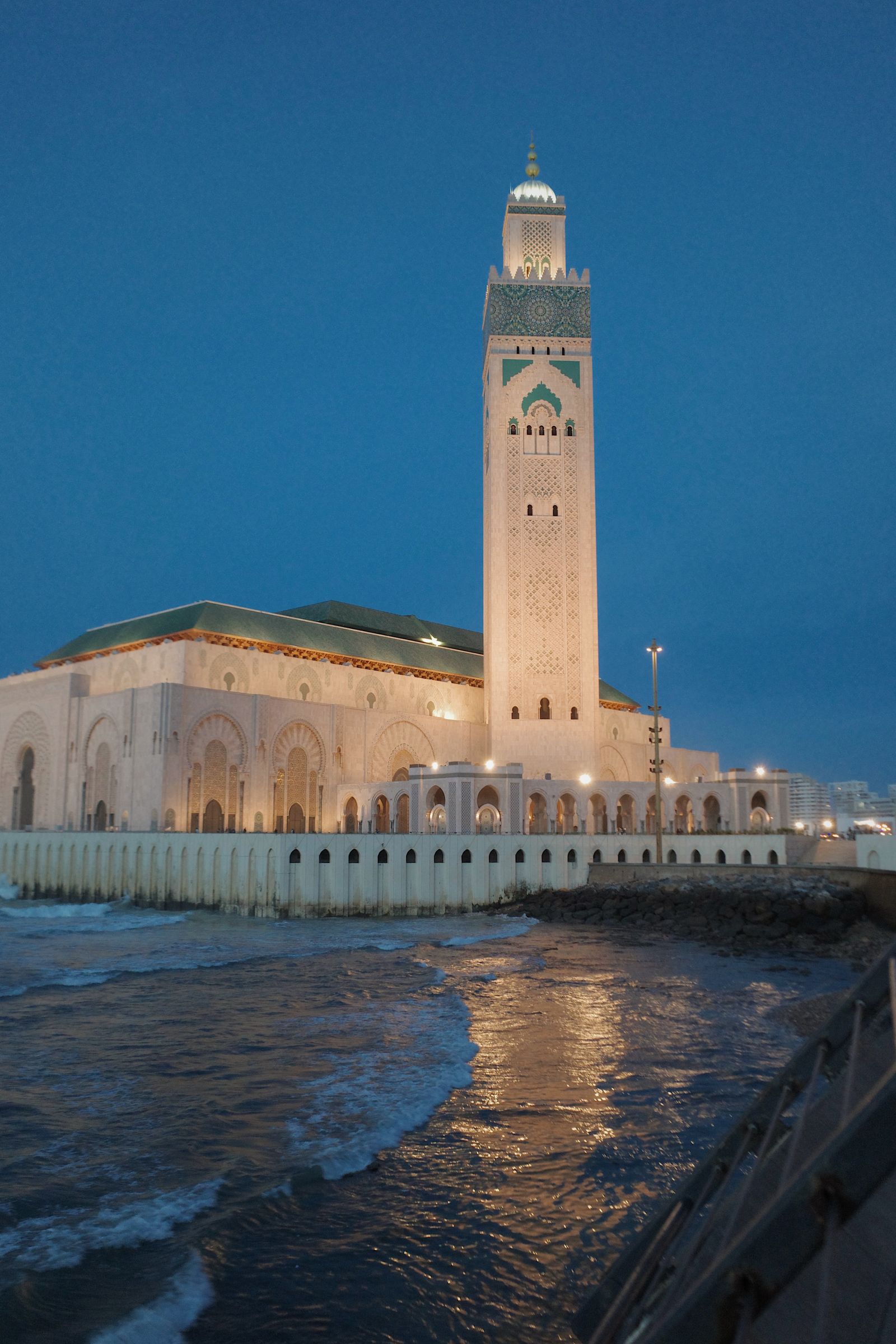
At night, Hassan II Mosque does not become a later version of the daytime attraction. The guided groups have stopped. The prayer clock has taken over. Atlantic wind moves across the marble and the public maritime walk, the minaret becomes a vertical strip of light, and any assumption that a monumental door must remain open to sightseeing becomes visibly wrong.
That change is the visit.
The useful plan is one conditional exterior hour: aim for the maritime edge 20 minutes before a date-specific calculated Maghrib time, verify that time locally, stay through the first 40–45 minutes of darkness, and leave before the next prayer flow or a thinning promenade makes transport feel improvised. Do not build the evening around getting inside. If the interior matters, book a separate official guided visit in daylight; for March 15–September 15, the Foundation lists departures as late as 16:00 and charges foreign adults 140 MAD [1].
At night, the anchor can cost 0 MAD, but only while the maritime walk remains open: Casablanca BAÏA says the parks and green spaces it manages have free access, but it publishes no night hours for this promenade [15]. Let the Atlantic, the lit exterior, and the movement around prayer do the work. The central uncertainty is access to the immense esplanade itself: official city copy describes a civic space used outside prayer times, while local reporting and recent Casablanca community accounts describe paid access, changing gates, and restrictions [3][4][10]. The resilient rule is simple. If security opens the esplanade to you, enter only on the terms given. If it does not, try the maritime walk only if current barriers leave that edge open and it still feels social; otherwise use the return ride you saved before departure and end the visit.
Two clocks, one building
The first local move happens before departure: check a date-specific calculated Casablanca prayer calendar, not only a generic sunset app. Note Maghrib and Isha for the exact date, then verify the working time against current mosque signage or staff; any official same-day notice outranks a calculation. The Foundation publishes its Boulevard Moulay Youssef address and phone numbers for direct questions [2][13]. Maghrib moves with sunset; AlAdhan’s July 2026 calculations alone shift it from about 20:50 near the start of the month to 20:36 at the end. Another season can move the entire visit by hours. A copied “8 p.m.” itinerary is not a plan.
Count backward 20 minutes from Maghrib. That is the promenade-side arrival target if the edge is open, not a promise of admission through a mosque gate. The light is still strong enough to distinguish sea wall, platform, minaret, and the open ground between them. Families, walkers, worshippers, guards, and photographers also have different destinations before the call to prayer; arriving early lets you read those routes before darkness compresses them.
The second move is to keep the tour clock and the prayer clock separate. For March 15–September 15, the Foundation’s visitor page lists guided departures at 09:00, 10:00, 11:00, 12:00, 15:00, and 16:00 from Saturday through Thursday, with a shorter morning pattern on Friday; winter and Ramadan use other schedules. It also requires visitors to remain with the guide, cover shoulders and chest to below the knees, remove shoes, and carry them in the supplied bag [1]. Those are interior-visit rules. They do not imply that a non-worshipper can return after sunset and roam inside.
Do not try to make the final tour and blue hour one continuous appointment. On July 30, 2026, for example, AlAdhan’s calculated calendar estimates Maghrib at 20:37, more than three hours after a roughly one-hour 16:00 tour would finish [1][2][5]. Use the gap elsewhere, then return for the exterior hour. In winter the interval changes, which is another reason to build from the date rather than from this example.
Recent visitor reports make the boundary concrete: travelers who arrived at night during prayer were not admitted for sightseeing, while daytime visitors describe fixed tour times, an official guide, and a roughly one-hour circuit [5]. Treat prayer access as prayer access, never as a free-tour loophole. If you are attending worship, follow staff direction as a worshipper. If you are there to see the building, remain outside unless the Foundation explicitly admits your visit.
This distinction saves the evening from a common failure. You are not waiting for a locked attraction to reopen. You are watching a tourist monument return to its primary religious time.
Let current barriers define the room
Hassan II Mosque rises on Casablanca’s Atlantic side beyond the old medina and marina. CasaBus lists eight nearby routes—11, 43, 55, 56, 60, 62, 67, and 139—but a route number is not a promise about the night you go; use the operator’s live planner for the actual origin and departure [11]. The third local move is more conservative: pin the mosque before leaving, get dropped at the lit perimeter, and save the return ride before you begin. Do not let the best light disappear while a driver and passenger negotiate which “Hassan II” landmark is meant.
Use two labels in your phone:
Mosquée Hassan IIfor the landmark.Fondation de la Mosquée Hassan IIfor the Foundation’s official contact point; it gives its own address as Boulevard Moulay Youssef [13].
The fourth move is to start on the promenade maritime, if current barriers leave it open, rather than walking directly into the center of the esplanade. Casa Aménagement defines the waterfront line toward El Hank as a 1.5-kilometre, 13-hectare public urban park; WeCasablanca describes the coast as a route used by athletes and families and says Casablancans come to the mosque’s open space outside prayer times to look at the sky and waves or find quiet [3][8]. A July 2026 community recommendation likewise identifies the mosque area and Corniche as good evening-walk territory [6]. The resident habit described by these sources is not “stand in the postcard spot.” It is to let the ocean edge function as somewhere to walk and pause.
Current access deserves humility. Le360 reported in November 2024 that outside-prayer visits to the forecourt had become controlled and paid; in a 2026 r/Casablanca thread, residents and visitors still disagreed over whether the esplanade was open, charged, or limited to prayer periods, and reports changed even within the discussion [4][10]. That volatility outranks old blog promises. The fifth move is therefore to let the physical barriers decide. Do not argue from a screenshot, offer a side payment, or follow somebody through a worship entrance. Ask security once. If the answer is no, see whether the maritime walk is still openly accessible. If it is, the full minaret and Atlantic platform remain visible there; if it is not, leave rather than turn access control into the story of your night.
That condition also keeps the expected spend honest. Budget 0 MAD at the anchor only when the free maritime walk is open [15]. For a simple door-to-door budget, that means 0–12 MAD total if you can walk safely both ways or the live planner gives one direct CasaBus ride each way: the operator lists eight routes by the mosque, and its fare table prices those routes at 5–6 MAD per ride [11][14]. A transfer or taxi adds the live fare from your actual origin. A separate official interior tour adds 140 MAD for a foreign adult [1].
Let Maghrib change the scale
Twenty minutes before Maghrib, take the long view first. The sixth move is to stand far enough back that the ocean remains in the frame. A close facade view shows carved stone and arches; distance explains why the building is here. Part of the mosque stands on a platform over the Atlantic, an architectural response to Hassan II’s stated desire for a sanctuary associated with the Quranic image of the divine throne upon water [7].
This is not an old medina monument enlarged. It was inaugurated on 30 August 1993, after a seven-year construction effort that joined contemporary engineering to Moroccan cedar, granite, marble, carved plaster, and zellige [7]. The Foundation gives the minaret’s height as 200 metres and the green laser’s range toward Mecca as 30 kilometres [12]. Other local pages use a different height figure, which is a good reason to follow the Foundation’s own number rather than turn the visit into a superlative contest.
The non-tactical detail that matters is civic. Moroccan citizens helped finance the project, and local media still describes that contribution as part of the mosque’s national inheritance [7]. That history sharpens the current argument over gates and fees in the Casablanca community source [4]. Residents are not debating an ordinary ticketed landmark. They are debating the terms of access to a place made with public contribution, used for worship, promoted as a civic esplanade, and managed as a major visitor site at the same time.
At the call to prayer, stop moving toward the doors. The seventh move is to give the entrance routes to worshippers. Stand clear of thresholds, do not photograph faces at close range, and keep a tripod out of circulation. Modest clothing remains the right default outside even when nobody is checking the daytime tour rule. The official visitor code bans food, drink, smoking, and noisy electronics inside; its underlying message—this is a place of worship before it is a visual asset—travels well beyond the door [1].
Listen to how the space changes. Before Maghrib, the building is an object against the last blue. During arrival, it becomes a destination. After worshippers begin to disperse, it becomes an illuminated edge again, but not the same one: the courtyard has acquired direction, and the green laser—if it is operating that night—belongs to the building’s qibla logic rather than merely to the photograph.
Now make the eighth move: walk, then make one photograph, then walk again. Taha El Oihaj’s night photograph holds the useful recognition cue—the entire minaret, gold-lit seaward walls, dark water, and enough blue sky to keep the building from floating in blackness [9]. Use it as evidence of the right relationship, not as coordinates. Do not climb onto wet rocks or block a prayer route to reproduce somebody else’s frame. Atlantic spray and polished stone can both be slick; shoes with grip are more useful than a perfect camera position.
Give the public edge about 60–65 minutes total: 20 before Maghrib, 40–45 after. Add 10 minutes of buffer if a driver must reach you through evening traffic, but do not keep extending the walk simply because the minaret remains lit. The ninth move is to leave with the same discipline used to arrive: return pickup already pinned, phone charged, and no last-minute attempt to walk an unfamiliar dark shoreline toward El Hank.
Four ways to flatten the night
Mistake one: arriving after dark expecting an interior visit. The current public tour timetable ends in the afternoon, and recent visitors report being turned away from sightseeing during night prayer [1][5]. Better: tour inside separately in daylight, then treat the night as an exterior experience with its own logic.
Mistake two: using prayer time as a way around the tour fee. Community comments may describe entering during prayer, but worship access is not permission to conduct a self-guided architectural visit [4]. Better: if you are not there to worship, stay on the public edge unless staff explicitly direct otherwise.
Mistake three: assuming the whole esplanade is permanently free and open. City promotion, local memory, and recent gate reports do not line up cleanly [3][4]. Better: ask once, accept the current boundary, and try the maritime promenade only as a first fallback, subject to the barriers in place that evening.
Mistake four: chasing the photograph instead of reading the room. The most dramatic image may be made from a wet or obstructive position, while the real evening includes families, walkers, prayer arrivals, wind, and a working security perimeter [3][6][9]. Better: keep the Atlantic in view, make one frame from public ground, and move with rather than against the space.
One exterior hour, clearly bounded
- Anchor: Hassan II Mosque’s maritime edge when open; the interior is a separate daytime visit.
- Best window: check a date-specific calculated Casablanca prayer calendar, confirm the working time locally, arrive 20 minutes before Maghrib, and leave 40–45 minutes after [2][13].
- Expected spend: 0 MAD at the anchor only while the free maritime walk is open. Total evening spend is 0–12 MAD if you can walk safely both ways or take one direct listed CasaBus route each way; transfers and taxis are origin-dependent. A separate official guided interior visit adds 140 MAD for a foreign adult [1][11][14][15].
- Queue and reservation: the Foundation’s visit listing offers no bookable exterior slot, and current barriers decide whether the plan can happen. The interior is a separate guided visit at fixed hours [1][4][10].
- Navigation cue: pin
Mosquée Hassan II; for visitor administration, pin the Foundation at its official Boulevard Moulay Youssef address. Treat the lit maritime walk as the first fallback, subject to same-day access [3][13]. - Where to stand: begin far enough back to hold minaret, seaward platform, and Atlantic in one view. Stay off entrances, prayer routes, rocks, and vehicle lanes.
- What to carry: a light wind layer, grippy shoes, charged phone, and a saved return ride. Keep shoulders, chest, and knees covered as a respectful default [1].
- Abort condition: security closes the exterior area you intended to use, the promenade feels empty rather than social, weather makes the ocean edge slick, or your return transport is uncertain. The building will still be there on another evening.
Hassan II Mosque is most legible after the last tour precisely because the visitor stops being the building’s organizing principle. Prayer sets one rhythm. The Atlantic sets another. Gates introduce a third, less predictable one. A good night does not defeat any of them. It stands on the public edge, watches the clocks overlap, and leaves before looking becomes intrusion.
Sources
- Fondation de la Mosquée Hassan II de Casablanca, “Paid guided tours” — official seasonal guided-tour hours, tariffs, and visitor rules.
- AlAdhan, “Prayer Times Calendar: Casablanca, Morocco” — third-party calculated Maghrib and Isha estimates, including the July 2026 month view.
- WeCasablanca, “Visit Casablanca” — local city guide to the mosque, the maritime walk, Casablancans’ use of the open space outside prayer times, and the wider Corniche’s family and exercise rhythm.
- r/Casablanca, “Mosque Hassan 2” (2026) — recent local community discussion of changing esplanade gates, fees, and prayer-versus-visitor access.
- Tripadvisor, “Hassan II Mosque” — recent 2025–2026 visitor reports on fixed guided tours, the 140 MAD ticket, the shoe-bag procedure, and nighttime sightseeing access being refused during prayer.
- r/Morocco, “Date location recommendations in Rabat and Casablanca” (July 2026) — recent community recommendation of the Hassan II Mosque area and Corniche for an evening walk.
- Sabrina El Faiz, “30 août 1993 : inauguration de la Mosquée Hassan II.” LeBrief, August 29, 2024 — Moroccan account of the seaward concept, construction materials, inauguration, citizen financing, laser, and civic-religious role.
- Casa Aménagement, “The Sea Promenade of Hassan II Mosque” — official project record for the public urban park from the mosque to El Hank, including its 1.5-kilometre length and 13-hectare area.
- Pexels, “Stunning view of the illuminated Hassan II Mosque in Casablanca against the sea at night” — Taha El Oihaj’s real blue-hour photograph of the mosque and Atlantic edge.
- Hafida Ouajmane, “Charging fees to visit the Hassan II Mosque in Casablanca: an official explains the facts and responds to criticism.” Le360, November 14, 2024 — local reporting on paid outside-prayer access, controlled hours, and the public debate over the forecourt.
- CasaBus, “Mosquée Hassan II” — official operator listing of the eight nearest bus routes and links to its journey planner, frequencies, and incident notices.
- Fondation de la Mosquée Hassan II de Casablanca, “Key figures” — official 200-metre minaret height and 30-kilometre laser range toward Mecca.
- Fondation de la Mosquée Hassan II de Casablanca, “Contact us” — official Boulevard Moulay Youssef address and telephone details for direct confirmation.
- CasaBus, “Fares by bus lines” — official current fare table, including the eight routes listed near Hassan II Mosque.
- Casablanca BAÏA, “Green spaces” — municipal operator page listing the Hassan II Mosque promenade among managed parks and stating that its parks and green spaces have free access.