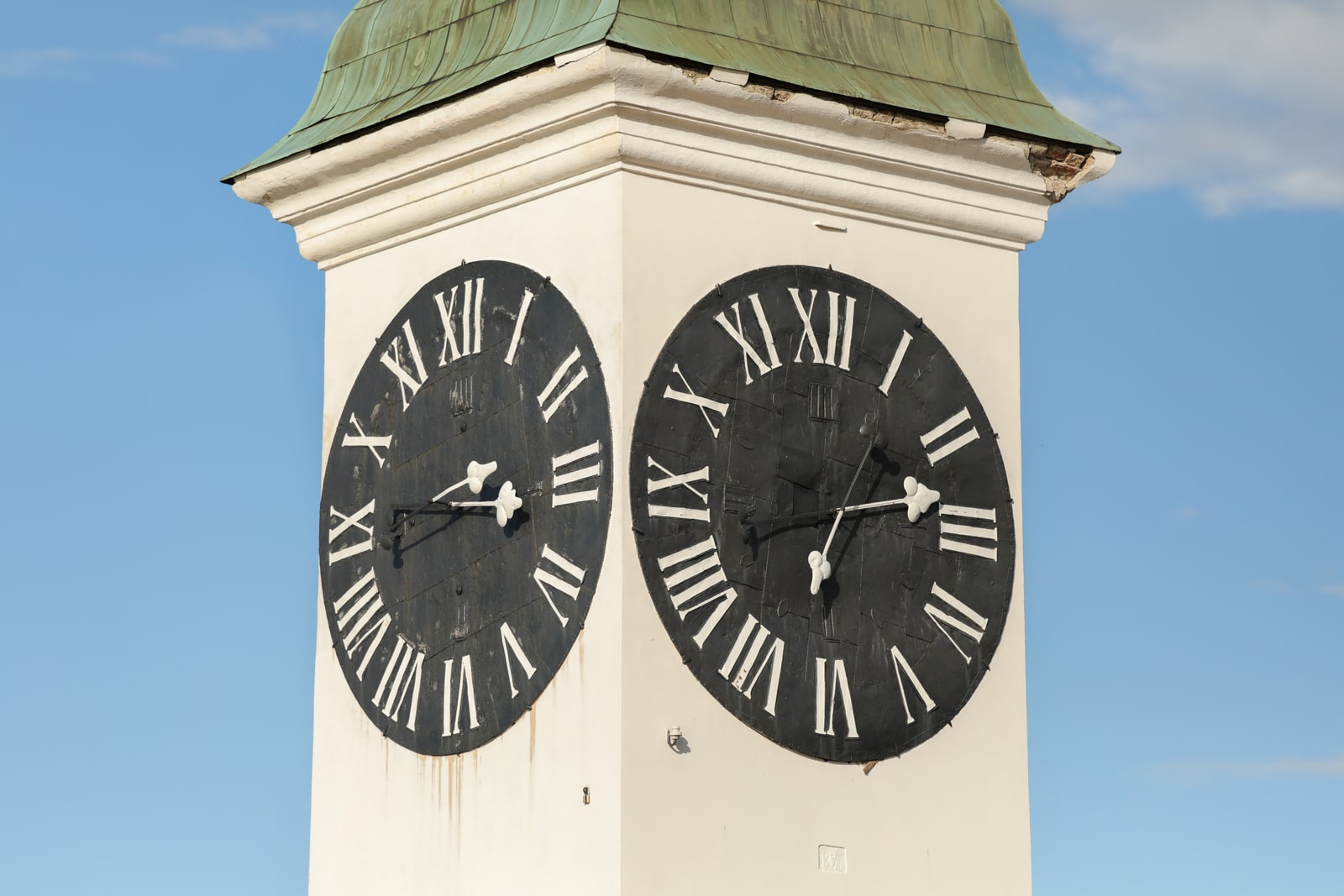
In July 2023, violent storms damaged the Clock Tower on Petrovaradin Fortress. Conservators later removed unstable plaster, repaired decorative bands, inspected the wall below, and decided that the unsafe original finial could not go back on top. A faithful gilded replica took its place; the original was retained for the museum. By late May 2025, the work was approaching completion.[5]
What the restoration did not do is just as revealing. The old mechanism still requires manual winding every day. Heat can make it gain time and cold can make it lose time. The long hand still shows the hour while the short hand shows the minutes. Novi Sad restored a public clock whose material imperfection is bound into its local name: Pijani sat, the “Drunk Clock.”[1][2]
That tension is the whole visit. Keep the outing to one anchor: the Clock Tower and the immediate terrace of Upper Ludwig's Bastion. Do not build another sunset-panorama chase around it. Come in ordinary daylight, inspect the repaired object from all four sides, compare its present surface with the 2023 cover photograph, read the hands, and leave the underground fortress for a separate guided visit. A useful editorial window is 10:00–11:15 on a Tuesday, Wednesday, or Thursday. Allow 55–75 minutes from the foot of the fortress and back, or 85–110 minutes if you begin at Dunavski Park and cross Varadin Bridge on foot.[2][3]
Recent evidence supports a live visit without pretending the site is frozen. March and April 2026 visitors reported reaching the clock and seeing the Danube view, while a June 2026 Novi Sad community thread still treated the fortress and Suburbium as a normal city walk.[7][9] The city also began preparing a detailed regulation plan for roughly 130 hectares of fortress and surroundings in January 2026. That announcement described a planning process, not a blanket closure, but live barriers and signs always outrank a saved route.[6]
Image context: the cover is a real October 2023 photograph, not a current-condition promise or a reconstruction. It records two faces after the destructive summer storms and before the subsequent conservation campaign. The weathered roof joint at upper right, streaked plaster, repaired-looking black dials, Roman numerals, and unequal hand lengths make it useful as visual evidence of the object that entered restoration.[5][10]
Conservation can preserve an imperfection
The present tower was built in the mid-eighteenth century where an older one had stood. Four clock faces address the cardinal directions, each with pale Roman numerals on black. The dedicated Novi Sad Tourism page describes dials more than two metres across; the broader fortress map calls them more than three. The honest description is simply multi-metre. Both official sources agree on the functional point: the long hand carries the hour so it can be read at distance, especially from the Danube, while the smaller hand carries the less urgent minutes.[1][2]
The reversed hierarchy is clever, but it is only the first layer. The mechanism is wound by hand every day. Temperature changes its rate. Residents once paid a “clock toll” for the service. Above the roof, the weather vane's directional ornament carries a heart where a spear point might be expected.[1] The object was never a sealed appliance delivering invisible precision. It was conspicuous civic infrastructure, tended by a person, watched from the river, and exposed to weather.
That is why “restored” should not be translated as “made new” or “made exact.” The 2024–25 campaign addressed damage and instability after the July 2023 storms. Local reporting says compatible lime mortar was used on plastered surfaces and decorative cornices; the northern wall below the tower was checked and found stable. The unsafe original upper elements went to the museum, while a gilded replica re-established the tower's summit.[5] Conservation stabilized the material carrier. It did not erase the daily winding, thermal drift, or locally understood strangeness that make this particular clock itself.
Eight moves for reading the repair
First, choose inspection light rather than spectacle light. The 10:00–11:15 weekday window is an editorial recommendation, not an official quiet-hour claim. Its purpose is to keep the faces, plaster, roof edge, and terrace paving legible while separating this visit from the familiar sunset crowd. Check weather first. Wet stone, high wind, or hard glare are reasons to move the window, not challenges to conquer.[7][8]
Second, choose the ascent for your body, not for authenticity points. The heritage stair between Lower and Upper Fortress has 214 steps.[2] Local practical guidance also describes a road-and-gate approach by car or taxi, and bus lines 3 and 9 toward Petrovaradin.[3][4] If you walk from the centre, use Dunavska Street, Dunavski Park, Varadin Bridge, and the signed rise through the Suburbium. If steps, heat, rain, or mobility make the road approach better, take it without apology.
Third, look at the roofline before looking at the time. Stand well inside the terrace and find the transition from white tower body to green roof. Then compare it with the archival cover. The photograph does not tell you that every visible blemish was storm damage, and the current tower does not tell you which component is original merely by looking clean. What it does give you is a disciplined before-image: a dated physical record against which repair becomes a question rather than an assumption.[5][10]
Fourth, make one full circuit. The tower has four faces, not one postcard side.[1][2] Walk around at a normal pace, yielding to through traffic, and notice how numerals, hands, plaster, and background change. Begin with your phone in your pocket. A complete circuit is more useful than ten nearly identical frames from the river-facing edge.
Fifth, read the long hand as the hour. Say “hour” before you look. Then let the short hand estimate minutes. If the long hand sits near VII and the short one near III, begin with seven o'clock, not quarter past three. The assignment was designed for visibility across distance; it is intentional. Whether the displayed minutes match your phone is a separate question.[1][2]
Sixth, compare the clock with your phone without declaring a winner. Use the phone for a departure. Use the tower to notice a different contract with time. Because temperature can make the old mechanism run fast or slow, a short visit cannot diagnose its seasonal behavior. Record the difference if you like, but do not caption it as fresh evidence that the restoration failed.[1]
Seventh, give the rampart more distance than a photograph seems to need. The broad city view tempts visitors toward the edge, but two serious falls from Petrovaradin's walls were reported locally in May and June 2026.[11][12] Stay on established walking surfaces, keep off masonry, and step back before composing. Take one river view from a safe position, then return attention to the clock. No photograph improves when the photographer becomes the emergency.
Eighth, keep the underground system outside this outing. Local visitor guidance directs people toward professionally guided access to the military galleries and sells deeper group tours separately.[3] Do not enter a dark opening because the exterior clock took less time than expected. Descend by the visible stair or road route you already assessed, and consult the live map listing and on-site notices for temporary work or event controls.[6][8]
What changed, what stayed, what moved to the museum
The most useful restoration detail is the split at the summit. Keeping the unsafe original finial on the roof would have confused age with integrity. Discarding it would have severed evidence. The chosen arrangement—original retained for the museum, faithful gilded replica installed above—lets the tower recover its silhouette while the displaced material remains available for interpretation.[5]
That makes authenticity here a chain rather than a purity test. The site held an earlier tower. The present tower is eighteenth-century. The long curving stone stair took its current form in the twentieth century. The mechanism still depends on daily human attention. A twenty-first-century storm forced new plaster work and replacement at the roofline. Meanwhile, the clock's “bad” timekeeping and reversed visual hierarchy remain part of its identity.[1][2][5]
The citywide planning process is another future layer, but it has to be described at the right confidence level. In January 2026, local reporting said work had begun on a detailed regulation plan covering the fortress and immediate surroundings. It did not say that a finished redesign had closed the Clock Tower terrace.[6] Treat a proposal as a proposal. Treat a dated restoration photograph as a dated photograph. Treat a barrier under your feet as the day's operational truth.
The visitor trapline
Mistake one: spending the whole encounter facing away from the clock. The Danube view is real, but it can turn any fortress into the same panorama stop. Better: give the view one frame, then circle the repaired tower and compare roof, plaster, faces, and hands with the dated cover image.[5][7][10]
Mistake two: reducing the object to “the hands are backwards.” That fact is correct and already obvious once explained.[1][2] Better: connect the distance-readable hour hand to manual winding, clock toll, thermal drift, storm exposure, and the decision to keep original material in the museum.
Mistake three: assuming restoration either made everything original or made the clock punctual. The roofline includes a replica, the original upper elements were retained, and the mechanism's temperature-sensitive behavior persists.[1][5] Better: ask which risks conservation removed and which characteristics it preserved.
Mistake four: treating the rampart or tunnels as informal extensions of the terrace. Recent falls make edge discipline non-negotiable, and the galleries belong to a separately guided experience.[3][11][12] Better: remain on the established surface, keep back from walls, and book the underground system on its own terms.
A compact go plan
- Best window: 10:00–11:15 Tuesday–Thursday, in dry, calm daylight. This is an editorial inspection window, not a published low-crowd guarantee.[7][8]
- Time budget: 55–75 minutes from the foot of the fortress and back; 85–110 minutes from Dunavski Park if walking both ways over Varadin Bridge.[2][3]
- Expected spend: RSD 0 for the self-guided exterior tower and terrace. The official and current community pages publish no clock ticket or reservation mechanism. Set an optional RSD 0–600 personal ceiling for a drink or small souvenir rather than treating a purchase as part of the object.[1][2][7][8]
- Queue reality: no formal exterior queue is described. Yield during your four-face circuit and do not wait for the river edge to empty.[7][8]
- Access choice: the direct heritage route includes 214 steps; the road-and-gate approach is the practical alternative when stairs are unsuitable.[2][3][4]
- Inspection order: roofline and finial, one full circuit, long hand as hour, phone comparison, one safe river view, signed descent.[1][5][10]
- Navigation cue:
Dunavski Park -> Varadin Bridge -> Petrovaradin Suburbium -> signed stair or road ascent -> Upper Ludwig's Bastion -> Clock Tower -> same assessed return.[2][3][9] - Same-day check: weather, live map status, event controls, current restoration barriers, and whether signed routing supersedes the familiar stair.[6][8]
Petrovaradin's clock is not compelling because it escaped time. It is compelling because time has to keep being negotiated around it: a person winds the mechanism, heat and cold alter its rate, a storm damages the shell, conservators decide what can return, and the city keeps reading the long hand from below. Do not ask only whether the clock is correct. Ask what the restoration chose to save—including the right to drift.
Sources
- Novi Sad Tourism Organisation, “Clock Tower” — official object history, dial and hand design, daily manual winding, temperature drift, clock toll, nickname, and weather-vane detail.
- Novi Sad Tourism Organisation, “Petrovaradin Fortress” — official fortress map and descriptions of the four clock faces, 214-step stair, Upper Ludwig's Bastion, gates, and access structure.
- Visit Novi Sad, “Petrovaradinska tvrđava” — local practical route from the centre over Varadin Bridge, stair and road approaches, bus alternatives, daily winding, and guided-gallery boundary.
- City of Novi Sad, “Petrovaradin Fortress” — official city description of Upper Fortress access through the gates and the preserved Clock Tower setting.
- 021.rs, “Obnova tornja sa satom na Tvrđavi pri kraju” (May 27, 2025) — local reporting on storm damage, conservation work, wall inspection, compatible materials, replica finial, and museum retention of the original.
- Aleksandra Reves, “Obnova Petrovaradinske tvrđave: Počela izrada plana,” 021.rs (January 13, 2026) — recent local reporting on the regulation-plan stage and its approximately 130-hectare scope.
- Tripadvisor, “The Clock Tower” — current community review surface, including March and April 2026 reports confirming access, the reversed hands, and the Danube view.
- Google Maps, “Petrovaradin Fortress Clock, Novi Sad” — current map and community listing used for same-day place-status and route checks.
- r/novi_sad, “Novi Sad i okolica—što obići?” (June 2026) — recent local-community route advice joining the centre, quay, Petrovaradin Suburbium, and fortress.
- Wikimedia Commons, “Clock tower at Petrovaradin Fortress 2.jpg” — Miluša Snidová's real October 2023 photograph of two clock faces, used as the archival cover image.
- 021.rs, “Muškarac pao sa bedema Petrovaradinske tvrđave” (May 23, 2026) — recent local report establishing the real consequence of crossing the fortress's established edge.
- 021.rs, “Muškarac pao sa bedema Tvrđave” (June 8, 2026) — second recent local fall report supporting explicit rampart-distance guidance.