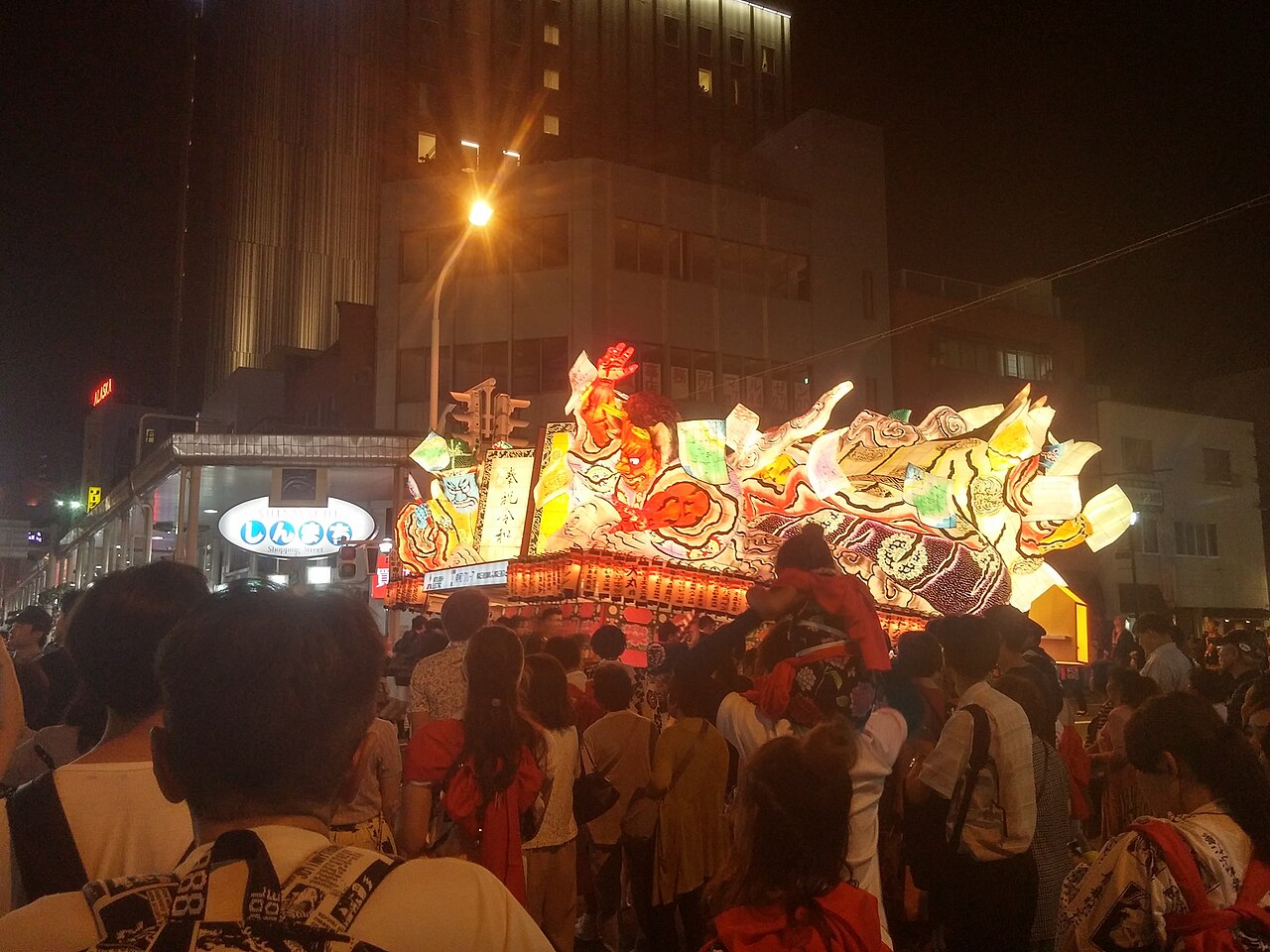
For six August days, central Aomori stops behaving like a set of streets and becomes a moving room. Drums reach the curb before the lantern does. Haneto dancers loosen the space around it. Then a paper figure, bright enough to erase the office blocks behind it, turns its painted face toward one side of the road and its sculpted back toward the other.
The first-time mistake is to chase that room. The better Aomori Nebuta night is smaller: choose one block on Shinmachi Street, arrive before the road closes, and let the procession assemble itself in front of you. The official 2026 plan sends floats counterclockwise around the city-centre circuit from two starting points, and it warns that traffic timing can prevent every float from completing the full loop [1]. A fixed position may not deliver every float. It does deliver the festival’s sequence—sound, dancers, handlers, light, turn, and release—without turning the evening into a fight through the crowd.
For that version, choose August 4, 5, or 6. The large-float procession begins at 18:45 on those nights, with roughly 20 floats planned; August 2 and 3 start at 19:00 and mix children’s floats with about 15 large ones. August 7 is a different event shape: the street procession begins at 13:00, followed by the harbour finale from about 19:15 to 21:00 [1]. If what you want is washi, ink, and internal light moving through a dark city street, do not save your only night for the seventh.
Let one block do the work
First move: choose proximity over spectacle. Shinmachi is narrower than the broad national-road section of the circuit, so the floats feel closer and the music rebounds from the buildings. A current JR East-affiliated local guide notes that Aomori residents tend to have favourite viewing areas: wider road for bigger manoeuvres, Shinmachi for nearness [6]. For this route, commit to nearness. Walk east from Aomori Station along Shinmachi, cross Hakkoda-dori, and choose one legal viewing position before Yanagimachi-dori, always deferring to the 2026 barriers, paid-seat footprint, and staff instructions.
Second move: use 17:00–17:30 as an arrival buffer, not a guarantee of curb space. Vehicle restrictions begin at about 18:00 on August 2–6 and run until roughly 21:40, varying by road; the August 4–6 procession itself is scheduled for 18:45–21:30 [5]. That makes a car drop at the route edge after 18:00 a bad plan. The current guide puts the circuit about a 10-minute walk from JR Aomori Station, but festival foot traffic can stretch any map estimate [6]. Arrive on foot, carrying less than you think you need.
Third move: decide whether your body needs a seat before the night does it for you. Official 2026 reserved seats cost ¥4,000 per person for August 2–6; the two rounds of general individual sales opened June 27 and July 18, so check the live sales page rather than assuming a late ticket remains [2]. Free viewing is permitted outside the installed seating areas, but it is crowded. A local Aomori guide, updated in June 2026, says many residents watch without tickets and recommends identifying toilets before settling; it also warns against advance place-holding [7]. Tape on the pavement is not local knowledge. It is an obstruction.
Fourth move: keep the hour before departure unprogrammed. Do not add the harbour, museum, dinner reservation, and a cross-town photo stop to the same window. Use the time to find the current barrier line, locate the nearest permitted crossing and toilet, buy water, and notice which direction the route staff are preparing. The circuit is about 3.1 kilometres, but the useful scale for a spectator is one block [6]. Once restrictions are active, cross only where and when staff direct.
Fifth move: watch the procession as a four-part object. First comes sound: flute, hand cymbal, and drum establish a float’s pace before its face arrives. Then come the haneto, whose repeated jump keeps the crowd’s energy mobile. The float follows, up to about 9 metres wide, 7 metres deep, and 5 metres high in the current guide’s description [6]. Finally comes the back. Do not lower the camera as soon as the heroic face passes. The rear painting, sponsor lanterns, pullers, wheel crew, and retreating music show that a nebuta is not a flat illuminated picture but a staffed piece of street architecture.
The 2019 photograph above catches the correct viewing grammar: Shinmachi signage remains visible, the crowd occupies the foreground, and the float is embedded in the city instead of isolated against black [10]. That is the frame to seek with your eyes. Take one photograph, then look long enough to see the handlers turn that enormous visual field through an ordinary intersection.
Sixth move: decide before dusk whether you are a spectator or a haneto. Visitors may join without belonging to a float organization, registering in advance, or checking in—but only in the full formal haneto costume. Participants must gather on the seaward side of the Shinmachi–Yanagimachi intersection before their group departs; joining midway may be refused, reversing direction is prohibited, and participants disperse after their group completes the circuit [3]. This is not a spontaneous step off the curb.
Rental sets run around ¥4,000, while tabi socks, sandals, and the flower hat can cost extra; the official list recommends reserving with a rental shop in advance [4]. The clothing is part of the role, not festival-themed dress-up. A 2025 Japanese travel-community account shows the threshold in practice: its author had watched Nebuta online for years, then joined on site once a haneto costume had been arranged [8]. If you have two nights, use the first to watch and the second to join. If you have only one night, watch. You will understand what you are agreeing to before you try to move inside it.
Seventh move: stay when the gap appears. Because large floats begin from two points, the circuit can produce pauses [1]. A quiet minute does not mean the procession is over. It is the moment to hear a departing drum line separate from the next one approaching. Chasing the glow toward an intersection trades that layered sound for shoulders, blocked crossings, and a worse view.
Eighth move: let the block become a street again before leaving. The planned finish is 21:30, while road restrictions lift sequentially afterward [5]. Keep the barrier line clear, follow staff instructions, and retrace Shinmachi toward Aomori Station only when pedestrian flow opens. A last train, hotel check-in, or restaurant closing time should have enough slack for a slow exit; the timetable does not owe you a ten-minute station walk in a festival crowd.
The light is modern, even when the ritual is old
Aomori’s official history places its first recorded nebuta in the 1716–1736 period and records dancing with it by 1772–1781. Yet the scale now associated with the festival is not timeless. The floats grew dramatically after the war; when the postwar port festival began in 1947, the lighting changed from candles to batteries and the sea procession entered the modern story. In 1980, “Aomori no Nebuta” was designated an Important Intangible Folk Cultural Property [9].
That history changes what one Shinmachi block means. The float is old practice, postwar engineering, civic organization, seasonal labour, and temporary artwork at once. Most are dismantled after the festival [6]. The object approaching you is not a touring monument that will wait in another gallery. It is a city’s short summer made large enough to occupy the road, then taken apart.
The visitor trapline
Mistake one: booking August 7 for a night street procession. The final day’s street run is at 13:00; the evening event is on the harbour [1]. Better: choose August 4–6 for illuminated streets, or choose the seventh knowingly for the day-and-water finale.
Mistake two: trying to improve the view by following a float. Two starting points, controlled crossings, installed seating, and possible incomplete circuits make pursuit unreliable [1][5]. Better: choose one Shinmachi block and read the gaps as part of the rhythm.
Mistake three: treating haneto participation as a last-minute costume flourish. Full dress, a pre-departure meeting point, forward movement, and group instructions define the role [3][4]. Better: reserve the kit, dress properly, arrive before departure, and join on a second night if possible.
Mistake four: confusing a short station walk with an easy exit. The circuit may begin about ten walking minutes from JR Aomori Station, but traffic restrictions and the departing crowd are the real clock [5][6]. Better: walk in early, keep luggage elsewhere, and leave slack after 21:30.
A compact go plan
- Best window: August 4–6, 2026, arriving 17:00–17:30 for the 18:45 start and allowing the exit to run beyond 21:30 [1][5].
- Anchor: one legal viewing position on the Shinmachi route segment between Hakkoda-dori and Yanagimachi-dori; do not add a second parade-side migration.
- Expected spend: ¥0 required for a free legal viewing position; ¥4,000 for an official reserved seat if available; about ¥4,000 plus separate accessories for a haneto rental [2][4][7]. Food and transport are optional, not the anchor.
- Queue and reservation reality: free space is first-come and crowded, nuisance place-holding is discouraged, reserved-seat inventory must be checked live, and haneto rentals should be booked ahead [2][4][7].
- Where to stand or sit: choose Shinmachi for closeness, remain behind the current barrier, keep crossings and shop access clear, and find the toilet before committing to the block [6][7].
- Navigation cue:
JR Aomori Station -> Shinmachi Street eastbound -> Hakkoda-dori crossing -> one staff-approved block before Yanagimachi-dori -> same route back after release[1][5][6]. - Same-day check: official schedule, weather, traffic-control map, reserved-seat status, rail departure, and any organizer safety instruction. Current notices outrank this route.
Nebuta does not need a visitor to conquer its full circuit. One block is enough to watch a street surrender its usual purpose, receive light and percussion for two hours, and then become ordinary pavement again. Stay still and the festival will show you how much movement that takes.
Sources
- Aomori Nebuta Festival Executive Committee, “Schedule and operation route” — official 2026 dates, start times, float counts, two-point departure plan, circuit direction, and completion caveat.
- Aomori Nebuta Festival Executive Committee, “Reserved-seat purchase information” — official 2026 prices, sale rounds, and individual/group ticket structure.
- Aomori Nebuta Festival Executive Committee, “How to participate as a haneto and participation rules” — official costume, meeting-point, movement, and no-registration requirements.
- Aomori Nebuta Festival Executive Committee, “How to buy or rent a haneto costume” — official shop list, approximate rental cost, separate accessories, and advance-reservation advice.
- Aomori Nebuta Festival Executive Committee, “Traffic restrictions” — official 2026 closure and procession windows for the city-centre route.
- *and trip. / JR East Travel Service Center, “2026 edition: The highlights of the Aomori Nebuta Festival are the colourful nebuta and haneto!” (June 24, 2026) — recent local guide to route scale, float dimensions, street-viewing tradeoffs, station access, and the 2026 program.
- Aomori Daibouken, “Which paid viewing seats are recommended for the Nebuta Festival? Can you enjoy it without a ticket?” (updated June 5, 2026) — local Aomori household guidance on free viewing, fixed seats, place-holding, toilets, and route-side tradeoffs.
- TND / note, “I participated in the Aomori Nebuta Festival” (August 4, 2025) — a recent Japanese travel-community account of moving from remote viewing to joining on site after arranging a haneto costume.
- Aomori Nebuta Festival Executive Committee, “The evolution of Nebuta” — official local history covering early records, dancing, postwar enlargement, the 1947 lighting change and sea procession, and the 1980 cultural-property designation.
- Wikimedia Commons, “Aomori Nebuta Festival 2019 Shinmachi Street” — Mccunicano’s real photograph of a lit float and crowd on Shinmachi Street, made August 3, 2019.