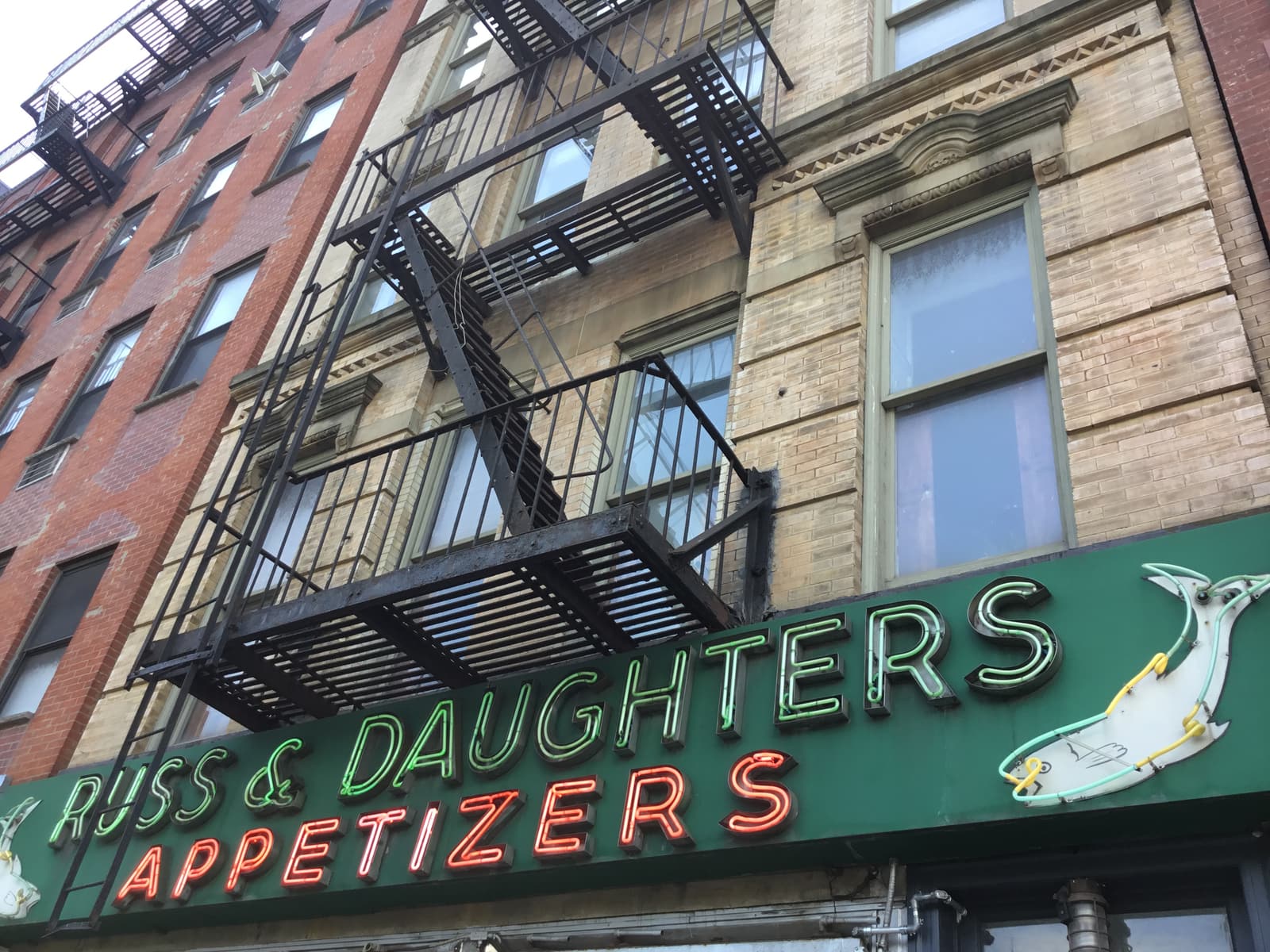
If you want one New York morning that feels specifically Lower East Side—not a generic "bagel stop"—keep the frame tight: Russ & Daughters at 179 E Houston Street and Essex Market at 88 Essex Street.[1][3] Two anchors, one walk, one neighborhood tempo.
This works because the route sits inside overlapping local memory, not because it is trendy. Russ & Daughters has carried the same LES appetizing identity since 1914, with the Houston Street location in place since 1920.[1][8] Essex Market is the public-market counterweight: a long-running neighborhood food hall with 30+ vendors, current site at Essex/Delancey, and broad daily opening windows.[3]
Image note: the cover image shows the Russ & Daughters storefront on East Houston, used as a recognition cue for this route’s starting point.
The ritual sequence
Start with fish-first ordering at Russ when the shop opens (8:00 AM–4:00 PM daily), then walk to Essex Market (8:00 AM–8:00 PM Mon–Wed, 8:00 AM–9:00 PM Thu–Sat, 10:00 AM–6:00 PM Sun) to finish the morning with seating flexibility and second-round options.[1][2][3]
The physical transfer is short enough to preserve momentum: mapping between the two addresses typically lands around an 8–10 minute walk, so you are not resetting the day between stops.[3][7]
Local moves that actually change outcomes
The first move is to treat Russ like a fish counter that also sells sandwiches, not just a prebuilt bagel shop. In local AskNYC discussion, the repeated advice is consistent: fish quality is the headline, while bagels are viewed as more replaceable, so customize around fish choice first.[4] That means asking what is tasting best that morning and then deciding format.
The second move is to order with price structure in mind before you hit the line. The official in-store menu gives a clear spread: a classic bagel-and-lox starts around $17, bagels are $2, base schmear is $5.50, and specialty fish scales up from there.[2] A practical one-person first round is often $17–$30 depending on fish tier and add-ons; a fuller "sample a few fish" pass pushes higher.
The third move is timing discipline. The Russ cafe review from April 2025 notes that peak brunch windows can mean around 45 minutes of waiting and that the cafe is walk-in only.[6] Even if you are using the shop rather than a sit-down brunch table, that same neighborhood timing logic applies: front-load the stop rather than drifting into prime late-morning crowd buildup.
The fourth move is to use fish vocabulary on purpose. Local community threads split preferences by cure and smoke style (nova vs lox, plus options like pastrami-cured and belly lox), and multiple commenters recommend off-hour conversations with the counter team to compare before buying larger quantities.[4][5] If you are undecided, this is usually the fastest way to avoid a "wrong fish for your taste" purchase.
The fifth move is to let Essex Market handle breadth. At 88 Essex, the value is not one "must-order" hero item; it is optionality under one roof, with produce, prepared food, bakery, and specialty lanes open across a long service day.[3] That makes it a strong second anchor after a high-focus fish purchase.
The sixth move is to keep transit optional but visible. Essex/Delancey is served by F/J/M/Z access and sits at a hub with heavy daily rider volume; the Delancey-Essex complex is documented at about 68,000 riders per day in MTA communications.[3][9] You can continue by subway immediately after the market without another neighborhood transfer.
The seventh move is to split sit-vs-go decisions by stop function. Use Russ for precise acquisition (fish + one immediate bite), then decide at Essex whether to sit, add one hot dish, or simply pick up for later. That sequencing keeps the morning efficient without making it feel rushed.
Non-local traplines (and better alternatives)
Trap 1: treating Russ as a default full bagel breakfast line item.
Better alternative: treat the fish as the core decision and build format around it; local discussion repeatedly emphasizes fish-first logic over bagel-first logic.[4][5]
Trap 2: arriving in peak brunch flow and assuming wait is negligible.
Better alternative: run this route earlier; recent local review notes waits around 45 minutes at peak in the same orbit.[6]
Trap 3: trying to do everything in one stop.
Better alternative: preserve the two-anchor rhythm—high-focus counter at Russ, then flexible second pass at Essex where vendor diversity absorbs mood changes and group split preferences.[2][3]
Concrete go-details before you leave your hotel
- Best time window: start around 8:00–9:15 AM at Russ, then shift to Essex before late brunch density builds.[1][3][6]
- Expected spend range: roughly $25–$55 per person for a practical two-stop morning (entry orders around Russ menu anchors such as $17 classic bagel-and-lox, plus second-stop add-ons).[2]
- Queue reality: plan for neighborhood brunch pressure; peak sit-down waits in this corridor can run about 45 minutes.[6]
- What to order first: at Russ, choose fish profile first (nova/lox/pastrami-cured style) and only then lock bagel/schmear format.[2][4][5]
- Navigation cue: pin only 179 E Houston St and 88 Essex St. If your phone dies, those two addresses and one straight LES walk are enough.[1][3][7]
The reason this route feels like Lower East Side rather than tourist choreography is that it keeps two old neighborhood systems in the same morning frame: Jewish appetizing-counter precision and public-market pluralism. When you let each anchor keep its own job, the city reads more clearly.
Sources
- Russ & Daughters locations (official addresses, hours, historical continuity)
- Russ & Daughters in-store menu (official pricing and item structure)
- Essex Market visit page (hours, address, transit lines, vendor context)
- AskNYC local thread (old.reddit mirror) — "Is Russ &daughters worth it?" (fish-first and off-hour local advice)
- FoodNYC local thread (old.reddit mirror) — "what's the best salmon at russ and daughters?" (style/ordering guidance from local commenters)
- The Infatuation review (April 25, 2025) — Russ & Daughters Cafe queue/timing signal and walk-in context
- Google Maps directions between anchors (route and walking transfer)
- Wikipedia — Russ & Daughters (founding-year and location continuity context)
- MTA press release (Delancey-Essex station rider-volume context)
- Wikimedia Commons — cover image file page (Russ & Daughters storefront photo)
Editor’s Pick Review
This article wins today’s Editor’s Pick because it is unusually executable without flattening the city into a checklist. The two-anchor ritual is tight, each stop has a clear job, and the guidance stays grounded in local-source evidence with concrete timing, spend, queue, and navigation anchors that can actually change outcomes on the street.
Chinese translation quality is also a decisive strength here: the prose reads naturally, technical carryover terms are handled with concise inline glosses, policy terms stay consistent, and jargon density remains controlled so the piece keeps precision without drifting into translationese.