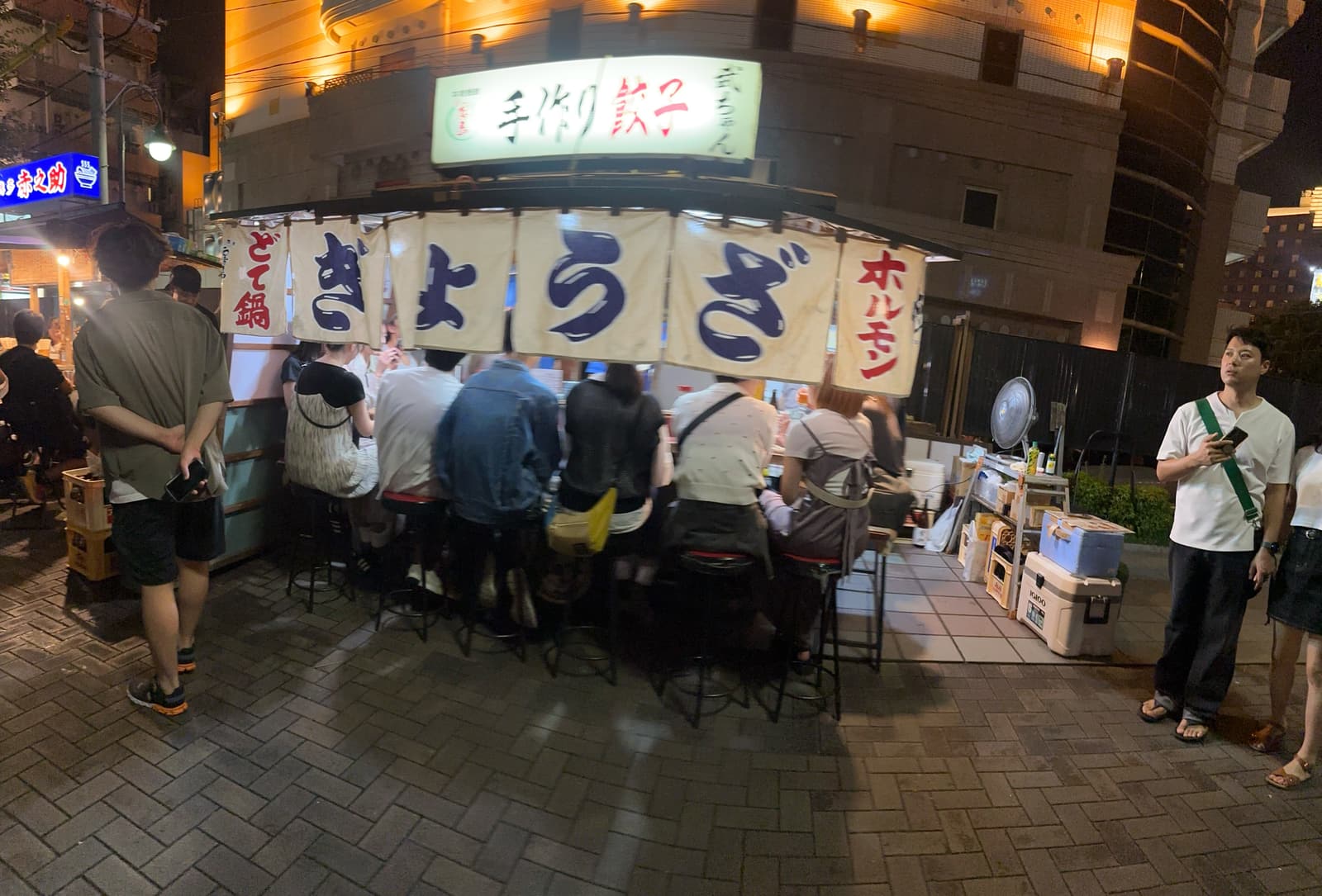
If you want one Fukuoka yatai night that feels local instead of random, keep your scope tight: Nihon Ginko-mae (Tenjin 4-2-1) and the BiVi Fukuoka curb (Watanabe-dori). These two short stretches are close enough to run in one evening, but different enough to give you two textures of the same city rhythm.
Fukuoka’s yatai culture is not just “street food at night.” It is a civic system that survived because the city treated it as living urban culture, not disposable nostalgia. The postwar roots still matter, and so do later policy choices: public-space operation rules, periodic public recruitment, and a deliberate pipeline for new operators.[1][2][3] That is why the Tenjin scene now mixes legacy stall logic with new entrants in the same few blocks.
Image note: the cover image shows Fukuoka yatai at night as a recognition cue for counter spacing, curb lighting, and shoulder-to-shoulder seating; it reflects the same street texture as Tenjin’s Nihon Ginko-mae/BiVi route, even though it is not a documentary frame of those exact two curbs.
The place portrait in one line
Run Nihon Ginko-mae first for early-seat certainty and newer concept stalls, then shift to BiVi curb for the second round when the district is fully warm.
Why this works in practice:
- citywide baseline is still 100+ stalls[1][4]
- many stalls begin around 18:00, with most active around 18:30–19:00[1][4]
- crowd energy is typically thicker around 20:00, with post-drink flow after 21:00[4]
- 2025 public-recruit cohorts added new Tenjin options at both Nihon Ginko-mae and BiVi positions[3][5]
Local moves that change outcomes
- Arrive on the early side (18:15–18:45), not at peak (20:00+). You are buying seat certainty and calmer first contact, not just food.[1][4]
- Do your first order at Nihon Ginko-mae, not BiVi. The newer stalls there make menu-reading easier when you are fresh, then you can move for atmosphere later.[3][5]
- Read menu and payment method before sitting. Local etiquette guidance explicitly says to confirm prices and payment first.[4]
- Keep group size compact (2–3 people) for first stop. Small parties clear faster in narrow counters where shared seating is normal.[1][4]
- Use price anchors from known stalls to avoid over-ordering early. In the 2025 Tenjin cohort examples, common dishes run around ¥450, ¥600, ¥800, ¥850, ¥1,000, ¥1,320, and ¥1,370.[3][5]
- Treat weather as an operations variable. Some stalls do not open in stormy conditions, and some have fixed weekday closures.[1][4]
- Carry bags small and close to your body. Space is physically tight; local guidance is explicit about compact baggage and quick turnover.[4]
- Use one “signature + one staple” order pattern per stop. You see more of the district and avoid getting trapped at the first counter.
Non-local traplines (and better alternatives)
-
Trap 1: “I’ll just start at 20:30 when it’s lively.”
Better: start earlier, get your first seat with less friction, then move with the crowd.[1][4] -
Trap 2: “Tenjin yatai is one generic strip.”
Better: split by curb character—Nihon Ginko-mae first, BiVi second—and your choices become clearer.[3][5] -
Trap 3: “I can decide menu and budget once I’m seated.”
Better: check menu/payment first and use known price anchors to pace the night.[4][5] -
Trap 4: “Bad weather only changes comfort.”
Better: treat weather as availability risk and keep one fallback counter in mind.[1][4]
Concrete go-details before you leave the hotel
- Best time window: start between 18:15 and 18:45; transition to second stop around 20:00–20:30.[1][4]
- Expected spend range: practical two-stop window is usually around ¥2,500–¥5,000 per person depending on drinks; menu anchors from 2025 Tenjin newcomers range ¥450–¥1,370 per item.[3][5]
- Queue reality: popular counters compress quickly on busy nights; shared seating and short turnover are part of the format.[1][4]
- What to order / where to stand: first stop one signature dish plus one staple, then move; stand briefly outside only for menu check, not long hovering.[4]
- Navigation cue: lock these two map strings before departure: “Tenjin 4-2-1 (Nihon Ginko-mae yatai cluster)” and “Watanabe-dori 4-1-36 (BiVi Fukuoka front)”.[3][5][9][10]
The reason this route feels distinctly Fukuoka is not only the food. It is the coexistence of old and new in public space: long-running curb culture, postwar memory, and a formal recruitment system that keeps adding new voices to the same night street.[2][3]
Sources
- FUKUOKA HAKATA YATAI (official city guide; 100+ stalls, opening window, weather caveat)
- Yokanavi — Fukuoka city yatai policy background (public-space character, ordinance pathway)
- Yokanavi — 5th recruitment cohort, Tenjin new stalls from April 2025 (Nihon Ginko-mae + BiVi details, prices/hours)
- Crossroad Fukuoka — yatai area characteristics, timing, and etiquette guidance
- Fukuoka LEAPUP local report — 2025 spring Tenjin new yatai (menu-price and location anchors)
- Tabelog — Tenjin “Hakata yatai” keyword listing (local review platform signal; 64 entries)
- Yokanavi — 2025-10-15 update on yatai recruitment system recognition (recent confirmation)
- Google Maps — Tenjin yatai area query (local wayfinding + live review stream)
- Google Maps — Nihon Ginko-mae address anchor (Tenjin 4-2-1)
- Google Maps — BiVi Fukuoka front anchor (Watanabe-dori 4-1-36)
- Wikimedia Commons — hero image file page (Hakata yatai photo, Sept 2024)