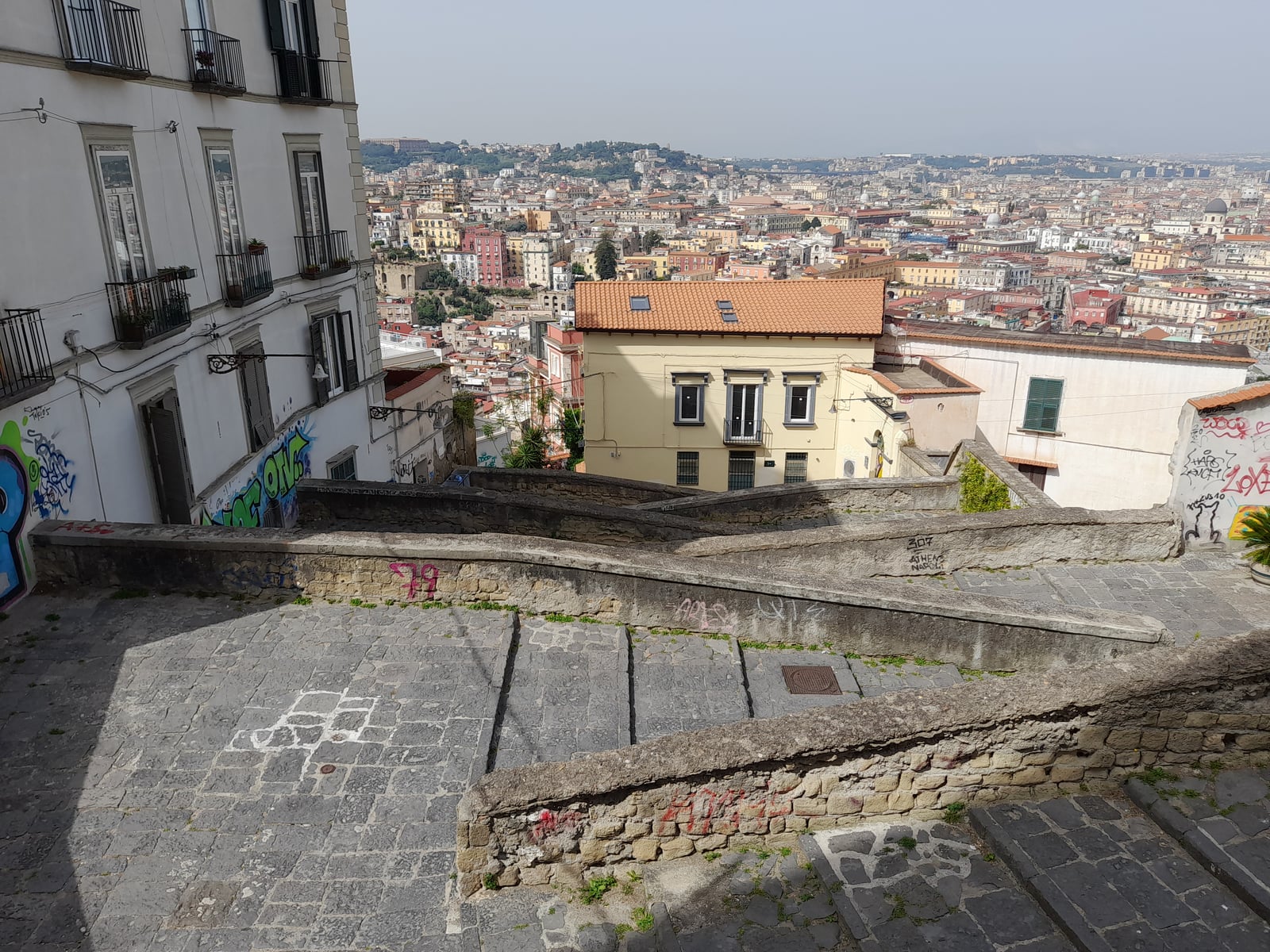
The revealing detail on Naples’s Pedamentina is a front door. In Argo Navis’s photograph, broad flights fold back beside apartment balconies while the city spreads out below. The distant view draws your eye outward, but the staircase brings it back to the hillside: a doorway, a turn in the path, somebody’s route home. The panorama shares its address with ordinary domestic life.[9]
The 414 steps connect Largo San Martino to Corso Vittorio Emanuele.[2] Walk them downhill, with enough time to notice what occupies the slope between those two names. A contributor to the local r/napoli community recommends precisely that sequence: San Martino’s belvedere, then the descent. Arrive above the staircase and let the city rise around you as you walk.[3]
Find the start before following the view
Aim for Largo San Martino, the open space in front of the Certosa. The staircase begins outside the monastery; entering its museum is a separate visit.[1] Artecard identifies the Central funicular’s Piazza Fuga terminus, the Chiaia funicular and Metro Line 1’s Vanvitelli station as approaches to the hill. For this walk, use Piazza Fuga, then continue on foot toward San Martino.[2]
There is a current trap in older directions. As of November 2, 2026, plan around the Montesanto funicular closure. Fanpage’s local transport coverage reports that the line closed on May 15 for a nine-month overhaul, with a replacement bus. A route description written before that closure may send you to a train that is not running. Use the Central funicular approach instead, checking ANM’s service notices before setting out.[4]
The walk itself is free. For an adult already within walking reach of either the staircase or the Central funicular’s lower station, budget €0–€1.30: nothing for the public steps, or €1.30 for one uphill funicular journey. That excludes other transport and museum admissions. ANM’s published fare table distinguishes the €1.30 bus/funicular ticket from its metro ticket; “a Naples transport ticket” is not a sufficiently precise request.[5][6]
My suggested November window is 10 a.m.–noon, on a dry morning. This is a planning recommendation, not an opening schedule or a promise of an empty path. Allow 15–20 minutes for the approach from Piazza Fuga, then 30–45 minutes for a deliberately slow descent and pauses. These are generous walking allowances, not measured journey times.
Napoli a piedi’s author reached Corso Vittorio Emanuele in under 15 minutes. Treat that as one walker’s pace, rather than a target for your visit.[1]
There is no timed admission or reservation for an independent walk on the public staircase. An organised tour is a separate purchase. Local accommodation operator Napoliving lists the Pedamentina among the city’s free viewpoints; paying for a guide buys interpretation, rather than permission to use the steps.[6]
A construction route acquires neighbours
The turns have a history more practical than sightseeing. Palazzi di Napoli traces the route to the fourteenth-century construction of the Certosa, when materials needed to reach the hill. Its account describes an early winding route, visible on a 1566 city map, that acquired its stepped form later. The present staircase preserves a connection made for work.[7]
That origin offers a useful way to look. Follow the shape of a bend before hunting for a complete skyline. Notice how a long traverse makes room on a steep slope, then how the next turn redirects both feet and gaze. The route is a piece of the city’s fabric that can be understood at walking speed: access to an upper institution gradually became access through an inhabited hillside.[7]
Artecard specifically recommends comfortable footwear for the stairs.[2] Choose shoes with grip and keep your hands free. Hundreds of steps deserve more consideration than a short line on a map suggests. Descending reduces the uphill effort, but it still asks something of knees and balance. If sustained stairs are difficult, stay with the upper viewpoint and return by an operating transport route.
The other easy mistake is to treat every landing as a viewing platform. The local walking account describes homes opening directly onto the route. Pause where people can pass, keep doorways clear and ask before photographing residents. These are straightforward courtesies for a residential street. The reward is a chance to observe how the path serves its neighbours without making their daily movements part of your photo session.[1]
Local cultural life also uses this passage. Napoli da Vivere’s December 19, 2025 festival programme listed a narrated Pedamentina walk meeting at San Martino at 11 a.m. on December 26. That past event confirms recent organised interest in the stairs; it is not a recurring departure to turn up for this year. If you want a guided walk, look for a newly dated listing and its booking conditions.[8]
Let the road mark the ending
At Corso Vittorio Emanuele, the Pedamentina ends.[7] This matters when a map labels the whole descent toward the historic centre as one continuous walk. Napoli a piedi describes crossing the road and turning left to reach the separate Montesanto staircase.[1] Reaching Corso is therefore a good moment to stop, check your onward route and decide whether your legs want more steps.
A second staircase can wait. This short visit has already moved between a monastery’s public threshold, the edges of gardens and the entrances of homes. Leaving at Corso preserves that scale. The lasting image need not be the widest view of Naples. It may be the modest space beside a doorway where a visitor steps aside and a neighbour continues uphill.
Sources
- Napoli a piedi, “Pedamentina a San Martino” — local walking account, residential details, changing stair proportions and the author’s descent time.
- Campania Artecard, “La Pedamentina” — regional cultural organisation’s route description, 414 steps, transport approaches, downhill recommendation and footwear advice.
- r/napoli, “Weekend a Napoli con il mio fidanzato,” April 2026 — community contributor mucy_s recommends San Martino’s belvedere followed by the Pedamentina descent.
- Fanpage Napoli, “Funicolare di Montesanto chiusa 9 mesi, navetta bus sostitutiva” — May 2026 local reporting on the closure from May 15 and replacement service.
- ANM, “Tabella principali tariffe maggio 24” — official fare table linked from ANM’s current ticket information page; €1.30 urban bus/funicular single, checked November 2, 2026.
- Napoliving, “Napoli Gratis” — locally based accommodation operator’s guide identifying the Pedamentina as a free viewpoint walk.
- Palazzi di Napoli, “Pedamentina di San Martino” — local architectural-history account of construction origins, early cartography and the route’s two access points.
- Napoli da Vivere, “Festival delle Scale 2025,” December 19, 2025 — dated local programme listing the December 26 Pedamentina walk and booking requirement.
- Argo Navis, “Pedamentina a San Martino, Naples 20230622 01.jpg,” Wikimedia Commons — photograph taken June 22, 2023, used for this article.