At Kebun Baru Birdsinging Club, the morning has a vertical movement: a cage travels up a pole, leaving its owner on the ground. The club describes zebra doves, known locally as merbok, being hoisted by pulleys onto 20-foot poles from as early as 06:00, weather permitting. The birds are brought together for singing practice; beneath them, people have somewhere to spend the morning.[1]
That separation is the pleasure of a visit. Look up for the cages, then lower your gaze to the people sitting around the field. Reporting here on a Tuesday in 2021, Kames Narayanan found owners talking around benches and shelters while the birds sang overhead.[2] Give yourself enough time to notice both gatherings.
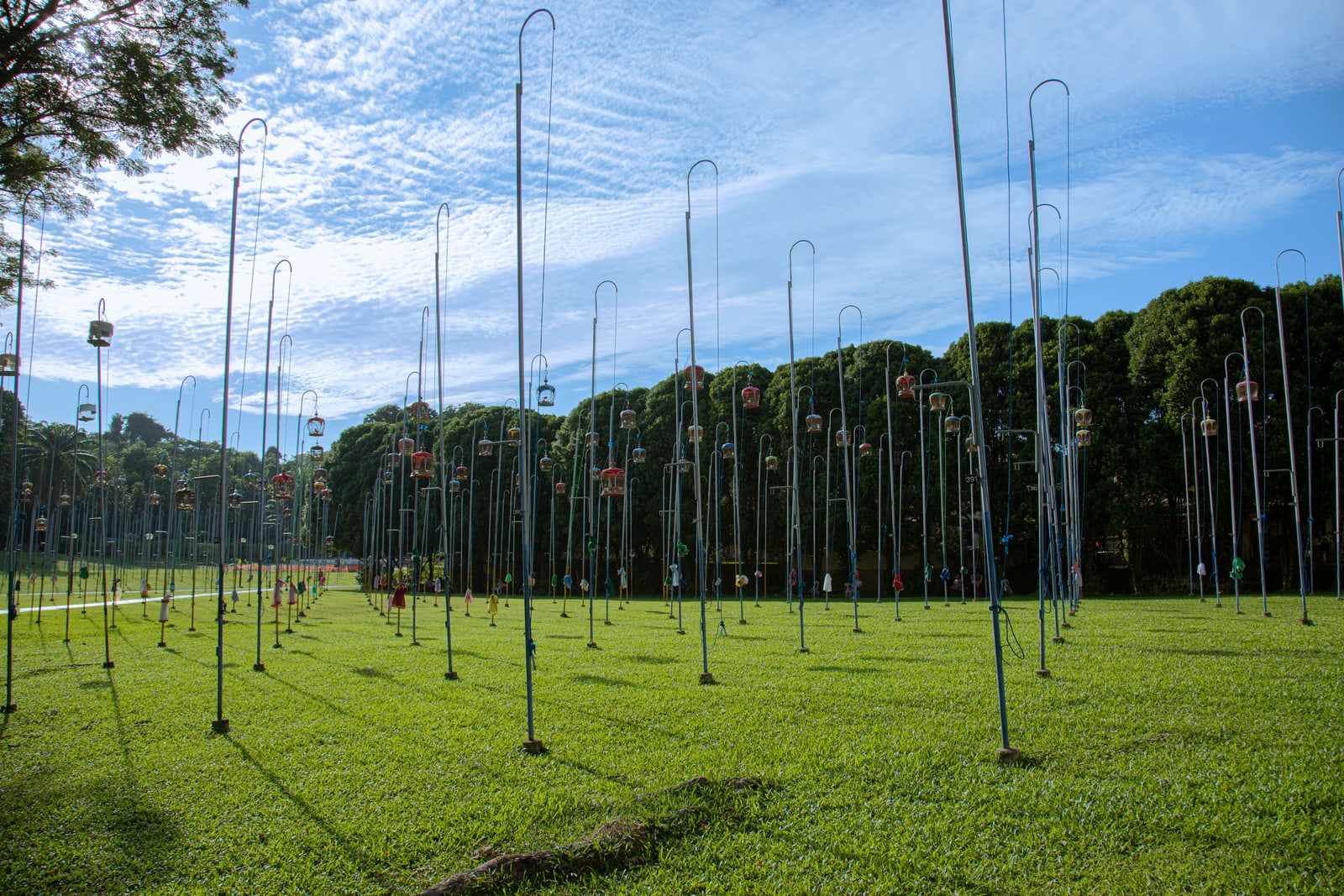
Find the field before the hill
Use Mayflower MRT, Exit 3, and aim for the open field beside Block 159, Ang Mo Kio Avenue 5. The Land Transport Authority gives an eight-minute walk from that exit.[3] Save the club’s location rather than only the larger Ang Mo Kio Town Garden West pin: the rows of tall poles at the foot of the hill are your recognition cue. This is a small destination within a park, and the right approach saves an unnecessary climb.
For a first visit, I would choose 08:00–10:00 on a dry weekend morning and allow 45–60 minutes at the field. That is a suggested visiting window, not a scheduled performance. The club identifies 06:00–noon as its active morning period and says weekends and public holidays attract the biggest crowds.[1] A September 2026 local account on Kopitiam likewise describes owners arriving on weekends, hanging cages and settling onto benches and chairs.[5] Choose a weekday if you value a quieter look; Narayanan’s Tuesday reporting shows why a competition is not necessary to appreciate the place.[2]
The mistake is to read a long opening window as a promise that the full chorus will wait for you. Singapore-based blogger Amila Wickramarachchi arrived around midday and found an almost empty hall and relatively few birds. Her advice after that visit was to return in the morning, or check for an event.[4] Let the birds determine the timing of this stop, before the rest of the day fills up.
Ordinary admission is free.[3][4] Plan a walk-up visit; a seat or a particular view is not reserved. An on-site budget of S$0–5 is enough for this plan: zero covers entry, while the upper end is an optional donation allowance, not a ticket price. The review platform Wanderlog describes the club as volunteer-run and donation-supported.[6] Transport is separate.
Give the pulley room to work
Start at the edge of the pole field. If someone is raising or lowering a cage, leave the rope and their route clear. Watch the hand movement before following the cage upward. The club’s account explains that the high, sunny positions are used for zebra doves; other songbirds, including shamas, occupy sheltered areas nearby.[1] A short change of position can reveal a different arrangement of cages without requiring another destination.
Then find an unoccupied place to sit near the perimeter. Wickramarachchi noticed the concrete seats as well as owners relaxing to one side of the field.[4] Try staying still for a few minutes before taking photographs. The poles are easy to register in one frame; the pauses between calls, and the way conversation continues beneath them, take longer.
Another avoidable mistake is to approach a cage as though it were an interactive display. Wanderlog’s visitor guidance explicitly says not to touch or feed the birds.[6] Keep that boundary, lower your voice near the shelters, and ask before making a close portrait of an owner. Those last two are simple courtesies for entering someone else’s morning. You can admire the cages from where you stand without asking anyone to interrupt their routine.
Bring water and something for sun or rain. The local Belgian Luxembourg Association included the club in its September 2026 morning walk and specifically advised water, sun protection and an umbrella.[7] If rain changes the gathering, accept a shorter visit. The club qualifies its early hoisting routine by the weather; there is no reason to expect the open field to behave like an indoor attraction.[1]
The company beneath the song
The poles have a history of accommodating more people. Narayanan traces the gathering to hobbyists who hung cages in trees during the 1970s; Teng Leng Foo and two friends erected poles in 1987 as participation grew. In the same report, co-founder Robin Chua—who did not own a bird himself—described companionship as a central purpose of the club.[2]
That history helps explain why rushing in for a photograph can miss much of the visit. The cages give people a reason to arrive and something to discuss once they have sat down. Kopitiam’s September 2026 account still finds that conversational rhythm, while a March 2026 post in the local SingaporePhotography community identifies the same club as its birdsong backdrop.[5][8] These are recent glimpses of a continuing practice, not a guarantee of how many owners will turn up on your morning.
Leave without requiring a grand finale. A cage may be coming down while another is going up. The satisfying endpoint is having spent a little time at ground level, where the bird owners have been all along.
Sources
- Kebun Baru Birdsinging Club, “About Us” — pulley operation, bird areas, weather and morning gathering patterns.
- Kames Narayanan, “The Co-founder of Singapore’s Largest Bird Singing Club Who Is Not a Bird Enthusiast Himself,” Our Grandfather Story, 22 December 2021 — local reporting, history, companionship and photograph.
- Land Transport Authority, “Explore More of Singapore with TEL2,” 2021, printed page 8 — Mayflower Exit 3, walking time, location and free admission.
- Amila Wickramarachchi, “Kebun Baru Birdsinging Club: An Unplanned Visit,” Leisure and Me, 11 February 2022 — Singapore resident’s midday visit, seating and advice on timing.
- Kopitiam, “Where Singapore’s Birdsong Still Lives: A Weekend Morning at Kebun Baru Birdsinging Club,” 27 September 2026 — recent local account of owners gathering and socialising.
- Wanderlog, “Kebun Baru Birdsinging Club” — Google-review aggregation and visitor guidance on donations and avoiding touching or feeding birds; checked 30 October 2026.
- Belgian Luxembourg Association of Singapore, “BLAS Weekend Walk — Ang Mo Kio-Town Garden West (bird singing!) and Bishan-AMK Park,” 19 September 2026 — recent community outing and weather preparation.
- u/sgpodcaster, “Listening to Birdsong,” r/SingaporePhotography, 28 March 2026 — recent local community photograph identifying Kebun Baru Birdsinging Club.