The cleanest small move in Nantes is to stop treating Trentemoult as a cute detour and treat the Navibus Loire as the street corner. Start at Gare Maritime, cross the Loire as ordinary public transport, step off at Trentemoult-Sablieres, and let the village, shipyard horizon, river wind, and return clock organize the hour. That is the useful version of the outing: not a cruise, not a taxi drop, and not a restaurant hunt, but a public-transport crossing that explains why Nantes keeps turning back toward the river.[1][2][5]
The operating facts are compact. Naolib's N1 timetable is valid from 12 November 2025 to 30 September 2026 and puts the Gare Maritime to Trentemoult-Sablieres crossing at about 8 minutes.[1] Nantes Metropole describes the Navibus as part of the public transport network, accessible with normal Naolib fare products, and notes that N1 and N2 cross the Loire between Nantes and Reze.[2] Naolib's current ticket page gives the practical visitor arithmetic: a 1.80 euro 1-hour ticket, a 6.60 euro 24-hour ticket, and machines at stations including Gare Maritime and Sablieres.[3]
The local signal is just as important as the schedule. In a recent r/Nantes thread about a late-May visit, one local suggested a circuit of Gare Maritime, Trentemoult, Le LAB, and Hangar a Bananes by Navibus; another pointed first-time visitors back to the green line but still singled out Trentemoult as not to miss.[7] A separate recent visitor thread got the same local correction: come back and take the Navibus to Trentemoult, because it is close, included in the Naolib system, and still reads as a former fishing village with color and resident life rather than only a view.[8] Read those together and the move becomes precise: go by boat because the boat is the city logic, not because it is the scenic extra.
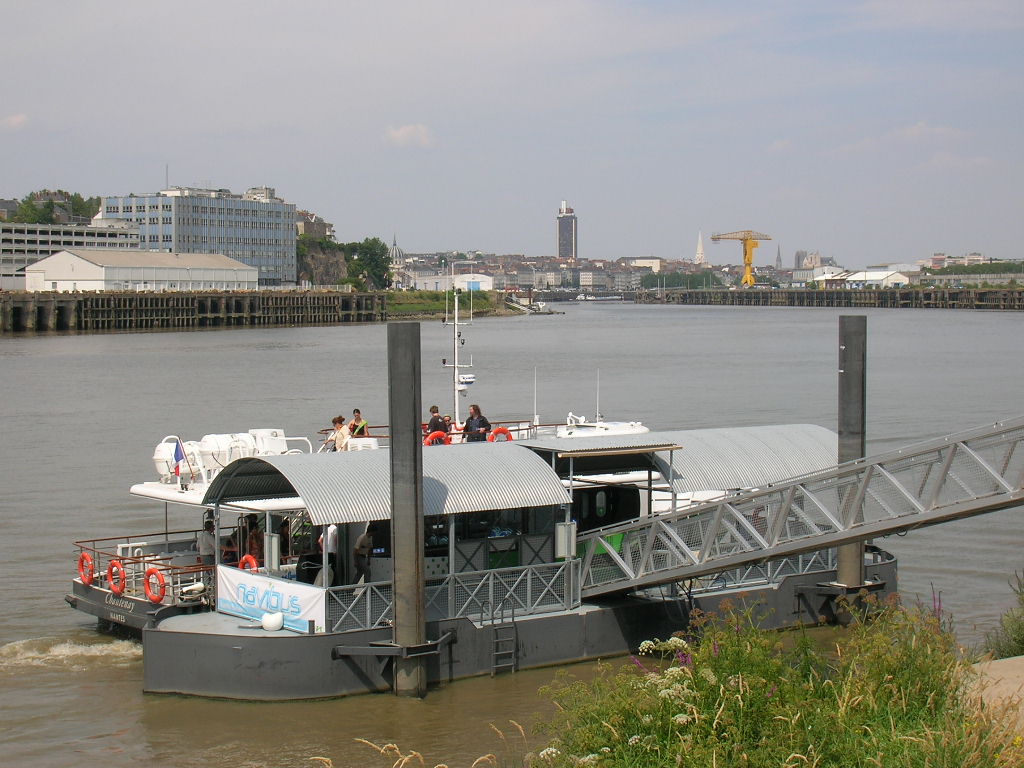
Image context: the cover uses Mathounette's 2006 Wikimedia Commons photograph of a Navibus at Trentemoult. It is an archival public photograph of the exact transport object and river landing discussed here, with Nantes visible across the Loire, so it clears the real-photography gate better than a route diagram, generated image, or decorative skyline.[9]
Start At Gare Maritime, Not At The Pretty Lane
Use Gare Maritime as the clean first anchor. It keeps the route attached to tram line 1 territory and the west end of the Ile de Nantes, rather than turning Trentemoult into an isolated taxi target. Buy or load the simple ticket before you need it, and if you are riding on a weekday, validate like you would on the tram. On Saturday and Sunday, Naolib and Nantes Metropole both frame the ordinary public-transport network as free, excluding the airport shuttle; that weekend rule is useful, but it should not make you sloppy about the return time.[2][3]
The best windows are 10:00-11:30 for a quiet first look or 17:30-19:00 when the Loire frontage starts to feel lived-in. Midday works, but it flattens the place into lunch traffic and glare. Late evening can be beautiful in summer, but only if you checked the return board first. This is a crossing with a rhythm, not a private boat waiting for you.[1][4][6]
Stand outside if the crew allows it and the weather is reasonable. Face back toward Nantes for the first minute, then turn toward Trentemoult as the river widens in your field of view. The crossing is short enough that people waste it by sitting down and immediately checking their phones. Do the opposite. Notice the Titan crane, the industrial edges, the church spires, the gangway, the mud-colored water, and the fact that the village arrives from below, not as a facade approached by road.[5][9]
Let Trentemoult Stay Slightly Practical
Trentemoult's charm works because it has not always been charming. Patrimonia traces the settlement through fishing privileges in 1397, Quai de la Fosse displacement in 1516, an eighteenth-century fishing economy, nineteenth-century sailors and captains, and the 1887 roquios, the steam boat-buses that carried people to regattas, guinguettes, bathing, and shipyard work. The Navibus restored the nautical link with Nantes in 2005 after decades of decline and rediscovery.[5]
That history changes how to walk. Do not rush from the dock to the first colored wall. Make the landing your first room. Then drift into the lanes, keeping the river close enough that you can find it again without mapping every turn. The better loop is small: pontoon, riverside, one or two interior lanes, a slow return to the quay, then a decision about whether to stay for a drink, continue by N2 toward Bas-Chantenay and Hangar a Bananes, or go back to Gare Maritime.[2][4][6]
The new infrastructure matters because it changes the village's daily pressure. Nantes Metropole's November 2025 update says the N2 now runs Trentemoult-Sablieres to Bas-Chantenay to Hangar a Bananes and back, while the new Trentemoult-Sablieres pontoon is 46 meters long and became the N1 departure point after the historic Trentemoult-Roquios pontoon closed to the public on 12 November.[4] The same update describes a 140-place park-and-ride nearby and service connections by bus lines 30 and 36.[4] In other words, Trentemoult is not just a preserved village face. It is being rewired as a south-Loire transport hinge.
Local Moves That Change The Crossing
First, take the Navibus from Gare Maritime even if a cab looks simpler. The crossing is the experience and the orientation tool. Arriving by road skips the main thing.[1][2][7][8]
Second, use one Naolib ticket logic for the whole move. A normal 1-hour ticket covers tram, bus, Navibus, and TER inside the metropolitan perimeter, outside the airport exception; a 24-hour ticket makes sense if you are stacking the ferry with Machines de l'Ile, Chantenay, or a tram-heavy day.[3]
Third, cross before the village is full of terrace behavior. The 10:00-11:30 window gives the lanes room to be lanes; the 17:30-19:00 window gives the river light without making the last return feel careless.[1][6]
Fourth, check the return before you wander. The N1 crossing is short, but the mistake is psychological: visitors treat a quick ferry as if it cannot impose a schedule.[1]
Fifth, walk the river edge first, then the lanes. Trentemoult makes more sense when you see Nantes across the water before you start collecting house colors.[5][6]
Sixth, do not block the gangway for photos. The landing is working transit. Step clear, then take the picture.[1][2]
Seventh, keep N2 as the extension, not the default. The new Bas-Chantenay and Hangar a Bananes link is useful, but add it only if you have time and daylight. N2 runs at a different cadence, with the Metropole update citing 20-minute peak frequency and 32-minute off-peak frequency for that route.[4]
Eighth, use the weekend-free rule deliberately. Free public transport on Saturdays and Sundays is a gift for a low-friction crossing, but sunny weekends also concentrate casual visitors. Go earlier or later rather than assuming free means easy.[2][3][6]
Non-Local Trapline
Mistake 1: treating Trentemoult as a car-accessible photo village. The better alternative is to cross from Gare Maritime, because the river approach explains the village's relationship to Nantes, Reze, shipyards, and south-bank movement.[1][5][8]
Mistake 2: assuming the boat is a tourist cruise with tourist rules. The better alternative is to use it as public transport: ticket ready, gangway clear, return checked, no surprise when locals are simply commuting or meeting friends.[2][3][7]
Mistake 3: walking only the colorful lanes and missing the quay. The better alternative is to make the riverfront your base note. Patrimonia's point is that the view from Trentemoult back across the Loire is part of understanding Nantes, not a bonus after the pretty streets.[5]
Mistake 4: adding N2, Hangar a Bananes, and dinner without reading the clock. The better alternative is to decide at the pontoon whether this is a one-crossing microcosm or a longer river loop. The N2 extension is useful precisely because it creates options; it is not a command to overbuild the outing.[4]
Concrete Go Details
Best time window: 10:00-11:30 for calm lanes, or 17:30-19:00 for river light and a more local after-work feeling. On summer evenings, check the last practical return before committing to dinner.[1][4][6]
Route shape: tram or walk to Gare Maritime -> Navibus N1 -> 8-minute Loire crossing -> Trentemoult-Sablieres pontoon -> river edge -> interior lanes -> quay pause -> N1 return or N2 extension toward Bas-Chantenay/Hangar a Bananes.[1][4][5]
Expected spend: 1.80 euro for a 1-hour Naolib ticket or 6.60 euro for a 24-hour ticket, with ordinary public transport free on Saturday and Sunday except airport-shuttle cases. Children under 6 travel free with an accompanying adult.[2][3]
Queue and reservation reality: no normal reservation; the friction is timing, weather, gangway crowding, and how many people had the same sunset idea. Treat a missed boat as a planning cost, not a disaster.[1][6]
Where to stand: on the ferry, use the outside edge if open and stay clear of crew movement; at Trentemoult, clear the gangway first, then photograph from the quay. In the lanes, pause at corners and wider pockets, not in front of residents' doors.
Navigation cue: if you can still see the Loire and know whether you are returning by N1 or extending by N2, you are using the route correctly. If you are three lanes deep, hungry, and only then wondering where the next boat leaves from, you have turned a clean city crossing into avoidable drift.[1][4][5]
The reason this small route works is that it compresses Nantes into one ordinary movement. In less than ten minutes, the city becomes river, port memory, public transit, weekend habit, village frontage, new infrastructure, and old working geography. That is more useful than a longer itinerary. It gives you a grammar for the place.
Sources
- Naolib, "Navibus Loire N1 timetable" - official schedule PDF valid from 12 November 2025 to 30 September 2026, including Gare Maritime, Trentemoult-Sablieres, and approximate crossing time.
- Nantes Metropole, "Se deplacer en bateau" - official boat-transport page, updated 9 February 2026, covering Navibus as Naolib public transport, N1/N2 Loire crossings, weekend free travel, and the Trentemoult-Sablieres landing.
- Naolib, "Tickets" - official fare page for 1-hour and 24-hour tickets, network validity, weekend-free notes, and ticket-machine locations including Gare Maritime and Sablieres.
- Nantes Metropole, "Ce que Trentemoult-Sablieres va changer pour vos deplacements" - official November 2025 update on the N2 extension, N1/N2 pontoon, old pontoon closure, frequencies, park-and-ride, and bus links.
- Patrimonia Nantes, "Trentemoult" - local heritage dossier on the fishing village, roquios, shipyard-worker crossings, 2005 Navibus reconnection, and view back toward Nantes.
- Loire Lovers, "Visit Trentemoult (Nantes): tips + photos + navibus" - March 2026 visitor guide used for current practical timing, crossing cadence, village walking scale, and parking cautions.
- Reddit / r/Nantes, "Visiter Nantes a la fin mai" - recent local/community thread recommending a Gare Maritime-Trentemoult-Le LAB-Hangar circuit by Navibus and naming Trentemoult as a first-visit stop.
- Reddit / r/Nantes, "Just came back - fantastic trip!" - recent local/community comment recommending Trentemoult by Navibus as an easy add-on and describing it as a former fishing village with color and resident life.
- Wikimedia Commons, "File:Trentemoult Navibus port.jpg" - photographic source for the cover image by Mathounette, showing a Navibus at Trentemoult on the Loire.