Kobe is often treated as a one-day connector city: beef lunch, harbor photo, Chinatown, maybe a quick lift into the hills if the sky behaves. That misses the better small move. Start at Shin-Kobe, take the Nunobiki Ropeway up, and make the Herb Gardens a downhill seasonal walk rather than a viewpoint dash. In late May and June, when the rose and lavender programming is active, the route has the right balance of transport, scent, height, and city view.[1][2][3][4]
The anchor is compact enough to keep the day honest. The official ropeway page describes a 10-minute ride that looks down over Kobe and can open views toward Osaka and Kyoto in clear conditions.[2] Visit Kobe adds the local geography that makes the ride feel unusually efficient: the attraction sits close to downtown, the gondola windows take in Nunobiki Falls and Gohonmatsu Dam, and the whole move begins near Shin-Kobe rather than from a remote mountain bus terminal.[3] That is the first local advantage. You do not spend half the day reaching the hill. You let the hill begin almost behind the station.
The current seasonal reason is also specific. Kobe City's event listing for Rose & Lavender Fair 2026 runs the fair from May 9 to July 5, 2026, with the garden's strongest flower window framed around roses, lavender, and the larger spring garden peak.[4] The official garden topic page gives the softer operating detail: English roses are presented in the Rose Symphony Garden and Four Seasons Garden, with the rose viewing window marked from mid-May to late June, and the fair recommends web tickets while warning that the boarding queue at the first-floor ropeway line still remains.[5] That last clause matters. Digital tickets reduce one friction point; they do not let you skip the physical rhythm of a popular ropeway.
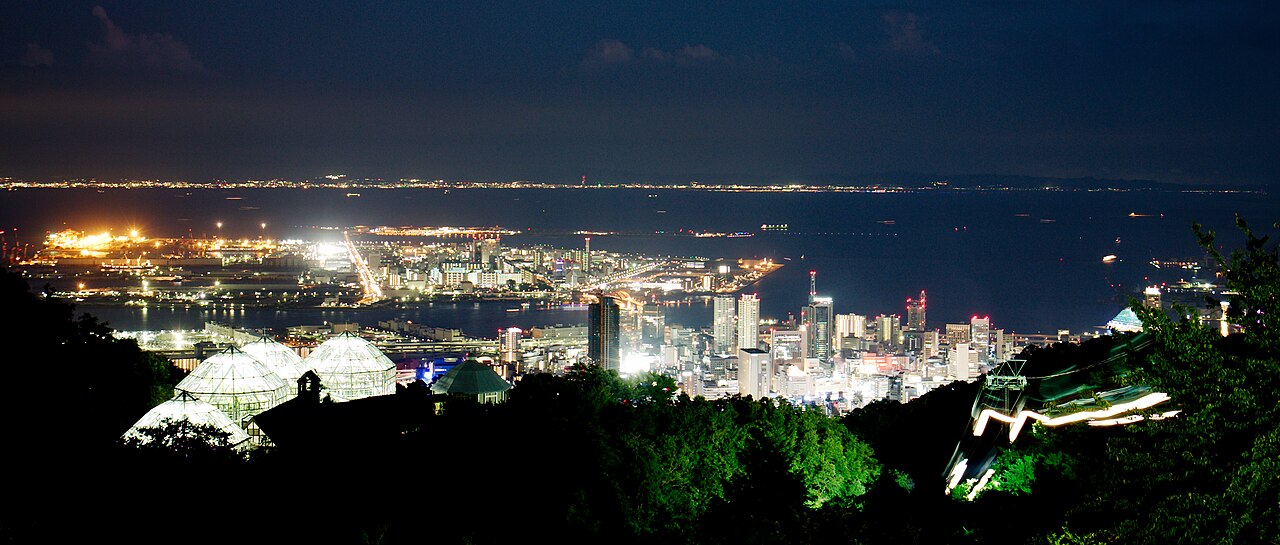
The cover image uses a real Wikimedia Commons photograph by Daniel Gerhard, taken on August 25, 2012. It is not a generic Kobe skyline. It shows the gondola, slope, and city in one frame, which is exactly the argument here: the route is a vertical sequence, not a single overlook.[8]
The correct direction is top-down
The simplest mistake is to ride up, take the plaza photo, and ride straight back down. That is efficient, but it wastes Nunobiki's best structure. The official hours-and-fares page makes clear that a daytime ticket covers the ropeway and garden as one combined experience: adult round trip 2,500 yen, adult one way 1,900 yen, youth round trip 1,250 yen, and daytime operation from 9:30 with seasonal last-up and last-down clocks.[1] The price is not only for elevation. It buys access to a garden laid across the slope.
That is why the route should run top-down. Ride to the upper garden, let the city appear all at once, then walk down through the planted areas toward the mid station before deciding how much more hill you want. The official materials keep the sequence readable: ropeway first, upper View Plaza, planted gardens, then the lower station and base link back toward Shin-Kobe.[1][2][5] The local move is not to prove fitness. It is to keep gravity on your side while the garden unfolds.
There is a timing reason, too. During the spring and autumn schedule, the official page lists weekday ropeway operation with last ascent at 16:45 and last descent at 17:15, while weekends and holidays extend upward service to 20:15 and downward service to 21:00.[1] In summer, the page shows evening-length operation every day, but it also warns that strong wind or thunder can close the ropeway.[1] In other words, the route is not a free-floating mountain ramble. It is a weather-and-last-car outing. Build the descent around that clock.
What locals and repeat visitors get right
Nunobiki works because it is convenient, not because it is hidden. A Japanese regional guide, TANOSU, keeps the useful framing blunt: the gardens sit in Chuo-ku, have no dedicated parking, and are best checked against the official site for details before going.[6] The current official fare page and Kobe City's 2026 event listing put the same place into a live operating rhythm: fares, weather, garden access, and seasonal programming all matter before you leave the station.[1][4] That does not make the place complicated. It means you should treat it like live infrastructure, with fares, weather, and operating calendars, instead of like a static scenic stop.
The local review surface points in the same direction. Google Maps is useful here less for prose than for friction: check the live pin before leaving, because the mountain-base station, garden entrance, and Shin-Kobe station are close enough that first-timers can still waste time circling the wrong level.[7] The official fair page supplies the other practical warning: web tickets can smooth the ticket-floor step, but the first-floor ropeway boarding line still exists, so timing remains part of the outing.[5]
Put those signals together and the cleanest version appears: go on a weekday if possible, start early enough that you are not fighting the ropeway base queue, ride all the way up first, and use the garden descent as the main event. If you only have a weekend, arrive before the day hardens or shift toward the extended evening window, accepting that after 17:00 some night-operation access is limited to the viewing area rather than the full daytime garden.[1][5]
8 local moves that make the route land
- Start at Shin-Kobe, not Sannomiya. The ropeway base is the whole advantage of this outing: city rail, short walk, quick vertical lift, no long approach bus.[2][3]
- Buy online if you can, but do not confuse that with skipping the ride queue. The official Rose & Lavender Fair page recommends web tickets for smoother ticket-floor handling while still noting the boarding line remains.[5]
- Ride to the top first. The first act should be the full 10-minute lift, because the city view works best before the garden path starts slowing you down.[2][3]
- Walk down through the garden instead of orbiting only the View Plaza. The top-down path turns the place from scenery into sequence: plaza, roses, lavender or seasonal beds, slope, mid-station decision.[5][7]
- Keep the last descent visible. On ordinary spring weekdays, that means respecting the 17:15 down-line close; on extended days, it means knowing whether you are in full garden time or evening viewing-area time.[1]
- Treat weather as an operating condition, not a mood. Strong wind or thunder can suspend the ropeway, so check before committing a tight transfer day.[1][6]
- If it is a weekend, go early or deliberately late. The boarding line is still real even with web tickets, and extended evening hours change what parts of the garden are available.[1][5]
- Use the mid station as a decision point. If shoes, heat, or time are marginal, return by gondola. If you continue toward the falls, understand that you have left the controlled garden rhythm for a hiking path.[2][3]
Non-local trapline
Mistake 1: treating Nunobiki as just a skyline platform. The better move is to let the ropeway and garden do different jobs. The gondola supplies the city reveal; the walk supplies the slower seasonal texture.[2][4][5]
Mistake 2: assuming online tickets solve all waiting. The better move is to separate ticketing from boarding. Web tickets help at the sales floor, but the first-floor ropeway line can still exist on busy days.[5]
Mistake 3: arriving in midafternoon on a weekday with no return clock. The better move is to know the seasonal last-up and last-down times before you enter. On spring weekdays, the useful clock is much tighter than the weekend night-view clock.[1]
Mistake 4: turning the descent into an unplanned hike. The better move is to decide at the mid station. The garden walk and the wider Nunobiki hillside are related but not identical experiences; shoes, daylight, and energy decide whether to continue.[2][3]
Concrete go details
- Best window: weekdays in the rose and lavender season, especially mid-May to late June, with arrival close to opening if you want calmer boarding and softer garden time.[4][5][7]
- Expected spend: daytime adult 2,500 yen round trip or 1,900 yen one way; youth 1,250 yen round trip or 950 yen one way; preschool children free.[1]
- Queue reality: no reservation is needed for the basic visit, but the base-station boarding line is the friction point on popular weekends and holidays.[5]
- Navigation cue:
Shin-Kobe Station -> Herb Gardens Sanroku Station -> 10-minute ropeway -> upper garden / View Plaza -> rose and lavender areas -> Kaze no Oka / mid-station decision -> gondola down or prepared trail continuation.[2][3][5][7] - Weather rule: if strong wind or thunder is in the forecast, do not make this the only irreplaceable item in the day.[1][6]
- Numeric anchors worth keeping: 9:30, 16:45, 17:15, 20:15, 21:00, 2,500 yen, 1,900 yen, May 9-July 5, 2026, mid-May to late June, and 10 minutes.[1][2][4][5]
Kobe does not need Nunobiki to become a mountain conquest. The smarter pleasure is smaller: one station-side lift, one sudden harbor view, one seasonal garden at slope speed, and one disciplined return before weather or the last-car clock starts making decisions for you.
Sources
- Kobe Nunobiki Herb Gardens & Ropeway, "Hours of Operation & Fares" (official current operating calendar, daytime and evening hours, fares, weather warnings, and 2026 inspection closures).
- Kobe Nunobiki Herb Gardens & Ropeway, "Ropeway & Location" (official description of the 10-minute ropeway ride, View Plaza, year-round Welcome Garden, nightscape, and address).
- VISIT KOBE, "Kobe Nunobiki Herb Gardens & Ropeway" (official Kobe tourism listing for the downtown-adjacent mountain resort, 10-minute ascent, and views of Nunobiki Falls and Gohonmatsu Dam).
- Odekake KOBE, "Rose & Lavender Fair 2026" (Kobe City event listing for the May 9-July 5, 2026 seasonal fair, hours, fares, access, and weather/inspection notes).
- Kobe Nunobiki Herb Gardens & Ropeway, "Rose & Lavender Fair 2026" (official topic page for the fair, rose locations, mid-May to late-June viewing window, and web-ticket/boarding-line note).
- TANOSU, "Kobe Nunobiki Herb Gardens & Ropeway" (regional Hyogo guide, last updated September 25, 2025, used for local access framing, parking caveat, weather caveat, and official-site check habit).
- Google Maps, "Kobe Nunobiki Herb Gardens & Ropeway" (local review and navigation surface used for live wayfinding checks around Shin-Kobe, the ropeway base, and the garden pin).
- Wikimedia Commons, "File:Kobe Nunobiki Herb Garden Ropeway - panoramio.jpg" (documentary photographic source page for the lead image by Daniel Gerhard, taken August 25, 2012).