Before you go — checked September 17, 2026: Tam-Tams is cancelled on September 6, 13, 20 and 27 for the Grand Prix Cycliste and UCI Road World Championships. Tourisme Montréal next lists Sundays from October 4 to October 25. Check that live listing again before travelling; the advice below describes an active Sunday, not the remaining September weekends.[1][2]
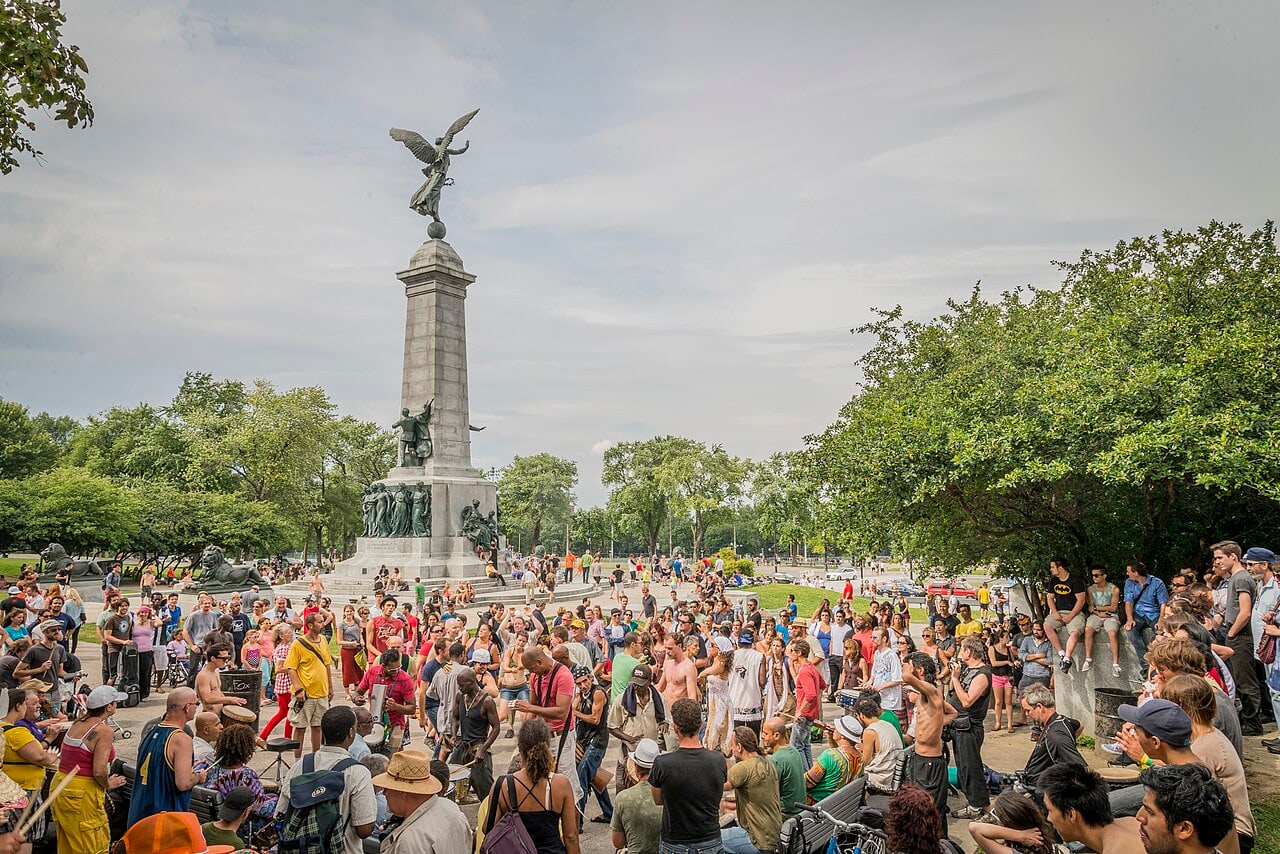
The stone terrace around Montréal’s George-Étienne Cartier monument has the ingredients of a formal stage: stairs, bronze figures, lions guarding the approaches. On Tam-Tams Sundays, dancers and percussionists turn that arrangement into something less fixed, as Matias Garabedian’s 2013 photograph suggests. There is music close to the monument and room to listen from the surrounding grass. Choosing your distance is part of the afternoon.[3][4][8]
That is the pleasure of this free, unofficial gathering at the foot of Mount Royal. You can arrive intending to watch and find yourself moving; you can also stay on a blanket. Nobody needs to complete a circuit of attractions for the visit to count. Give this one patch of the city enough time to change your pace.[1][6]
Find the gathering at street level
Set your destination to Monument à sir George-Étienne Cartier on avenue du Parc. The useful landmark is the column crowned by a winged figure, above the broad terrace and bronze lions. The city’s public-art catalogue identifies that figure as La Renommée, Fame, and dates George William Hill’s monument to 1919. Those details help you recognize the right place without making the mountain’s summit your destination.[1][3]
For the fullest atmosphere, aim for 14:00–16:00 on a dry, active Sunday. That window comes from an August 2025 r/montreal discussion: a contributor suggested mid-afternoon as the peak while explicitly calling the observation anecdotal and weather-dependent.[5] It is a useful expectation, not a performance timetable. The first visitor mistake is applying concert logic—arriving for a precise opening act—to a gathering whose density grows with people turning up.
If settling on the lawn matters more than arriving at the busiest moment, I would try around 13:00 and let the afternoon develop. That is a planning suggestion, not a verified quiet hour. Local writer Isa Tousignant describes the difficulty of finding spare grass as the gathering fills.[4] Allow 60–90 minutes initially; leave the rest of your afternoon flexible if the music catches you.
There is no admission ticket or seat reservation to arrange.[1] The practical competition is for a comfortable patch of ground, not a place in an entrance queue.
Bring your own small patch of Sunday
MTL Blog’s Tam-Tams packing guide gives unusually revealing advice: bring a blanket, snacks, comfortable clothes and a bag for your rubbish.[6] These are the supplies of people planning to stay. Fold the blanket small enough to carry easily, choose clothes you can sit and move in, and bring water with the picnic. The second mistake is turning up equipped for a seated show and expecting the site to furnish the afternoon. Here, a little preparation buys freedom to linger.
Budget CAD 0–20 per person, excluding transport and shopping. Zero covers listening and dancing when you bring supplies from home; the upper end is an editorial allowance for simple picnic provisions bought beforehand, not a vendor price quote. The gathering itself is free.[1]
Do not confuse the craft stalls with guaranteed lunch service. The city’s current permit scheme gives vendors 40 spaces, allocated first come, first served, with sales permitted 12:00–20:00. It excludes food and drink sales under that permit.[2] Those are market rules, not the drummers’ opening hours. Buying your picnic before arrival also avoids making the visit depend on whatever separate refreshments happen to be available.
Listen before moving closer
The centre can be loud. In Louis-Philippe Messier’s 2020 report, percussionist Michel Séguin met the journalist across the road, away from the din around the monument. Séguin recalled starting weekend sessions with family and musician friends in 1970, and lamented how the expanding gathering could reward volume over musical conversation.[7] This is one participant’s account of its development, not a settled claim about the very first drum played here.
His complaint offers a better listening prompt than the usual promise of effortless harmony. Try to hear an exchange between players within the larger sound. If you bring an instrument, spend a few minutes listening before joining, and look for a group whose rhythm you can follow. That is a courtesy suggested by his account, not an audition requirement.
The third mistake is assuming the closest position must be the best. Start at the edge, move toward the dancers when you want the intensity, then retreat onto the surrounding lawn when you want to talk. The monument’s terrace concentrates the activity; distance gives you a different way to enjoy it.[4][7] Keep a route open for others instead of spreading belongings beside the moving circle.
Before leaving, gather your litter into the bag you brought.[6] Then look back at the monument. Its bronze figures organize attention upward toward a commemorated statesman; the people below keep redirecting it toward one another.[3] On an active Sunday, that changing relationship is enough to hold an afternoon.
Sources
- Tourisme Montréal, “Les Tam-tams du mont Royal” — current official visitor listing; free, unofficial gathering, exact location, September 2026 cancellations and October return dates; checked September 17, 2026.
- Ville de Montréal, “Applying for a vendor permit at the Sunday tam-tams,” updated March 27, 2026 — dated current-season confirmation, September cancellations, vendor hours, allocation and excluded products; checked September 17, 2026.
- Bureau d’art public, Ville de Montréal, “Monument à sir George-Étienne Cartier” — George William Hill’s 1919 monument, terrace, lions and crowning figure.
- Isa Tousignant, Tourisme Montréal, “Get the Beat of Montréal’s Tam-Tams” — local writer’s account of dancing by the monument and crowded lawns; used for spatial description, not current dates, historical chronology or guaranteed vendor availability.
- r/montreal, “Tam tams time?”, August 30–31, 2025 — community advice suggesting a weather-dependent 14:00–16:00 peak; an individual observation, not an official schedule.
- Lea Sabbah, MTL Blog, “Your Official Montreal Tam-Tams Survival Pack” — local packing advice on blankets, picnic supplies, comfortable clothes and taking responsibility for litter; used for practical habits, not current event dates.
- Louis-Philippe Messier, TVA Nouvelles / Agence QMI, “50 ans de tambours sur le mont Royal,” August 21, 2020 — reported encounter with Michel Séguin, his account of family sessions and his reflections on listening and volume.
- Matias Garabedian, “Les Tam-Tams du Mont Royal,” July 28, 2013, Wikimedia Commons — archival photograph reproduced above, CC BY-SA 2.0; resized for this article.