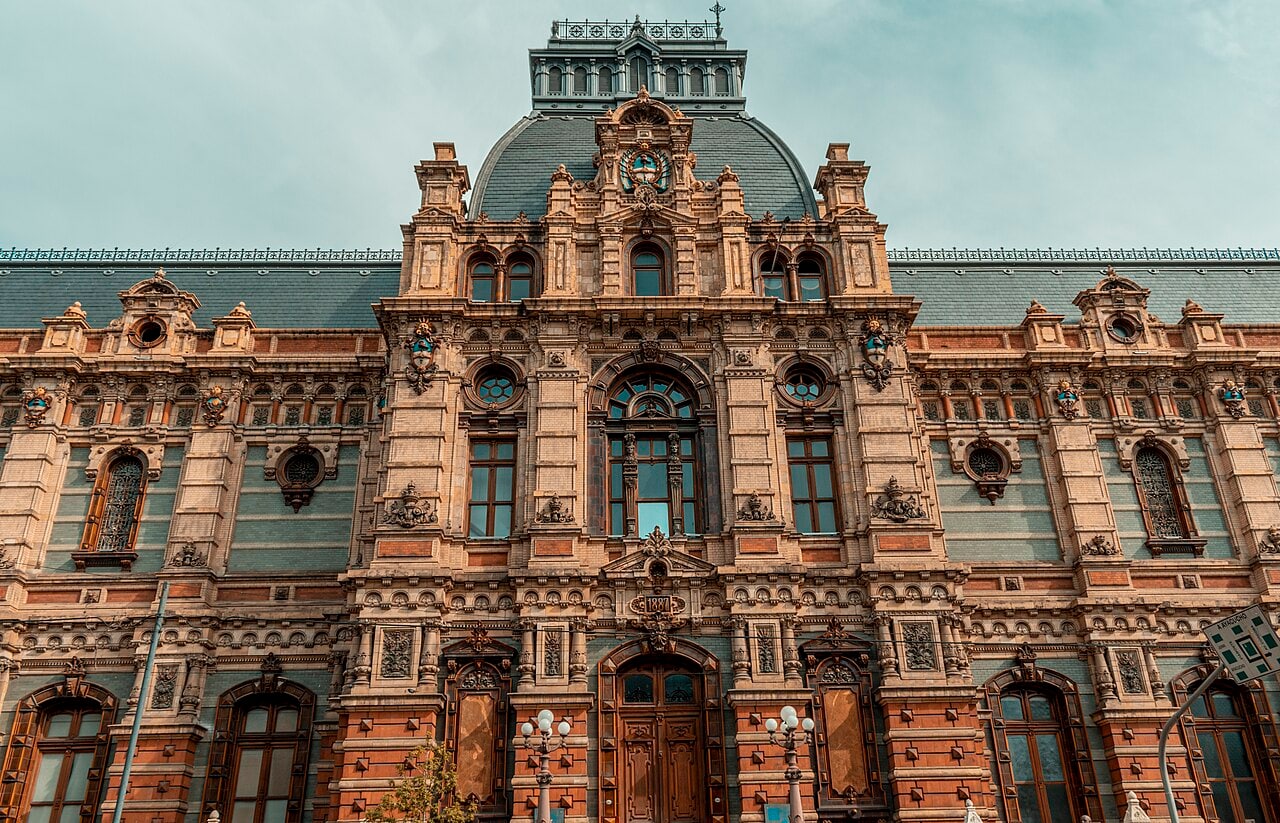
Buenos Aires put a remarkable amount of ornament around its drinking water. At the Palacio de las Aguas Corrientes, glazed brick, ceramic reliefs and green slate roofs dress a structure built to hold twelve enormous tanks.[1] Give this place two looks: the façade from across the street, then the machinery and everyday fittings inside.
Built between 1887 and 1894, the palace occupies the block bounded by Córdoba, Riobamba, Viamonte and Ayacucho. Its iron skeleton supported tanks on three levels, with a combined capacity of 72 million litres. Provincial coats of arms decorate the exterior.[1] Find those shields before you enter: they give a public utility the presence of a seat of government.
First, give the façade some room
Start on the opposite sidewalk of Avenida Córdoba. This is a small but useful correction from a Buenos Aires community discussion: a photographer complained that the surrounding streets were too narrow, and another contributor pointed out that Córdoba offers enough width to see the building properly.[2] Stay on the sidewalk and let the traffic pass through your view. Trying to fit the palace into a frame while pressed against its fence makes the decoration harder to read.
From farther back, notice how insistently the colours and roofline repeat. Then come closer to pick out a single relief. The national heritage description records ceramics made in Belgium and England and roofing slate from France.[1] Imported materials carry Argentine emblems: looking for that combination gives the frontage a more specific identity than a vaguely European backdrop.
For the museum, change your destination from the broad façade to Riobamba 750, first floor. Local guide BuenosAires123 identifies that entrance and recommends Line D, using Callao or Facultad de Medicina; AySA confirms both stations.[5][3] The architectural address and the visitor’s door serve different purposes. Following the museum address saves an unnecessary circuit of a very photogenic block.
A weekday visit needs a little preparation
Visit details checked September 18, 2026: AySA lists opening hours of 10:00–16:00 on working weekdays, with last entry at 15:30. Admission is ARS 3,400 for residents and ARS 6,300 for foreign visitors; Wednesdays are free. The listed admission budget therefore runs from ARS 0–6,300, depending on day and eligibility, before any booking charges. Follow the museum’s online ticket link before travelling: its current notice requires advance online tickets and says there is no physical box office.[3][4]
Wednesday morning is my suggested window: it combines free admission with the 11:00 guided visit. The same tour time is listed for Monday and Friday; Tuesday and Thursday tours start at 15:00, and the operator estimates 60 minutes.[9] Aim to reach the entrance around 10:40 for the morning visit and allow 75–90 minutes overall, including time outside. Those buffers are planning suggestions, rather than a measured queue forecast. Check the selected date’s booking conditions, including the process for free admission.[3][4]
The second visitor trap is relying on an old account of simply walking in. A March 2025 community report describes exactly that, and BuenosAires123 still says no advance reservation is required.[6][5] Both help explain the experience, but the operator’s newer entry notice changes the preparation. Keep the booking confirmation accessible; do not arrive expecting to solve ticketing at a counter.[3]
Expect Spanish commentary: the local guide describes the tours as Spanish-language visits.[5] If you need another language, check with the museum before choosing a slot. The objects remain worth looking at even when you cannot follow every sentence, but the guide supplies connections a quick photographic circuit can miss.
Let the plumbing finish the portrait
Inside, resist the expectation of furnished salons. The museum’s collections move through pipes, meters, taps and sanitary fixtures: objects that bring the scale of the great tanks down to the scale of a home.[9] Pick one fitting and look at its shape and material before moving on. Water infrastructure becomes easier to imagine when the endpoint is something a person turns, reads or cleans.
A visitor’s March 2025 account describes entering a former tank at the end of the guided visit.[6] Ask the guide whether that space is included on your day; the report records one visit, not a promise of unrestricted access. Canal 26’s July 29, 2026 coverage confirms that tours and cultural programming continued inside the palace, while distinguishing the Riobamba entrance for palace visits from a different entrance used for special activities.[7] A workshop announcement is not automatically an instruction for your museum visit.
The strongest reason to go upstairs is the change in scale. Across Córdoba, the building asks you to admire a façade. Among the fittings, it asks you to imagine water arriving in a room. Return to the street with that domestic endpoint in mind, and the extravagant shell has something more interesting to say: Buenos Aires made an everyday service conspicuous enough to stop a passer-by.
Sources
- Argentina’s National Monuments Commission, “Palacio de Aguas Corrientes” — construction, tank capacity, materials and provincial emblems.
- r/BuenosAires, “Qué es esto?” — August 15, 2024 community discussion, including the Córdoba-side photography advice.
- AySA, Museo del Agua homepage — current online-only admission notice, prices, public opening hours and entrance; checked September 18, 2026.
- TuEntrada, “Visitá el Museo del Agua” — official booking page linked by AySA; checked September 18, 2026.
- BuenosAires123, “Palacio de Aguas Corrientes: el palacio de los mil azulejos” — local visitor guide to access and Spanish tours; its walk-in advice and prices are superseded by AySA’s current notice.
- r/BuenosAires, “Palacio de las aguas corrientes” — March 27, 2025 firsthand museum account and discussion of the former tank; historical entry advice is not current booking policy.
- Thiago Lapuente, Canal 26, “Vacaciones de invierno en el Museo del Agua” — July 29, 2026 confirmation of tours and special programming, with distinct entrance instructions.
- Nikito 91, “Palacio de Aguas Corrientes Buenos Aires.jpg” — photograph taken October 1, 2022, Wikimedia Commons, CC BY-SA 4.0.
- AySA, “Visitas” — guided-visit timetable, estimated duration and collection overview.