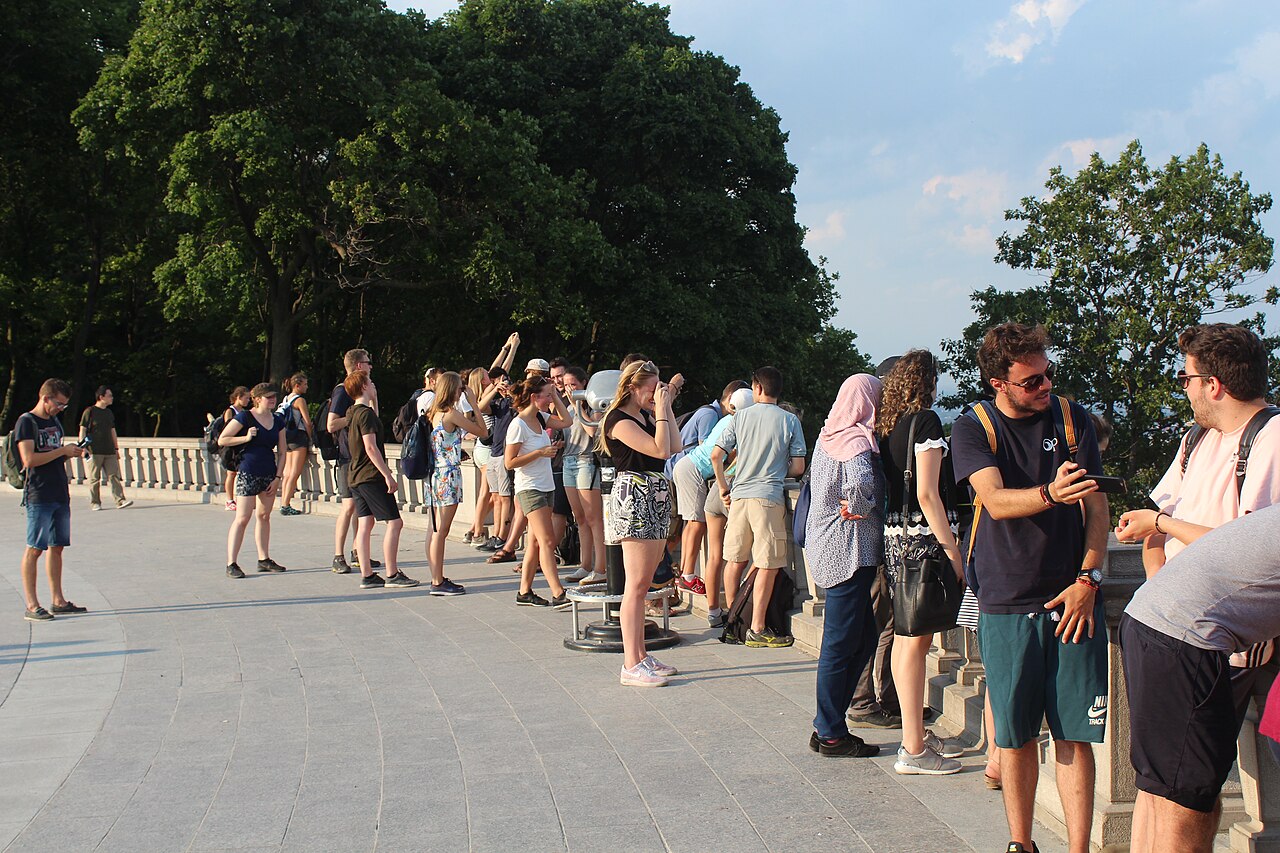
If you want one Montreal move that feels local rather than checklist-touristic, do not turn Mount Royal into an all-afternoon blur. Shrink it to two linked spaces: Mount Royal Chalet first, Kondiaronk Belvedere second, timed for the 35-to-45-minute window before sunset when downtown is still readable and the terrace has not yet turned into one continuous phone line.
This is a non-food place portrait, not a mountain hike guide. The useful thing here is that the chalet and the belvedere behave like one civic room with two temperatures. Inside the chalet, you get heat, benches, washrooms, and a visual reset. Out front, the terrace gives you the full downtown plane, the river line, and the particular Montreal sensation that the city is both dense and slightly theatrical when seen from above.[1][7]
The site itself is more layered than the average skyline stop. The belvedere is open daily from 6:00 a.m. to 12:00 a.m. at 1196 Voie Camillien-Houde, with parking, washrooms, a snack bar, drinking fountain, and free Wi-Fi listed on the city page.[1] The name "Kondiaronk" is not decorative. Montreal's toponymy record ties it to the Huron-Wendat leader who died in Montreal during the negotiations that led to the Great Peace of Montreal of 1701.[6] The chalet behind the terrace is part of the local texture too: Tourisme Montreal still treats it as a landmark in its own right, not just a service building behind a view.[7]
Image context: the cover is a real photograph from Kondiaronk Belvedere. That matters here because this article is about arriving at a specific terrace and reading the skyline correctly, not about Mount Royal in the abstract.[1][9]
The high-yield evening window
The cleanest version is simple: arrive on the mountain about 50 to 70 minutes before sunset, step into the chalet first, then move outside once the sky starts cooling.
Why that sequence works:
- The belvedere stays open late, but the architecture of the view is strongest before full dark, when the mountain, downtown towers, and river edge still separate into layers instead of collapsing into lights.[1][7]
- The chalet is the useful buffer. If wind picks up, you have an indoor reset before committing to the terrace.[1][7]
- Transit friction is low enough that you do not need to drive. The STM specifically frames Mount Royal as a bus-accessible park, with the 11 Parc-du-Mont-Royal / Ridgewood running seven days a week, 365 days a year, and the 711 as the wider cross-mountain option.[4]
- Fare math is clear: a 1-trip, All Modes A ticket is CAD 3.75, a 24-hour, All Modes A fare is CAD 11.25, and a single fare is valid for 120 minutes from first use across several services on the same trip.[3]
That already gives you the practical edge. You are not solving "how do I do Mount Royal." You are solving one evening room.
The operating sequence that changes outcomes
The strongest south-side approach is still the old downtown-to-mountain handoff. Tourisme Montreal's current park guide says to enter from the corner of Rue Peel and Avenue des Pins if you are coming from downtown, then climb the stairs to Kondiaronk lookout.[5] Community advice from Montreal threads says the same thing in plainer language: Peel is the obvious first climb, and it feels more like an uphill walk than an expedition if conditions are dry.[8]
That does not mean the stairs are mandatory. If you want the lower-friction version, use transit to the mountain and save your legs for the terrace and the short loops around it. STM's Mount Royal page makes the bus logic explicit, and the Friends of the Mountain FAQ is even more direct about driving: you cannot drive to the chalet or the belvedere itself. You leave the car at Smith House and walk about 600 meters, roughly five minutes, up Olmsted Path.[2][4]
That single operational detail is where visitors waste time. If you treat the summit like a doorstep, you end up negotiating parking and then walking anyway. If you treat it like an arrival sequence, the whole place makes more sense.
8 local moves that make this place work
- Use the chalet before the lookout. The terrace is the payoff, but the chalet is what stabilizes the timing. Step inside first, warm up, and only then commit to the outside window.[1][7]
- If you start downtown, use Peel as the mental line. It is the cleanest south-side handoff from grid city to mountain path.[5][8]
- If you want less uphill strain, bus up and walk down. The 11 and 711 exist so the mountain does not have to become a conditioning test.[4][5]
- Do not plan on BIXI solving the last stretch. Friends of the Mountain notes there are no bike-share stations at the top.[2]
- Aim for one terrace cycle, not a long camp. About 20 to 30 minutes outside is usually enough before the cold or crowd texture starts flattening the experience.
- Read the skyline from the center first, then drift to the edges. The middle gives you the classic downtown plane; the edges are better after you have already oriented yourself.
- Budget it as civic space, not paid attraction. A normal evening version costs CAD 0 to 11.25, depending on whether you walk up or use transit.[3]
- Keep the return fare alive. Because the fare window is 120 minutes, a quick up-and-down sequence can stay inside one transit purchase if your timing is disciplined.[3]
Non-local trapline: 3 common mistakes and the better move
Mistake 1: driving up as if the chalet had front-door parking
Better move: either approach from Peel on foot or use the bus. The mountain's own FAQ says the chalet and belvedere are reached from Smith House by a 600-meter walk on Olmsted Path, not by pulling up to the terrace.[2]
Mistake 2: arriving only after full dark because the lookout is open until midnight
Better move: arrive before sunset, use the chalet as your buffer, and let the city darken gradually in front of you. Open hours are not the same thing as best-reading hours.[1][7]
Mistake 3: treating the place as a photo stop and leaving immediately
Better move: use the chalet, take one slow terrace pass, then decide whether to loop farther. The site works as a civic room because it has an interior and an exterior, not because it gives you one postcard angle.[1][7]
One-screen logistics card
- Anchor 1: Mount Royal Chalet
- Anchor 2: Kondiaronk Belvedere, 1196 Voie Camillien-Houde
- Best window: arrive 50-70 minutes before sunset; terrace strongest 35-45 minutes before full dusk
- Lookout hours: 6:00 a.m.-12:00 a.m. daily[1]
- Transit options: 11 year-round; 711 weekends all year and daily in summer from the current tourism guide[4][5]
- Walk-up cue: south-side entry at Peel + des Pins if starting downtown[5]
- Car reality: park at Smith House, then walk about 600 meters / 5 minutes[2]
- Spend range: CAD 0-11.25[3]
- Best sit / stand: warm inside the chalet first, then center terrace rail, then drift sideways
- Navigation cue: chalet first, terrace second, downhill after dark
What makes this Montreal-specific is that the view is not just scenic. It is civic. The belvedere is named for a diplomat tied to 1701 peace negotiations; the chalet and terrace still function as a public room above downtown; and the whole sequence turns a very photographed place back into a usable evening habit.[1][6][7]
Sources
- Ville de Montréal, "Kondiaronk lookout" (hours, address, amenities, accessibility).
- Les amis de la montagne, "FAQ" (Smith House parking, 600-m walk, no direct driving to the chalet/belvedere, no bike-share stations at the summit).
- ARTM, "Fare schedule" (All Modes A 1-trip fare, 24-hour fare, 120-minute validity).
- STM, "Mount Royal Park" (bus 11 and 711 access patterns and summit access guidance).
- Tourisme Montréal, "Montréal tour: Mount Royal Park" (Peel entrance, bus routing, current visitor approach guidance).
- Ville de Montréal Toponymie, "belvédère Kondiaronk" (name origin and 1701 Great Peace context).
- Tourisme Montréal, "Les lieux montréalais instagrammables (1ère partie)" (chalet details, murals, and current local framing of the belvedere/chalet pair).
- Reddit / r/montreal, "Mount Royal Question" (community guidance on Peel stairs and south-side approach, February 2, 2025).
- Wikimedia Commons, "File:Belvédère Kondiaronk IMG 3963.JPG" (cover image source).