If downtown Seattle is wet and you want one compact move that still feels local rather than tourist-programmed, use one concrete-and-glass seam: Central Library first, Freeway Park second.
This is a tight non-food micro-route, not a checklist for “doing downtown.” The useful trick is sequencing two civic spaces that solve different weather problems. The library gives you vertical shelter, sightlines, and a controlled reset. The park gives you air, concrete terraces, fountain sound, and the strange sensation of stepping into landscape while Interstate 5 runs beneath you.[2][4]
The route works because the two anchors sit close enough to behave like one system. Central Library is at 1000 Fourth Ave. and the park runs between 6th and 9th Avenues, bounded by Union Street on the north and Spring Street on the south.[1][4] In practical terms, you are moving from one of Seattle's best interior public rooms to the first park in the world built atop a freeway, finished in 1976 and later placed on the National Register in 2019.[4] Seattle Parks is also still in an improvements cycle around repairs, wayfinding, and signage ahead of the park's 50th anniversary, which makes orientation part of the experience rather than an afterthought.[5]
Local community signals still treat both places as actual downtown infrastructure rather than postcard stops: the Seattle Times' current library walkthrough and the Google Maps review streams for both locations all point to repeat use rather than one-off sightseeing.[6][7][8]
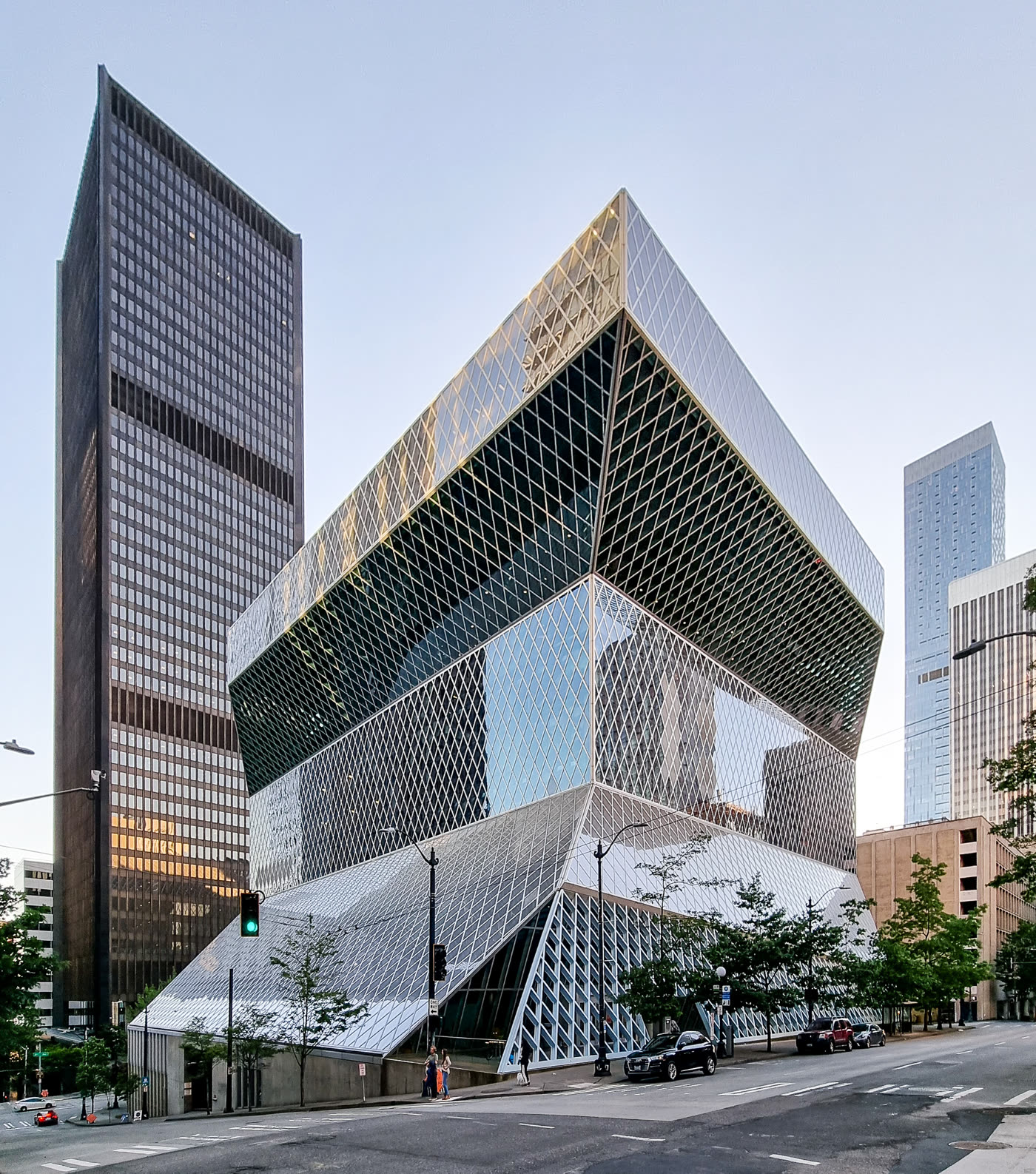
Image context: the cover shows the library's exterior shell, which is the correct visual anchor for this piece. The move described here begins with recognizing that faceted glass skin from Fourth Avenue, then using the building as the entry chamber before slipping east into Freeway Park.[2][6]
The high-yield wet-weekday window
Use this run on a weekday between 10:30 and 12:30, or from about 13:30 to 15:30 if you want the quieter version.
Why those windows hold up:
- The current branch listing shows a 10 a.m. opening start, with some 8 p.m. late nights and 6 p.m. closes on the shorter days, so there is no reason to hover outside before opening.[1]
- Freeway Park is open 6 a.m. to 10 p.m., but the park reads far better in daylight than after dark because its terraces, stairs, and concrete cuts are easier to understand when you can see how the levels connect.[4]
- A clean visit usually takes 75 to 105 minutes.
- Baseline spend is $0 to $12 unless you add coffee elsewhere; there is no ticket, no reservation, and no paid admission gate for the core route.[1][3][4]
The operating sequence that changes outcomes
Start on Fourth Avenue, not Fifth. The Fourth Avenue side gives you the exterior read first, plus the George Tsutakawa fountain just outside the entrance, which immediately tells you that this is a Seattle civic building rather than a sealed corporate atrium.[1][6]
Once inside, resist the instinct to settle on the first comfortable floor. The building is an 11-floor, 362,987-square-foot machine, and the mistake is treating it like a one-room lobby with books attached.[2] Go up before you sit down.
The highest-yield first move is to ride upward and claim the Level 10 perspective early. The library's own tour materials and Seattle Times walkthrough both treat Level 10 as the main payoff: bird's-eye sightlines back into the building, the Reading Room, and the Seattle Room all sit up there.[2][3][6] If you start low, you often never recover the upward momentum.
After that, come down through the building rather than bouncing via elevator. The best internal descent is the Books Spiral, which runs continuously from Levels 6 through 9.[2] That keeps the visit feeling architectural instead of transactional. You are not hunting one shelf number; you are letting the building explain itself floor by floor.
Only then use the Level 3 Living Room as a short pause point. It is the obvious comfortable zone, and that is exactly why it works better as the third move than the first.[3][6]
When you leave, exit eastward toward Fifth Avenue and keep your walk to Freeway Park tight. The park's western edge overlooks the financial center, but its mood changes fast once you move inward: fountain sound rises, traffic turns into pressure underfoot, and the concrete starts to behave like canyon walls rather than office-district hardscape.[4]
Inside the park, stay high first and only then drift down. Freeway Park is not a lawn where you improvise in any direction. It is a level-shifting composition. If you plunge to the interior immediately, first-time orientation gets worse; if you walk the upper terraces and read the geometry first, the interior stairs make sense faster.[4][5]
8 local moves that make this seam actually work
- Use Fourth Avenue as your entry cue. It gives you the cleanest outside recognition and the Tsutakawa fountain before you disappear indoors.[1][6]
- Go high before you go comfortable. Level 10 first, Living Room later.[2][3][6]
- Descend through the Books Spiral. The route from Levels 6 to 9 is part of the point, not a decorative detour.[2]
- Keep the library stop to about 45-60 minutes. Longer stays turn the second half of the run into an afterthought.
- Treat Freeway Park as a daylight space even though it stays open until 10 p.m. The architecture is better when you can read the levels.[4]
- Take a short sit, not a long sit, in the park. Ten to twenty minutes works; a long static stay often drains the rhythm you built inside the library.
- Budget the route as civic space, not consumption. A $0 run is normal here; optional spend is incidental, not structural.[1][4]
- Use rain as a feature, not a reason to cancel. Wet pavement makes the library-to-park contrast sharper: glass interior first, concrete terraces second.[4][7][8]
Non-local trapline: 3 common mistakes and the better move
Mistake 1: treating the library as the whole destination
Better move: use the library as the first chamber, not the final one. The reason this route feels local is precisely that it does not end in climate control.[2][4]
Mistake 2: entering Freeway Park only after dusk because the posted hours allow it
Better move: go while there is still enough light to read the levels cleanly. Open hours are not the same thing as best-conditions hours.[4]
Mistake 3: settling immediately on Level 3 because it looks like the easiest place to stop
Better move: climb first, descend second, sit third. The current source pattern around this building keeps pulling attention toward the upper read and the red-floor / spiral sequence, not the generic first available chair.[2][6][7]
One-screen logistics card
- Anchor 1: Central Library, 1000 Fourth Ave.
- Anchor 2: Freeway Park, 6th-9th Ave / Union-Spring
- Best window: weekday 10:30-12:30 or 13:30-15:30
- Library opening pattern: starts at 10 a.m.; current branch page shows a mix of 6 p.m. and 8 p.m. closing times by day[1]
- Park hours: 6 a.m.-10 p.m.[4]
- Route length: about 75-105 minutes
- Spend range: $0-$12
- Queue / reservation reality: none for the core route
- Best sit / stand: Level 10 Reading Room side first; then one upper-terrace edge in Freeway Park before descending
- Navigation cue: Fourth Avenue in, Fifth Avenue out, Spring Street into the park
What makes this Seattle-specific is not only the architecture. It is the civic texture. One anchor is a 2004 glass machine of public access. The other is a 1976 concrete lid over freeway infrastructure. Put them together on a wet weekday and downtown stops behaving like a business district for about ninety minutes.
Sources
- The Seattle Public Library, "Central Library" branch page.
- The Seattle Public Library, "Central Library Architecture."
- The Seattle Public Library, "Take a Tour of the Central Library."
- Seattle Parks and Recreation, "Freeway Park."
- Seattle Parks and Recreation, "Freeway Park Improvements."
- Sarah Fox, "Seattle's Central Library is a showcase of art, architecture and community." The Seattle Times, May 12, 2025.
- Google Maps community listing, "Seattle Central Library."
- Google Maps community listing, "Freeway Park Seattle."