Buenos Aires gives itself away in layers, and on Sunday mornings in San Telmo those layers are still visible before the crowds arrive to smooth them over. The antique dealers unfold their tables on Defensa street with a practiced quiet, the café con leche appears in the windows of El Federal at Carlos Calvo, and the cobblestones hold the overnight coolness of late summer. By 10 a.m. you can still walk the full eight-block length of the market from Parque Lezama north to Plaza Dorrego in under fifteen minutes. By 11:30 that same walk takes forty-five.
The Feria de San Telmo has run every Sunday since 1970, occupying Defensa street for roughly 8 blocks between Avenida San Juan to the south and Calle Independencia to the north [1]. The fair is the outward expression of a neighborhood performing its own contradictions: expensive brass telescopes beside cardboard crates of reproduction postcards, hand-sewn leather pieces two tables from mass-produced mate gourds, vendors who know the provenance of every piece alongside vendors who know none of it [5].
Enter from the Lezama end, walk north
The productive approach is from the south — enter Defensa near Parque Lezama and walk toward the plaza. This aligns you with the crowd flow and, more importantly, places the working dealer stalls at the start of your walk and the higher-priced tourist-facing tables at the end. The price gap between these two ends of the 8-block run is significant: the same category of antique piece can cost 40 to 50 percent more near Plaza Dorrego's perimeter than it does at the Lezama end [5][6].
Allow 45 minutes for the street market at browsing pace. Bring peso cash for the stalls — most vendors prefer it and card acceptance is uneven outside the Mercado's interior [2]. One block west of Defensa on Carlos Calvo, the Mercado de San Telmo operates under its original 1897 iron-and-glass roof [2]. Its interior houses established antique dealers alongside specialty food stalls and a working neighborhood market; the upper-floor antique section stays navigable until roughly 11 a.m. before foot traffic peaks. Plan on visiting both in a single morning.
The neighborhood's yellow fever inheritance
San Telmo is the oldest surviving barrio of Buenos Aires, and its architectural contradictions root in a single public-health catastrophe. When yellow fever swept through the city in 1871, the porteño upper class fled their colonial mansions south of the Plaza de Mayo and relocated north to Recoleta and Palermo [3]. The houses they left — high ceilings, interior courtyards, ornate ironwork balconies — were subdivided into conventillos, crowded tenement housing for the Italian, Spanish, and Eastern European immigrants arriving through the port [3]. That cycle of abandonment and subdivision is still readable in the building faces along Defensa: a neoclassical lintel above a plywood door, ironwork balconies on a wall unpainted for decades. The decay is not neglect so much as accumulated time left legible.
The tango start time as a clock
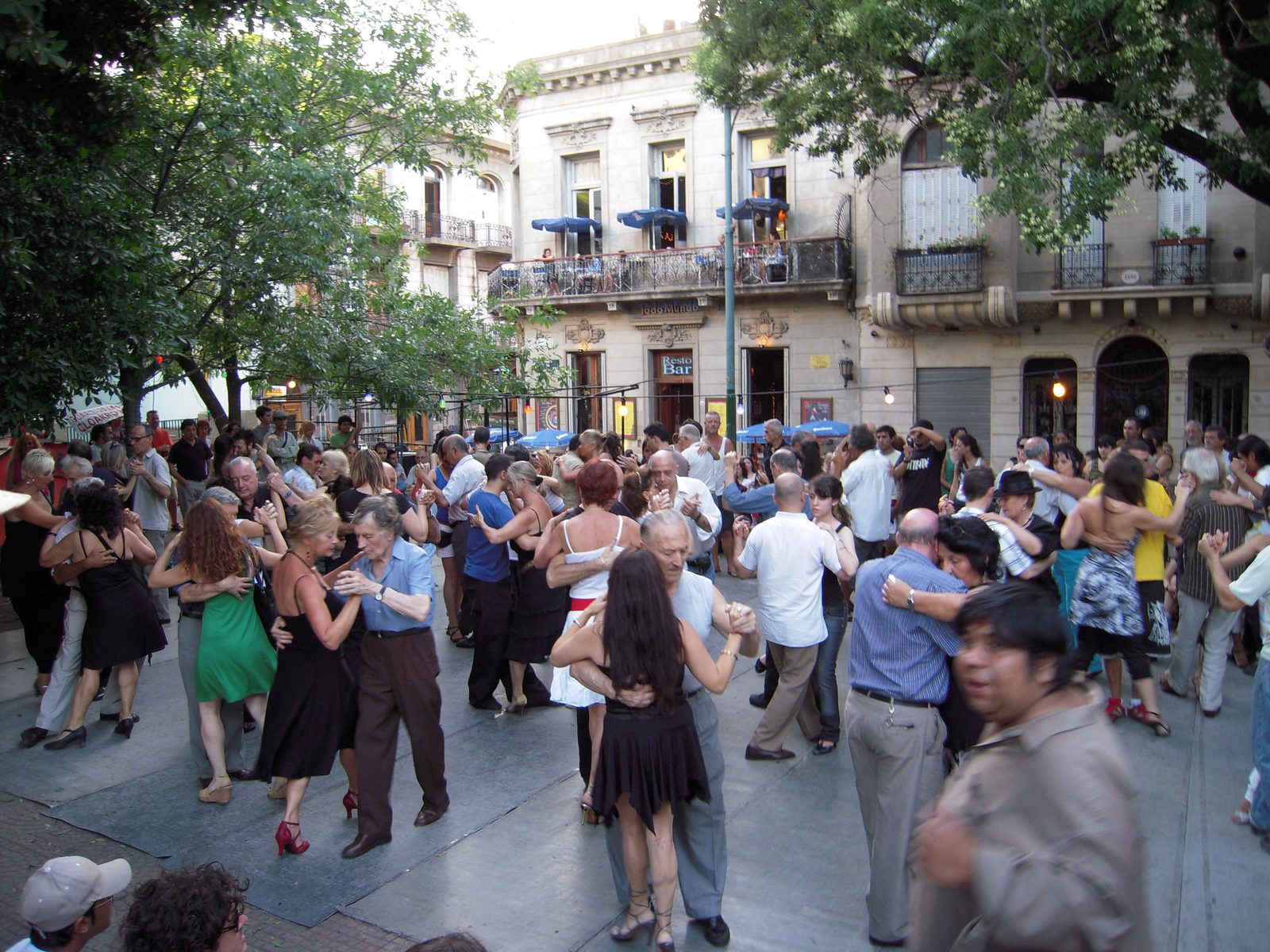
By 12:00 to 12:30 p.m., street tango performers take positions at the corners surrounding Plaza Dorrego [1][5]. This is useful not as entertainment but as a timing marker: when the dancing has started, the market has shifted fully into its tourist-facing mode, the browsing logic has changed, and the window for finding anything at a working price is effectively closed. Most dealers begin packing between 4:30 and 5 p.m.; the fair has no announced closing time and ends when vendors decide [1].
The bar at Casa del Café, on the west side of the plaza, offers better sightlines for watching the tango than the outdoor tourist tables arranged closer to the performance: you stand rather than sit, you pay local prices, and the angle is less choreographed [5].
What visitors consistently get wrong
Arriving at 11 a.m. under the impression that is still early is the most common miscalculation. The productive browsing window — quieter stalls, better light for examining pieces, easier conversation with dealers — is compressed into 9:30 to 11 a.m. [5][6]. Eleven is not early at the Feria.
The second pattern: buying from the first antique table inside the plaza's perimeter. These stalls occupy the highest-visibility position in the fair and price accordingly. Reproductions sit alongside authentic pieces on the same table without clear distinction. Walking south along Defensa for at least 4 blocks before buying puts you among dealers working on volume rather than tourist foot traffic.
A third issue is the currency environment: changing dollars at informal rates from vendors near the market entrance is both legally complicated and financially unnecessary. The Mercado's interior shops and most established street vendors have adapted to the current exchange landscape [5].
What to hold in mind before going
Best arrival window: 10 to 11 a.m. gives one hour of the street market and roughly 45 minutes in the Mercado before the upper floor fills. The Bolívar station on Line C (the blue line) is a 5 to 7 minute walk from the Defensa-San Juan entrance at the Lezama end — take the exit toward Brasil and walk north one block [1].
Budget range: ARS 5,000 to 15,000 covers casual browsing and a coffee; serious antique pieces begin at ARS 30,000 and rise without ceiling. Card acceptance is good inside the Mercado; street stalls are largely cash-preferred [2][4].
Weekday alternative: the Mercado de San Telmo itself operates Monday through Saturday and is worth a visit for the 1897 iron-and-glass architecture alone, before the Sunday market transforms the surrounding blocks entirely [2].
The plaza predates Argentine independence, operating as a cart market in the colonial period before Buenos Aires had a proper commercial center [3]. What you are walking through on a Sunday is a compressed version of a mercantile habit that has occupied this same cobblestone ground for over two centuries, with different goods and different names but the same logic of exchange in an open square.
Sources
- Buenos Aires Government Tourism, "Feria de San Telmo" — official listing with location, hours, and neighborhood context.
- Mercado de San Telmo, official website — floor plan, tenant directory, and opening hours.
- Wikipedia, "San Telmo, Buenos Aires" — neighborhood history, 1871 yellow fever epidemic, and conventillo transformation.
- Lonely Planet, "San Telmo, Buenos Aires" — neighborhood overview and practical visitor notes.
- r/buenosaires — community discussions on Sunday market timing, vendor tips, and crowd windows.
- La Nación, travel section — Argentine press coverage of San Telmo and the Sunday market.