The bridge gives Glasgow’s Necropolis a deliberate beginning. You leave the cathedral precinct, cross towards the hill, and enter a landscape where monuments compete for height. The Bridge of Sighs once crossed the Molendinar Burn; the stream was put underground in 1877. Knowing that makes the approach stranger and more interesting: a surviving crossing over a watercourse the city has concealed.[1]
The hill had a public life before it became a cemetery. Known as Fir Park, it held trees and walks; the foundation stone of the John Knox monument was laid there in 1825, before the first burials. That earlier park helps explain the pleasure of approaching slowly. Here, a walk through Glasgow’s history also involves choosing a bend, finding a view and deciding which inscription deserves a pause.[1]
Find the bridge before following the pin
The local directory We Outside Glasgow makes a small but useful distinction: its map pin marks the historic site, not necessarily the entrance. Its listing, checked on 6 October 2026, identifies the cemetery as free to enter. Following a postcode to the nearest boundary is an easy way to turn the first few minutes into a search for a gate; aim for the cathedral precinct instead.[2]
From Queen Street station, the Friends of Glasgow Necropolis give an approach of about 15 minutes. Take North Hanover Street, turn right along Cathedral Street, then cross Castle Street into the precinct. Beside the cathedral, follow the signs along its south side towards the Bridge of Sighs. The bridge is your recognition cue: it makes the transition from street to hillside unmistakable.[3][4]
For a first independent visit in November, I would choose 10:00–12:00 and reserve 60–90 minutes inside. Those are suggested planning allowances, not a measured circuit or a promise of quiet. An August 2026 r/glasgow contributor recommends roughly an hour to wander; the extra half-hour leaves room for stopping without making every path a commitment.[6]
There is a reason to protect that time. In a separate r/glasgow itinerary discussion, contributors warn against squeezing the cathedral and Necropolis into a day already stretched across the city. One advises leaving enough freedom to meander. Treat the hill as a visit with its own pace, rather than the gap between two appointments.[5]
Let the paths set the pace
The Strathclyde Geoconservation Group’s guide warns of steep stairs, muddy grass, rubble and slippery ground in wet weather. Wear shoes with grip and favour paved routes over grassy shortcuts. For a visitor who needs step-free access, paving alone says little about the complete route: ask for specific access advice before attempting the hill.[4]
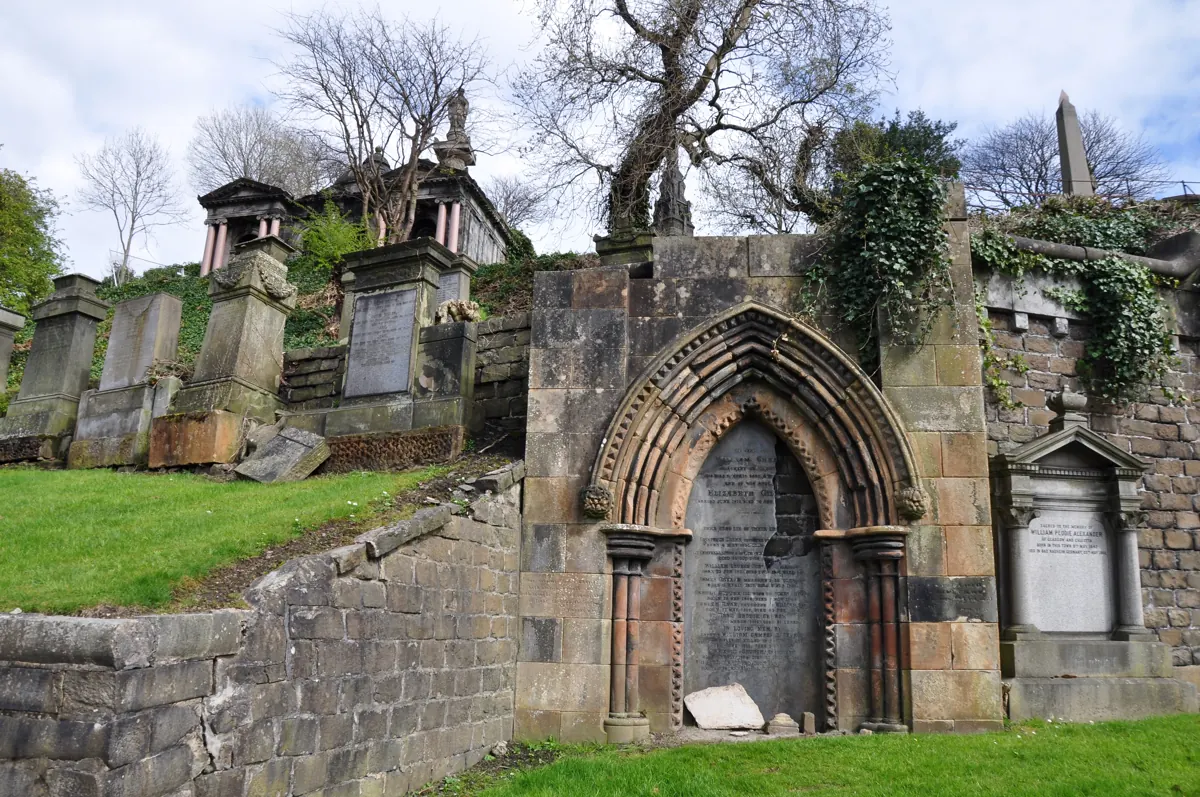
As you gain height, pause on a path where you can look back towards the cathedral. Let the foreground stay in the view: stone memorials, grass and the route you have just climbed. The pleasure is in seeing how the cemetery occupies the city, with the cathedral close enough to remain a building rather than dissolve into a skyline.
Then turn back to the stones. The geological guide points out fossil shell fragments in the limestone base beneath Henry Monteith’s red-granite obelisk. It is a good invitation to change scale, from the city spread below to something embedded in a single monument. Look from the path without climbing or disturbing the memorial. The same guide asks walkers to remember that this remains a graveyard.[4]
You need not identify every famous burial to have spent the hour well. Choose a legible inscription, read the relationships as well as the names, and leave space for other visitors to pass. The Necropolis becomes more particular when one family briefly holds your attention.
Free entry and a guided place are different things
For stories beyond what the stones disclose, the Friends run general walking tours lasting about two hours. These are free, with optional donations supporting conservation; cash and card donations are accepted on the day. A personal budget of £0–£10, excluding transport and refreshments, allows for either free access or a voluntary contribution. That range is a planning suggestion, not a ticket price.[7]
Advance booking is essential, and the confirmed booking supplies the meeting point. As checked on 7 November 2026, the programme marked every remaining listed 2026 tour fully booked. An announcement dated 2 November says bookings for the 2027 programme open on 9 November at 10:00. Check availability before building a visit around a guide; an independent walk remains a separate option.[7][8]
For ordinary public access, the Friends currently publish 07:00–16:30 daily. Use those hours when planning your departure, and follow any notices at the entrance. The morning window leaves room to descend without watching the clock.[3]
Return towards the bridge with time for one last stop. From below, the monuments will gather into a hillside again. After the climb, a few of them will have become individual places.
Sources
- Ruth Johnston, “About Glasgow Necropolis,” Friends of Glasgow Necropolis — Fir Park, the John Knox monument and the culverted Molendinar Burn.
- We Outside Glasgow, “Glasgow Necropolis,” details checked 6 October 2026 — free admission, map-pin limitations and the credited photographic derivative used here.
- Friends of Glasgow Necropolis, “Location & FAQs” — published public hours and the Queen Street–Cathedral Street approach; checked 7 November 2026.
- Margaret Greene and David Webster, Glasgow Necropolis: A Geological Trail, Strathclyde Geoconservation Group, 2019, printed pages 2, 4 and 8 — path conditions, cemetery etiquette, bridge approach and Henry Monteith’s monument.
- Reddit r/glasgow, “Visiting Glasgow from the US,” June 2026 — local-community advice on avoiding an overpacked itinerary and allowing time to wander.
- Reddit r/glasgow, “Ideas for local exploring/day trips?”, August 2026 — a contributor’s approximately one-hour allowance for the Necropolis, used as an individual estimate.
- Friends of Glasgow Necropolis, “Walking Tours Programme and Events” — duration, donations, mandatory booking and listed availability; checked 7 November 2026.
- Friends of Glasgow Necropolis, “Walking Tour Programme 2027,” 2 November 2026 — announced opening of bookings.
- Helen Simonsson, “Glasgow necropolis.jpg,” photograph taken 12 April 2012, Wikimedia Commons — original image record and CC BY-SA 3.0 licence.